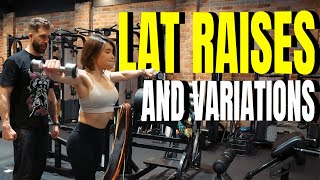
Five lateral raise variations to build bigger shoulders: seated dumbbell, floor mermaid, staggered stance, lean-away cable, and hybrid hook setup. Each variation changes the resistance profile and difficulty, with cues like keeping elbows high and avoiding rocking.
Chapters
In this video, I'm going to show you lateral raises and its many variations. We've got Manami here today. She's going to be demonstrating. We're going to start with the seated lat raise, and I'm going to show you how to make this harder, easier, and everything in between using dumbbells, cables, and even hybrid hooks. So off we go, Manami. As you can see, Manami does this with pretty much perfect execution. There's not really much I need to tweak on her technique right now. One of the cues though that I like to use is I like to get the client or athlete as they're doing it to reach their hands out towards me. So I will purposely stand on the sagittal plane, the side of their body, and I'll get them to reach as far as they can towards me. So reach, reach, reach, reach your hands out towards me. And you can see Manami has beautifully capped outs. Now in the seated position, for me to make this harder, as she starts to lean back, all I can do is I can shove her forward and it becomes a little harder. Now I'm going to show you how to make this mechanically harder. So what we're going to do is we're going to move to the floor, and I get Manami to sit right in front of us, and we're going to show you how to make this mechanically harder. This is— you could actually start with this position, then move to seated, but this is your mermaid variation of a lat raise. Now, the reason why this variation is great is because for people who do rock, they do move, and they really don't feel their delts when they do this. This eliminates the lower body completely, so the only thing you can really move here is the delts. So I need you to lift up your arms to the sides, reach out to the walls. Reach out to the walls. Beautiful. And again, if I want to make this harder, I'm going to push her forward. Let's just do 8 reps of these. 2. And as soon as you touch the floor, you're back up. The other cue that I'm going to use is elbows up high. Keep the elbows up. Try and push the elbows to the roof. See, it eliminates all of the rocking. That was a perfect position where a lot of people would have cheated then. But because we're in this position, she's completely unable to cheat. And again, you can see her shoulders working and the cap delts really coming out. And just do one more, just do one more, push it up, push it up. There we go, you can see that the shoulder's getting a pump on. All right, now we're going to use a mechanically advantageous position, so I'm going to get you to grab the dumbbells, same dumbbells, we're going to get on our feet and we're going to stand. So unlike— we've gone from the floor, we've gone to seating— standing up is always going to be mechanically advantaged. Now to lock in position, I'm just going to go one foot forward, one foot forward, just a tiny foot, one foot, that's it, just a tiny bit like this in a staggered stance. That's it, now off we go, really drive them up as hard as you can. There you go. I like this stance because it creates a more stable base. And again, we can see this capping, and I'm going to stop at my hands and come straight up, stop at my hands, come straight up. And you can see now she's standing, she can rock now, whereas before on the, on the mermaid press, the rocking really wasn't able to happen. And the other thing with a staggered stance, you can see she's in that forward position where the delts have to work. That's beautiful. Now let's come over here. Let's leave that there for just a sec. Her delts are on fire. They've got a good pump. We're going to go over here and I'm going to show you a variation. You're going to get a good pump on today in this video. Shoulders, we come like boulders. One of my other go-tos when it comes to lat training, the lateral delt, is the lean away cable lat raise. Now I'll get you to demonstrate this. As she goes through, the difference that you want to understand between a cable lat raise and a dumbbell lat raise is on a cable lat raise, the majority of the tension is from here to there. So on the cable lat raise, the resistance profile, really the most tension she's going to experience is from there to there. On the dumbbells, the most tension is from here to there. Now we're going to do something that's going to give her the best of both worlds. So put that down, Monami, and I'm going to get you to grab the 2 kilo dumbbell off the rack. Yep, grab 2 kilos and we'll put this— this is a very inexpensive but very, very useful cable attachment. It's called a hybrid hook. You can get it from Hybrid Hooks, and no, I'm not endorsed to say that, so they just make a great tool. So we're going to put this on here, and now we are going to get the best of both worlds. So, Manami, off you go. Our lean away hybrid hook And what this is going to do, it's going to create an ideal resistance profile. So there's going to be lots of resistance at the start and lots of resistance at the end. And if it's done right, you're going to get a really good pump. So, and again, same cue, reach towards me, reach your hand towards me. Good. Reach right towards me. Excellent. Good. Reach, reach. And let's try not to cheat. So as soon as here and back up and back up. Good. And back up. Good. And let's do 2 more. 1, keep your feet down. This is the lean away. Beautiful. Excellent. So there are some variations of your lat raises for you to try and enjoy. If you've enjoyed this video, consider subscribing.