Lessons from a World Class Personal Trainer - Mark Ottobre Interview
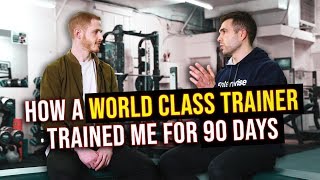
Mark Ottobre, an Australian trainer who works with Olympians, diagnosed movement problems holding back the host's strength. He fixed upper-back instability that unlocked a 40 kg bench-press gain, used carb cycling to manage energy and fat loss, and ran a seven-day training week by stressing muscles at the edge of their limits to force growth.
Chapters
Hey guys, in this video I got to interview Mark Ottobre, who's one of the best personal trainers in Australia. He's trained Olympians, top bodybuilders, he's had people travel from around the world just to see and learn from this guy. So he truly is amazing, and he was one of the people that helped me on my 90-day body transformation. In this video, we talk about what did he think when he first met me, how does he assess a body, how does he think about nutrition, and how did that play a role in my transformation. We also spoke about general training strategies, and we spoke about motivation and a lot more. So it's one to watch. So let's get into it.
Do you remember when I came to you a couple of, like, what is it, like 12 weeks ago now? Do you remember some of my dysfunctions and what you kind of recognize there were going to be issues?
Yeah, um, I suppose there was a few things that kind of ticked in my head straight away. You're a guy who's trained before, which can be a good thing, but it can also be a really bad thing because— and in your case, it was more of a bad thing than a good thing— because usually when people have trained before, they pick up a lot of bad habits and they do the same exercises and they get really strong at certain movement patterns, which then makes the opposing movement pattern really bad and really weak. And for you, certainly, um, your upper back hadn't had the love and attention. And it's pretty standard for a guy, you know, to get in the gym where they see, you know, one bench press, right? So they bench, but they don't really know how to retract and set their scap and, you know, make sure their lats are on and they're up here with their traps and all of this is pulled forward and they're tight through their pecs. So there was a lot of stuff with you there. And the thing, the thing that added to your kind of dysfunction and problems is the fact that you're tall and And the reason why that's significant is because the taller you are, the bigger your levers are. So there's more muscle that has to, you have to get right, for example, and also because the lever's longer, the opposing muscles also have to get stronger. So for example, where this really kind of came in for you was your back issues. So when you would squat, you'd let go of your core, which then you'd feel in your lower back. So it was really a case, and I think for that we gave you a lot of counterbalance squats in between squatting. And also front squatting was a great one for you. You know, you found it very uncomfortable, but Front squatting was a great exercise because, you know, you can't put a bar on your front without your core having to activate. And that was a great movement for you. And it was a movement very uncomfortable for you because it's a movement you haven't been exposed to. But that's the thing, when training on your own, you usually self-select exercises of things that you like. So look, you weren't horrible when you began by any stretch, but it was somewhat stereotypical of what I see from, you know, a guy You know, usually around, you know, anywhere between 25 or 22 to 40 who's trained before and was tall. Probably the biggest thing that I was impressed by was what your bench press has gotten up to, and I don't think that's a case of actually getting you better at bench press as it is more of a case of getting you more stable in your upper back because you can't fire a cannon out of a canoe. So if you have instability and you try and, you know, promote force, it's not going to work, right? So you've got to really make sure everything is nice and stable so you can produce that force. And that's what we definitely saw, you know. I think your bench press at the start of your program was like at 60, and at the end you did like 92.5 and still going.
Just did 100.
Just did 100? Okay, fantastic. So, um, which is quite a significant gain. And I know like previously you had done that, but you hadn't done it with the tempos that we were— they were asking you to do it with.
In terms of programming for nutrition, I know I'm challenging because I'm essentially vegan. I'm vegan, but I eat eggs, ethical eggs. I know that you were involved in that to some degree, but like, how do you think about programming and how do you think about what's optimal in designing?
So certainly, like, I'll say straight out, I don't think from a body composition point of view vegan diets are optimal. However, I am of the belief that I respect everyone's decisions so long as they're sound in what they're deciding. If someone's kind of made like their moral stance, for example, that's not something that you can necessarily argue with, and I don't shut my doors to that. Ideal, I think it is a varied diet, so, you know, meat, fish, vegetables, lots of vegetables, absolutely, you know, good fats, butter, avocado, coconut oil, that all should be a part of your plan.
One thing that was in my food program in was carb cycling. Do you want to talk a bit about like the strategy and logic behind why that works?
Yeah, so basically you want enough carbs to fill out the muscle and feel good to train, but you also— it's a kind of a double-edged sword. You don't want enough that's gonna, I suppose, overspill and overspill glycogen stores, for example. So in your muscle, you have your glycogen stores. Your glycogen stores are, you know, probably going to be replenished with carbohydrates. The thing is, a lot of people look at what they're eating over the course of a day But sometimes that's too short-term. You need to look at it over the course of a week, course of a month, how much food are you consuming. So carb cycling is an undulating strategy around your nutrition where we're lowering, you know, your overall food intake on certain days, but increasing it on days where you're more physically active or, you know, you're getting ready for a big workout, for instance. It's a case of depleting muscle glycogen so you do start burning fat, but what can happen is if you don't have those refeeds, you start getting tired. Also, it's a double-edged sword because if you're not replenishing and eating right, you're gonna elevate cortisol. When you elevate cortisol, then you're not gonna lose body fat because you've got elevated cortisol. So it's a very fine line to juggle the two, but it's a strategy that absolutely works. And we implement it really with clients who, you know, are down to that last couple of percentage and they need to get even leaner. So, you know, getting you to kind of deplete for a couple of days Bringing you in, really getting kind of a bit more of a fat loss or fat burning zone. And then as you start to, you know, really start to feel it, you know, say 3 days, then you increase your carbs again. It depends on the person because some people deplete and train a lot harder and they deplete a lot faster. So therefore it could be a day, you know, with no carbs and then the next day, you know, they might do their refeed or, you know, a moderate day, for example.
Another thing that was interesting with the programming was having like 7 days training. So I know we started with 5, sessions a week, and then not 7 days, then we went to 7 sessions a week. And, um, I know with this goal I was like, hey, how do we get this as fast as we can? But like, what was the strategy behind 7 sessions a week?
Well, I think Reese was a bit easier anyway. 7? Yeah. So some general principles that, you know, kind of to, to explain or frame up your question a little bit is the weaker the muscle is, the more frequently you can train. The stronger the muscle is, the more time it needs to recover. We want to build up frequency and volume inside that muscle so that there's— we're creating more trauma essentially to the muscle so we can basically help it hypertrophy. Because I suppose the most growth in biology and hypertrophy is going to occur on the border of chaos and order. So we want to basically train you as hard as we can possibly train you and then let you adapt, and then train you again as hard as we possibly can train and then let you adapt. So the weaker someone is, the more they can train. So it's a strategy that we'll use, say, in the short term, because the thing is, you can use that for most people, but it's just a case of when is that person going to burn out. Because if you keep training twice a day flat out, you will burn out if your nutrition and everything's not looked after. But I mean, there will come a point where you'll probably just burn out and not be able to get a return from that because you need time to recover. So it's, it's a, it's a good strategy that can be used, say for example, if you've got a goal, it's like, look guys, we just need to get this goal, we've got a photo shoot 12 weeks, let's go hard. You know, that maybe last 6 weeks or 4 weeks, the body will usually be able to sustain that for that exponential result. And that's where again, the carb loading and refeeding feeds come back in and just managing someone's fatigue. It's not necessarily a bad thing being trained into a hole, so long as you allow recovery out of that hole. And that's what's called supercompensation. So allowing the body to compensate from a load that is exponentially more than what you've had in the past.
Yeah, cool. I guess for people that are wanting to get started in fitness, do you have any tips or strategies to get them motivated to actually get them to start that journey?
Yeah, absolutely. So, um, you can either be motivated by pain or you can be motivated by pleasure. And, you know, the way I kind of live my life is a little bit like pain will push you until the vision pulls you. So, and sometimes, unfortunate as it is, some people need to be in a lot of pain to actually snap themselves out of behavior and then do something. But I think if you can manage manifest or even like create it as a habit of a way of being, not relying on pain to push you, but rely on the thought of my life could be better. You know, the only race you need to win is the one against yourself, and that's what fitness is. You know, you don't— if you're not getting up on stage, it's not competition. You know, do it for you and do it for the best version of you because you can be more. And I think the wrong message is, you know, you're perfect the way you are. You know, a lot of people out there, they're in pain, they're hurting, they don't feel perfect. And but, you know, my message would be, well, you can do something about it. You know, get off your ass, get to the gym, work out, learn. Um, you know, I'm a physical culturist. I love, you know, physical things. Uh, you know, that's why I have a gym, because I love training. And, you know, if I went on holiday, I would want to find the gym or go for, you know, a super long hike somewhere and do something physical because I find it fun. And you can make it fun and you can make it challenging, but you've got to find something that is enjoyable. And it's going to suck the first time you do it, but it's not a reason to stop. Um, you know, it's not a give up. You have a body, you know, people spend hundreds of thousands of dollars on their car, you know, they get out ridiculous, you know, loans and these kind of things, but they don't spend the same time and care on their body. And you've only got one, so, you know, might as well make it the best one you've got. And be willing to grow, because I think when you grow physically and in your fitness, you're going to grow mentally, and you can really use it as something beautiful and connect with people who are all on that path of betterment. I've seen it time after time. There is so much personal change that goes on when you get someone in shape or losing weight and doing things that they never thought they could do. The way they look upon themselves changes and evolves, and it's a really beautiful thing to see. If you're in a place and you think you need to change, well, do it and don't look back.










