Lower Body Mobility Exercises You Need
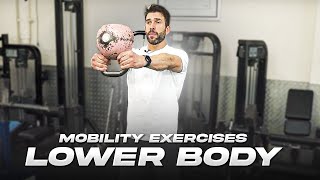
A trainer screens your squat with bodyweight and overhead tests, then walks through drills to fix mobility or strength gaps. Counterbalance squats, band-assisted work, glute bridges, and ankle drills build the stability you need for a better squat.
Chapters
Welcome to class. In this class, we're going to go over my go-tos for lower body mobility. All right, so to begin with, the first thing you do is you're going to screen your client and see what a bodyweight squat looks like. So I'm going to demonstrate a bodyweight squat, and obviously we're also going to screen them with the overhead squat test, which is where you've got this stick and shoulder width apart. You don't want to go too wide because making it wider makes it easier. So really want to get into that thoracic extension, and this is a challenge test, right? So this is challenging the upper body and the lower body to stay aligned in full position, right? So more or less, that is the ideal range. So your clients are probably not going to look like that. So what do we do? The first thing is you want to address and see what is actually going on with the client. Often people think it's an issue of mobility where really it's an issue of strength. So actually a lot of, I suppose, squatting issues can be solved through helping your clients get more stable. When you create more stability, you'll create more strength, right? So it's hard to say for sure because obviously I'm not with you when you screen your clients, but almost the first thing I do if for most clients. I've got an 8 kilo here. You could use a 2.5 kilo plate for this exercise, or you could use the 8 kilo like I'm going to show you both variations. Thank you. So this is called a counterbalance squat. The reason why counterbalance squat works is because if I put this out in front of me, my core and my abs have to switch on. I don't have a choice. So if I do this and my core doesn't switch on, I'm just going to fall and smash my face, right? So I put something out in front of me, core switches on, and you'll find for a lot of clients— now that's not going to do anything for me, so I'm going to use the kilos, right? But you find for a lot of clients by putting this out in front, right, in the arms, it's not here, it's not a goblet squat, right? 4 to 5 reps for this. It's out in front. Again, if they're not as strong in their upper body, you can use 4 kilos, you can use 2.5 kilos, completely fine. The goal is for them to switch on their core. So again, we're going to assume that pelvic tilt in, get the core on, arms stretched, and we're gonna get them to squat down, right? For a lot of people, just that will improve their squat. Now, if someone doesn't have the range of motion, perfectly fine. You can use and get them to squat to a bench. As you can see here, you know, I've reduced the range of motion just by squatting to a bench. So this is my first go-to, and it's not going to necessarily improve mobility overnight, but what it is going to do is going to teach the client to help create stability, and stability creates strength. The next go-to is just a simple band. And again, the best cues you can give your client are cues where you don't have to torque. So there's a few different ways you can use the band. You can start with a band by simply putting it around their ankles depending on what they're doing, right? So just simply putting around their ankles, it's going to help the client spread the floor apart. So you could use this and get them to do the same thing. You'll probably find they're more stable. You could use the band and also use a counterbalance squat and get them to do both, right? You can also play with it if they need to be using more glutes. You can certainly put this band higher, right? So if I do this and let's say they have— they're not using their glutes as well as they should, simply by me putting the band around the knees, they're gonna have a propensity to push against it, which when we push against the band, we're going to be using our glutes. So the band's here. And now all of a sudden, I'm using my glutes a lot more because there's a band there. So it's a very simple hack. Once you screen someone for body weight, if they're not using the right muscles, so for example, they're not using their glutes, they're using their core, you could do a combination band counterbalance squat, 5 reps, get them to do a warmup. With this, you always want them to be moving. I did that way too fast. So with a client, I'd want them to be moving through a 4 to 5 second cadence, right, up and down. So I don't want them just to pop up out of it. I want them to really think about what's going on. Now, this is pretty challenging because there's a lot of things that I have to stay stable. But again, how do we build speed? How do we build strength? It's through good movement patterns. And this is going to create that stability. So these are my first two go-tos, and I like these because they hit a lot of things at once. But again, if the client's so removed proved that they're not able to even a bodyweight squat, we're going to have some work to do, right? So something as simple as if they're not using their core, we need to start with a plank. Now I know we said this was for lower body, but if we are looking at trying to get a client to squat, if they're not able to stabilize their core, then they're not going to be able to squat. You have 3 main hubs of stability: your pelvis, your spine, and your scap or your shoulders, right? You need to make sure those hubs of stability are stable. So pelvis and spine, obviously, when we're squatting, are primary. So a simple thing, if a client isn't able to And if they're squatting and their squat looks kind of like that, right, this is where a counterbalance squat really works well because again, immediately they're going to switch on their core because that's often why that happens. The other way is you get to teach them by using a plank. So the correct way to do a plank is not— you know, a lot of people do this when they do a plank, they get as narrow as possible. Completely wrong way to be planking. What you want to do is when you actually get to make it harder, you want to get as wide as possible. So I'm gonna bring my arms wide, I'm gonna bring my feet wide. Now the trick with the plank is I'm gonna push— as you can see, I'm pushing my upper body off by rounding my back. My butt's not in the air, right? I'm gonna hide my tailbone. So I'm gonna pull my pelvis in, and I'm gonna imagine there's $1,000 in my bum cheek, right? You're trying to pull it out, I'm trying to keep it clenched in my butt cheeks, right? So you've got to flex your butt, you've got to flex your quads, and now my core is on. The other thing I like to do if I'm doing this with a client is I just give them a little bit of tension. They get that position, I just give them a little bit of tension I say, imagine you're planking on a fence and I'm gonna try and push you over, right? I might use one hand on the hip, one hand on the opposite shoulder, push them, and then switch, right? So what that would help do is helps them flex, make sure everything is on from the core. So you can see here, this is a good plank position, my core is on. So I might take them through a few rounds of planking, get them to squat again. What you generally find is as they activate their abs, their squat starts to look better. Again, particularly if their movement pattern is when they squat, they break at the hips and they just fall, fall down. So there's a few different ways we can solve it. Again, what that says to me is weak core. The next thing, we can scale these up and we can scale these down. So one of my favorites kind of mobility exercises to start with a squat for me personally is what I like to do is to sit into a squat position, grab an ankle, thumbs up, go to the side and stretch out my lats in conjunction with the full bodyweight squat. So that really, I like to to do this as a, as a nice warm-up. I like to be able to get clients to be able to do this. Now obviously not a lot of clients will be able to do this straight from the get-go, so what's the regression? If this is the ideal, what do we look at as the regression? Well, the regression literally is what I'm doing right now, is get your client to sit in a full squat position. Now granted, their full squat position might look like this, and they might be sweating bullets trying to get down into this position. Completely fine. We want to build this up over time. I want to maybe get them to do reps of this or sets of this, right? So it might start with 30 seconds staying in this might be an isometric position. Their shins might be burning because they're tight, their ankles might be burning, but again, we just work with their level, get them to hold that for 30 seconds, get up, get them to walk around, get back into it. And then again, this is something they can do on their own, and the more exposure they have to the full squat position, the better it's going to be, the more their body's going to remember that position. But then we can also look at what is enabling them from hitting that position. So if they're rounded, and, you know, they've got poor ankle flexion, then we can add in some calves before they do this, right? So, so when I say add in some calves, making sure they go all the way down, all the way up, really stretching out the calves as they go through that motion, then getting them in that position. Doing tibialis raises, right, against the wall or using the tibialis bar, that might help with a fascial release. They could potentially go see a soft tissue therapist as well, as well as building strength through that tibialis as well. So, so looking at what is actually breaking down as they squat is going to give you information as to what to program. But generally what you'll find with limitations to a squat, it is technique often. So they just haven't had the exposure of technique, and I'll show you in a moment how I start ingraining technique. But it's going to usually be from a mechanical aspect, it's going to be their ankles, or, you know, basically ankle flexion in general, and the ability to stabilize their hips and also their right, because they're flopping into it. Obviously, look, upper back does play a role because you do find a lot of people who are just too weak to get in this position with a bar, which is fine. But generally starting off, the reason why they can't get in this full position is everything's round. They don't have the ankle mobility and they don't have the strength. So you don't just want to jam people into it straight off. You want to work them in. So the way you could work them in, and what I've done pretty successfully with a lot of different clients, is just start with something and completely help them not overthink it is what I want you to do. This is how I'll start the squatting. I want you to sit to a bench, right, and stand up, right? And I'll get them to do that, literally sit down and stand up, because everyone can sit down and stand up, right? So make it really, really easy. Sit down and stand up. Then I might add a little layer of complexity. I want you to sit down like there's a thumbtack on the bench, and just as you're about to sit, you realize and you come straight back up. Up, right? And you realize there's a thumbtack there and you come back straight back up, right? So getting them not to just relax, but getting them— the next thing you could do is you could use trusty band and use the band as you go through. The next progression is using a stick, not a bar, putting the bar on their back, or stick on their back in this case. I say to the client, imagine this is 100 kilos or 200 kilos, right? So you want everything nice and stable. When I'm putting the stick on their back, I'm getting them to imagine that this is a bar and that it's very very heavy and that it's real, not just, oh, it's a stick, yeah, I'll just be relaxed, it's uneven, oh yeah, that's fine. No, because that creates bad habits when you do decide to get them to the bar. So you practice like everything is going to move into something else. So this is a barbell, right? This is what your squat's going to look like. We want— this is a nice position. We want the triceps anterior down, we want a little bit of a lean forward, and we want you to stand up right now. If a client's very weak, they will find this extremely challenging, extremely challenging because we're stabilizing and we're moving through. So that's generally— and if they need a higher height, sure, use a higher height. If they progress and they can use something lower, we progress and use something lower. The next one, if we're just talking about the mechanics of switching on glutes, and this is a big bang for buck exercise. So what I do is I pull my pelvis back, as you can see. So my pelvis is forward, get the clients to shift their pelvis back, feet on the floor, and I'm spreading the knees. So you should find when you do this, you, your clients, you're gonna feel this directly in your glutes. Now, if you're not feeling that as you do that, the easiest way to get someone to find their glutes is to lie down on a 90-degree angle and do exactly the same thing. On the 90-degree angle, there is nothing else that can be involved in this except really for the glutes. So this is a great exercise for someone who can't find their glutes their, you know, the clams aren't working for them. You want their glutes to get stronger, put a band around their knees, get them to lie down at 90 degrees and do 20 reps here. And then the 20 reps, you know exactly where your glutes are. I like to combine this once they've done their 20 or 10 to 20 reps depending on the client. I like to combine it with the squat because after they've done that, when they squat, they'll really be feeling their glutes as they do that. Now, if you want to make it even more advanced, you go into something like a kettlebell swing, but most of the clients won't be ready for that, so I won't talk about that in this video. So it's usually just the double that we'll use for, for general pop clients. Things that clients can do— the more clients get exposure to things at home, the better. One of the drills that I really like before we even begin is it's called swivel hips. So swivel hips is where we internally rotate with the hips. Now you can see a lot of clients when they start, they might only get to here, and you know, all of this might be jammed up through the hip flexor, etc. They're not able to get all the way down, but what we're aiming is this toe— I'm sorry, this knee, this heel, right? And I swivel back and forth. Now, 20 reps, you don't have to count necessarily, just to warm up through the hips. A lot of clients will find this pretty challenging and the more, again, exposure they get as a warm-up. That's what I like to do as a warm-up. The next one that I really like, again, because I like things that hit a lot of things at once, is fire hydrants. This is probably the most underrated warm-up drill. Fire hydrants is you get on all fours, imagine that you're a dog peeing on a fire hydrant, right? So what you're going to do is you're going to lift your leg up and around. Now we want to create a nice circle, we want to do it slowly. One of the mistakes that people make with the fire hydrants is they move everything as they go around, right? We're not moving everything, we're staying stable, the hips and pelvis is staying steady, we're lifting up and moving around. So you really should feel this through the glutes and adductors as well. But this is where I like to— I start a lot of clients doing fire hydrants because it is a big bang for buck exercise and people people feel it. So I'm hitting glutes, I'm getting the mobility aspect of it in there as well, I'm getting the stability aspect where they have to start thinking about where their pelvis is. So definitely start clients with fire hydrants, usually like 10 reps each side, and then we'll move to something a bit more progressive. But that's a great one. Now if someone is— and this is for bonus points, right— if someone is a little more advanced and So they're powerlifter and they're not doing the movements exactly the way you want. I'm going to show you a really, really cool exercise. Come with me. You can do this with a stick, you can do this without a stick. I'll show you both variations, but this is probably one of my favorite warm-up exercises personally. If I've got a low bar Squat. So all you need is a wall to do this, alright? You're gonna get as close to the wall as humanly possible. The better you are at this, the closer you're going to be able to get to the wall. So I'm gonna get pretty close to the wall, and then I'm gonna squat down. And what this does is, for folks that squat— and again, this is where, if you're using this exercise, this is a technique exercise and people do need a bit of strength to do this. This is really going to fix people's bad patterns. But again, if someone's weak, you're not going to start this. This isn't an exercise for, for someone new to training. This is an exercise for someone who's been training a while and they've got bad habits in their squat, right? And again, I still might use the counterbalance with that person as well because their abs might be too weak. For someone who's squatting, let's say as a powerlifter, or what they do is they lean forward when they squat, this is a great exercise. Or they're not opening up the floor enough. Again, for me to get in the right position here, I have to open up through my, through my legs and through my hips. I can't, I can't lean forward, right? I got to stay up tall. So I'm stacking the ribs, I'm in this position here, and back up. Now, I really want to challenge someone in this. I'm going to get them with a stick on their back and get them to spread and back up, right? Simple wall squat. Let's call it a wall squat, right? Simple, but it helps with establishing good technique patterns. We'll go back over here. The only thing that I have yet to show you, uh, is basically the ankle flexion and calf things, because again, often what happens is we forget and neglect calf training because we think about the squat. But a lot of the mechanics of the squat happens with that knee flexion, right? So we don't get knee over toe. And this is where a lot of the practices that we'll teach when you come into a seminar is we'll start with unilateral things because we need to get that knee flexion to be able to squat properly. So calves is supposed— the ability to stabilize through knee flexion is also a function of the calf and also a function of that tibialis anterior. So you are going to need some calves. I mean, you can do them standing, you can do them seated, you can do donkeys. Donkeys, I particularly do like the donkey variation. That's where you're going to completely stretch out through the hamstring, go all the way down and all the way up. Probably too much for a general population client who's just beginning their journey, but a great exercise nonetheless. So I'll show you, I like to do single leg. Your clients may be too weak to begin with for single leg, so you just simply double leg, but you want to be working that unilateral function, particularly ankle flexion rather, is an issue for the client. The more ankle flexion you have, the better your knee flexion the ability to get into knee flexion it's going to be, right? The more range of motion, because often the constraint is ankle flexion, right? This is where and why, you know, if someone squats like this with flat feet and you put them up on a, on a box like this, they can immediately get into position. Yes, the center of mass has changed, that's also true, but you've allowed for that ankle flexion too. So it's a hack. That's why, you know, lifters have lifting— I mean, lifting shoes have that heel, is to get into that better position. Shifts the center of mass forward just a a little bit, but bypasses that limitation for a lot of people, which is in ankle flexion. So again, with your calves all the way down, don't just come down. Again, we're doing calves, instruct the client. It's not just flop up, flop, not flopping. Pull your heels down to the floor, come up, and then come up again. Pull your heels down to the floor. So you're really getting that stretch. Now, there's quite a bit of a stretch that I've got there. There's quite a bit of range. Clients might only be there, completely fine. What you want to be doing is you just want to be working that range with your clients, right? Getting down all the way into it, all the way out. If they don't feel it, they're doing it wrong. You should feel this. Take the time to do it and do it properly. All right, so that was the video on my go-to exercises for lower body mobility, stability, and getting someone to be able to squat and move without pain and better and injury-free. Hope you enjoyed. Stay tuned to more more great classes.










