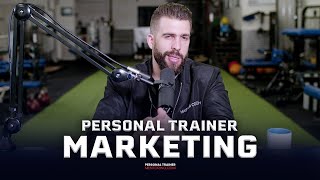
In this video Mark Ottobre delivers a concise marketing crash course aimed at personal trainers and studio owners. He begins by clarifying the difference between sales (converting a prospect into a paying client) and marketing (generating the initial inquiry that leads to a sales conversation). He explains that for trainers working in big‑box gyms, the rent they pay is essentially a marketing expense because it grants access to the gym’s existing member base. Ottobre then stresses that the foundation of any marketing effort is a clear definition of a single target client persona – gender, age, goals, and lifestyle – rather than trying to appeal to everyone. He illustrates how distinct client goals (e.g., muscle gain vs. weight loss) require different messaging, imagery, and value propositions. Next, he discusses how the chosen client persona dictates the most effective marketing medium, contrasting online platforms (e.g., Instagram for younger females) with offline tactics (mail drops, seminars) for older or professional demographics. Finally, he outlines additional practical considerations such as pricing, location, household income, and geographic reach, tying them back to the target client. The video concludes with a call to action for viewers to comment, subscribe, and download a free $500 personal training pack from personaltrainermentoring.com.
Chapters
Hello, Mark Ottobre here for personaltrainermentoring.com, and in this video I'm gonna be giving you a crash course to marketing for personal trainers. So the first thing I wanna talk about in marketing is the difference between sales and marketing. Sales is basically the objective is to convert someone as a paying customer, so they've gone from prospect to client. Now marketing, on the other hand, is getting the phone to ring. So getting that initial person to say, hey, That's someone who I wanna train with. They call up, they Instagram, they Facebook, they YouTube, whatever it may be, and they get in contact and they basically start, they inquire. But the initial conversion of their inquiry or that then conversion is sales. So marketing, one of the things you wanna consider with your marketing is where are you getting your clients from? And to give an example, 'cause I know a lot of people who are watching this video will probably be independent business owners or working at say big box gyms like your Fitness First, Goodlife, Anytime Fitness, et cetera. Paying a rent to the floor. So I often say to trainers like this, the reason why you pay the rent is not to rent the equipment, it's actually to rent the clients, it's to rent the members. 'Cause let's say if your average big box gym has let's say 2, 3, 4, 5,000 members, it's getting access to those members. So that rental fee really is a marketing expense to get the clients in front of you or to have access to those clients because those clients obviously have already pre-selected themselves as being someone who are into their health and fitness and actually wanna do something about it. So that's where the rental expense is actually really a marketing expense for the large part. Now, if you are a studio owner, you might be, and even for some of the big box gym people, you might wanna be looking at, well, how do you market more effectively? So there are many ways and you need to consider on and offline and what is fundamentally one of the biggest things with marketing is figuring out what is the user experience. So number one, who is your client? And this is something that I find most people fall down on across industries. So it's not just personal trainers. They They wanna be whatever it is for everyone. They wanna be a personal trainer for everyone. They wanna do everything. Now, while your skillset, I know for me personally, your skillset might actually be able to train beginners to the very, very elite and I can do that so I understand the problem. You're not gonna market yourself as that, right? You need to start to have a conversation with that one person. So let's say for example, is your client, are they male or female? Now I know for some of you watching this video, you say, oh, well, I wanna train both. Yes, I get you wanna train both, but where you wanna start with marketing and designing a brand, designing the user experience, experiences, you really want to have a singular focus on who that person is to be able to speak to them directly. Because again, a guy wanting to put on 7 kilos, 10 kilos of lean muscle mass is very different than a female in her 40s wanting to lose 20 kilos. They have different needs, different desires, and fundamentally from a marketing perspective, they're going to respond to different marketing messages. You know, in the, the weight loss marketing message, I might say, do you want to lose weight? Right? In the person trying to gain muscle, it's like, well, do you want to gain weight? These are polar opposites of what people want. And also the branding of what people respond to. You know, one might have images of toned and fit people, the other one might have images of big bodybuilders with veins sticking out. Now the veins on the weight loss one might scare off those people and say, well, I don't, I don't, that's actually not what I want. They might have a different perception. So your marketing does need to start fundamentally with who are you trying to serve? Because even more than that, what it also affects is the medium. So for example, if you're going after, I don't know, let's say barristers in the CBD of your town, you know, the likelihood of barristers investors, let's say, interacting with, say, things like social media on a daily basis, especially if they're in the older demographic of, let's say, 50+, is less and less. Not to say they're not on Facebook and they're not on Instagram, but they may not be on Facebook or Instagram. However, they probably are in the city doing their thing. So in this case, an offline strategy where you're sending letters to their direct places of business, or a mail drop, so to speak, could be much more effective than trying to do an online campaign. Likewise, what we know about Instagram is the demographics are 18 to that 35-year-old female predominantly is a great platform to target if that's who you're targeting. So again, knowing who exactly your client is really affects every step from your actual business. So this is all part of marketing, like how much is your product? How much are your services? What's your fees? What's your pricing? Where are you located? What's your demographic? All the geographical concerns, how far they— 'cause again, personal training, if they're traveling to come and see you, Geographical concerns certainly need to be considered in terms of how much average household income and all these other things, demographics of that actual area also need to be considered of who you're actually targeting as well. So again, with marketing, the first step, the absolutely first step is understand who your client is. The second step is about designing that message to that client. So what is that message? What does that client actually want? How do we put together that message something that they're actually gonna respond to. And then finally, the third step is actually the medium. So what are we gonna use? Is it Facebook? Is it offline? Is it mail drop? Is it doing a seminar and speaking about, you know, X topic to pique their interest and then offering personal training from that? So that's a little, I suppose, taster of what marketing is. Let me know what you think in the comments below. Let me know what marketing struggles or techniques or tactics you're working with right now and how I can be of help and more of service. Until next time, folks, make sure you subscribe to us YouTube and ring that bell. And if you haven't already, download— go to www.personaltrainermentoring.com and download your free $500 personal training pack from the website. Until next time, let's keep raising the standard of personal training worldwide.