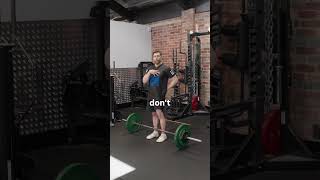
Mark Ottobre breaks down deadlift mechanics, emphasizing reaching for the bar to shorten the pull and pre-activate the lats. He stresses the "fishing hook" lower back position, tucking the tailbone, and using a cue to point forcefully at the floor before lifting to engage the lats and pull the bar into your center of mass.
Chapters
This is me reaching down to get the bar, right? Or just picking up the bar. Now this is me reaching for the bar. The difference, you understand? So reaching, reaching, reaching, reaching, reaching, reaching, reaching, reaching. Because this is the thing, in this position I'm nice and tight, and tightness is our friend in all the lifts. So here I'm reaching, reaching, reaching, reaching. In this position there's two key things. One is that my heels and my feet are locked in. The other is that my sternum is pushed up, not my chest. When I get into my chest, I'm getting to that thoracic extension. On a deadlift, I do not want thoracic extension because then I'm relying on my rhomboids to stabilize. I want my rhomboids to stabilize. This is where the fishing hook is true. My lower back needs to be stabilized. So the gymnast position, right, I showed some of you before, where tailbone is tucked up, our rib cage is on top— that is your deadlift position. Your lats are a spine stabilizer. So if you want to get your lats involved in a deadlift, point before I even start. Like, every time I deadlift, I point to the floor as hard as I can. Why do I point to the floor as hard as I can? Turn my lats on, right? I'm also shortening the distance that I have to pull the bar by reaching my hands. So reach, reach, reach, reach, reach, reach, reach, reach, reach. Lats are on. And you can see in this position, my back is nice and tight, it's stable. My lats are on. I'm reaching, I'm pulling it into my center of mass.