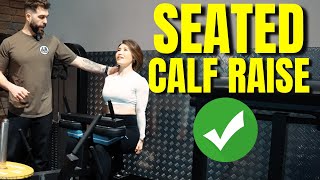
Seated calf raises target the soleus muscle, which responds best to higher reps (15-30) since it's mostly slow-twitch fibers. Keep your heels low at the bottom, rise onto the balls of your feet, and avoid rocking your upper body to isolate the calves.
Chapters
In this video, I'm going to show you the right way to do a seated calf raise. So we have Manami here. Off you go, Manami, do a couple reps, and I'm going to give you the tips and tidbits along the way as we go. So firstly, we've got her hands grabbing the poles here forward. What we're going to do is we're going to get her to put the hands on the seat behind. That way you can see immediately her posture. She's up nice and tall. Now off you go, go a couple of reps. The big difference between your seated calf raise and your standing calf raise is your seated calf raise is going to work a lot more of the soleus, whereas your standing is going to work a lot more of the gastroc. Now, both are necessary, but this one is going to be a little bit more slow-twitch fiber in nature, which means we want to be doing higher reps, around 15, 25, 30 is where we really want to be. Now, in training calves, she's going at a really nice pace here, just as she does, but we really want to get full range of motion. So we come down, and the cue I like to give is, so come down, And then think of it as coming down again. Now come up, come up, and then think of it as coming up again, really get up onto those tippy toes and the balls of your feet. Now, going that, and we don't want to be using tendon strength as we do this, we want to use the actual muscle itself. So come up. And we just also want to watch, we might even need to put some stretch blocks underneath her knees, just raise that up a little bit because I think you're hitting the bottom. So let me show you what I would do in this case. We'll be right back. So we're going to use these to ensure— just lift that up a little bit for me. Thumbs up. I'm just going to pop this here, then we're going to wedge it nice. Which is that one? Lift and pull that out. Pull that out. That's it. All right, now try that. That way we can just get more of a stretch. All right, off we go. So now she's not going to hit the bottom, so you get much more of a stretch. Feel the stretch and hands away. So you can see when she did that, she started rocking through the upper body. I want to eliminate any rock, so it's all through, all through her calf. Just want her calf to be working here and really getting that stretch. So that's beautiful technique. Now, the reason why our lower leg is so important in terms of our upper leg and our whole body development is because if we do have restrictions at the ankle, it's going to work out to have restrictions in terms of that knee flexion. So any ankle restriction is going to equate to that knee flexion, we're going to have less knee flexion. So even if you don't want to have huge calves, it is important that we take our ankles and our calves through a full range of motion so that way we can squat nicely. If you want more great tips like this, make sure you subscribe to our channel.