Skinny-Fat Dad Gets Shredded in 10 Weeks (He Almost Quit)
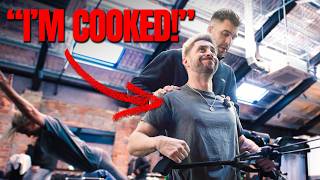
Trainer Mark guides Jamie through week two of a 10-week transformation, focusing on upper-body work with proper form before intensity. Jamie struggles with ego and coordination while learning to engage his lats in rows and maintain chest-up posture. Mark emphasizes a progression: movement first, then technique, then pushing hard.
Chapters
There you go, my man. Belly button, belly button, belly button, belly button.
Good.
Slowly. 4, 3, 2, 1. That's 10. Good.
I'm just going to grab a sip of water if that's okay. No.
What if I said no? It's not okay.
I got to listen to you. I got to listen to you. You're the sensei.
This is week 2 of Jamie's 10-week body transformation journey. Last week I took Jamie through his initial consultation and fitness assessment. Now it's time to push him and have some fun. First session, upper body. I want to have a look at how you dumbbell press. 10. All right, put them back. All right, I'm going to make some tweaks. All right, cool. You know, just watching Jamie dumbbell press, I can already see that he's a guy who wants to work hard that just simply hasn't gotten the right coaching. I want you kind of like really, really tight. So see on my upper back, I'm pushing that up to the roof.
Yep.
That position, right, it's It's not like I do it once. I'm doing it the whole time. Okay, I stay in this position. Then as I move up, that position stays. As I move down, that position stays. What I'm trying to teach Jamie here is the secret to lifting heavy weights. This is the part that most people skip over. Creating stability enables higher levels of performance. Yeah, press up, press up.
3.
All right, good. Okay, sit up.
I'm just really struggling with just getting my, my chest up and performing the motion. It just doesn't feel natural at this point because I've always been flat when I'm on a bench. Now I'm having to learn to arch my back, but I am feeling it more in my chest as I do it. But I'm just having to constantly remind myself, like I'm doing a dance move right now.
Come over here. Now you do lat pulldown. Yep. Again, you're going to do you.
Hey, we've got some Nas playing.
All right, release. So when we're doing this, I want you here, I want you long. So see, like, stretch forward, then you're going to pull down and pull, right? Every time I coach a client, I really like to observe what they're doing. So watching Jamie on the lat pull down, I can see he doesn't have the right cues. Again, he just needs the right coaching. He's a guy who wants to work really but hasn't been given the roadmap. This is your starting position. Now pull down, pull diagonally.
There. So the thing with the lat pulldown is I've always felt relatively confident in it. I've been able to lift a decent amount of weight, but I've always wondered why I don't really feel it in my back. Now at this point, I'm feeling it in my back, but I'm also feeling it in my ego because all of a sudden I can't lift the same amount as I could before because I'm having to actually engage my lats for the first time.
We're adding a skill now. When you lower this, you're going to lower it 4 seconds. 4, 3, 2, 1. So taking Jamie through this workout right now, he must think that I'm a bit of a nutty professor in so many ways. Here I am getting him to strip the weight back, getting him to do it slowly, getting to do it with tempo. But basically what I'm doing here is making it repeatable effort done so we can scale him up to working him very, very hard. Congratulations. Level unlocked. Put those away and grab the 13s.
I'm just going to grab a sip of water if that's okay. I'm just making excuses to get a little bit of rest time at this point because I need a little bit of rest.
No, what if I said no, it's not okay?
I gotta listen to you, I gotta listen to you. You're the sensei, so luckily I can have some.
Free in front of your body, full stretch, and row. One. I want more. Chest up more, chin up as you stretch. Now pull. Good. We need to go lighter. Okay, yeah, rest, rest, rest, rest, rest. You're back over, chest up nice and high. Power up, up we go. So often people want to train to failure straight away. They want to go to the heaviest weights at the beginning. What I want is the same technique performed exactly the same way, and then once we master that skill, we absolutely take that to failure. So what we're doing here with Jamie is we're teaching him the skill.
All right, we're getting there. It's starting to feel a little bit more natural. I'm definitely feeling it in my chest at this point. My chest is on fire. We're getting there.
It's actually like the first real working set that we've done. The rest were just like practices, tweaking your movement. I felt it. Making sure like where you were on that intensity. That's the beginning of your working sets.
Okay.
Simple mantra is I teach people how to move, then I teach them how to lift, then I train them hard. The phase that Jamie and I are in right now is teaching him how to move directly. Really stretch it and pull hard.
There you go. I felt that. I'm feeling this in a whole different way to previous times where I was just going through the motions. And that's literally how I'd feel when I was doing the lat pulldown. I'm just going through the motions. Now I'm engaging my lats and I'm definitely feeling it.
No, you're done. Done. You felt that last one was sloppy, right? Stick it to 10. First couple were good.
Yep. It's getting better, I hope.
I want 2 more really good sets like you just did. So that first— that one you just did before was your first set. This will be your second set.
I'm trying to push, I'm trying to push, but this is good. I'm going to failure, and I feel like when you're working out, you definitely have to be pushing yourself to failure. Otherwise, what are you here for?
Generally speaking, if I'm doing this to begin, then my B series, the next exercise we do, will be a straight shoulder press. Okay, now pull, but chest up as you pull. You can really see here now Jamie's really using his shoulders to try and get the bar down.
Do you want One more.
All right, that one was no good. And that's why I cut the set short, because I really want to drum into the right technique. I really want to make sure he's using his lats and his rhomboids to bring that bar down and not going into this, because that's where he defaults to. If the trap— these are your traps, you feel that? Yep. If the trap is on, the lats can't be off. Okay, if the lats are on, the trap can't be on.
That feels so weird. I understand that it feels so weird. So as I'm pulling down, I'm thinking about this thing that Mark told me. He said point your fingers to the ground and flex your lats, and then that's how you know that they're switched on. So you guys at home, do that. Point to the ground, flex your lats. That's how you know they're turned on. Now that really helped me with my mind-muscle connection.
Straight up, straight up, straight up. Chest up, chest up. Into position. Go up, up. There you go. Jamie's really working hard here, and the difference between pressing with a pronated, neutral, or semi-pronated grip is actually considerable when it comes to shoulder health. So I'm making sure at all points that Jamie is working hard but keeping his shoulder safe. More, more, more, chin up as you stretch. Good. Treat it like a stretch, treat it like a stretch. Chin up, chin up, chin up, chin up, chin up. Pull the lats down, pull the lats down.
Nah, done.
Fried, cooked. How you feeling?
Sore but good. Okay, got to get over the ego factor because I know I'm clearly pushing myself harder because I'm sweating and I'm feeling it.
Well, Here's the thing about that, right? The way you— there's two ways you can look at this. The way you lift will continue to give you the result that you already have. Definition of insanity is the same thing every day and expect different results. The way you lift has a ceiling. You've hit it. Yeah, you're not going to get better from the way you do it. What I'm teaching you to lift has no ceiling. This is the biggest mistake that lifters make, is they don't refine their technique and they don't set themselves up for success long term. And this is what we're undoing right now, making sure that Jamie is set up with success for the long term. All right, so when we do this, what I want you to do, I want you to stack everything on top.
Shoulders has always been a struggle for me. I don't have big shoulders, and it's something that I definitely want to grow, and I've needed some coaching when it comes to shoulder exercises. So right now I'm struggling, I'm not particularly enjoying it, but this is something that I know that I need to get to the place where I want to be. So I've got to push through.
Chest up, chest up, chest up.
And you're done, man.
You're done.
I'm cooked right now. I'm feeling it. My shoulders are on fire. They're like, I'm done. But my mind is like, come on, Jamie, you got one more left in you.
Training is about addressing the weaknesses. So the way you've been doing things, and like, this, this exposes you. It exposes all your weaknesses. You are very like, you don't keep yourself up tall. So putting in this position makes it very, very hard. We're going to modify it just a little bit next set, just to make it a little bit easier and the position a little bit better, because that is a little bit too much for you right now.
I'm going to be honest, this is one of the reasons why I've always felt quite self-conscious when I'm at the gym, because I feel like the gym really does expose my weaknesses. I go there to be stronger, to do better, but then I end up comparing myself to other people at the gym, which then stops me from that journey of getting better. And so this has been half of the obstacle for me to stop thinking like that, to think about the final destination rather than where I'm at right now. So I've just got to continue pushing myself.
I'm guessing you've done seated row before?
Yes.
Show me how you do it. The two most powerful words in coaching is show me. So actually, you just do you. Okay, you just do you.
In my head, I know how to do this. In my head, I know he's going to tell me I'm doing this wrong.
All right, so we get you to bend your knees. We need a lot of work here. Stick your ass out.
Why is it always about my ass? I'm working on my abs, leave my ass alone. Ass out, ass out. Yeah, lean forward. Stick your chest up.
Stick your chest up. Up, up, up. Now I want you to retract. So squish my fingers in the back. Now pull. But I want more, so I want you to wrap. That's one stretch. More, more, more, more, more, more, more. I can see Jamie's never really used his upper back before. Keep your hips back, hips back, hips back. Now pull.
With the seated row, I've always pulled a little bit higher, not quite to my chest, but a little bit higher. And I think I have been using my biceps more than my back, and it just feels easier to do that. But it's obviously not what I'm meant to be doing while I'm doing the seated row. So now I'm actually— I'm feeling it where I'm meant to be feeling it. But it's definitely a learning process at this point.
I feel for Jamie here. He's tight through his hamstrings, he's weak through his upper back, and he's not having a good time. He thought he was doing it correctly, but there is so much I need to correct here. But transforming this is going to have a massive impact in his musculature on his upper back and also the way he moves. Fixed position is— I want your hips fixed back, right? So see where my hips are fixed? My hips don't move. So the first thing that's going to move, if I break it down, is see how I move my upper back. Now that moves— see how much movement I have there? That moves independently of my elbows. So I pull back, then I row.
I always struggle with coordination. This is why I can't dance. It's like so many different things going on at once to complete one fluid movement.
The only difference is this time we're going to use a neutral grip, right? Okay, but I want you up into it, so I want you there, and don't move your hands at all. So it just stays neutral the whole time.
Okay, so just like this?
Yes, but you gotta lock that thing out at the top. So I changed that grip there to make it easier for Jamie, but really, like, he was really struggling quite a lot throughout upper back. And again, you can see here how he starts to break down. It's because that upper back is weak. So getting these right for him is absolutely paramount in getting him to the next level.
No back.
So this will help your pressing exponentially if you get strong at this movement. Okay, you can actually see why Jamie has shoulder issues as well. Well, and why his bench press is capped is because his back isn't actually strong enough to keep up with his pressing. Do us two parts. Pull more, more, more, more, more, more, more, more, more, more, more, more, more, more, more. Now pull, but into your belly button.
Higher.
Go again. Just do one more for me. Retract hard. Retract hard. Now pull. Right. We are going to change the grip on this. Okay? This you up a little bit.
Yeah, sorry, bro, uncoordinated.
There is nothing you need to be sorry for at all. So there you go. Yeah, you go. So stay up tall and push up straight overhead too. So as you push here, instead of being like that, I want you to push yourself forward.
Okay.
I don't know if this is for the— but I, I didn't actually— watching back, I didn't realize how hard Jamie was actually working. That's the thing, when I get locked in, I just want to make sure the movement is exactly the way it needs to be. And I have a standard and people meet my standard. I never drop my standard for anyone. So what I'm doing here is making sure Jamie hits my standard. If there's one movement that's wrong, I'm on him. It's not a lean back, it's a retraction. So let's move this independently. There you go. Now pull yourself into it. That's one, right? And you can see here how I've just stripped everything back to just isolating that back movement to make sure that he does it correctly.
And go again.
There you go, my man.
What about that?
Well, we're gonna do some abs and then we're done. Cool. Code name, whenever I say to a client we're gonna do abs, it's actually code for I'm gonna bully you. On, on, squeeze your ass, squeeze your ass. No, it's not.
It's squeezing.
I want more. Your ass wasn't squeezing for shit.
I just don't have ass muscles, that's all.
I'm poking it, it's soft. You're like this.
Yep.
I want you here.
Is that better? Nope.
You're still here. Look at me. I want you here.
Like, like that.
There we go. Good man. Flex. All right, 5.
I've never found planks challenging, and I think that's because I've been cheating, not knowing that I'm cheating. I've always been like, well, what's the big deal with planks? I can do this forever. I'm light, so it's not incredibly hard, but now I'm feeling it. My abs are burning at point.
Really, the abs. I can push him as hard as possible to the absolute nth degree, and I can just see he's in a world of pain. This is how to do a plank. Okay, my ass is flexed. Okay, okay, you ready?
Not really.
Too bad.
I'm not going to lie.
There you go. Good man. All right, let's start from that. Flex your ass. That's it. Now that's a flexed ass, right? I can feel that. Abs, abs, abs, abs. You know, if this was Marcus, I'd be kicking him because he's a martial artist.
This is soft, right?
30 seconds.
30 seconds. Oh my goodness, 30 seconds. All right, I can beat that.
Very simple workout, hey? Simple but hard. Yeah, just like a punch to the throat.
Pretty much.
Yeah, we haven't— there you go, almost there. 5, 4, 3, 2, 1. 40 seconds done. Are you still going? Keep holding, keep holding, keep holding, keep holding. Belly button, belly button, belly button, belly button.
Oh, I had to beat the 30 seconds.
Well done, man. We hit our target. Excellent.
What did I hit?
Uh, 45. Nothing more satisfying than seeing a client collapse on the floor knowing that's a result of your good work. That's it. That's it, man. That's it.
Thanks, bro.
You're welcome. That's week 2 in the books. Subscribe to see week 3.










