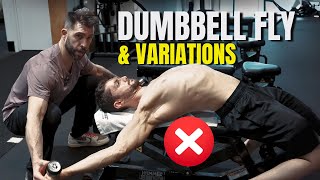
In this instructional video, the host demonstrates three primary dumbbell fly variations— the standard flat fly, the press fly, and the pec (pronated) fly— using a demonstrator named Jason. For each movement, the instructor explains optimal elbow positioning (elbows toward the ears), the importance of a slight elbow bend to manage lever mechanics, and where tension is felt throughout the range of motion. He highlights how to apply light resistance during the fly’s peak contraction, why the press fly allows heavier loads with reduced shoulder stress, and how the pec fly (including an unrolling‑grip version) targets the pec minor and end‑range strength while demanding careful load selection to protect the shoulder and biceps tendon. The video also mentions incline adaptations, load recommendations (light‑to‑moderate for end‑range work), and coaching cues such as spotting, resistance placement, and visual checks for proper form. The overall message is to correct common fly mistakes, use variations to suit individual mobility, and prioritize joint health while building chest strength.
Chapters
In this video, we're going to be showing you dumbbell flies and its variations. We have Jason here who's going to be demonstrating. So Jason, show us the first variation, or the main way that most people would be doing their dumbbell flies. So when we say dumbbell flies, this version is what most people think of when they do a fly. They're on the bench, it's usually flat, and yes, you can do obviously your pec flies on an incline, that's not a problem. But as you can see there, Jason's coming through this position and coming all the way up. So Some things to note on a fly is at that end position, that's where most of the tension is, and where Jason is right here, that's where the least amount of tension is. So if Jason— if I was training Jason in this case, what I'd be doing as he comes through is giving him a slight resistance on the way through. So come through, Jason, go again, do your fly. And as he comes through, I'm going to give him slight resistance here. Now you may have not have seen it on camera, but where Jason's elbows are coming through, they're coming through on this angle, they're coming a little bit low. So What I prefer is people to come out with their elbows more towards their ears. So Jason, just show us that variation, and if you need to bend the elbows, and up again we go. So the reason why we bend the elbows is obviously the lever point. As we bend the elbows, there's going to be less tension at the pec, but we'll let Jason go through as he does. And depends on your range of motion, Jason's doing this pretty well as he goes through. So his elbows are more towards his ears in this case, and you can see his pecs, they're straining and stretching a lot more in this position. So that's a pretty nice looking fly. And again, if I'm training Jason, I can stand through, and as he comes up, I'm going to put my hands there to give him a little bit resistance and go straight in. So there's no easy spot of the fly. So that's where the most attention is, and I just give him that. All right, sit up for us, Jason. Excellent. So let's do a variation of what some people turn it into, which is the press fly. So using the same amount of weight, the press fly, we're going to be lying down and he's going to be bending the elbows a hell of a lot more on this one. Usually we can— well, not usually, you can handle a lot more weight because you're bending the elbows. So bend the elbows and turn that into a fly. So up we go, and this is the press fly. So we're still bending the elbows, but there's nowhere near as much lever point. This is a really nice stretch. I really do like this one as well because it does give that stretch, and you can use— there's a lot more forgiving, but the shoulder is in a much nicer position in this. The pec is a lot more understretched, a lot more under tension, so it's a one to use, and I do like this one. Where do I like this one? If people don't have the range of motion, it's a good one to start with. So that's a really nice one. And again, we can put him on the incline and use it. So that's the press fly. Now the last one, we're going to need to drop the weight. The last one is the pec fly. So Jason, if you just want to grab a pair of dumbbells. Now I learned this one from my mentor, Charles Poliquin. The pec fly is we're going to go in a pronated position. We're not going to go into a neutral position. We're going to stay in a pronated position. So lying on your back, Jason, back into, into the, into the fly. And we're going to do the pec fly. So he's going to be in this position here, and we're going to purposely move our— slight bend in the elbow, and we're going to move those dumbbell— the elbows towards our ears. So Jason, even more so. There we go. And back up. So we want it to be even more so through this range here. So we're really hitting that pec minor. So you really, really do get quite opened up, and you do have to start— most people, most guys like Jason, for example, and we want to stretch, that's a little bit too much. We want to really still treat it as a fly and back up. So open up, open up, open up, open up, open up. So you want to start with this one at a fairly light to moderate weight. Obviously you can go heavy if you've got the range of motion, but most people just aren't strong in this range of motion here. So especially when it comes to that shoulder, that bicep tendon, that end range strength that's required for this exercise. But you will find that your pec minor, it's placed under a lot of load. And you can see Jason's moving more towards with his elbows as we do this, which is a sign that it's probably hitting the right spots and back up. So that's your pec fly. Now you can also do your pec fly with an unrolling grip, which is where he would point the thumbs down as he does it to get more range of motion, but we won't do that. So in this, this range, if you've got the range of motion, Jason, you would then flip your elbows that way, which would create even more of a stretch. And then you come back. That's the unrolling grip position. So at the bottom, so you come here into there and then you unroll and then you roll back in that way and come— that's called unrolling grip pec fly, which again, just as you unroll, it creates more of a stretch at that end position. And this again is about creating strength at end range position. So I mean, it will help build muscle. It's not traditionally a bodybuilding exercise that people think of because the load is limited in your end range, but it is something that you could incorporate to keep your joints healthy. So just do one more, Jason, and then we'll leave that one there. How's that one feeling? Pretty good. You feel that more light up in the stretching and pulling the chest apart. All right, jump up for us, Jason. So there are the three main variations, and of course, you know, you can add another variation where you simply put it on an incline, or even, even go a slight more incline, and that's just going to create even more of a stretch and strain and really hit those fibers in the upper chest more if we do create the incline. But same principles remain of what we've just shown you there. If you've enjoyed this explanation of pec flies, consider subscribing. Want more videos to learn how to build your superhuman? Click here or here.