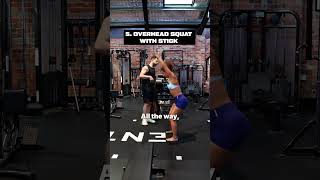
Mark Ottobre watches a trainee squat and spots three problems: core weakness causing butt wink, unilateral glute weakness with femur rotation, and thoracic weakness affecting bar position. He shows how screening findings must drive the next training program.
Chapters
I'm gonna get you to do a bodyweight squat. Your bum to your ankles, go all the way down. Let's have a look. Okay, cool. When you go into that full squat, right, what happens to begin with is that you actually lose control through your abs. You got quite a bit of a butt wink, so that means your core's weak. Do a backbend for me. Yeah, without— yeah, that's fine, you are fine. Just reach down, touch your toes one more time. Yeah, you don't use your hips.
Oh yeah, yeah, both legs actually.
Both account— your femur rotated in towards the VM. What's weak is the glute. Again, all the way, all the way, all the way, all the way. So you have some upper back weakness too, right? Because here that bar has to come, so some thoracic weakness as well.
3, 2—
quite a bit weaker on this side, huh?
Yeah, my left leg is a lot stronger than my right, actually.
Yeah, if your glute is one size weaker, then it's going to compensate for the other side.
Oh, okay.
I'm pretty happy I've got answers. So with programming, you can't divorce screening from programming. So what we just did then informs how we should train.