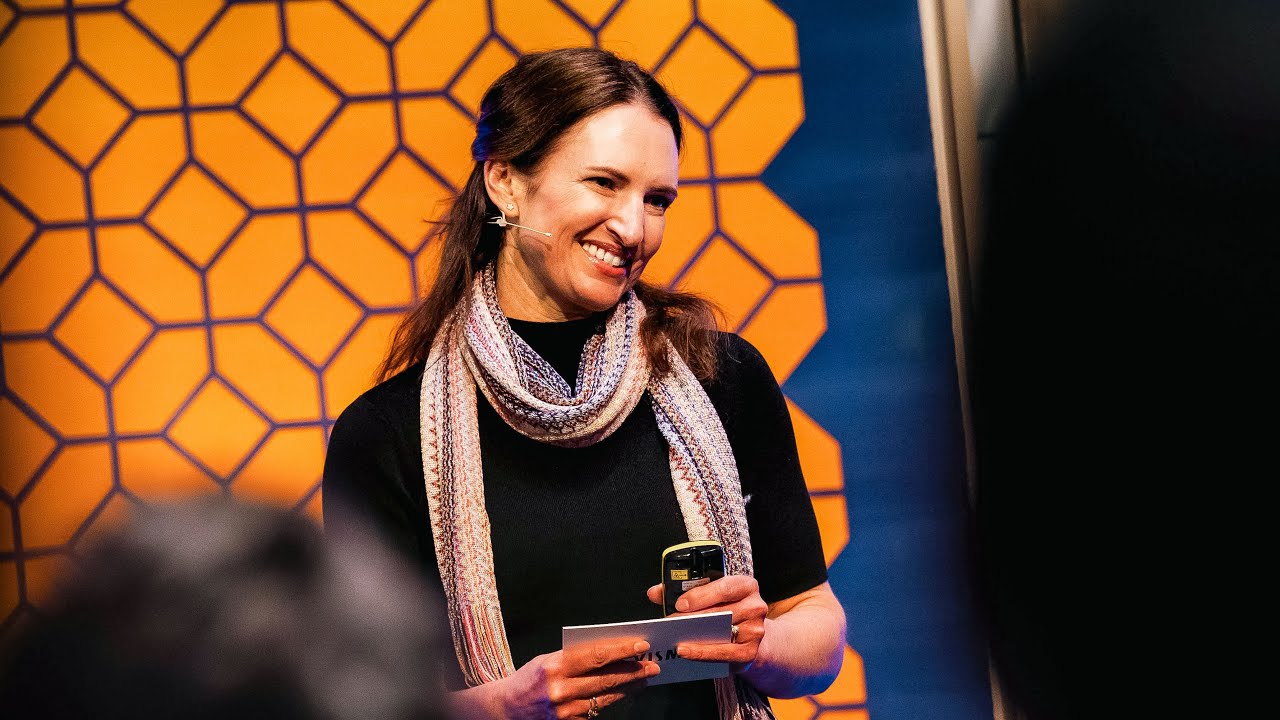
In this keynote at the Norges Bank Investment Conference 2025, Visma CEO Merete Hverven explains how Visma leverages a deliberately measured and operationalised culture to drive financial performance and sustain its aggressive M&A‑first growth model. She outlines Visma’s scale (Europe’s largest privately owned software group, present in 33 markets, €3 bn revenue, 14× EBITDA growth since 2011) and its strategic focus on mission‑critical cloud‑based accounting, payroll, e‑invoicing and tax solutions, now >90% cloud. The growth engine is built on acquiring “star” companies – 180+ acquisitions since 2020, 33 in 2024 alone – with a rigorous people‑centric due‑diligence process that evaluates cultural fit, founder retention, and clear expectations. Post‑acquisition, Visma integrates firms through data‑driven dashboards, continuous employee engagement polling (NPS 63, top‑5% in tech), and a company‑wide leadership index covering ~1,500 leaders. Leadership development, peer learning among managing directors, and transparent feedback loops are used to improve leader effectiveness, recognizing that people follow leaders, not the brand. The cultural flywheel is linked to measurable financial uplift: the Rule‑of‑40 score of acquired companies improves on average by 8 points after one year within Visma. Hverven concludes that disciplined strategic positioning, cloud/AI focus, and a strong, data‑backed culture together ensure continued value creation.
Chapters
Thank you very much for that nice introduction, and thank you, Nikolai, for letting me present Visma today. That is a true honor. Today I will be talking about how we in our company use culture as a value driver to drive our success. And I have to say that in Visma we have a strong culture that we are immensely proud of. proud of. But culture in Visma is more than warm words. It's not just warm words. In addition, it's more than soft input to financial outcomes. In Visma, we quantify and we operationally execute on how we drive the culture and how we make sure that the leaders are equipped to drive the business in the way that it should be. Recognizing that some of you do not know Visma, I do appreciate that I want to spend just 1 minute on our company. Today we are the largest privately owned company in software in Europe, and we are present in 33 markets, both in Europe and in Latin America. We do pride ourselves on making a lot of acquisitions. Now in 2024, we acquired 33 companies, and that's a normal year for Visma. After I became CEO in 2020, I have been a part of more than 180 acquisitions. So this is an important part of our growth journey, definitely. What do we do? Well, you mentioned that really nicely. We provide mission-critical business processes, and the core of our delivery deliveries is accounting, payroll, e-invoicing, and tax. And our customers, they're SMBs and they're local governments. And our products and our product suites are perfectly tailored to the local needs in the markets in which we operate, giving them a competitive advantage. This is our passion, and through our story, it's gone pretty well. So looking at our performance, we are younger than several of the companies that have been presented today. Great companies, I have to say. So we've not been around that long, but we've been around from 1996. And as you see on the chart, we were delisted back in 2006 and have been privately owned ever since. When I joined Visma back in 2011, our revenue was €247 million. Today we are closing up to €3 billion. And in addition, we have increased EBITDA by 14 times in that period. So I have to say that we are quite proud of our results, and I'm confident that we will continue that journey going ahead. So what is the reason for our success? I usually say, keeping it simple, it's twofold. First of all, it's about our strategic positioning. I talked about how we deliver mission-critical business software to the markets that we are present in. We pride ourselves on having the latest technology. We have been on a cloud journey for many, many years, and now more than 90% of our revenue is cloud. And with AI coming, wow, like Nikolai stated, it's a really nice time to be alive. So many changes, so many positive changes going along, definitely. In addition to our strategic positioning and strength, staying true to that, we enter into new countries through acquiring stars with the latest technology, great products within our strategic positioning, and we try to make very good companies become great companies based on our competence and what we know, staying close to the core. In addition, our culture is a second reason for our success. We have a very strong culture in Visma. Through acquisitions, we today actually present the largest entrepreneurial network in Europe. 70% of our founders, they stay put in Visma after 5 years. And you can think about how you would describe the culture of Visma, naturally, with all of the entrepreneurs. I don't have time to go through that today, but the pace is quite fast. And as was mentioned by Mark, yes, we make mistakes a lot, but we learn from them. We experiment and we fail fast. And these 2 parts, growth and culture, they are 2 sides on the same coin. We do believe that focusing on culture drives value. So let me showcase how we do this in Visma. I'll present another flywheel today where culture is a massive driver of our business. And since we do a lot of M&A, let me give you an example on how we operationally work with M&A within the business and drive culture. So first of all, when we look for companies, we look for stars. We look for already successful entrepreneurs that have a proven track record of a great product that the customers like. And of course, when you meet these entrepreneurs, several of them we have been talking to 5, 10 years, we're talking to them about thinking about giving their baby a new home. And for all of you that are parents, of course you want to make sure that that home is the best home for that baby. So the first thing we do when we're talking to all of these amazing companies is that we put our sales hat on naturally. And then we dig into the DD. Several of you as investors, you probably do a lot of DD, and I have the privilege of doing lots of DDs myself. I've been a part of more than 300 acquisitions, and of course lots more DDs than that. And we do all the regular stuff. We do the DD ourselves, the legal, the tech, the commercial. The list is long. But in addition to all of those natural tracks, We also do a very thorough people DD. And to cut it short, there are 2 things that are immensely important for us. First of all, it's very important to have clear expectations. So companies in a process, when you do— when you meet them, they always have a business case. And of course, in the DD process, our job and your job as investors is to make your own business case. When we have done that based on our knowledge, we focus on having the tough discussions in the DD where we showcase what our business case looks like. Where do we believe they should focus? Where do we believe that they will grow? How much growth do we see in the next 5 years? And we have all the tough discussions there to clarify the expectations. And if we do not see in those meetings that we find common grounds, we walk away from the deal. If we see that we do not see the same going into the future, we walk away from the deal. If we see in the negotiation that it's tough, we walk away from the deal. And we showcase our business case, and that actually becomes the budget. Creating mutual trust, no surprises, all the tough discussions taken while we do the DD. The second thing that we do is that we do a lot with respect to trying to figure out who are you, what is your culture, is it a cultural fit, can we work together. And that's not about being the same. We have lots of subcultures in Visma, but it's about coming together with the same core values because all of us are looking to work with people that we trust. So we talk about that as well, and we look for patterns. Do we find facts based on what they're telling us? Can I trust the data points coming in? We also talk a lot about one-to-ones with the talents. What needs to be in place for you to stay put in 5 years? Because these wonderful entrepreneurs, these wonderful employees, it's a successful company already, And all of you know how costly it is to recruit and possibly wrongly recruit. We want to keep them put. So addressing this and figuring out if we're able to deliver on these promises, that is also something that we really double-click on. And when we figure out that it's a cultural fit, the strategic position works, we agree on the business case, well, that is when we onboard them to the Visma family. There are no surprises. We onboard them to all the KPIs that are important to us. Of course, in addition to people, we have tech, we have customers. I don't have time to go through that, but we're very data hungry. So we roll them onto the system so they get a lot of intel on what kind of statistics actually will drive growth into the future. Because in general, financial results are just a consequence of you focusing on what really drives the business. We measure, we reflect, and of course we follow up and take action. And just to give you some flavor as to how we do that in Visma, we have people dashboards that are live, that they get all the time, giving you the natural KPIs. In addition to the people dashboards that we have made ourselves, we of course measure engagement. We know that engaged employees and the right employees they provide a lot better performance. And here you see our statistics. Many of you probably are aware of the employee engagement net promoter score. Our score is 63, which represents the 5% top of the tech industry, which we are definitely proud of. But most importantly is our leaders, they get the measures, they're transparent, all the employees see it, we do it monthly. So you take a pulse on the organization all the time, not taking a lot of time to get in the data. It's just 6 questions, and they change depending on where the business needs to be and what kind of KPIs you need to get in, so that they get valuable input that they can act upon and that they can address. They get facts to have good discussions with their teams. And what is the massive driver of engagement? That is their leaders. People follow leaders, they don't follow companies. So we measure this as well. We have a leadership index, all of us are measured, 1,500 leaders including myself. I always find it immensely interesting when I get the feedback because the feedback is often unspoken. So you get a lot of interesting input and it helps you to figure out actually what to focus on. And being a leader, all of us know, it's not a popularity contest. It's hard work, definitely. But getting this input, very important, and it's not as though it always needs to be high. We change a lot in Visma. I usually say that change is our stability. And of course, in the midst of a transition, and especially if it's not a welcomed one, Of course it will drop. But in the long term, we cannot have the leadership index being weak because then the talents will leave. Because the people, they follow leaders, they don't follow the companies. And this is not to finger point for anyone, it's for development. And we coach them and we help them, we have leadership development tools, we need to equip our leaders because a lot of the leaders today They didn't educate themselves into being a leader. They became leaders because they were great with regards to the field. So we do spend a lot of time making sure that we help them and follow up with respect to actually getting the tools you need to be a great leader for your people. And then, in addition, we also, of course, in addition to getting your feedback and also looking at like-minded companies, you don't only get feedback from your own company, you get it from everyone. We put together like-minded companies, like-minded managing directors, so that they can learn from one another. They learn from their successes, they learn from their mistakes. So typically we often say that we actually, we celebrate also when we make a mistake, because then we can put masterclasses out to everyone, making sure that they don't make the same mistake again. And then we put masterclasses with the best successes so that the others can copy. It's a very fast way to be quite successful early out. And how do we make sure that we are innovative and that we experiment? Of course, we make mistakes a lot. I share my mistakes. So important, actually, to foster this culture. In addition, of course, to putting companies together and people together, there's lots of mobility within the firm. And then you go back to the flywheel, and we show the value and the value you perceive. If you look back the recent three years doing several acquisitions, it's quite easy for me to showcase the value that we provide for our companies. We acquire very, very good companies, and in tech, we're always measured on the rule of forty. You add up the margin, the EBITDA margin. And in addition, you add up the revenue growth. And on average, you see here the light blue is all of these 100 acquisitions that we've done these recent years and what their Rule of 40 score was when they entered in. The second bubble is what their Rule of 40 score was after one year in Visma. And that actually increased 8 points. pretty nice. So I will go back to where I started. We have historically done pretty good. I'm very, very proud of that. And why do I feel confident that we will continue our journey going forward? We will stay very focused on our strategic positioning. I like what was commented earlier, you can't be everything for everyone. We are very niche, we're very true to our strategic positioning. And in addition to that, even though we are a tech company, we will be continuously working to build this culture which is so, so strong in Visma. Because at the end of the day, people want connection. They don't want perfection. Thank you.