The Real Reason You're Afraid to Pick a Niche And What It's Actually Costing You
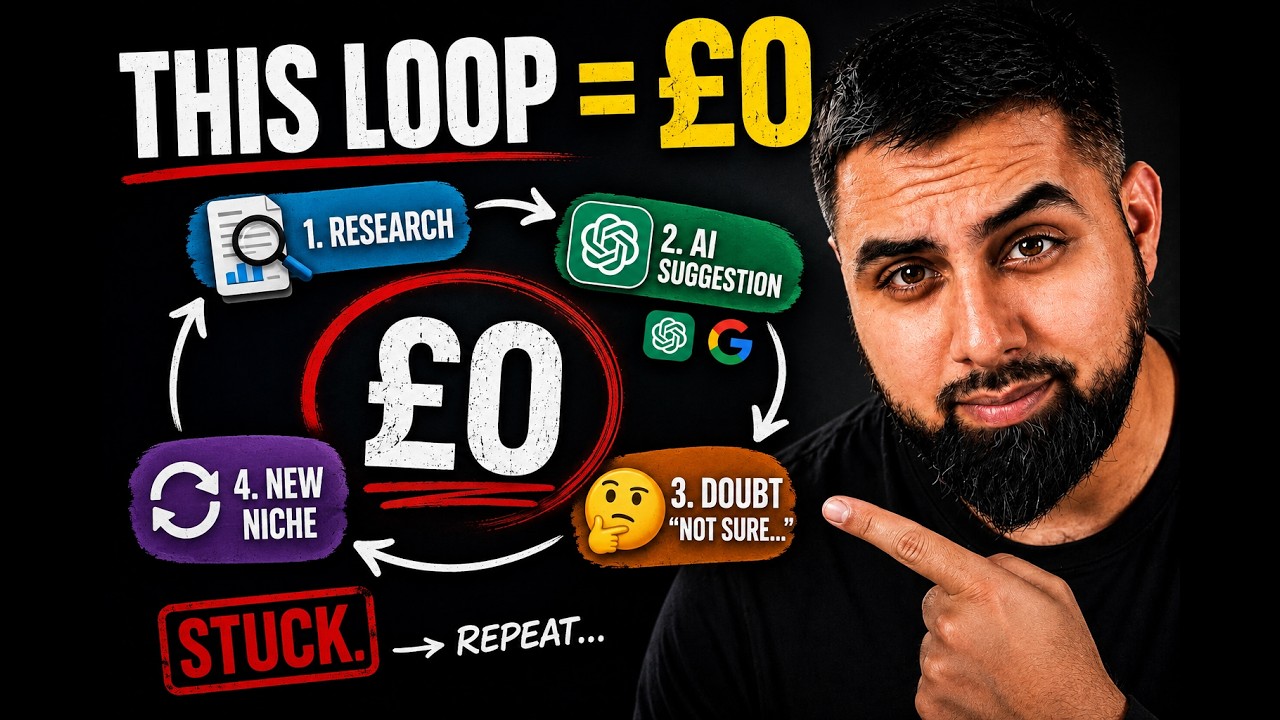
Mohammed Adris explains why founders get stuck researching niches instead of picking one: they're trying to predict their lives 5-10 years ahead, which is impossible. Constant niche-hopping prevents you from building market knowledge and relationships. Pick something good enough and commit long enough to gather real intelligence.
Chapters
If you've been sitting with a list of niche ideas for weeks, maybe even months, and then telling yourself that just a little bit more research, a little bit more certainty, a little bit more time, and then you'll commit and you'll fully lock in, this video is going to be a really important watch for you because the fear of picking, I'm going to say, the wrong niche isn't really about the niche itself. It's about something much, much deeper. So that's what I'm going to dive into. So let me explain this to you. And here's what I see all the time with people that I work with., and this is regardless of whether they're leaving their full-time job to go and start a recruitment business, or whether they're trying to scale because they've already started, or even if they're literally in that phase where they're just trying to get their first placement. And what it is is that they get stuck in this loop. They end up going to a stage of research and they go and ask AI, and then they get some suggestions. Then they dismiss the suggestions because it doesn't feel right, or it feels too hard, or they don't have direct experience in the thing that whatever AI has suggested to them. And then they go back to the research stage, and then the loop just keeps going on. It literally repeats in that exact same stage over and over again. And I want to name what's actually happening here because it's not what most people think. It's not an information problem. You just don't need one more Google search or one more AI conversation with another AI tool to find your actual niche. What you're actually doing is making a permanent decision about the next 5, even 10 years about your business and maybe even your life based on how something feels right now before you've even started. And that's like an almost impossible standard to meet. I want to give you a couple of examples. If you get married to somebody, I don't know why I gave this example, but if you get married to someone and after a period of time, months, years, weeks, whatever, that's a difficult decision to change. It comes with consequences. There are problems that would arise. Families that are going to be upset, and it's a very heavy decision that you have to make. Meaning that to make a marriage work really, really well, there are some things that either party has to change about themselves so that they can become the kind of parents and type of person that they want to be, and they have to mold and live together. That's what makes marriage work, without turning this into a marriage coaching video. However, the change— if you decided to change direction It's a very difficult one to make. On the other hand, let's just say you committed to a diet. It's not a life-threatening issue if you didn't like the diet a few weeks later or a few months later and you decided to change and try a different diet. It's okay. The thing with business is that it sits somewhere in the middle. It's not a heavy, heavy-weighted decision that if you wanted to change, it's going to cause a lot of problems for a lot of people. And on this side, it's not something that you can just keep switching over and over again and then nothing's gonna happen. No, you have to have at least a little bit of consistency and ride through some of the difficult periods. And the problem that you have when you're starting out, especially right at the beginning, you just don't know what those difficult challenges and problems are. And you're trying to make an adjustment and a suggestion to yourself and you're trying to recalibrate and triple calibrate and make sure that the decision that you're making today is one that is going to suit you 5 years from now. My friend, you are gonna be a different person 5 years from now. Your life is going to look completely different 5 years from now. You probably don't even know what it's going to look like in 5 years from now. In fact, for most people, if you just look at the last 2 years, your life is completely different to what it was 2 years ago. So you're trying to make a decision on what your business, what your clients, what everything is going to look like for the next 5, 10, even 15 years, and you don't even know if that's going to work. I've shared this story a couple of times before. I didn't know that I was going to have a child with special needs, and that has brought some challenges even into the business environment. Because now there's certain times where I can't work. There's some time constraints that I have that not everybody else is going to experience. But I didn't plan for that 5, 6 years ago, and my niche had no bearing on whether I was going to have challenges with my younger son or not. Just a personal story. However, that does have an implication on how many hours I can actually work in total. I can't work even full-time hours compared to other people who might be operating in the same space. I can't do 40 hours a week. Impossible for me. So now for me, me specifically, I have to shape my entire business and my working routine around my family's needs. You might not have that challenge, or you might have a full-time job. You're going to have your own constraints, but that doesn't mean that you delay the decision for the thing that you're going to commit to. So I want to give you a little bit of a reframe that I think will stick with you, and I think it's going to help. Imagine you're driving from your hometown and you're going to a destination that you've never been to before. You've got a sat nav on, you know roughly where you're heading, and then you go to the end of the road and you turn out of your street and you get, let's just say, 2 or 3 minutes down the road, and then something in your gut says, "I'm not sure this is right, maybe I should turn around." So you do. You go back home, you look at the map again, you check on Google Maps again, then you use whatever sat nav that you're using, maybe the in-car one or the one on your phone, you look at a completely different route, and then maybe you ask somebody else which way that they'd go, and then you try again. And then 3 minutes later, the same doubt creeps in. And here's the thing, you never gave yourself the chance to get far enough out of your hometown to actually see whether the road or the direction or the route was actually working. And that's exactly what niche switching or niche hopping does. Every time you start again, you reset from zero, not just in terms of progress, but in terms of the market intelligence that you were about to gather, the conversations that you were about to have, the patterns that you were about to start noticing, the client names that you were about to become familiar with. It wasn't the road. The road was never wrong. You just hadn't driven on that road long enough. And that reminds me of even business development cycles and even candidate generation cycles. There are clients and even candidates that we have wanted to work with. And sometimes it took 5, even 6 years before they turned around. Now, obviously there were others that came through a little bit sooner. And I hope no client takes that long for you to business develop. But once they came through, they were some of the best clients and candidates that we had ever worked with. And we're so glad that we stayed consistent. And all it was is the consistent business development activity, including consistent follow-up for 5 years. I'm not saying that it will take you 5 years to get any client. No, we secured our first placements, first few clients and everything all within the first year and then the second year and the third year and it continued. What I'm getting at is the compounding effect. Speak to any recruiter, anyone who's got experience in this industry, and they'll say to you, year 2 is always better than year 1, and year 3 is always better than year 2. And if at any moment in time you change direction, you know what, I'm gonna set up a completely different business model. Let me just try and do something completely different. Let me just start this side hustle at the same time. That is an amount of capacity that you are taking off the table that you could secure into your current and your own business. And if you just maintain the focus in what you're doing, you'd probably get a lot further along than if you had a side hustle at the same time. So it's worth just getting really honest about what the real fear actually is in all of this. It's not really, what if I pick the wrong niche? Or what if I commit fully and then work hard and it still doesn't work? Because if you never fully commit, you never have to find out. You can always say, well, I wasn't really all in on that one anyway. And like the niche was the problem and the timing was a bit off and I was still figuring out. But here's what I want you to sit with. The two reasons that people give up on things, I'm talking about anything here, not just business, are always the same two reasons. It was too hard or it took too long. That's it. Not because it wasn't possible, not because they were going in the wrong direction, almost never. For those reasons. It's always the difficulty or the timeline that breaks people, and both of those things are to some extent within your control. Not because you can make success happen faster, but because you can decide in advance that you're going to stay in it regardless. And the people who do take it through aren't necessarily the most talented. They're just the ones that decided that discomfort wasn't a reason to stop. And it reminds me of one of my old managers. When I was working in a job in recruitment, there was one manager that I had, and he taught me a lot of things to do with recruitment, and I really respect him for that. And I can still remember there was this one time where he said, 'We should go and start up a recruitment business. You know what you're doing. I know what I'm doing. We can build out the database. We can do all of this. Like, we just know how to make this work. Let's just go and do it.' And I said, 'Okay, cool. Let's do it. Do you want to have a conversation over lunch?' And immediately he said, "Yeah, I'm on a good career trajectory." And I took that as a no. I was like, "Look, if you want to talk about it, I'm down. I would love to talk about it." Anyway, it's been like probably about 12 years to this day, and he hasn't started a recruitment business, and I believe he's still working in a full-time job. Some people do it and some people don't. That is it. And there's something that I want you to take away from this. Here's the thing. Stop trying to fall in love with your niche. Before you've been in it because you can't. It's like trying to decide whether you love a city or even a person. Let's bring the marriage example back into it as well. Before you've even lived with them or lived in that place, you're just working with imagination. You're not working with experience. What you can do is apply the right criteria to your niche decision, not feelings, criteria, and then commit to giving it a genuine run, not a toe dip, not a Hey, let me test this for 3 weeks and then see. Just a real, real commitment where you go deep to actually find out what the market is telling you. Because here's what's on the other side of that commitment. Market knowledge that nobody can take away from you. Relationships in your specific niche, reputation, referrals, the kind of business that compounds with every single placement, with every single conversation, and every client makes the next one a little bit easier. None of that is available to someone who keeps resetting.. So if you are somebody who's working in a full-time job, maybe even working in recruitment, and you're trying to make that transition, I've been through that entire journey. I've been working in a full-time job with the dream of starting my own recruitment business, starting it, just getting it going while I was still employed, then quitting, going all in on the business and growing it from zero to where it is today. And you can find everything on LinkedIn. And just bringing it back to that example of my old manager and where I am, I took a decision for something that was going to change the trajectory of my career and what I was going to do in the recruitment space. And I took that decision 10 years ago, and the idea wasn't even mine. It was Mohammed Adris's. He's the one who suggested it. At that moment in time, I didn't think that I was going to go and start up another business. I just thought, this is a well-paid sales position, I'm going to stick to it. So just keep it in mind that the niche that you commit to doesn't have to be perfect. It just has to be good enough to start. I didn't know what I was recruiting in the first few years of me specializing in my particular niche. You just have to be brave enough to stay. Now, if you have watched this video and you're thinking, you know what, I just could do with a clearer roadmap. Maybe niche is not the problem. Maybe there's another area that's your problem, which is you're thinking, how do I get my first client? How do I get my first candidate? These are all thoughts and questions that will go through your mind. So just to help you completely crystallize and completely clear it, go ahead and watch this video, because this is everything that I would do if I had to start my entire business all over again from scratch.
More from Mohammed








How to Build Client and Candidate Relationships That Make You Impossible to Replace
