You Watched Everything. You're Still Stuck. Here's Why.

Mohammed Adris says recruiters fail not from lack of knowledge but from wrong execution order. Build an accurate market map listing every job title and company type first, then engage candidates, then contact clients. Skip automation until your data foundation is solid.
Chapters
So you've watched all the videos, you've read the guides, you know about niches, you know about campaigns, you know about automation, hiring VAs, you know probably more theory than some working recruiters, and you're still not making any money from this. Here's the uncomfortable bit. The knowledge was never the problem. The order is your problem. I've been supporting recruiters in my own recruitment business and those that are working with me as a coach. Alongside running my own 14-person agency that does 6 figures a month. And I see this specific problem just play out reasonably regularly. Someone consumes everything, starts everything, and then finishes nothing, and then wonders why does a business look like a pile of parts instead of a machine? So I'm going to show you exactly what order that you have to execute in and why skipping any part of it or even skipping ahead has impact on your business a little bit more downstream. And the reason why doing everything basically one at a time fixes things for you. So if you've got your recruitment business going, you're 3 months or even 12 months into the journey, this one's going to be really good. But let me give you the picture. And I use this with people that are working with me. Just imagine that you just threw a box of Lego bricks in the air and then they landed. And now you're standing there wondering why it just doesn't look like a house. That's what learning everything at once does for you. Every piece that you learned is real. The niche stuff, the outreach stuff, that automation stuff, all of it genuinely is useful bricks. But bricks don't assemble themselves. A house gets built in order. Foundations first, the walls next. Obviously, I'm not experienced at this, but then the roof. You can't put the roof on first, not because the roof is wrong, but because there's nothing to put it on top of. And I can usually tell within a couple of minutes of talking to someone which bricks they've thrown because they will ask me questions. They'll ask me questions about email warmup and onboarding a VA, which are basically roof questions while their market map and their actual foundation is either half built or wrong. And the questions that they're asking me are 3 steps ahead of the problem in their business. So if that's you, then nothing is actually broken. You've just been building from the middle. You don't have a knowledge problem. You have a sequence problem. Same bricks, wrong order. No house. So let me give you the order. I think it's going to be a little bit shorter than you think. And there's only 3 stages and they don't run at the exact same time. And the first stage is your market map. Who exactly do you recruit and who exactly hires them? Every job title, every variation of that job title, every company type mapped and making sure that it's accurate as well. This is the foundation and it's the stage that almost everyone rushes. And the second stage is about candidates. Only once the map is right do you start conversations with candidates. Connection requests, messages, calls. Because now you can look at a profile and know usually within seconds whether they're the right fit because the map taught you what right actually looks like. And the third stage is this. Then and only then, the client outreach. Campaigns, calls, all of that kind of stuff. Because now everyone seems to ask me a very, very similar question. Which one comes first and which one should I target? Do I target candidates first? Or do I go for clients first? Because there's no point me talking to clients if I don't have a candidate to represent. And there's no point me talking to candidates if I don't have any vacancies for them. Just keep in mind, as experienced recruiters, this is a situation that can play out even while you're working in the business. So effectively what we're talking about is the chicken and the egg. And the answer is, it's a cycle. It doesn't matter that it is circular. What matters is when you enter it. And just to present that argument, chicken and egg situation. Neither the chicken or the egg have the ability to be able to bring themselves into existence. Therefore, it doesn't matter which one started. It's just none of them have the ability to bring themselves into existence. So what actually matters is when and where you actually enter it and the order in which you do. You can absolutely speak to clients without a candidate, and you can absolutely talk to candidates without a vacancy. They're humans. They'll talk to you, but you just can't speak to either of them well without the map. It's literally map, then candidates, then clients, not all 3 at once. The order is the strategy. And here's what getting to stage 1 actually looks like, because this is where the work hides the most. One job title is never one search. That will probably give you enough value just for the entire video. If you take, for example, just giving an example because this is a live one, let's take a fire safety manager. Some companies call it fire safety manager. Others They call it fire and safety managers. Some people call it fire safety director, building safety manager, building safety director. And the same person has all these different labels for the exact same job. And if your search only carries one of those labels, then your list is incomplete. You're not finding all of the candidates in your actual talent pool. And the worst part is you might not even recognize it. So for every job title in your map, you can probably find 3 or 4 variations. And guess what? Use AI to your advantage. Ask it the question, give me every way that this role gets titled in this market. Then you go and build a search using all of those variations. And it might take 3 or 4 searches to capture the role properly. But when you see the results page, all of a sudden you've got so much more because there's a compliance manager in accounting and there's a compliance manager in construction and there's a compliance manager that manages just about every other element of every single business. There's some sort of compliance manager in there. But if you're recruiting in that niche, there's only one type of person that you're going to be interested in. So is this boring? Yeah, it is. And it's also the difference between achieving 40% and 90% accuracy in the business when you're building out that list. And this is the thing about automation. Since everyone's so itching to get onto AI and automation, this is the point that is really important to drill home. If the market map and the accuracy of the data you put into it, automation just flops. It fails. It just does the wrong thing really, really quickly for you. That's why accuracy is way more important than automating. And only once you have accuracy, then you automate. That's when everything works beautifully. So boring accuracy now, or you will inevitably just waste time for hours because every hour on a map saves you 10 when you're contacting clients and candidates, especially when you get them wrong. And just while I'm going through this, just very quickly, if you're realizing that you've built maybe your business in the wrong order without prioritizing the right things, then this is basically the structure that we go through when people are working with me. And that includes recruiters who I've hired in my own agency. This will include those that I'm coaching. And this will be a sequence of events for anybody who I look to acquire their businesses as well. Because the most important thing is that you have the foundation in place Then you apply AI and automation to make it really quick. So if you've watched the video to this moment in time, if you're interested in working with me from a coaching perspective, there'll be some details below. And if you're interested in talking to me about acquisitions, then just find me on LinkedIn, send me a message that you watched this video and we can take it from there. But for now, just back to the video. Okay. Now, if you've heard all of that and you're sitting there and you're thinking, you know what, I've already done all of these and I've probably done them wrong, then this is the important bit. I don't know if you've seen it, but there's a movie called Men in Black. And one of the guys in the movie, what he carries around is this little pen and it flashes a red light. And when he presses the button on the pen and it flashes a red light, it just basically does full erasure data reset on the person's brain. So they just forget whatever they were thinking about and talking about. So I want you to just forget all of the modules and the training videos and the YouTube videos that you've binge-watched. Forget the outreach elements, how to use AI for personalization, forget hiring a VA, None of it is just completely wasted. It's just we need to park that for the time being because right now there's only one thing that you have to prioritize and that's the map. And you can now get AI to check your niche, validate your niche, build out your market map, check adjacent verticals and suggest to you the job titles that you should hire for and the hiring managers and their variation of job titles and even find all of their email addresses, LinkedIn profiles, phone numbers, all of that stuff. And even if you are either building, growing a business, like wherever you are in your journey, it might feel like going backwards to look at your lead list again. But you're not because you haven't done it wrong. You just haven't built the list properly. And it just needs to be a little bit bigger, maybe a little bit more refined, maybe a little bit more accurate. And you're understanding now because it's so much more deeper and you understand your niche better. Guess what? The refinement process is even quicker for you. So just keep in mind that if you're building or if you're fixing a foundational element, That's not failure. It's just what builders do. The only actual failure is pouring more work, time, energy, and money on top of something that already has cracks in it. And I've said this to people that I'm working with. I'd rather you be 2 weeks behind schedule and on the right foundation than 3 months ahead of schedule and just be on the wrong foundation. Because the person on the wrong foundation isn't ahead at all because everything that they've built is either going to waste or it's going to crack or it's going to come loose. And they're not going to realize it until they become too emotionally attached to it. So starting again isn't necessarily going backwards. It's building on cracked foundations. So here's a working method. And from here on, I'm going to say almost stupidly simple. Treat everything like a checklist. One module, one step, one implemented idea, and then tick it off one at a time. And then only then do the next one. Watch one thing, do one thing. Don't watch 5 things and try to do none of them. And if you really want to make it fun, post about it, write posts about it. I don't care if it's on Facebook, on Instagram, on LinkedIn, whatever. Tag me in the post. I will engage with you. I'll cheer for you. So just keep in mind, this is exactly what a week looks like. And it's always 3 things in that order. Almost nothing else. Pick a couple of job titles. Don't go for like 7 or 8 and different niches and so on. 2 that you can genuinely learn. Then go and map that market out properly. Every title variation, every search, every checked page. Use AI to your advantage. Help it do some of the heavy lifting for you. It can ask you questions. It can validate things for you as well. And whatever you do from an accountability perspective, use it to your advantage. If you see the details below, I have a group of people that I'm helping through this entire journey. So you don't have to do it alone. You're welcome to join in. But just don't send a connection request. Don't use automation until the The first few steps are done because I know it feels slow and it doesn't feel like the fastest route, but it's all because you're building everything so that the building stands up. You're not building it so that it's going to collapse later on down the line. And the people who literally win, succeed, and do well from this, they tend to build slowly and they do it in the right order, not necessarily the quickest. And then if you're watching this and you've watched to this moment and you still feel like, okay, cool, you know what, I've got the information, I've got the knowledge, I even know what the order of execution is, then I think there's a possibility that it might be fear that's creeping in that's stopping you from either building, growing, or taking the next stage of growth in your journey for your recruitment business, or even as a professional recruiter. So if it is fear that's holding you back, then please go and watch this video because I promise you, you'll change things and you'll change the way that you'll think about things immediately after you finished. I'll see you there.
More from Mohammed







How to Build Client and Candidate Relationships That Make You Impossible to Replace

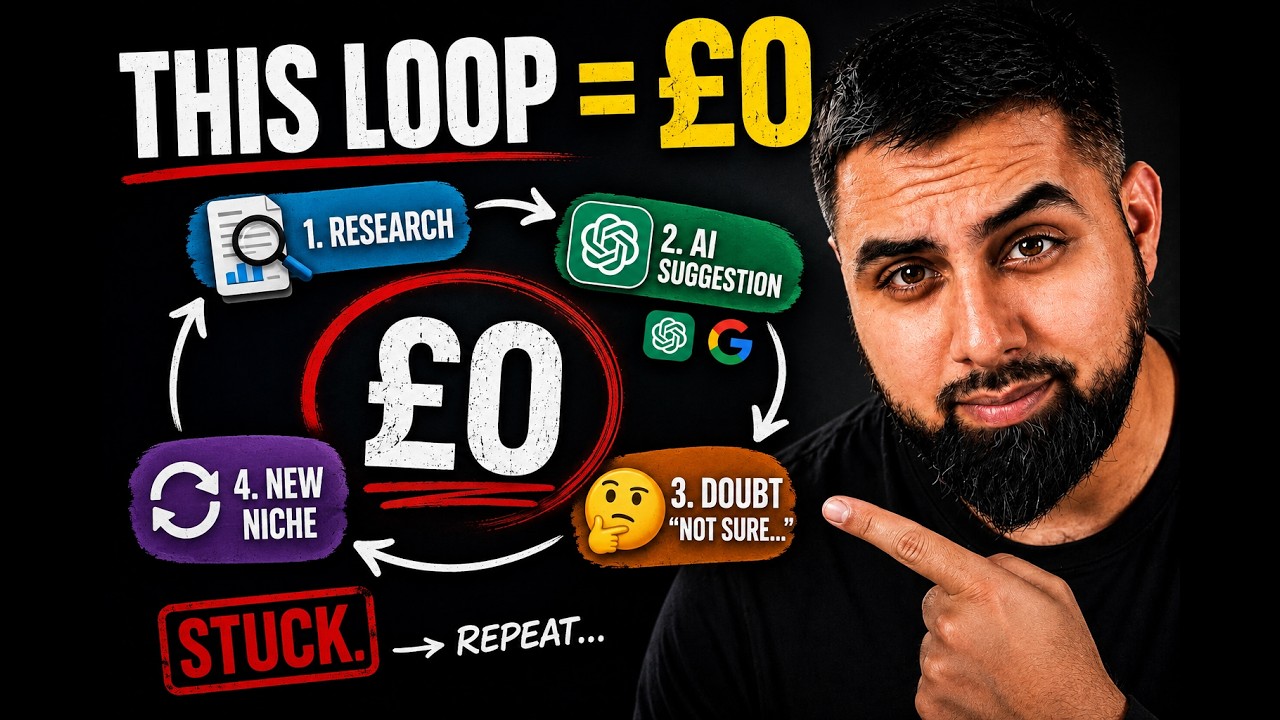
The Real Reason You're Afraid to Pick a Niche And What It's Actually Costing You