Digital Equity with Kristina Ishmael
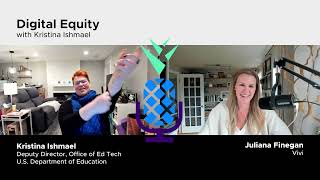
Kristina Ishmael, an educator and leader in educational technology policy at the U.S. Department of Education, discusses digital equity, federal policy challenges, and how educators can engage with state and federal technology initiatives.
So how are we making sure that people are making decisions about ed tech that are grounded in evidence, that are grounded in learning theory, that aren't just some random technology that someone thought, you know, that sounds pretty cool in a classroom.
Welcome to the Educator Pineapple Podcast, which features trailblazers, pioneers and ed leaders who all started their careers in the classroom. Come hear about topics ranging from digital transformation, data literacy, blended learning, innovation, and honestly, everything in between software. So excited to have you join our show. Okay, so I'm already laughing because we were chatting a little bit before I started recording, but I would like to welcome an amazing educator, leader and friend, Christina Ismail. Welcome to the Educator Pineapple Podcast.
Hello. I'm so excited to be here.
Yay. So now I'm going to embarrass you and read your bio. So Christine Ishmael is an educator on learner advocate and agent of change. As the leader of the Office of EdTech, she executes the office mission of developing national EdTech policy that enables everywhere, all the time learning and supports digital equity and opportunity. Prior to joining the Office of Ed Tech, Christina worked in the OET leading the hashtag goopen initiative. And that was what it was called. That's why there's a hashtag. I already asked. As well as serving the state of Nebraska as the digital learning specialist. So do you have anything to add? I'm so excited to have you here, obviously. Thanks.
I'm excited to be here and this is like talking to a friend. So I'm excited to be able to talk about work, but also like just talk. The only other thing, only because of the name of your podcast, is I started out in the classroom and I want to make sure that folks know that because that is how I lead, especially in my policy work. I'm a former early childhood and elementary teacher from Omaha, Nebraska, so just want to make sure that that's included.
I was going to say it's like you knew the other section of my podcast.
So weird. It's so weird how that works and.
I love that it was. It's like I'm talking to a friend. I mean, we're friends, very similar. But I as you know, and you previewed for us, everyone who joins the Educator Pineapple Podcast has to have started their careers in the classroom or has been a classroom teacher, which I think is just so important when we're talking about some of these big education issues and just education in general, having that experience. So what did you teach and where initially and then how did you get from there to where you are today?
Yeah. So I started as a preschool teacher in Omaha, Nebraska and, and then moved into a kindergarten role. Then I was in a second grade dual language Spanish. So I taught all second grade content in Spanish. That was a very long year to be teaching in my second language. So getting a small glimpse into what our multilingual or our emerging bilingual learners face on a daily basis. And then went back into a regular second grade classroom. And then I was an EL teacher in a smaller district where I worked with K6. And so I would pull out in small groups and provide interventions especially for our newcomers that were brand new to the country and then push in and co teach with as many teachers that would let me do that. And then while I was serving in that EL role, I was working on my master's in learning technologies. That led to some action research to determine if teachers across the state of Nebraska were getting adequate access to professional learning around tech integration. And just so happens that there was a position that opened up at the state at that time and it was the digital learning specialist or the state ed tech director, however you want to look at that role. And so I applied for it, got it, got to fulfill my school year with my learners, and then moved right into that position and was there for four years. Moved out to D.C. in April of 2016 to lead the Go Open project and then have kind of stayed out here ever since then. There was a. There was a brief moment where I got to go to the Pacific Northwest. You know, I was supposed to be going abroad for a year. The pandemic changed all of those plans, which is how I ended up in the Pacific Northwest. And then the universe puts you where you are meant to be, but I firmly believe that. And so I was a part of the Biden Harris transition team, which is what led me back into kind of the public service in general. And I just celebrated my one year anniversary at the department in October.
Congratulations. Just to think through like the timeline that you were starting at that ed Tech position in Nebraska basically in 2012 when like that was like the start of blended learning, right? Yeah. So that was an interesting time to actually be leading at that level because it was just so pocketed. And also people just saying, what is blended learning? How do we use computers past? You know, we've had them in the classroom for a long time, but how do we actually leverage them to address instructional challenges and really help our teachers and our students? So it's an interesting kind of timeline. You kind of started almost the same time as me when I started in blended learning.
So, yeah, absolutely.
Super cool there. So, you know, now I'm laughing because we discussed before we got on that my podcast has a little lesson planning to it. Like, we have different sections, so you hit on what you taught. And then also. So it's the Pineapple podcast, because everybody has a crown and everybody's also ripening something, and those can change and grow and mature at different times. But, like, what would you consider your crown? What are you currently ripening? And then how does that inform your work or your outlook or your focus?
A couple of years ago, I was so lovingly coined the Kevin Bacon of education.
So true.
And I have to say, at first I was like, that's funny. And then I'm like, no, I will probably wear that because I am a collector and connector of people. And that is definitely, I think, the superpower that I bring to all of my work, whether it's in the classroom at the state level, and now at the federal level. And being able to make those connections between those levels is also really powerful. And so I definitely think that that's an area that I can bring. But then as far as the. What I mentioned kind of already is like, in the policy world, the superpower is that I'm a practitioner and that that's how I lead with all of our policy work.
Awesome. And I would just also like to highlight that when I think of you and your crown, I think you also make everyone feel seen, which actually speaks to that whole connector collector, is that you're able to build and keep relationships across the country, across the world. And so I'm very grateful to be one of those.
Thank you. That means a lot. I really appreciate that.
And also, so what your crown is and what are you currently ripening? So, like, what are you working on? And then how do kind of those two pieces maybe inform your work or your focus, your day to day?
Yeah, I think it is definitely within, like, subject. Subject matters. Can never say that. Like, I prefer SME. I also think of the character from Peter Pan when I think it's me, though. And so, you know, we've got. We've got some really great work on digital equity, but one of the ones that is pushing me in my own thinking right now is AI and education, because I've been part of some of these larger conversations both nationally and internationally with edtech developers, entrepreneurs, and even folks that are in public interest technology or like civic technology, that are trying to think about how technology interacts with our everyday lives. And it's something that I am really cognizant of as far as like the safety, the security, the responsible use and design, but also like, what are the risks and then what are the opportunities for all of us? And so I think it's digging deeper into that. One of my team members is pursuing that work right now and we will soon have a report out on that topic. And so that is definitely an area that I'm continuing to learn and grow in. And then this is honestly the first time that I have been a leader on paper in this position. And so I am definitely growing in the area of flexing those leadership skills. And I think informally I've had the opportunity to do that in many of the roles that I have served. But to, to be the supervisor of record or the manager that has the check ins with my team members on a weekly basis or whatever else. And it, and it pushes me. I am the type of person that, you know, does not enjoy conflict. I mean, I don't know who really does. There are people that do, but it's like, how do you, how do you gracefully, tactfully, respectfully talk about some of those hard conversations that you have to have with remote workers or remote teammates, also recognizing that that is just a difference in dynamics and I think all, like, all put together. I care about my team, I care about my people. So if I think about the collecting and connecting of people with pushing the leadership in the area of growth, that's how I've been approaching this work for the past year. And prior to coming back, I spent the time in between working in this office doing a lot of kind of mental health development and working with my therapist and everything. And I came back and I was like, we're going to establish some healthy boundaries as a team, not only for our individual lives, but as a team as well. And that was really important to me because there were different expectations when I was last in the office about responding to communications at all hours of the day. And that is just something that I've gotten really far away from because I want my own time and I want my team members to have their own time. And so I do think that that has now informed at least my own leadership style and then recognition of each of my team members as the humans that they are.
I love that. And also, I know it's not my turn to share anything, but if you haven't read Radical Candor, if you haven't read that book.
I have not read that one.
Amazing. I will send it to you.
Okay, great.
I will also put it on the VIVI site for those who want to read, but it's really helpful way. And I know you like frameworks just as much as I do to really like think through those conversations. Like what part of the quadrant does it fall in so that we can have those conversations in an authentic and meaningful way while also bringing in the fact that we truly care about people as people and how do we. It doesn't have to be conflict. It's like growth, but having radical candor to support each other, to like learn.
And I love that.
And it's really nice to be like, okay, so where is my conversation right now?
Is it this side?
Is this, how am I reacting? How am I hearing these things? You know, sometimes it helps with relationships too. So you know all the good stuff. So. But I really appreciate you sharing all that and I think that like, that helps to frame for those listening, you know, like, who's doing this work, how are they doing this work? How are they working together for this work? But I think that before we jump into anything deeper, I want to make sure that those listening know what the Office of Ed Tech is. That sounds like a good start. Who they are, I mean, always a good start. Who they are, what they do, and really kind of what their focus is.
Yeah. If you didn't know that we existed, we do. And I'm glad you know now because we're a pretty kick ass team. So Congress in their foresight in the mid-90s, said, hey, it looks like this technology is going to probably impact education. And so they congressionally mandated that this office exists at the Department of Ed. And there have been many directors that have kind of come and gone. They're typically political appointees, so they are appointed by the Secretary and, or the Presidential Personnel Office. And the charge of the office is to develop national ed tech policy. And it is primarily done through the Lighthouse public publication called the National Ed Tech Plan, as well as making sure that the priorities of the office are aligned with the Secretary and the vision of the overall administration. So when I was there in 2016, that was when Secretary King was in charge of the entire agency. And my director at the time was Joseph south, who is now the Chief Learning Officer over at iste. And we made sure that there was alignment between what our office was doing and what Secretary King was doing, doing. And especially towards the end of like a two term presidency and making sure that there are things that need to kind of get out the door before the change of administration. And so when I stepped in. In October of last year, the secretary and the team at the Department of Ed were in the process of like, really defining what the priorities were for our agency during this administration. And it was around recovery, response, and then access to higher education, teacher recruitment and retention. Like, there are some very specific priorities that were outlined. And so we had to come in and kind of be like, okay, where do we want to go? Like, obviously, Ed Tech has seen a huge increase because of the pandemic ed surge. I believe earlier this year has fully identified that we're at 95% of schools are 1 to 1. And so what does that mean for our office? What does that mean for policy? And where do we go from here? And so we definitely looked at the idea of digital equity. And once we get the digital equity, we get to those opportunities. And so that's where we are. We've kind of framed everything through digital equity and opportunity. And our office is actually in charge of early learning, K12, higher ed and adult and workforce. So we brought like we are across that entire continuum. So we have to be thinking about our earliest learners as well as our adult learners and everyone in between.
That's interest. I mean, that's a huge group thinking about just, I mean, with a lot.
There are eight of us.
I mean, so that's plenty, obviously.
Yeah, plenty, of course.
I mean, because there's all different entry points and there's all different needs. Right. And then thinking through, there's a lot of moving parts. And I think you already spoke to this about the fact that leading the team and how to lead that team. But are there any nuances about leading a team at the federal level, the federal governmental level?
Oh, sure, sure. A lot of it is like understanding the bureaucracy honestly. And, you know, to the point where we have four new team members that have joined us since mid September, more or less. And we, we staff a lot through fellowships. Some of them are paid by my own kind of budget, but then others are paid by foundations or external organizations that have those subject matter experts that can come into public service for a finite period of time, work on a specific project, and then carry on with their. Their careers. And so we have four new fellows that have joined and one of them had previous federal experience and then the other three did not. And so we're trying to catch them up and be like, yep, that sounds great in theory, if we had X budget, if we had the ability to contract or put out an RFP that could quickly turn around. And these just, these aren't realistic for US and so it's also explaining like how the federal government and more specifically the US Department of Education can actually work. Folks think that we have a lot of authority. When we don't really, we have limited authority. The authority really relies or really remains in the states that then kind of trickle down to the local and the school district level, whether that's content standards, curriculum, even funding. Like we are the conduit that Congress appropriates the money, it comes to us and it goes directly to the states from there. And so it's helping folks understand that and helping them like succeed and create some really successful projects within some of those, those constraints.
So it's a building, it seems like it's like building a lot of the alignment across the level that they can then trickle down into the states and also giving them the resources they need to really think through some of those topics, policies, funding, et cetera, so that they can make actionable decisions on their like, Absolutely. State level.
Absolutely.
So with that in mind and like that's, that's a ton of work obviously. And there's kind of, you can go many different directions, of course. Tell me more about like you're. The current work you're doing around ed prep programs, digital equity, like, what are some of the things people should be looking out for.
Yeah.
That you guys are currently working on?
Okay, so as I mentioned, all the things, as I mentioned, you know, we have framed everything through digital equity and opportunity. Within that we have three priorities which are digital inclusion, ecosystems and emerging trends and technologies, and the bipartisan infrastructure law that was signed by the president a year ago, now actually codified in law for the first time ever, the definition of digital equity and digital inclusion. So we're like, we should probably do something with that. And we have clearly. And so within our priority of digital inclusion, that is, yes, connectivity and devices, super, super important because we still have a lot of folks that are not connected, especially when it comes to home access. Then we have instructional models and content within the law's definition of digital inclusion. It really focuses on the content access especially, especially as we all experienced at the beginning of the pandemic, when you have no more access to physical textbooks or materials, what are you going to use instead? So how are we getting access to the content? And then how does that change our pedagogy and practice and the models that we have in our classrooms? And then the last piece of that is the digital, excuse me, digital literacy. So when we think about, yes, we got hotspots out, we got devices out at the beginning of the pandemic. And that was just the first step. We now need to make sure that not only our learners, but our families and communities can also get on these devices and actually navigate things to get to online banking, to access telehealth services and whatever that may actually look like and contribute to kind of a digital society now. And so that's kind of within the one priority area, the digital, or excuse me, the ecosystems priority includes digital infrastructure, as well as educators and educational leaders and families and communities. Whenever I was thinking ecosystems, I was thinking of the systems in which make the edtech work, which is where the infrastructure piece came into play, because that's the backbone. You know, when I worked in Nebraska, we had network Nebraska, which was unlike many other states. We had that broadband that was already kind of through a co op model across the entire state that every single school district bought into. And it drove the prices down for that reliable high speed Internet from like the mid 2000s before I was even at the state level. And so I've always seen like the importance of that infrastructure. And of course they've built out the services around student data privacy, cybersecurity. And that's what I was thinking whenever I okay, infrastructure, we need interoperability, accessibility, all of these pieces. And then when I met with Assistant Secretary Roberto Rodriguez, who is my director, you know, he was, he's coming from Teach plus and he was like, but, but where are the humans in all of this? And so how are you thinking about the, the systems with people in mind as well? And so that's when we were like, well of course educators and educational leaders need to be a part of this as well as the families and communities, because we would not have been able to do what we have done in the past three years without them coming alongside us and being able to help with that continuity of learning. And so that's where some of the work around the educator prep programs is also focused within the educator space because we know that we need to better prepare teachers, pre service teachers to go into classrooms and teach with technology. But we also need our faculty members within colleges of education to be versed in the edtech to be able to teach with it as well. And the one, the one EdTech class like I had in my program, it was a starting point. But then whenever I did my reading methods class or my math methods class, there was no technology involved. And so how can we think about that being program wide and program deep so that ed tech is integrated just like we would expect it for Our learners in their own experiences. And then these two, the ecosystems and the digital inclusion are really kind of grounded in current practices. But part of our role is keeping our eye on the horizon, what's coming, and that's where the emerging trends and technologies comes into play. So we need to leverage, my favorite word, the bully pulpit. And that is like the convening power of our office and of our agency and the administration, where I can put out an email invitation to X amount of educators and they're going to want to come, or X amount of ed tech companies and they're going to want to come. And so how do we bring them all together to vision and think about what's coming and what's possible, as well as designing for responsible use and then the evidence part of it as well. So how are we making sure that people are making decisions about ed tech that are grounded in evidence, that are grounded in learning theory, that aren't just some random technology that someone thought, you know, that sounds pretty cool in a classroom. And so those are kind of those pieces within the emerging trends and technologies that we have to focus on as well.
I just wrote like a crazy amount of notes, all of that, but it's because it's really interesting because it's, it's almost like a, you know, federal example of what we're trying to do in a lot of our states. Right? Yeah, it's like, you know, and I do think that the crown of the office of ed Tech, if you will, is the fact that you have this convening power, which if you can capture and codify some of those best practices around all of these different pieces, you can scale it so much easier than other service providers or other supports. Right. Because a lot of times they're just. And I think from an access standpoint, so going back to the digital access, yes, there's the like, access to actual Internet and access to actual devices, but there's a huge access issue with support and content and examples. Right. Because I think that like, you and I have worked together for a while and like, we're part of this little tiny bubble that's like constant sharing. But like, what is a majority of the country doing and how do we get those learnings, those examples, those highlights of excellence and those like, structures and supports that others have used shared and accessible to everybody. So, like, exactly. And, and I think like, so with that in mind, you know, what, what have been some of your wins? And I know this, I'm going off script, but like, what are some of like, I like highlighting wins first before going to the challenges. But like, that's fair. What were some of, like based on this, some of the wins you've had on the ability to share some of these pieces and then like, what are some of the challenges you're facing or maybe some of the learnings through that process?
Yeah, there's always learning. I think some of the wins have been the digital equity work in particular. So Jisoo Song is our digital equity advisor. I previously worked as an, as an intern in OET is how he first started. That's how I first knew him and then is now back as like the lead of all of our digital equity work. And so it started with five bullets on a, on a word doc that he presented to me last, last year at this time. It really was around this time. And he was like, there's something here. Like we know with the bipartisan infrastructure law being signed, there's $65 billion that went to the Department of Commerce through the National Telecommunications and Information Agency, or ntia, that are going to work on the actual broadband infrastructure, but then also put out development grants for states to develop their own state digital equity plans. And as it was written, education was not included. We were like, hello, over here, over here. Hi.
And.
So it was kind of like, how can we get involved in this? And even if we're not asked to be involved, how can we still make sure that education is represented and included in some of these plans? And so the digital equity education roundtables, or because we're in education, we love acronyms, Dear was started back in November of last year. And we identified kind of five specific populations that are furthest from digital equity and opportunity. And we wanted to hear from membership organizations that represent these populations as well as directly from some of these folks. And so it was. We identified students of color, students in rural areas, students in urban areas that have been digitally redlined, native and indigenous students, as well as our kind of higher education students, our Pell Grant recipients, as well as our adult students. And like they kind of fell in that, that fifth category. And we held these incredible listening sessions to learn. We know that availability of reliable high speed Internet is important. Affordability of these things are also important. But we also know that there is an adoption barrier there. This is a project that has obviously started a year ago and it led to a publication that was released the same day that we had our National Digital Equity Summit on September 28th. And it is a really, really great publication. When the digital equity director from NTIA came and presented at that summit. She said it to me in the green room beforehand. But then she came out and part of her remarks was like, I was reading this resource and I could hear the voices of the communities that you met with. And that is so powerful to me, especially at the federal level, which can be somewhat removed from the community and some, and from the folks that they serve or that we serve. So that has been a huge win getting involved in the AI space. We provided feedback and consultation to the Office of Science and Technology Policy at the White House on their blueprint for an AI Bill of Rights. And now they're helping reciprocate by providing some comments and feedback on our new, our forthcoming AI report that will be coming out either later this year at like the end of the year or early 2023. All depends on the process to get it reviewed, of course. And so there have just been, there have been big wins like this, but there are also small wins. Being able to make sure that ed tech and all things digital learning are considered in those policy conversations from the ground up. Yesterday I was involved with a policy committee meeting talking about assessments and I asked, you know, like, what is the mode of delivery for this assessment? I am not an assessment expert by any means, but I do know that our state summative assessments are largely done on computers now. So how are we thinking about the process to get learners familiar with the use of some of these devices before they are ever put in front of a state test or a state assessment? And so even those pieces, like a small comment like that is actually a big win for us in the long run. The challenges I've already kind of mentioned, I think it's the bureaucracy. I mean, it really is. But we, we get, we get scrappy, we get innovative and we figure out solutions. Because in the end, we have to remember our why. We have to remember who we're here to serve. And we're here to serve our learners and our educators. And that's our whole thing. And so there have been several things that have not gone the way that we anticipated, and we have to take each of those as a moment to learn. And we certainly do. I mean, as much as we had a very successful event with our National Digital Equity Summit, we also had a debrief or a post mortem, however you want to look at it. And you know, like, we talk through the successes of the day and what went really well, and then we're like, okay, but next time let's do X and next time let's do this. And it wasn't that we were saying this didn't turn out well, but we always want to get better and we always want to improve. And I think we're actually somewhat of a unique office in that we do get to work. About half of our our work is internal and internally facing and consulting with other, other teams, but the other half is external. And not every office of the Department of Ed has that opportunity. So we always want to make sure that we're taking advantage of that.
That's wonderful because I think that that's also what probably fills a lot of your cups too, as educators yourselves and really getting out there. So with all of this going on, tons of work, tons of things, I am sure many people listening are wondering, so how do I get involved or connect with my State Department or even the oet? Where would you recommend them starting?
It starts, honestly from my very first days at the state. I did not understand this. And I. I have talked about this many times since. Every school has a school board, and those are public meetings that you should be attending and paying attention to. And the same happens in your state. There is a state Board of Education that meets and helps approve or disprove the policies that happen at the state level. That is also a public meeting. Sometimes it is during the school day, which is not conducive to your involvement in person. But you can leave public comments. You can also write in public testimony, get your voice heard in the State Board of Education, because as I mentioned, the state level actually has a lot more authority and control over what happens in your own kind of schools. And then as far as the federal level, there are ways that you can engage, of course, if you're interested in some of this digital equity work that we've got going on. Awesome. We're also in the process of revising our national Ed Tech plan. You can Visit us@tech.ed.gov and there is a contact Us form on there. And I actually help oversee that mailbox. So it will be coming to me, I promise.
It's coming to you.
It is coming to me. It is quite literally coming to me. And that is how you can stay in touch with us for sure.
Awesome. I love that it's coming to you. I'm just going to send you a ton of emails right now.
Okay, great. Great.
So before we hit our last question and then jump into some of the closing stuff, I just want to say hi and welcome to our second guest, Fergus, who is behind you. Those who are not seeing this visually, you should probably get on the YouTube station and get to see Fergus because he's really.
I could see that he had moved.
He's really, really cute. And he was just saying hi from behind.
I love that. I love that. I was like, did someone show up in your office? What do you mean?
No, mine are hidden upstairs. Right. Otherwise, I'm sorry I didn't prepare, but Fergus is way quieter. As you know, Bruno and Harper, if Amazon guy came during our discussion, it would be. It would be chaos, pure chaos. So what is something you're hopeful for in your work? And basically how do you hope to leave? Like, what mark do you hope to leave in the world while in this role? With that in mind.
I used to really think this is going to be the resume builder. Right. Like, this is the thing. There are definitely things I think of as far as leaving my legacy kind of in this role. It's making sure that I get to see the national ed tech plan revision through it, seen through a lot of the digital equity work and hopefully like actually making some changes in there and connecting more households to reliable, high speed Internet. But more than anything like it is, it is making sure that people know that they are seen. And so the fact that you said that at the top, like, it means so much to me. It's not always easy, especially knowing that there are 50 million students that we work for more or less in our work. But if folks recognize that there are humans that work at this department and that we're here for them, that is really significant to me.
I promise you, you are making that mark.
Thank you.
Just to throw out there. So is there. I know that, like, I truly believe sharing means caring.
Yes.
And we, you know, we've talked about a lot of different ways for people to get involved, for ways to share. And I've been kind of jotting down some notes of things that I'll include on our VIVI website so that people can come and continue the conversation. And like, that's my big thing is on this podcast. I want to make sure people can hear and learn and get inspired, but also get to put that into action. So really have those resources. So I have, you know, the tech ed.gov and then the netp. Is there anything else you'd like to include in that list? I have radical candor on there for anybody who wants, you know, perfect.
But honestly, if you go to the tech.ed.gov that will take you to all of the publications and all of that. The digital equity resource that I've mentioned is digital equity for all. And so you can access it there. The National Ed Tech Plan. You will also see we do have a page queued up and ready to go. We already have a couple of blog posts for the AI and education work and so all of these things can be found on the OET website.
Awesome. So we are officially, sadly nearing the end. Is there anything else you'd like to share?
I think just. It's really hard to say this because I don't want it to feel disingenuous by any means, but thank you to the educators for everything that they have done over the past few years. In particular, please know that we see you. We are incredibly grateful for the work that you do and continue to do. And we, we work for you. So please remember that.
I wish I could just end right there. That was so beautiful. But I'm gonna make you do a post it promise.
Okay, I'm ready.
Okay. Post it promise. You got your post.
Okay.
What is one thing.
I have my lined post Its because.
Okay, you need. I need line post it. You need to send me a link for that because I feel like mine really just get messed up. So please, we'll add that link in.
Okay.
Okay. But what is one thing you promise this week, next month, next. You know, something that you're going to sit in the post it promise for those listening who haven't listened to other ones is I firmly believe a lot of times we get inspired and we have these conversations and then life happens, right. You have the next meeting or whatever. And so I always put the post it promise on my laptop. So it kind of stares at me and says okay, you promised yourself that you're going to do X and I'm just going to jump in because it was based on what you just said. But I, I'm really going to promise to get more involved in my state itself. Now I have a student who's a first grader and I work nationally quite a bit. But I think that like I need to take some more steps to really like work both locally and at my school.
Yep, yep, I totally see that. Where do I want to write?
It has to fit on the post it.
Oh that's so funny. It has to fit on there. Well also they're the bigger post. Its just so you know that she's cheating.
Guys.
Can. It can be selfish. It can be for myself too. Okay.
Absolutely.
Okay.
Because one of mine was like not putting my kids in front of Bluey but actually doing active learning at home. That was after Elizabeth's.
I like that. I like that. I think this is a is that's a daily reminder I need. But it's remember your why.
I love that.
Yeah. Remember your why.
You're gonna. That one is like a continuation one. You might need it. Like it's a sticker. Like I've got this sticker from Dwayne. It's like do right by students.
Yes.
It doesn't come off.
I love that sticker.
Dwayne, we are calling you out in this for your amazing stickers. But I mean I knew this was going to be fun, obviously. But thank you so much for joining Christina and chatting and sharing your expertise, experience, wisdom and energy.
Thank you. Thank you for having me. I really appreciate it.
And thanks to all those at home, in the car, on your walk, wherever you are. Listening to the Educator Pineapple podcast. And that was my answer. Amazon man. And if you have any questions, comments, feedback, everything in between, feel free to reach out and then also go to our Vivi site for links to all these amazing resources. We might even put the link to the aligned post. Its because we know those will make everyone's lives just a little bit happier. And thank you so much for joining today.
It.