Renewing Teacher Preparation with Karen DeMoss
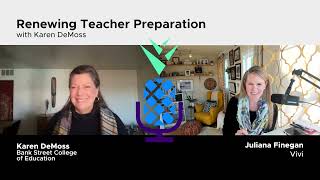
Karen DeMoss, Executive Director of Prepared to Teach at Bank Street College of Education, discusses how teacher residencies can improve preparation and address equity gaps in U.S. schools. She explains why integrated clinical practice matters and describes efforts in New Mexico to redesign how teachers are trained.
Even though we've got this like moral imperative, we can do this, it can be better. We need to do it today. We also have to give people the space to co construct that in a way that is authentic for them and that works for their schools and communities. So our team works really hard to find ways to be sure that we've got a lot of voice and that that voice is frequent and that those conversations really are conversations that allow people to build what it is that they want to build in terms of these.
Teacher welcome to the Educator Pineapple Podcast, which features trailblazers, pioneers and ed leaders who all started their careers in the classroom. Come hear about topics ranging from digital transformation, data literacy, blended learning, innovation, and honestly, everything in between. So excited to have you join our show. Okay, so welcome to the Educator Pineapple Podcast. I'm excited to welcome an education leader and friend who continues to amaze me and make me smile all the time, Karen DeMoss. I'm going to embarrass her a little bit for a second. Karen is the Executive Director of Prepared to Teach, an initiative at Bank Street College of Education working to make affordable, paid, quality teacher residencies the norm across the country so that all aspiring teachers complete their studies while engaging in a year of classroom practice alongside an accomplished teacher. Well designed residencies can disrupt systemic educational inequities by ensuring all students have access to high quality, fully certified teachers. Karen received a PhD in education policy from University of Chicago, served as a National Director of Research and Evaluation for new leaders, Director of Preparation Programs for Wagner College, and Faculty, and Educational Leadership at the University of New Mexico. So do you have anything to add?
Only how happy I am to be here with you, a fellow friend and educator who inspires me with your commitment, the classrooms and the teachers inside those classrooms, your innovation, your excitement about all the work that's going on all over the field. So let's have some fun together today.
Oh my gosh, you are too kind. I really just enjoy our time together all the time, so I've been very excited. As you know, everyone who joins on the Educator Pineapple Podcast has to have started their careers in the classroom or taught at some point. So what did you teach and where?
So I consider myself as having two different starting points. So first I started actually in college. I was working on my Master's degree and I was an instructor of Freshman English. So I did that for about four years. Then I did a lot of other teaching, including internationally. And then when I came back from from international I was a long term sub That I consider my second start because that's really where I was going to start trying to figure out how can I bring some of the things that some of my teachers gave me into the field more broadly.
Long term sub is a seriously challenging position because you're jumping in to a class, learning everybody, learning the culture. I know you did that at Dallas isd, so just wanted to call that out because it's one of my favorite places. Hello, Kristen Watkins. So what is one teacher or student story that still makes you smile?
Yeah, so that's just a great question. You told me you were going to ask this and so many come to mind, but I decided in the end to settle on one. I don't know what the issue was, but I was just as stuck as could be. I don't know if it's that, you know, I didn't think I could make rent or that my master's thesis wasn't going well, or I don't know what it was, but I was stuck. And one of my students just kind of noticed that I seemed a little off and said, you know, do you park in the same place every day? I said, yeah. Have you ever tried parking in a different place and walking into where you go to work from a different perspective, from a different route? I said, you know, no, I don't do that. He said, you might try that. And I did. And it totally made me conscious of needing to get out of my mental rut, where I was, whatever I was, you know, thinking about, I was thinking about. And that story stayed with me because it's more to me than just getting out of a rut. It's actually about remembering how many perspectives there are in the world. And that's something that I continue to try to bring into my work today.
I don't know if it's because there's a little bit chilliness in my office right now, but I just got like, the chills. I feel like kids are just amazing, you know, I would have never thought about that. But it's so true. We get into this, like, I do this, then I do this, then I do this, and it becomes a little Groundhog Day, you know, and just changing one little piece can really just like change your perspective or vantage point from that day. So I love that.
That was a great one. And even just remembering that you did that and it changed, that itself can change. So it's just really a great thing. Yeah, it was a gift.
Well, I. I love kicking off with that. So I like to joke that the Podcast is a little bit, you know, lesson planning. We have different sections because I'm a teacher and you know, sometimes we, we get in our ways. So I love how you started in the classroom. You've had multiple different points there and now you've moved obviously into teacher preparation. We met when talking about residency, which we'll get to later. But really thinking through, I did the Educator Pineapple podcast because the pineapple that everyone has a crown, their area of expertise or something that is like their superpower, but you're always still ripening something. So what is, what would you consider your crown? And then what are you ripening? And then how do these pieces inform your work or your perspective on how.
You approach your work? Yeah, I think my crown is related to the gift that that student gave me. I really do see the possibility and the potential. I see the power of educators. They're the most inspiring people in the world. To me, teachers are. And when they're freed up, when they have the supports they need, when they're given permission and given the framework for the things to talk about that can make a positive difference for their students and schools and communities, they really can make change. So I've brought that into the sort of broader system work that we do. And that really is my crown, is seeing that possibility and working from that. I think my non crown pineapple part is I can move a little fast sometimes. And you know, human change and human development takes space and time. So I'm always working on trying to be sure I'm giving whoever it is I'm in conversation with the space they need. When an idea is new, like most of these ideas are new because we've been struggling with our teacher preparation system as we inherited it a century ago, for a really long time. So giving people space to be able to engage the ideas is sort of where I work on developing all the time. And anybody is always welcome to tell me, sleep, slow it down, give us some space. We want to think about this a little bit more. That's an open invitation to anybody who happens to listen to this. And I think I bring those two together through the inspiration, without the inspiration of our colleagues across the country. That's teacher preparation programs and the districts and schools that they work in, working together and making all of this move, we just reinforce those stories, lift those stories up and help create more of that possibility. And at the same time, even though we've got this moral imperative, we can do this. It can be better. We need to do it today. We also have to Give people a space to co construct that in a way that is authentic for them and that works for their schools and communities. So our team works really hard to find ways to be sure that we've got a lot of voice and that that voice is frequent and that those conversations really are conversations that allow people to build what it is that they want to build. In terms of these teacher residents, I.
Would definitely agree with what you've shared that and you even hear it with how you're applying it to your work now. But your positivity and your grace when coming to this and saying, you know, like, okay, this is a challenging situation, but what are some ways that we can start poking together? I also actually just listening to you was like, maybe this is why we get along so well, is that we both move a little quickly at times and that, you know, sometimes we're going a million times a minute, but we're able to like, kind of connect and see like through the weeds of what are some of those things. And I just love that. So I know we're talking about teacher preparedness, teacher residencies. I think for those listening, it could be helpful to kind of say, start off by saying what is and what is not a teacher residency.
Yeah, that is a really, really great question.
Loaded question.
I'm going to actually start with the concept of teacher preparation in general. So it's a little bit of a rough sort of outline, but there really are pretty much three different ways to become a teacher in the United States. In other places there are only two, but in the United States there's three. And one of those ways is actually with very little, sometimes no clinical practice, as little as a week of observing in a schoolroom, and then suddenly you're hired as a teacher. Sometimes those individuals are required to take coursework simultaneously, but that coursework isn't necessarily connected, and sometimes they're not. And so we have a lot of people, in fact, it's more than a third of the people coming into the profession in the United States of America since our regulations changed with no Child Left behind when it was only about 8% don't have any clinical practice practicing next to somebody who knows what they're doing as a teacher before they become the teacher in the classroom. Secondly is what most people know of and most people think of as teacher preparation. And that is what we call traditional student teaching. I'm not sure there's really anything traditional in any one particular student teaching experience, because every student teaching experience is different. If you talk to people who had Student teaching experiences. What is similar across the model that universities sort of had and developed is that there's not an integration between the kind of clinical, the placement that they have, what they're doing inside their placement and what's happening in the coursework. And that's because of structural reasons, because the districts or the school principals decide where people are going to go. You just hope you can get them a placement. Right. There's not really a co design of what that clinical placement looks like. That's usually one semester, then the third kind, which is where we all want to go, that is a teacher residency. That's where in a well designed residency and there are some that are better designed than others. In a well designed teacher residency you have people who are taking their coursework which is integrated with a planned experience over the arc of the school year side by side with a mentor teacher doing things like co planning, co teaching, co assessing, co reflecting, really understanding what it means to build relationships with students and support them over the arc of a curriculum of a school year. And that is a teacher residency where the program and the school and district and the mentor teachers and the university supervisors or the program supervisors are all working together to make sure that this is a cohesive whole. We almost think of this as a third space where there's really instead of a baton passing from the program to the placement, everybody is doing that all now together in a third space. That's a great residency. There's a new resource that I'll share with you so you can share it with the listeners and viewers. That's a. We call it towards the national definition of a teacher residency. This was a co constructed document through a group called Pathways alliance which is a lot of large organizations in fact. Yeah, you introduced me to them. A lot of organizations really committed to this that haven't always historically worked together but that have come together saying we are really, really focused on what it looks like to have strong teacher preparation in particular through residencies across the nation. And one of our first things was we decided to tackle what would a definition be. And it was really co constructed. It was very transparently constructed. It had lots and lots of external viewers who vetters who gave us a bunch of feedback on it which really great feedback, improved it immensely and it's been well received and it talks about what key aspects of the partnership building look like of the pre service curriculum, of the residence experiences and of the mentors support and development and integration into the work. So it's a great document and that will really Give readers some more information about what a residency is.
That'd be awesome. And I just love that. Just a nice little call out to Pathways Alliance. Some amazing work and partnerships coming out of that.
Yes.
So I mean there is a lot of moving parts and just hearing you talk about residencies and this is. I'm going a little off script, Karen. But you know, I got into teaching through Teach for America, which was different, a different way in. But I definitely got to work with a master teacher when I first entered. And having that valuable time with them to really learn not just about the instructional practices and the pedagogy, but the culture of the school and of the students was huge. Especially with being like a brand new teacher. Right. And so thinking through how do we build that experience for everyone. And I probably could have dealt with like a little more time there before jumping in, most likely, you know, if.
I mean there are actually, as I understand it, again off script, some Teach for America models that are doing a year of that same classroom placement. Right. And then they have the two years on their own as part of their contract. If our system invested enough so everybody could be in that co placement for a year, just how much more could we all give our students in our first years when we're alone in the classroom?
Yeah, because that first year of teaching is, I mean, the struggle is real. Like it is. There is. I mean, because you're also maturing as a person too if you're coming straight out of college. So me as my 22 year old self versus my 41 year old self are very different, you know, mental space. So that was also, you know, challenge in itself. So how did you initially get involved in this work from, you know, where you started?
So I think the initial really starts actually from my own educational experiences. I was a transient child. Eleven schools by seventh grade, I often say, went to a lot of different schools and they had really variable opportunities to learn. As school institutions, I will say shout out to my teachers. They were almost universally. And all of those teachers, there's only one I wouldn't recommend to a student. Right. They were almost universally just really right there trying to give their kids all they could. Even the kid like me who walked in in the middle of a lesson with no background, no information, like just sit down. Right. But the schools themselves have really different resources, really different understandings of what their purposes were. So I've always been very aware that opportunity to learn is not equitably distributed and that funding is key to making sure that gets distributed. It's not everything. You got to do a lot of other things besides funding in addition to funding. But without funding, it's tough to do a lot of things. And it turns out that in teacher preparation, it's the only part of our entire educational system that does not have a dedicated funding stream. Other funding streams may be too small for what we need to do, but we have them. Something exists there. And nothing exists for the aspiring teacher to learn to teach. So it's one of the reasons the no clinical practice models are so attractive to people. Because you go in and get a salary so you can pay off your student loans, so you can feed your family, make your mortgage or rent. Right? So that's important stuff for human beings. But you shouldn't have to do that and learn on the job. Work heroically to try to make tomorrow work because you're not really sure what you're doing yet. You should be supported to learn how to do it well so you can succeed and your kids can succeed. From day one. That's sort of our position. And this is a little bit probably longer than folks want to hear. But Bank Street College had a new president coming in who had been second in command in New York City public schools. Shale, Polokal, Saransky. And in the New York City public schools there was a. But there were several different things. There was a kind of a. There was Teach for America, the fast, the fast track from, you know, people coming in from any number of places. There was a district led sort of internal Teach for America style, like let's recruit you in, give you some boot camp. The New York City teaching fellows. Then there was the traditional preparation programs and then there were some very expensive, like $60,000 a candidate grant funded residency programs that were really concentrated in schools. Those programs had amazing outcomes for the kids in the schools, for the other teachers in the schools and for the people who became teachers. So Shale knew that of all these models, that would be the one we'd really like to do. And so when he came to bank street, which has always had sort of three aspects from its very beginning as a, an experimental school trying to understand how kids learn and then understand how can we help adults learn how to help kids learn. So that's our graduate school and our school for children, right? And then finally share what we know, share what we're learning. So we're in the share what we learning part, what we're learning part. Bank street has historically had a lot of paid residency type things which are actually two year placements in many private Schools, schools as an associate teacher while people are doing their studies and it works really well, but they're paid and so you can do that because they're private schools and they do that. How could we have that be what happens for public schools? That's really an equity question. And Shale was interested in that. And I just happened to have the background of law, finance, policy preparation. And so I was lucky and have been at this for seven years. Wow.
It's funny, I'm like only seven years. I feel like you've been in this for as long as I've known you. So that's amazing though. And I think that the call out of the inequity piece is also like a big component of like how are we ensuring that everyone has access to not only from the teacher perspective, but from the student perspective, getting a teacher who has that preparedness before they come in. So I know we've struggled with these challenges for decades now, right? Trying to connect the teacher pipeline from start to finish. And even like we've even seen some districts like Saint Vrain, they're starting it even earlier in like high school. If like talking about what does it mean to be a teacher, are you interested, you know, trying to build those competencies really early. So why is it so important for teacher preparation ecosystem to shift, especially now given, I mean, we're hemorrhaging teachers at the moment, so why is it even more important now?
We are at a kind of a turning point. If we don't shift the goals of our ecosystem, if we say we're hemogoring hemoglobin. Did I say that right?
Hemorrhaging, that's like if we say I.
I know that they can edit, so I'm really glad. Yeah, all good. If we say we're hemoglobin hemorrhaging teachers and therefore please come in with, you know, anybody, right? We'll have a few amazing people who always should have been teachers, perhaps. But on the whole we now have, since we opened up the doors like that, we now have about 25 years of evidence that says we're going to make it even worse. Because when somebody comes in the classroom under prepared, they're so much more likely to leave than those who come in prepared. And what's worse, they are so much more likely to be placed in with students who have students, they're students with special needs in terms of their students with disabilities placements, their special education placements, their students from low income backgrounds, their students of color. They are the people we have historically marginalized in the education system. And so if we don't say it is a crisis, we have to fix the root cause of the crisis by being sure people can afford to become teachers and be well prepared so they see day, then we actually could make the situation worse. So it is a really critical time for us all to look really deep and say, do we want a qualified workforce in front of our teachers, in front of our students today? And I think the answer is yes, when people stop to look at that question. But getting people the space to believe that we can do this transformation, we can have a system where this is the norm that I think is the harder work.
So I'm going to jump in, jump a little ahead, because I think this is framing up kind of the. What makes the big difference is both having the mindset that we can make a difference and how we're framing the conversation and the narrative shift, if you will. So originally, when Karen and I met, it started because I was doing some research around building questions for districts to ask around residency and found your paper and was like, okay, so I want to base it all on what you did. So literally cold called poor Karen. And she was not only willing to meet, but we had one of the best conversations right off the bat. And it was just right away the synergy. And so I just really appreciated that. So I think, like, we talked about that a lot of times we work with residencies themselves to say, like, okay, what are the pieces you need to be successful? But then when we started talking, we kind of switched the narrative. Like we said and said, what should districts be asking to make sure that that's the true partnership between supply and demand, if you will, in an oversimplified way. But like, how do we make sure that the teachers that we're getting into, the schools match that district, that district's needs and like you said, so that we're setting everybody up for success so that we don't have this turnover that they stay in and feel successful. So I just gave you a ton there, but bringing in the idea of, like, what is the secret sauce of prepared to teach? And have you seen any systems using this successfully? If so, how.
Yeah, so I'd say, and I know.
I clumped a bunch of things together there, but I.
But it all fits together so the clump makes sense. I'd say that the secret sauce is giving people the space to themselves. Bring it all together. So if both, let's call it sides, the preparation program and the district say, it seems like a Good idea for us to explore something that works a little bit better than these two siloed places and hoping in the end there's a match. Right. How can we, like bring this a little closer together and have conversations if both parties say that, then our, our first piece of secret sauce is showing how many places across the country have made really amazing progress, usually historically, unless you were grant funded, too expensive for most places, or you were just really small where you'd be under the radar. Yep. People really didn't know this was going on. It's been actually going ON since the 70s, these kinds of really deep partnerships to create something called, or not called, but looking like a residency. Right. So once we show that there are a lot of places that are making progress down the road in different aspects of a high quality residency, and then you all might want to talk about what you might want, then we can focus the conversations on what their needs are on, on both sides of the partnership. And they amazingly come up with things. So, for example, the districts will almost always bring staffing needs to the table, and then the university, if it's a university, will almost always bring needs of placement to the table. And so those two things don't seem very aligned, but suddenly they do become aligned. Because if the district has staffing needs in early bilingual, even if a candidate isn't in a bilingual program, when they are placed in that bilingual class, they can get that supplementary bilingual, and they can then go into that bilingual program. So that conversation with placing candidates and district needs suddenly creates a whole new synergy in the system that frees them both from the historic approaches they've used to place people in their placements and then hope somebody becomes hired. The second piece is it becomes not the university or the program itself doing all of the work about bringing people in, telling them what everything is, and then saying, okay, district, here they are. Instead, the district is coming, and all of a sudden those candidates. I think this is particularly important when you have undergraduate candidates. Those candidates realize, wow, this isn't my senior semester of school. This isn't just quote, unquote, my classes. This is actually work. They're kind of like interviewing me. And that really raises the awareness of what it is I'm coming into. And that, I think, also helps the partnerships figure out, what does this right match look like? How. And then. And then they start talking about, how can we in the long term get more secondary STEM people in? And there's a lot of great creative ways that people are doing some of that work. How can we get more people who look like the students that they're going to serve. Suddenly, like digging into our paraprofessional and a classified staff, folks to see who already has a bachelor's degree who can come into your postbac or master's program. Those things happen all over the country after the first conversations of it's possible. What might we want to do together?
That's. That's awesome because I think that the. I think you nailed it with just having that one small piece that you mentioned about the interview brings a whole new value to the experience because it says I earned this and I really want to impress them because I said this is what I was going to do. And I think that it seems little, but that's a really big step in the process to not only match on like the system level, but also on the personal level and build that personal buy in to the community as well and say, like I interviewed, this is what I heard, this is what they saw in me that I could bring. So I think that there's a lot additionally that comes in with just adding that small piece to the process.
I totally agree. And I think at first it's not what partners say is the biggest piece. I think at first they say that the program and the district better understand who the people are they're working with and what the needs are on the other side. So like, if, if you're in New Trier and I'm in rural Mississippi and we pretend like we can talk about what our classrooms are like, Right. Without ever having seen it, it's a lot harder. Right. But when the sides sort of see, oh, that's what they're thinking about. Again, back to my faith in educators. Educators want to do the right thing. They figure out how to get there. So there's actually this two partners piece. I think that's the bigger shift at first. And then it's almost at first a bonus that the individual comes to think about this work not as coursework, not as the end of my degree, but actually as the beginning of my career, which is what it should be.
So when I asked you to originally join, I was just going to talk about residencies and like, you know, what are the things we need to think about? How do we set it up? And then you, you started telling me about New Mexico and I think I made you book your time immediately. So segueing in there of. So we're, we've been talking a lot about residencies and teacher preparation and how important it is to align across the board. But what are you doing in New Mexico?
So first of all, let's not say what we're doing, let's say what prepared to teach our project is, let's say, say what New Mexico is doing because I think super, super important framing and the right one. So first I'm going to go back a little bit historically that New Mexico has always taken its state responsibility to education very seriously. A lot of people might be raising an eyebrow saying, well what do you mean? They're always way down on the bottom on the outcomes. It's not a particularly well resourced state and it's a very, the population within this, populations within the state are really varied. Despite the fact that we don't think they are. They are really varied culturally. The structural systems for education because of the Pueblos and reservations and sovereignty for the indigenous peoples nations, that's really complex too. And so the outcomes aren't so good, but the outcomes really don't talk about the state's commitment to education and the outcomes. Also we could talk, I'm sure you're going to have somebody, if you haven't already on the podcast about, you know, how some of the outcomes are not necessarily what we're looking for. So that's another piece. Right. But way back in 69 when California had a state lawsuit about finance equity, the the court there ruled that, yep, it's the state's responsibility. It's in the state constitution. State needs to do this, needs to be equitable. Every other state started getting worried and thinking about how are we going to protect ourselves and.