Strength-Based Data Literacy with Dr. Rebekah Kim
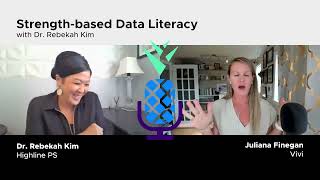
Dr. Rebekah Kim, an education leader at Highland Public Schools, discusses building strength-based data systems that center equity and student potential. She explains how schools can move beyond deficit-focused metrics to create holistic student profiles that recognize what students can do, not just what they lack.
You can have the richest data in the world, but if you use it in a deficit or you use it in a way that perpetuates these biases, especially around race, then that is not being strength based and that is, I would say, the opposite of being data literate.
Welcome to the Educator Pineapple Podcast, which features trailblazers, pioneers and ed leaders who all started their careers in the classroom. Come hear about topics ranging from digital transformation, data literacy, blended learning, innovation, and honestly, everything in between. So excited to have you join our show. Welcome to the second episode of the Educator Pineapple Podcast and a huge welcome to an amazing education leader, friend and glassy baby expert, Dr. Rebecca Kim. Had to add it in for you. Dr. Rebecca Kim is a proud second generation immigrant from South Korea. She is the executive director of Teaching, Learning and Leadership in Highland Public Schools. Before she came to central office, she was a proud principal for 12 years. Her core values are centered around racial and social justice. These core values drive her personally and professionally. She recently completed her doctoral studies in building and fostering data literacy and K12 public education with equity and strength based data systems. Very impressive. Congrats there. And she is the proud mother of two teenage children, dogs, and various other pets in her household. And I will just add, she is also an amazing decorator, as seen by my backdrop. Though she's probably a little upset that you're seeing more of it than we normally do, but we have to move the frame. So. Thank you so much for joining me.
Thank you for having me. It's an honor to be part of your launch of your podcast.
Yay. It's so excited to have you here. I was actually thinking today about how long we've known each other, and I believe we met after I had my first kid, if that's possible, at the BPLC. So that was like 2015 Rhode island in Rhode Island. Yep. And then after that, we met on an airplane on the way to a conference and you know, as many people say, the rest is history. I was immediately impressed and quite honestly, a little scared of you at first because you had everything put together and I was like, oh God, how do I approach her? But then I'm just so grateful to have you as a friend. So thank you for coming on.
Yes, thanks for having me.
So, as you know, everyone that I have on the Educator Pineapple Podcast has started their career in the classroom. So my, my first big question for you is, what did you teach and where?
So I taught second grade, third grade in Tukwila, Washington. One of the most diverse districts in the U.S. love it.
And when you were there, you know, I'm going to cut that. So how did you get to where you are today from, you know, teaching elementary school in Tukwila?
Great question. Without spending hours explaining all the details, I think a couple of things to name would be having the right mentors and leaders and role models throughout my educational journey, from the classroom to my English lit teacher who believed in me and gave me positive feedback on one of my first essays that I ever wrote. To the principal where I was a student teacher who looked at me and said, you're going to be a principal someday. To my first principal who is an African American leader who I looked up to and who demonstrated what strong leadership and role modeling looks like. To the mentors along the way, up until today, where I have an executive coach who was a former supervisor when I was a principal, all of those different role models along the way and people that believed in me were huge contributors to my role as a teacher, as a principal, a director of instructional supports, and now an executive director of teaching and learning.
I love that you highlighted just the value. Did that just sound weird to you?
No.
No. Okay, cool. Redo. I love that you highlighted just the value of having mentors and people surrounding you who not only believe in you, see what the future can hold, but also have been those people you can lean on to help you kind of move forward. And I think that, like, especially in education, well, in everything that makes it not just life possible and the possibilities to grow, but also it makes it fun because I'm sure a lot of those people are also people that, that you can share in the day to day. So I think that that's also really important. Speaking of, so then and now, kind of what the other part of the podcast is. I also, I like the pineapple analogy because I say everybody has a crown, but everyone's ripening something. And I'm sure that a lot of those mentors saw your crown and also helped you to write in different things that maybe even turned into your crown later on. Maybe I'm going a little deep in this analogy at the moment, but what would you, maybe even then or now, what do you see as your crown or your superpower besides being able to do a million things at once? I loved how you were like, so I got my doctorate. I also help decorate with Pottery Barn, and I'm also leading all of this equity work in my district. So what is your crown and what do you see yourself as ripening and how has that made or guided your decisions on what you do?
I would say that one of my crowns might be that I see people and their stories, or I seek to see people and learn their stories. And I think that derives from my own experiences of growing up as a second generation Korean immigrant. My parents immigrated from South Korea in the early 70s in Milwaukee, Wisconsin, of all places, and. And growing up in the Midwest as one of the only Asian families. I most definitely had experiences and stories that I wish that educators would have asked or learned or listened to. And I think that really compels me as an educator to be driven by my core values around diversity and equity, personally and professionally, and the families that I've been able to serve that come from richly diverse countries and communities and bring different stories and strengths into diverse communities. I always have room to grow in the way that I listen and use what I learned to respond. And so that's where my crown just needs to be adjusted, because it's not always perfect, but it is an area that I continue to seek to sharpen. But it is something that, because of my personal experiences, continue to compel me to want to serve families based on their stories and what their strengths and their challenges or needs might be in their educational experience.
I love that. And I would definitely agree that that is one of your crowns, because I think that every person I ask them like, oh, do you know Rebecca Kim from Highland? They're like, oh, yes. And they have a story about you. So just FYI. And I think that that's just always, always wonderful. But I think that you have a. You. You're one of the most passionate and genuine people I've met in my work, and I just really appreciate that. And I think that speaks to what you do and what guides you daily is because you take that passion and you don't just talk about it, but you put it into action. So you really think through, you know, like, this is a gap we see. And I want to move this theory into action. I know it should work, but how can we make it work and make it work collaboratively and work together? So where. I mean, you said kind of where this passion came from, growing up in the Midwest as a second generation and saying, you know, like, I wish people knew more about me and how that guided how I learned and how I grow, would that be yes?
Yes.
So how does that continue, that passion kind of move into what you do in your day to day?
Yeah, great question. So as a school leader who always had access and the honor to be Able to serve as a school leader, I would have access to staff and students and families. There. I was really able to actualize loving out of community, listening to the community, and in my later years of being a principal, really using what I learned to drive the way that we engage with families and we deepen family participation. I have many examples that have really taught me to be a stronger leader from those relationships I've built with students, staff and families. As a central office leader, I really had to navigate how I make that direct impact in the ways in which I'm able to serve the families that I choose to serve in the community of the district where I currently work. In my current role, some of the areas that I supervise are data and assessments. I decided to focus my doctoral studies and my action research on data literacy, which is something I would have never imagined that I would have done seated as a principal. But that is an area where I really wanted to start owning my own learning and to enrich what I was doing in the way that I was supporting data and assessment in our district. One of the opportunities that I've had to lead through a generous grant is to help to lead the work of building a strength based staff and student profile. There are many cross departmental collaborative structures that have taken place, but in that space, to build a data profile that we are still building it. We are still trying to figure out all of the challenges that come with building it. But as we are able to bring in those core values to know our students and staff by name, strength and need, I am able to serve the community and serve our students, to create and support ways in which we look at our students holistically. Let us not define our students by high stakes accountability measures like their discipline, their attendance and their state test scores. What if in this profile, which is the way that we've been designing it, we bring in metrics that give us answers to questions we want to answer, like what are their talents and their skills and their interests? Let's move beyond seeing that a student may have been disciplined multiple times throughout the school district. Oftentimes those are adult issues, those are power struggles, those are based on implicit biases, often racial. And so if we are able to highlight and know students by different types of metrics that may not yet exist, that we don't have systematically, that is something that I feel is a way that I'm able to continue to support the way that we are seeing and knowing our students. And as a mother of children who are in school, it is my wish and dream Makes me a little emotional that staff would have access to tools like this so that when they look at my children, their GPA or their state test scores, they're also going to see the talents and the skills and the athletic abilities that also define who my children and all other children are holistically.
So I know we jumped right into the data literacy obviously and I'm going to like zoom back for a second. So just to give those who are listening, Rebecca started in the classroom when I was a principal and then moved to central office. And I will say you were, you were given the task of like when you heard the bio. It's like you're working across all different parts of the puzzle when we're looking at teaching and learning. And I think that just hearing what you're speaking about that also speaks to the whole idea of this data profile and data literacy is that like.
I.
Think a lot of times we look at students and I don't want to say this in like a mal intent way, but like sometimes we're like what has the student done? Or what is the student as far as like data as opposed to why and how and how can we support and really thinking through like you've mentioned, you know, that strength based mindset and I love the fact that you brought up your kids because I think it's, it's funny, I just filled out the kindergarten or I guess first grade thing for the teacher where it was like, what do you want me to know about your student? What are your students talents and achievements like? And I'm seeing you do that on like a system level so that we're able to aggregate all of that intangible data that truly makes what our student, makes our students who they are so that we can leverage their talents and experience and expertise to better support them in their academic goals. Right? So that we're like, we're saying, okay, how can I support you as a whole student so that you can be successful in and not reinvent the wheel too? Because I think like probably like I'm probably gonna get the same survey next year, right? And so like how do we actually. And then how do we show how my daughter has grown between this year and last year? And so I just gave you a lot there. But I wonder with thinking through the data profile and all of the data you're collecting for it and your research on data literacy and I know we're going off script, so I apologize. But what do you think are like the key, like where do you start?
Yeah, I think I can, I could, I could respond to or try to make some connections here. So first of all, in our district in Highline, we have a promise to know our students and adults by name, strength and need, specifically for students so that they can prepare, be prepared for the future they choose. When we think about knowing our students by name, strength and need, we need to have strong multi tiered system of support systems in place, mtss. And that's another body of work that I have the privilege to be able to co lead with colleagues to identify and to co construct the vision of mtss. The guiding principles like being holistic, looking not just at academics, but social, emotional behavior, mental health, strengths and areas of need. When we have those systems in place, we don't want to just look at the satellite high stakes data. But now let's talk about street data, which is something that we are focusing on in our district from the boardroom to the classroom to ensure that we are going beyond that satellite data and bringing it also to the street level data. And I think that we can admire that concept of street data, but the work that we really need to do that and the hope of these profiles is not all the street data would live there, but that we are conceptualizing or finding application opportunities and strategies to bring that street data alive. And so, you know, advice, I don't know if it's vice, but we really need to ground ourselves when we say that we want these strength based profiles. We need to ground ourselves in research. We need to identify our guiding principles, have MTSS structures in place and then really articulate and calibrate on what do we mean by street data and what does that look like for application? In our district we do not have that all perfected, but those are some important priorities as we think about strength based profiles that we've been building. Now the reason for the data literacy action research that I spent the last several years studying is that you can have the shiniest, coolest data systems out there. But if the. Did you see me pause? You know what I was going to say?
I'm not even sure if we're allowed to on this, but maybe.
I'm keeping it professional. What we want to do is to make sure that the end users know how to respond to now what? So you can have this amazing holistic data and it's going to answer some questions. But the data literacy piece is the now what? How do you take what you know about being strength based in the way that you engage with data and how do you. How do we make sure that our educators have the skills that they need to be able to respond to the data, to celebrate strengths, but also identify ways to intervene and enrich students based on what the data is telling us. Our team and through my action research have been building a data literacy training framework that's specifically customized to what the teachers are saying they need to build their knowledge and skills around data, use how to reimagine or reset the relationship with data as a result of the no Child Left behind somewhat negative or unhealthy relationships with data because of that high stakes accountability and then identifying what barriers get in the way. Another area of research that I did was asking school leaders and district leaders what gets in the way of being able to move data from the principal's desk to your teachers. And there, you know, there was really great feedback. And so we're using those to design what that data literacy training framework looks like. There are many definitions of data literacy out there in the research, but what I have learned through my studies is that co constructing what that means in your district is extremely important.
Yeah, I was actually just going to jump. I was actually just going to jump in on that because I think I keep hearing you say my team and then talking to principals and then talking to system leaders and then talking to educators. And I just really think that this is a big highlight moment of, you know, what are the key stakeholders you needed to engage early on in your research and the relationships you needed to build to actually take this from theory to action and to do it in a way that is empowering all of those stakeholders.
I think professional trust and the relationships. I definitely think that I'm in my 18th year as a leader in my district and the relationships that I've been able to build have definitely been an asset to be able to get the responses and to get the truth. There's a lot of honesty. They were, you know, it was, it was done anonymously. But I do believe that beyond, you know, those surveys and that research, I just think the ongoing conversations. I also have the privilege to serve as a district leader with our union leader in a Highline joint assessment team. And in those joint assessment teams, we engage in conversations around what does data literacy mean to you? And we actually co constructed that data literacy vision together. It's leading in those different spaces and building those important relationships that leads us to be able to do that co construction and to listen to that feedback. That same body of collaboration also have come together to see some of the previews of our staff and student profiles and have given such rich feedback that are giving us change ideas to iterate on our current development of those profiles.
So it sounds like you've been working a lot internally at Highline. Have you been working with any other districts within this work or sharing with other districts? Because I do think that, you know, one of the big reasons I wanted to do the podcast too was we reinvent the wheel so much in education and because not because we don't want to share, but because it takes a lot of time. Right. And how do we both like build the plane, fly the plane, and also help others to build the same plane? So how have you been able to share what you've learned and also build those partnerships to help scale? Because I think it's so important for all of our students across the country to really be known be seen. I love your everyone known by name, strength and need. I wish that was like a catch line everywhere. So how have you been able to do that and share that more broadly?
Yeah. So first of all, I just need to underscore that we are still on a learning and development journey and we've identified that there are other districts who are working towards a lot of the same goals. Some goals are specifically focusing on data interoperability. So how can different data applications speak to each other in one system, which is more on the technical side? And that is where I first learned about what is data interoperability and why would we want data to live in the same space from multiple applications? I sat in a cohort at Digital Promise through one of the focus groups, a lot of chief technology officers, a lot of smart talk. I was a fly on the wall, just going in to listen and learn. Who knew that several months later that we would find ourselves in the development stage again, afforded a very generous grant from one of our foundations to start thinking about building it. That is where I started working with some of the foundation members, some of the cohort members to start giving advice of some of the vendors that they worked with, some of their lessons learned. And so I did spend time being able to learn from other districts around their development, who they got involved, what was their communication plan to engage stakeholders to buy into the new systems. And then as I continue to learn and be part of this journey, I was invited to be a data equity coach, most recently with three school districts I spent last year, again through Digital Promise to be able to support them in their beginning planning stages and was just able to share our progress along the way. And, you know, the message that I shared with all of Those districts was how important it was to find yourself in the research as you design and to include stakeholders from the beginning. And the importance of that cross collaboration between departments, all contributing to that design, which is going to involve school based and central office team members. Currently, as we are finding some challenges in our continuous build of these profiles, we are talking to another foundation who connected us with a local district in the Pacific Northwest who's working towards some of the same goals. And we've been able to make some connections and we're going to do some follow up meetings so that we can hear about the ways that they're getting through some hurdles and they can also hear about ours as well. So we can kind of put our heads together.
So I guess like my question is, what's next? Like, do you have anything else you want to kind of add? Anything else you want to ask the listeners to engage with? Because I think I love your idea that just you keep bringing people into the conversation and I think that like we continually can support each other. Like, would you like to ask the listeners anything to engage to share. This is your platform.
You get to share, I think, share your celebrations. If you've been engaging in this work, share your celebrations and what's worked well. And if you're hearing similar challenges such as finding the right standardization that will give us the historical data that we need, that you have piloted and tried this on and received feedback that you too are following a strength based profile design. And if you have questions for us that you would want to ask or you have some ideas to share, would be happy to learn about those. The data literacy training framework is something that I'm very interested in launching so that when school leaders or school teams say that they want to do some data navigation, we want to be able to use components of that framework to be able to share ways to learn and calibrate on what it means to be strength based. When we look at, analyze and respond to data, you can have the richest data in the world, but if you use it in a deficit or you use it in a way that perpetuates these biases, especially around race, then that is not being strength based. And that is, I would say, the opposite of being data literate. I'm very interested in launching that and getting momentum. My work is building and fostering that kind of culture of data literacy. And maybe we'll have a part two Juliana where you will ask, yes, so you built it? Have you been fostering it and where are you at now and how is that data Literacy being applied to this amazing profile that has launched and is in momentum. That is my dream and hope of where we will be in the next six months to the end of the school year that we have something rich up and running again, continuing to iterate on making it better and better for our stakeholders, but that we are using it in a way that we are being data literate. That would be my hope and really again that those coupled together, data literacy and having these strength based profiles will make an impact for students so that students can be seen holistically for who they are and not being defined by test scores and discipline and attendance.
I just want to say thank you for doing this work because I have littles who haven't even really gotten into school yet. So I now I'm just like, well first off we will definitely do a part two podcast. But second off I just, it just makes my heart so happy thinking about how my student will be viewed and how my student, you know, will be able to leverage their skills and not be dinged and not be dinged for, you know, the past or what's happened or without knowing the full story. And I think that that's the biggest thing. So as you know, I believe sharing means caring and I know you shared some of this for people and like again you will see her Twitter, I don't know, Twitter handle. I'm learning Twitter words. We will have that with this so that you can share your work. But is there anything that I love continuing the conversation because I think a lot of times people get inspired and excited. Is there anything that you would recommend from moving to concept to application or trying to figure out how to do this work themselves, things to read, things to watch that would be helpful for them to start this journey or continue their journey around strength based mindset and data literacy?
Well, the framework that I built has a lot of those resources. Recognizing and listening to our stakeholders in our district of the way that they want to engage in learning, identify professional reading videos, ways to different ways to be able to engage in the learning to our value of universal design for learning. I can give an example. Knowing that a lot of teams and schools and school board members have been reading street data and what I've been able to do is curate some videos, some webinars from the authors and we most recently in our teaching and learning leadership group of administrators, there's about 18 of us, we engaged in some learning through watching one of those webinars together, pausing, reflecting and what we did was we looked at the collection tool ideas of applying the concept of street data. So in chapter four we get some ideas of what are ways we would want to collect street data Listening campaigns. It might be like an equity walkthrough tool. It might be observing a fishbowl home visits. There's so many different ways. There is not one just standard list. But the work that we are striving to do together to put that concept to application is identifying what are the street data we want to collect and what are some common ways that we would want to collect it so that we can come together and talk about what have we been noticing in our collection and the now what's. But again, not wanting to take away from the authenticity of what street data is, not being prescriptive about what those collections tools are, but just finding some calibration about what that means across the stakeholders in Highline who are interested in collecting that street data.
Awesome. Well, I'm definitely, I promise that I will post some of these resources and do some more digging into things for people to read. So post it promise. I know you've been, we've worked together with our Innovation Directors network and you know, I always end with a post it promise because I think a lot of times we have these exciting conversations and then it's like kind of the now what of this. It's like I get excited but what am I promising to myself to do tomorrow, next week, next month? So if do you have one post it promise? You can write on post it or you can just say it of what you hope to do next week, next month and I can share mine as well.
I really need to learn how to be okay with learning from failure and being okay with uncertainty. With all of the changes that we see happening in education across the country or closest to our neighborhoods, the uncertainty is okay with the impact of the pandemic. I think that that is something that we really need to respond to and be urgent. But there is no roadmap or guide on how to do this the right way because we've never experienced this. And we just have to be committed to continuing to stay urgent and committed to the work to ensure that our students who have experienced the pandemic over the last several years and the impact on their schooling, we need to pay close attention to that and stay committed. And then when I say that this is a really big post it by the way, you got one of the.
Really big post its okay.
Yeah. When I say that I want to, I need to be okay with failure. When we are innovating with Technology, we're innovating with data, and there's not yet something out there that exists that has the code or has the blueprint or guide of how to build something. We have to be okay with sometimes taking a few steps backward or doing things a different way or with different partners because of all those lessons learned. And I just need to teach myself that that is not synonymous with failure. Rather, it means that you have to be more innovative and you need to be thinking more creatively. Again, there's no guidebook. And I'm always trying to, you know, have that A. And I just got to be okay with it not being that way.
No way. You're a perfectionist. I never would have known. No, I love that. And I think that it's funny. I changed my post it to learn more and to share what I've learned because I think that I'm at this, like, really weird juxtaposition. Like, I've been in education for a really long time. I was a teacher for 10 years. I worked, like, nationally on all this stuff. But I've never been a parent of a kid. And so that's my new navigation point. And I think listening to you speak about how important this is to do not only for my kid, but for. With equity in mind for every single kid at the school to make sure that they are all known by name, strength, and need. And so I think that, like, my post it promise is to share this with the school that's a half block down the street and say, like, hey, you know, like, this is something I just learned. I would love to share it with you and I'd love to find out how we can do even just that small piece to work towards a greater big puzzle, which obviously has a lot more pieces. So thank you for inspiring me to do that because I think I'm still navigating this whole parent thing. It's different. I can't be like, so here you go. But I've had amazing teachers so far and my daughter loves school, so bonus. But I just. Thank you so much, Rebecca. You continually inspire me. You make me laugh, you make my house look nicer. And. And I definitely promise to have you on again. And I just, you know, it is amazing to see how your passion has pushed so many different avenues of your career, but also that it's going to push and impact so many more beyond your kids, beyond Highline and beyond, because I think that you are a great magnet to bring in people to do this work. So thank you.
Thank you for coming of course.
Have a great day.
You too.
Wait, so I'm going to stop. I'm going to stop the recording, but do you want to say anything at the end? So I'll just be like, thank you so much, Rebecca, for coming and I really just appreciate you joining me. Do you have anything? Last thing you want to share?
I would just say thank you for listening to anyone out there listening. Continue to support the Pineapple podcast and just know again, we are on a journey and we're learning and so if you have ideas to share, we are most definitely open to that because we're all in this together.
Thank you for listening and we appreciate you. Reach out if you have any questions, comments, feedback and everything in between and hope you enjoyed the time. We can do even just that small piece to work towards a greater big puzzle, which obviously has a lot more pieces. So thank you for inspiring me to do that because I think I'm still navigating this whole parent thing. It's different. I can't be like, so here you go. But I've had amazing teachers so far and my daughter loves school, so bonus.
That's amazing.
But I just. Thank you so much, Rebecca. You continually inspire me. You make me laugh, you make my house look nicer. And I definitely promise to have you on again. And just, you know, it is amazing to see how your passion has pushed so many different avenues of your career, but also that it's going to push and impact so many more beyond your kids, beyond Highline and beyond, because I think that you are a great magnet to bring in people to do this work. So thank you.
Thank you for coming. Of course.
Have a great day.
You too.
Wait, so I'm going to stop. I'm going to stop the recording, but do you want to say anything at the end? So I'll just be like, thank you so much, Rebecca, for coming and I really just appreciate you joining me. Do you have anything? Last thing you want to share?
I would just say thank you for listening to anyone out there listening. Continue to support the Pineapple podcast and just know again, we are on a journey and we're learning and so if you have ideas to share, we are most definitely open to that because we're all in this together.
Thank you for listening and we appreciate you. Reach out if you have any questions, comments, feedback and everything in between and hope you enjoyed the time.