In this 10,000‑token training session Nate Kennedy walks the audience through the full spectrum of ways to monetize a newsletter ecosystem. He begins by contrasting free and paid newsletter strategies, then dives into the core revenue levers: sponsorships (primary vs secondary placements, dedicated emails, content‑only sponsorships), lead‑generation (CPL/PPL, Beehive Boost), affiliate and CPA networks (ClickBank, CPA platforms, direct advertiser relationships), and on‑site ad platforms (Google AdSense, Decide, AdRoll, LiveIntent). He explains how each model works, typical payout ranges, performance considerations, and the importance of audience size and quality for platform approvals. The session also covers product diversification (consulting, physical goods, membership reports), hybrid revenue mixes, testing methodology, and practical next‑steps for the participants (applying to boosts, scouting competitor ads, using Sparkloop). Throughout, Nate emphasizes a pragmatic, data‑driven approach: start with CPA/affiliate offers, layer in sponsorships as the list grows, and eventually add on‑site ad revenue while maintaining a good reader experience.
Chapters
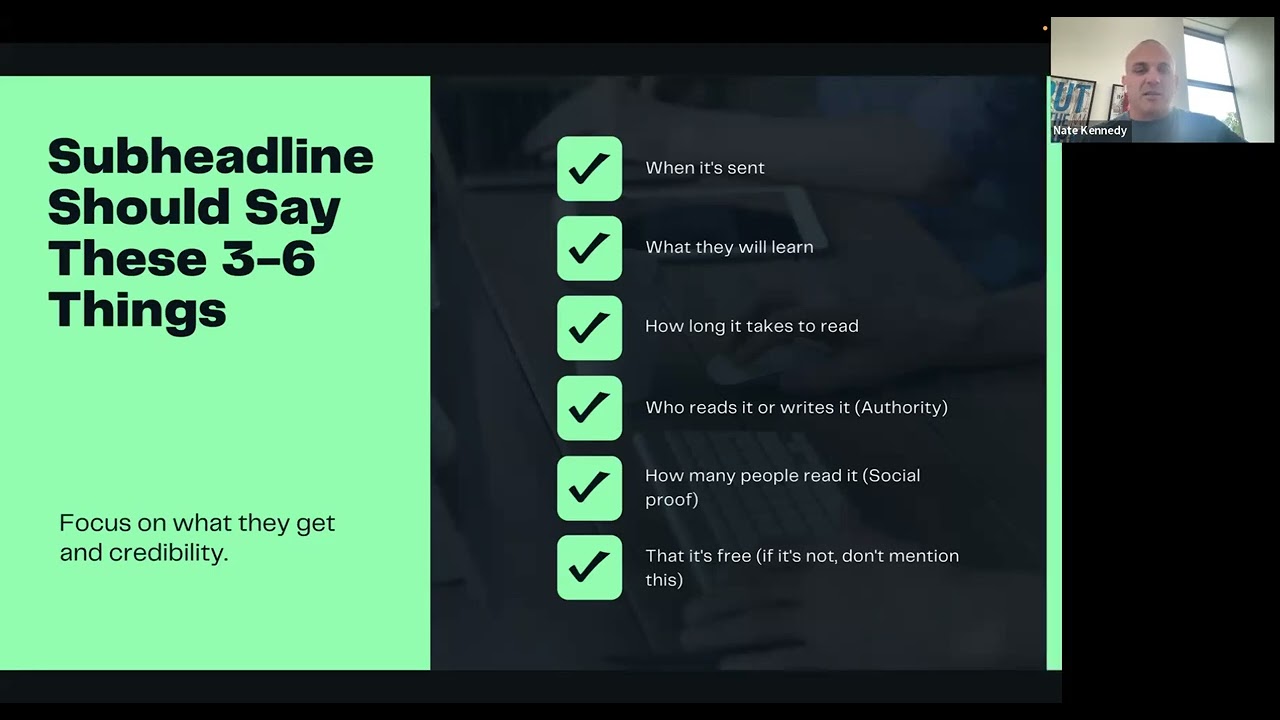
Um, let's, let's jump in. I've got a training, back to the training piece today, so I'm going to get going on that with you guys. And then I also want to go behind the scenes a little bit on some of these pieces and show you the— how we've got it set up. So Do this. All right, so back in here, we've got— today I'm talking about there's free versus paid newsletters. We've talked a little bit about this on, on different calls, on different ways that we can do it.. And then I'm going to get into pay-per-sale, pay-per-lead, and then CPM sales, kind of different monetization. So today's money models, right? So we're getting into the actual revenue opportunities that are available and different things you guys can start working towards. So I just want to cover an overview of all the, the core ones that we leverage internally that you guys can leverage, uh, going forward as well. So free versus paid. So we've always operated on the actual free newsletter front. We basically freeze what you guys are building as well for now, and the free side is us giving value content information out to subscribers and no fee for being a part of the, the newsletter, right? So very free content. And then for the free content, they turn around and we get sponsorships, CPL deals, kind of different things we'll talk about here shortly. But then there's also the paid option. On the paid front, I've, I've never— I've done kind of like a short crack at it, but it's never really been my model. But I definitely want to address it because it is a successful model. I've always just focused on the free model. And but the paid model is something you guys can definitely execute on where you create some sort of higher level of membership, right? So that level of membership maybe could get them at an industry report report for the month. Uh, it could get them higher-level content if you're in the— so possibly access to other tools and resources that you developed, right? So there's a lot of things you can do on the paid front. That's one way, right? You have a free version and then you have an upgrade version where they get access to kind of gated content, right? Gated value, you know, the content being higher value, maybe reports and tools and resources that you potentially don't get in the free model. Now there's also, if you look at what a lot of these newsletters have done, is they've made their entire setup paid. So your local newspaper, if they have an online platform, chances are it's a paid version. They give you like 3 or 4 free tools and that are free articles to read, and then they hit you with that, you know, $1 a day type subscription, right? And so that's also another option. You go in some of this stuff if you choose to, but it's— it's— you're competing against some, uh, some savage companies on that front with a lot of tech and money behind it. So, you know, there's— I've never chose to go that route. Now, on the paid front, and with the one that I'm building, I do plan on trying to test an industry report, which is why I mentioned that on the paid version, right? So they subscribe, monthly fee, maybe it's You know, there's a company out there that— so The Hustle built this. They built the version, I believe it's called Trend, back in the day, and they were charging $300 a year for industry reports, like industry trends report that would come out to you. So, you know, keep that in mind. Like maybe you guys have something along that manner and it makes sense. Maybe it doesn't. You have to look at your model and decide. There's also the ability, once you get more subscribers, you ask them, hey, would you be interested in this, right? I do know in the coaching consulting space, if you're kind of selling your own products and services as well, which we'll talk about here, you could potentially have a community where people pay for that at the same time too. So free, that leads to paid. So anyways, that— those are the two options really for the most part that you're gonna run into. Now, free, obviously without diving pre— pre-cursory state, what I just said, you guys have all launched a newsletter, everything's free at the moment. You're trying to build to grow that subscriber base before going into paid. There are some other paid options, and this is the Trends one I just mentioned. Each one has its own kind of pros and cons for you guys to determine what you want to do. So in the free, in the free newsletter side, right, everything is— you can do CPM, but it's, but it's also, it's still performance marketing, right? Because if the ad does not perform, they don't rebuy. If it performs, they rebuy. Sometimes they spend more. If, if it takes a while to perform, maybe they'll spend less. But either way, it's still performance marketing on the free front, on the free side. And then, uh, so here's some different money options, right? Money moments or, you know, models that you can follow. So sponsorships— this is where we've done a lot of our revenue. A lot of our revenue has been through a company comes to us and we do sponsorships. You can do it two different ways. One can be it's built right into your newsletter. So it's an advertisement that is all you have your newsletter, then you have your advertisement, and then from there you have more content around it, right? And then sponsorships also, you can— there's another model kind of tweak to that where it's more of a dedicated email. So they actually give you the email, the content, and you send it and you send an email out with a dedicated promotion of their product and they're paying you for that as well. So there's two different ways to structure that. We do a lot of dedicated stuff and then we also do also include sponsorships. So when we sell a deal, we sell on the news side, we sell a dedicated plus a sponsorship. And now what we're moving to on one of our brands, uh, that we're testing out in this whole new year that we're, that we're going to be doing is content only, no dedicated, just straight value with some sponsorships sprinkled in. I'm actually really excited about that front to see how that performs. I think I've mentioned on previous calls, but you know, I'm excited about it. We'll see how it performs and how the numbers back out for that. For what we do on our front. Now, a little bit different for everybody. You can see there's tons of opportunity in sponsorships alone without having to do that. And sponsorships work well more in an avenue like you guys are building with your business newsletters or, or your content for specific niches, right? Sponsorships tend to work really well with, with the more niched out product, with a large general news dedicated tend to Tend to work well too. Well, that doesn't mean sponsorships only don't work because there's a company, Join1440, they got millions of subscribers, they charge like $50,000+ for sponsorship, and companies keep buying month over month. We know companies that buy from them every month and it works well for them. So sponsorships being, as I've talked about it, it's offers placed with inside your newsletter, right? There you might have an article and then you— and underneath that article is the offer. Is the sponsorship piece to your actual, uh, to the offer or the advertiser that bought that space from you. Sponsorships can have two different kind of placements. You can have a primary one and you can have a secondary. Primary can be up towards the top. I like it above the fold, and above the fold means it is something where they can start seeing some of it or get introduced to it before they— without having to scroll. Their phone or on their computer in the email. And then the secondary is in the segment that's potentially in the, uh, if you guys look at how the first template I put together with you guys is we have a content piece, then we would have a sponsorship primary, and then underneath that where we have the headlines, that would be a secondary type sponsor that you could generate revenue as well. So yeah, in content. So here's a couple different examples. If you look at the one on the left, How to Achieve Business Success, uh, if you see the Uncommon Advice, that's a weekly newsletter and podcast where Nate Kennedy develops. So that was me on a secondary placement. If you look at the one in the middle here, is a, uh, actually, no, I'm sorry, that was a primary placement because that was How to Achieve Business Success. That was done before. And then you have this, uh, This other one here with the Kraken Pro, which you take an example, this was a Milk Road, which was a— it almost looks like an article and content piece that is making an offer. Same thing on the right there, competition with AE. So these are some different— they're longer form, right? A primary placement has more space, more content, more opportunity to build your message and sell. So the primary ones. And so— or the secondary placements are, if you look on the left here, that's actually one of ours breaking, uh, Kenneth Bazar spice regrown knee cartilage. And that goes out to an offer of one of our, uh, one of our advertisers in that side of the newsletter on that, on that space. And then on the right, as you can see, is another one that I've bought. And this was my secondary placement inside of that same newsletter. So I had a primary and a secondary., placement for that. Now, just to re— rebring up what I talked last week, I actually on this one, on my personal one, the Common Advice, I did with the Magic Link. So we ended up with some interesting data on that. It, it worked well. We gained some good subscribers. Uh, we did lose a lot of subscribers pretty quickly too, though. So other ways to generate revenue is lead generation. So companies will pay you per lead. This happens in a couple different ways. Some of these, they'll pay you per lead, meaning for every lead you send or every form fill they get, they're paying you for that. So where we've done well with a lot of the PPL stuff is in— for our audience is in the gold financial space. We've done really well with the debt relief space, right? So those national major companies will pay, per lead. And they actually pay, you know, the debt relief stuff pays anywhere from $30 to $50. And then Gold, similar, will pay anywhere from $30 to $50 as well. So it's a decent quality lead, but it doesn't always have to be a higher lead. You'll find that some people, uh, when you connect with them, will even pay $1 per lead, $2 per lead. So we've sold hundreds of thousands of leads, at $1 to $1.25 as well. We've even had some lead sources that we've had at 50 cents, right? So, and that we have resold leads on, and it's, it's a great opportunity to monetize the traffic you have coming in. And as I talked about previously, a lot of people will be on multiple newsletters, and when they're on multiple newsletters, they, you know, if you give them there, people subscribe to multiple newsletters, as you'd see with the boost. And because of that, it's a way for you to leverage that to generate revenue inside and per lead for yourself as well, knowing that, right? A lot of times people say, I don't want to give my leads away, but they're going to subscribe and listen. But at the same time too, it's on you to make sure that you've got good quality content coming out to them and they engage and enjoy what you've got, right? But at the same time, it's going to help you monetize your traffic. Regularly. So lead generation, plenty of clients, and like I said, that'll pay you inside of, uh, Beehive. They've got the Boost platform and they have the ability for email stuff that people will pay you per lead when they do come in. Now, a little bit different if you're going to— so a prime example, I went to— I was showing you the primary and secondary sponsorship. I paid a flat rate for that. And I ended up getting— the leads I got were like $3, right, on a click-to-opt-in, uh, piece. It was okay, it was good. I mean, we got good leads in and good quality leads, but it— the cost, you know, was a little higher than we ended up having subscribed. So that cost went up a little bit. But with— we have no control whether they open or stay around and click and engage, right? With the Beehive platform, you're actually— if you buy leads through there, they have— those leads have to be actively engaged before you pay for them. So that is an, uh, an opportunity. It kind of changes it a little bit, right? Meaning if someone drops in 1,000 leads to you and you're, you're saying I'll pay $2 a lead, they drop 1,000 leads, but only 25% of those 250, those leads actually engage in your newsletter, then you're obviously paying more per lead. Whereas if, if those people don't engage through Beehive, you're not paying for them. So there's kind of pros and cons to both, but you want to keep an eye on, on that. You might get better lead costs and more leads on off-platform, not using Beehive, but you do have a little bit of protection in the beginning on your front with Beehive as well. And you also have to get people that are, that are willing to promote it. You can't just, uh, promote your stuff and you promote theirs, right? So you can always start out with promoting theirs and then put your stuff in as you send more traffic to it. So that's Beehive Boost, right? So we just, uh, now with your boost, and we covered this a little bit last week, but inside your boost, like, think different industries. So for example, in industry growth, for us, the blueprint is the newsletter. Blueprint is you know, helping residential construction owners, uh, you know, improve with— we're giving them business knowledge, uh, industry trends, and financial tips, right? We're helping them increase— we're helping them keep their money is really the goal. But— and given the knowledge, tips, tools, and resources to do that. But with that is, I'm thinking, all right, there's other avenues I can go down instead of— I don't just have to recommend construction or housing boosts. I started looking at and said, all right, well, let's— these same people, they're business owners, they're going to want information on financial, they might want some information on management. And so I started looking at other avenues to put that in, and we applied to a few more boosts. So don't just think it has to be your niche. Your subscribers are going to be interested in multiple different things over time. And so think outside the box of— think outside of your niche of stuff that would be relevant and beneficial to them. But then you can also, as you drive more and more leads in and you get that data from the Boost side inside of Beehive, you'll be able to look at it and go, this, you know, this one's working, this one's not, right? And then if it's not working, eliminate it, add a new one and test it. So affiliate networks is another platform, or platforms. So affiliate networks are platforms that you can go to and they will pay. You can sign up with, with the platform, and then they're gonna have a bunch of different advertisers inside of there that they've cut a deal with, right? So affiliate networks are kind of the middleman of all of it. Meaning you might go there and want to— so if you go to, let's say, ClickBank's one I'm going to show you here, and I've talked about the past, they're going to say, all right, we're going to— we're going to, uh, the advertiser's going to go to them and say sign up with them, and then ClickBank's going to take a percentage of that sale, and then they're also going to pay you out a percentage of the sales. So they're the middleman in essence, right? And then there's also the CPA networks where they— you log in, it's like, hey, all right, I'm going to pay you $25 for this video camera. I'm going to pay you $10 for a lead on here, uh, this type of lead, right? I want to pay you— if you're in the health space, like offers company has a free trial off, and they're going to pay you maybe $25 for every free trial that your subscribers sign up for, for that supplement. Bit. So there's different things in the affiliate networks, but they operate as a middleman, right? So they've got a set fee they're making, and then they pay you a larger percentage of that. But the cool— the key is you don't have to go create relationships with all these different advertisers because they've already done it. But as you get into setting up more, um, as you get deeper into the game a little bit, you're you're going to want to develop some relationships directly. So for us, you know, this year we actually set up two relationships direct. And a lot more of these companies are doing this because there's more technology coming out that's making it easier for them to onboard a lot of affiliates and everything else and pay CPA deals. But we have two that we work directly with that we used to work within a CPA network, but now we work directly with them and they have the tech and tracking and all that already in place. And now we get better commissions on those deals that we're working on with them. So they're gonna pay out a couple different ways. Uh, you can have— some of them are CPC campaigns, some are cost per lead campaigns, some are cost per sale campaigns, right? So it just depends on what's the action that they're willing to pay you for. And these are different payouts that you get. So for example, I was looking at— Beehive does a very similar thing. They've got two options when they— once you get in there and start growing that, they're gonna have two different options on payment side there. Number one is going to be they'll pay you per click, and then they also have a CPM side, so they'll pay you another fee. So maybe they'll pay you $1 per click, but then maybe they're going to also offer you the option to pay $3 for every 1,000 opens that you get. And so they're paying you on a CPM side as well. So they do— there's different ways you can be paid. Just understand what they are and then you'll be able to roll from there. So AdRoll Sites is a platform we've used. You got to have an audience kind of in place already for some of these networks to get working with you. There's some other ones that are— that you don't have to, and then some that you do have to. And like, you know, AdRoll Sites is one of them. They're going to vet you, make sure you got a website online, make sure you got some traffic, make sure you have subscribers, and then you'll— they'll set up an account with you and you go have all these different massive amounts of different offers and opportunities to pull from. Hey Nate, can I interject real quick? Yeah. How do they know what you have? One and two, like, what's kind of like a general cutoff of subscribers or whatever that starts opening those doors? We're recording, but I'll say it anyways. So with Adprecise, they want to make sure that you're a real business, you're online and you have something in place. So we've helped— I've helped people get approved over there that were new companies and they didn't have large audiences. So you don't technically have to have it, but you also want to make sure that you're not filling it out saying, I'm brand new, I do nothing. And right. So there's some ways to answer those questions to get approved and get access to that. But they just want to see that you're a real business. Some of these, like, on the flip side, I'm going to show you here in a second, LiveIntent is something we use. Some of these CPA networks are a little bit easier to get approved on, even if you're newer. You just have to, like, you got to have the pieces in place, which you guys do. The LiveIntent, which I'll talk about shortly, they're going to want to go see that you've got X amount of impressions per month, right? So right now they're 10 million impressions per month. Is if you don't— is their minimum, and they're looking for someone with a minimum 10 million impressions a month. And obviously anything higher, they're going to know that really kind of— they can, they can find that out pretty, pretty quick through some of their tools and stuff to see if you're actually driving and do you have enough traffic, right? So, um, I don't know, does that, does that help answer your question? Sounds just perfect. Uh, so also, guys, as we talked about, some of you can have your own products and services. So that's another way that you drive revenue inside your business. The products and services become— it could be a book, it could be high-end coaching, it could be a monthly group. It could be like we talked about earlier, it could be a paid version of your newsletter with more reports or content value. So there's a lot of different products and services you can promote that you can create if you choose to. Uh, more so in the coaching consulting space, I think, you know, on the AI front, there's opportunities for you guys to create, you know, a platform that they get access to with all your different reviews potentially, or some sort of way to leverage which you guys have there. There's also in the auto world, right? In the auto space, you could potentially have an industry trends report that these people pay for, or maybe they pay an annual fee and they get one every month of trends report of how, how they're leveraging, you know, AI to grow these businesses. And you're kind of giving them the lowdown really, really fast so they're not going out searching, trying to figure it out. Now, physical products is another thing. So physical products, this is me being a little bit humble with y'all, uh, the— this is one that failed on us. I still think it was more because we didn't have the right, uh, butts in the right— butts in the right seats to run it. But we— coffee, we created a Liberty Coffee because we had a conservative audience. We're like like, hey, let's check this out. Let's, let's, let's create a conservative-based audience for coffee. At that time, there was really the real— the big player in the marketplace when we did this years ago was, uh, Black Rifle Coffee, right? So chances are some of you all heard of it, and they became really, really big, and there's no one that was really competing with them. And so we went and built out a coffee company. We We sold a bunch of coffee, we gave a bunch of coffee away, sold a bunch of coffee, but it was a whole nother business outside of the media game on the physical product space. Some of you guys might be great at that, and if you're great at it, this is a, a huge opportunity for you to drive revenue inside your business, uh, if you have a physical product, or potentially, you know, connect with some other product owners that do have your audience and test it first, and then if you see that your audience is thriving, like really loving it, want more of it, then you can turn around and go create products, right? So for me, I should have tested coffee with Black Rifle as an affiliate to see how that sold and performed before investing and launching this business up. But, uh, it's definitely— physical products is an opportunity for there's definitely opportunity in that side of e-com world if you're into that stuff. So like I said, yeah, consulting offers and physical products are different ways that you can leverage, drive revenue inside of your own newsletter. So if you've got consulting offers, you put them inside your newsletter, you can add sponsorships inside. Same thing with physical products. It becomes a sponsored product.. It could become a primary or secondary sponsor. You can do dedicated emails as well. So there's opportunities for you to drive a lot of traffic. You, you build a lot of rapport in the newsletter. You could drive a lot of traffic back to those offers as well going forward. So one thing too is you don't have to just have one way of doing it. You don't just have to do, uh, sponsorships. You can also do CPA. You can also, uh, do CPA, CPL, CPA kind of model as well. We, when we started out, we were, we were about 50/50 majority. Well, in the very beginning we were about 80% CPA CPL revenue, then we shifted really quick to about 50/50, and then we went to 75% sponsorship, 25% CPA, and at point along the way we became basically like 95% sponsorship revenue generated. And then in the last year and a half, we have really focused on becoming more dependent, less dependent on sponsorship revenue and adding in more CPA revenue and onsite revenue pieces over time. Right. So I think for me, I like the hybrid model because you're going to have ebbs and flows. There's going to be seasons that your advertisers spend money and seasons that they don't. Like for us, our advertisers in December, they literally close the office like after— well, they stop working after the first week of December, but they don't actually claim they're not working. They start claiming they're not working by the second week of— after the second week of December, by the 15th. And so it's just tough to get business done. And if all your sponsorship revenue is there, a lot of times they're not sending. So in July is a really slow month in the, in the space that we're in too, right? So I think there's, you know, understanding and having a mixture of different ways of generating revenue is a good opportunity. But here's the key. Just start with one. And most all of you should be starting with the CPA style offers, affiliate offers in the front. And until your newsletters grow bigger, then you'll be able to move into where people will pay you per email as a sponsorship, right? But for now, you can also build your newsletter out, have it as a— put an affiliate offer in there as a sponsorship and start tracking how it's performing even as an affiliate. Because now you can also go to your competitor, that maybe that company's competitor, and say, by the way, you know, we, we have been promoting this this company, are you guys interested in accessing our audience as well, right? So there's opportunity there to leverage that information and what you're doing to go access— get access and open the doors to some other advertisers as well. But that's where you guys want to be, is in the CPA side with affiliate marketing. Now, additional revenue opportunities for you guys as you go. Now, I've been big on driving back to the website because that's a big push for us for the last 18 months, and content-driven sites, because I think, I think there's going to be a— I've already seen the industry and shifting a lot to that, and I think it's an opportunity long term for you guys as well as, as us to own that ad space as well. Now, it doesn't mean we need to complicate things and have it all running right now and be hyper-focused over there. I think you'll find that it's a long, long-term play. The website is going to be a big piece of the business and a large revenue opportunity for you going forward. So for example, AdSense is, and is a great opportunity to have on-site revenue. Right? So Google AdSense is massive platform, and you install the code on your site once your site gets approved. Now, you know, you guys aren't ready to get approved just yet because you got to have more content on the website. It takes time. And then one— eventually they— you go through the process, you have good quality content, and then they will approve you. So for example, we submitted a couple sites recently recently for, for a couple new sites for approval. We submitted 3 of them. One got approved, 2 got declined. And so we have to add some more content, some more value to those sites, and then resubmit them because they're looking for some additional content. And eventually, it's a process, right? It takes some time to get it approved. Sometimes you're lucky, it gets approved right away. Sometimes it takes a little time. So next thing is, so this is an AdSense example, and I'm going to actually show you how we have our stuff now. Uh, we've got a little bit— I'm going to go to our sites and show you the— that. So there's a quick little sample. So Decide is another platform. So if you don't have AdSense, Decide's a platform that also has on-site revenue opportunities. It's another AdSense-style platform, except it's a little bit easier to get approved and get added to your website. So we actually use both. So we're, we're actually split— we're not split testing, we're testing both on-site to see what ones are performing. And then, uh, it's kind of an example. I'm going to show you a live example actually here. Live intent. So this, I've mentioned this a few times over the last few weeks, right? Live intent's an opportunity for you to put ads inside your newsletter. So at the bottom of your newsletter that you want to insert different ads instead of having, um, just like you would have an AdSense ad on site, it rotates ads inside your newsletter. Simplest way to put it. So that's another opportunity. So for you guys, uh, I want you to kind of see who's advertising. You all have competitors. So what I want you to do is see who's advertising with your competitors. And once you see who's advertising with them, you can then go to their— those, those competitors, those advertiser sites, and start looking for an advertising with 'Join Us' button, fill out their information, and have them reach back out to you to potentially start working with them. You got set up— you can set up some affiliate accounts to get access to access offers. So I'll give you, uh, one easy one here to get started with. And then also you want to start integrating them into your newsletter. You guys start sending more, just get used to doing it. Uh, don't expect major results until you guys obviously— your newsletter grows, you'll be able to do that. But Those are some of the things I'd like to see you guys do over the next, uh, couple days, over the next week, and try and get this stuff set up before our next call, which is about a week and then 2 days out, right? 9 days out. So, but let me show you some live examples real quick, and then a couple things, a couple things here. So here is construction competitors that we're in. And if you look here, so when I say go look at your advertising, at your competitors, look in the newsletters and see what they have promoting. So right here, they're promoting— this is an advertisement for this Arizona Dealmakers Build to Rent conference in Texas. So they're— one of the ways they're clearly monetizing is by helping other people promote their events, right? Then, and down here is another advertisement, Construction Labor Market Tight End Tightened at the end of '24. So they, you know, they're offering up— actually, this is an ad, this live in town style ad. It comes into the shingle side, understanding about the shingle. So this is a lead gen where they're filling out a lead and pulling information from there. See, so another one here. This, um, this company here, they're actually sending out an actual free, uh, report, and then they're, they're partnership— partnered with Verizon, which is pretty interesting. And I think Verizon has some sort of ownership in this one, the more I've looked at it. But either way, track and protect your construction equipment. This is brought to you by Expert Market. So let's see what they've got here. So this is, this is an ad that they're running. So this is Expert Market is obviously something we could look at and see, start diving in and reaching out and see if that's somebody that we can actually work with. And let's see what else they got. So either way, I think you guys get the drift. I don't need to scroll too much here. Uh, so here is a— this is a site that we have that has Google AdSense on it. So this is Google AdSense, this Google AdSense. And then this is actually— this here is our Decide Network. So this is not AdSense. This is the Decide piece I mentioned, right? So they're inserting ads into it. And then we also have this here. Which is the site as well. So those are some examples of how that stuff looks on the site and how we're using it. And so you can go to a lot of AdSense sites. I'm, I'm going to stop sharing that. So for me, I've had our AdSense sites before that, like, and it's everywhere you click, it's an ad, it's in your face. And I think it ruins the experience of the reader. So we're working hard to build these subscribers, we're driving these subscribers to our, our websites, you know, for outside revenue opportunities. And if you're throwing ads in front of them everywhere they're at, the, the challenge is they don't want to click on those links the next day, right? So for me, I tried clean up. And this is a newer test for us, and it's actually— it's producing more revenue, which is good. And it's cleaned up in a realm to where, like, it's— yes, we generate revenue on ads, but we're not in your face giving you, like, everywhere you try and click, it pops up a new ad in front of you. That makes sense. It's a better user experience and reader experience. And so I think that's a big piece to keep in mind when are when you do move down this avenue, right? It sounds like, uh, Netflix and Prime using, uh, ads in their, their streamers, and you can upgrade so you avoid the— some of the ads, or you can click on watch the ads. But, uh, sounds like that component. Yeah, so there is— there are tools out there, like on the newsletter front, where you could say, hey, like What is, uh, you could, you could have an ad-free, like, so what is it, uh, Daily Caller maybe? There's a couple, there's a couple websites and newsletters out there that will, you can upgrade for like $100 a year for having an ad-free newsletter, right? I mean, it's an opportunity. I personally think If you do it the right way, you know, just have the ads in it. But if you're hammering too much and it's everywhere, every other second clicks an ad, then you're not really keeping the reader in mind, in the experience in mind. Well, like, it is very similar to that for sure. Like where they say you're gonna— okay, this ad's gonna run 25 seconds and it will not— you won't have any more interruptions in your program. You know, once or twice I can to handle. But the old networks, uh, NBC, CBS, and so on, you watched every 5 minutes, you had 2 minutes of ads. I couldn't take that. Yep, agreed. Um, my kids can't stand ads at all. They think it's nuts. They're trying to watch TV show and like, what is this? So they didn't have to get up and turn the dial back in the day. Hey Nate, what was your website that you were just on? The Americans Digest. Theamericansdigest.com. So, so that Americans Digest is actually part of a big play that we're, we're testing in the new year. So, you know, as things progress, that's one thing I'll be talking about in, in the cartel group here, right? And how that's working and how that's performing. That's— we're moving to a full content play with that content where we're making all of our revenue from tools like LiveIntent, tools like, you know, companies like LiveIntent, companies like Desired, companies like AdSense. So still trying to dial in the metrics to see how it's going to all pan out. But it's I've got a lot of hope and a lot of excitement about it only because I know somebody who has the blueprint that's being very successful with that blueprint. And he went from a couple million dollars a year, just hit 8 figures last year with that exact, you know, process, right? Um, been in the game a little bit, a couple extra years prior, a couple years prior to me. But he, uh, is— it's very interesting. I'm I, I got a lot of high hopes for it, so I'll keep you guys posted as we progress with that. Anyone have any questions? I can't find the website online. The American Dietist. I, I'll drop it. It's all about, it's all about the, uh, proper, uh, links here. Okay, gotta have an S. Americans, Americans, gotcha. Oh, Ryan, so you said you applied to 12 boosts, 9 still pending. I've got a lot of pending too. I've had one rejected, I've had multiple accepted. So I find it very interesting, you know, they're, they're driving very hard on that boost piece. So another thing that we can always you can always look at too is Sparkloop is another option. It's a paid option though. So I think you're— they're playing— it's $99 a month. And if you— we can't get track— we can't get you traction over there, then we might want to look at Sparkloop. You guys good? Yeah, I like the idea of affiliates, um, certainly in the beginning. For me, it's almost like social proof, like right away you're looking at something, I'm like, whoa, look at all these great names on here. And I think I've said that before, but it's for me a good boost to just kind of get the ball rolling. Yep. And I'm just trying to build a list to sell my own stuff. Yeah, I hear you. How'd your first email go? Went good. Okay, good. Awesome. The click-to-opt-in worked? Uh, it did. Okay, awesome. Well, don't, don't be afraid to send again. Nope, I'm gonna keep on doing that. So, hey Nate, does the affiliate stuff work similar to what you were talking about with the The, uh, like AdSense, like they want to have a certain amount of traffic and things like that before they accept you. So affiliates, usually not, right? So ClickBank.com has got a ton of, ton of stuff. Not my favorite platform, but it's a platform you can get approved at pretty quick and cut your teeth on. Uh, if you're trying to go to like someplace direct Yeah, it's a little bit— if you're going to direct, if you're going to the offer owner direct and they've got affiliate programs, then you don't have really any issue, right? They're not concerned. It's when you go to the CPA networks that have, you know, 100 different advertisers inside their platform and they're basically trying to vet you for that advertiser, right? Okay. Yeah, I'm just wondering because I went to like Transparent Labs and like Elementi and, uh, Athletic Greens, and I haven't heard Transparent send back a denial. The other ones haven't responded at all yet. Where did you fill out information to apply to them? Yeah, yeah, from their website with their affiliate links. Okay, so they might just be taking a while. Yeah, well, Transparent said no, but they did say in there that they're kind of like You might be looking for more like influencers slash like, you know, professional athlete types. Okay, so, okay, so there's a lot of training products, fitness products inside of ClickBank too. So there's a lot of stuff, you know, they all have supplements over there, but you want to— it's kind of There's actually some bigger name supplement companies that have been over there. I don't know if they still are, but they're still quality product. So that's important too, though. Yeah. Okay. Um, and the CPA networks, I don't know that the, the one I was looking at, I don't know if that'd be a good fit for you. That one wouldn't. But we can, we can look in and I'll see if I can find some and drop them to you as well. And then when you go fill out the questionnaire on the next one, let me know before you do it. If you find another one, if they have a questionnaire, we can massage those answers a little bit. Okay, sounds good. So business credit, guys. So I talked to Felix, who wrote back from last call. The reason why I'm calling is if you sign up if you guys have people that are looking for business loans or credit, he does have an affiliate program for those leads that lead from. So for some of you guys, that makes sense. So that's an opportunity. So Carlos, potentially for you, Ryan, for you, uh, possibly Anthony for you too. So, uh, opportunity to leverage that guy's affiliate program as well. All right, all good. All right, all right, everyone. Cool. Thank you. Thank you.
More from Nate

Anxiety doesn’t have to control your life. @realcraigballantyne breaks down how he faced it head-on
Chasing someone else's version of discipline cost him everything. Success on the outside means nothi
Scaling your business doesn’t have to be a slow grind. There’s a smarter way to grow faster without

Starting a business from scratch isn’t easy, but rebuilding it all over again was the best decision