Crafting a Career Vision
Eric Nehrlich, an executive coach with 20 years in tech including a decade at Google, walks through building a career vision by identifying what energizes you, running small experiments in target roles, and surrounding yourself with the right people and responsibilities. He emphasizes tying daily work to broader purpose and meaning.
Chapters
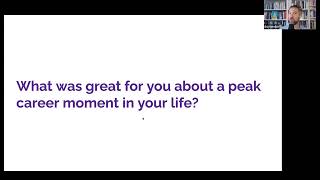
Hello and welcome to this virtual talk for the Wonder Tech Fest. I'm here today to talk about crafting a career vision. And first, let me start by introducing myself. I'm Eric Nerlik and I work as an executive coach, helping leaders to have more impact. I do that by drawing my own career where I worked in the tech industry for over 20 years, first across a number of different startups as an engineer and product manager, and then for 10 years at Google working in business strategy and operations, eventually leading the search ads team at Google in its business strategy and operations for over six years as chief of Staff. For the last five years, I've worked as an executive coach, working with dozens of leaders to grow their effectiveness. I'm here today to share some of what I've learned on my personal journey and what has helped my clients be more effective in their journey. We're going to start with this quote from Arlen Hamilton. Let me share my slides because that's going to help. Arlen Hamilton said, the first step is to decide why you're doing what you're doing. Ask yourself, why do I care about this? What is my mission? Knowing what your intentions are will help you bring about your goals. You can't reach your goals if you don't know what they are. Let me say that again because it's really important. You can't reach your goals if you don't know what they are. Arlen Hamilton started off with nothing. She didn't have any money, she didn't have any connections, but she knew what her goal was. She wanted underrepresented groups, people that looked like her, people that didn't fit the standard venture capitalist profile to get funding. And she was so clear on it, she wrote a press release. I will have funded 100 companies by 2020. She actually reached that goal in 2018, but she didn't have connections. She just flew to the, flew to San Francisco, slept in the airport and took any meeting she could get her hands on. And she raised money and she fulfilled her goal because she knew what she wanted and she did whatever it took to, to move herself towards that goal. And that's the first thing we need to do. If you're going to craft a career vision, where are you trying to go? What does a great career look like for you? Let's start thinking about that and we'll look backwards to look forward. I want you to think about your career so far. What was great for you about a peak career moment in your life? What is a project you were so proud when you completed it. What is a time when you were so excited to work you couldn't wait to get to the, to the office because you were like, this is so cool what I'm doing every single day. I'm so excited. The impact I'm having. I'm excited by my teammates, I'm excited by the work I'm doing each day, whatever it is. Think about for yourself what made this experience great for me. That, I think is the essence of your vision. And people say, like, that's not a career goal. A career goal is like, I'm going to be a CFO in five years. Yeah, it could be, but that's the output. That's the what comes out of pursuing a, a career that fits you. What I found is the people that go the furthest are the ones that are genuinely excited by what they do on a day to day basis who are motivated by the work they do. So that's what we want to tap into. What is your fuel for your career? What energizes you? What makes you so excited that you can't imagine doing anything else? I'll give an example from my own experience here. At one point I'd mentioned I was an engineer. I was working as a software engineer at a software startup. And our lead engineer, Brett, was an amazing engineer. He was on top of all the latest technologies. He did some great work. He was the most senior engineer for a reason. We went out for beers on a Friday night. I said, hey, Brett, what are you up to this weekend? He said, eric, you know what's awesome? I was like, no, what's awesome, Brett? And he said, my fiance has to work late tonight. She's not going to get home till midnight. That means I can go home and code for four more hours. Isn't that awesome? I was like, whoa. But you know what? It is awesome. He loved what he did day to day so much that when he had an unexpected Friday night free, what was he going to do? He was going to do more of it. And that's why he was so great at his job. He was spending that time teaching himself, getting better, crafting his work, getting better at his craft. That's what he was doing with his free time. And that was a moment of realization for me because that is not what I was doing with my nights and weekends. I didn't love coding and I looked at the future and it's like, I will never compete with somebody like Brett because they're going to always be ahead of me and get ahead faster. Because they love it more. Fortunately, I was able to look at myself and say, like, what did I care about? In the same way? And if you're watching this video, you can look behind me and see what I was doing. I was reading books, I was writing about leadership, business, management, culture, strategy. These are the things I was doing in my free time. It took me 10 or 15 years to figure this out, but now that's what I do for my job, also as an executive coach. That's why I feel like I'm great at my job, because I love doing it. It's what I want to do. As you look ahead to craft your dream job, let's ask some of these questions. If you look at your day to day work, what energizes you? What brings you energy? You're like, yes, I want more of that in my life. Let's pay attention to that. And let's look at what drains you, where you're like, ugh, I can't bear facing that. How do we get less of that in your life? Maybe you can trade jobs with somebody else or trade tasks with somebody else. Turns out the things you find draining somebody else might find energizing. I know it's hard to imagine, but there are people that love accounting. I don't, but somebody does. And you need to find those people and partner with them. That's partially what I mean by that. Third question. What supports you in being your best self at work? Because that's what we want to think about. What helps you be your best self at work? And let's create that infrastructure around you that's finding the right teammates, maybe the right manager, maybe the right job responsibilities. But as you start to get clear on what helps you be your best self at work, you can aim for it. You can't reach your goal if you don't know what it is. This is what we're talking about. And then lastly, let's talk about meaning and purpose. Where are we going? What is the impact we want to have? How can you connect your day to day work with that impact, with that purpose, with the impact with helping others in the way that you want to help them? If you want to go in more on this topic, by the way, I should want to mention I have a book, you have a Choice Beyond Hard Work to Meaningful Impact, which is a whole book devoted to unpacking some of these questions. Those are the kind of questions that you can use to start crafting your goal. Where do you want to navigate? Where do you want to go with your career. Then you start navigating. I don't know what your ideal job's going to look like, and probably neither do you. But what I do know is you can experiment, try things. Hey, that looks interesting, let me try that. And you can do it in small ways. Instead of saying like, oh, that job looks interesting, let me just drop, quit my job and do it from now on. Instead you say, hey, let me take three meetings with people who are doing that job and see if I'm still excited after I talked to them. Let me try a task from that job for one hour a week. By the way, these are the tactics I used when I went into coaching. I started coaching people one hour a week. I interviewed five professional coaches and asked them how they got there, how they got started. Both of those confirmed for me that I was excited about coaching and I took it one step further. I enrolled in a year long class to get better at coaching. These are the kind of steps I took step by step by step. I compare it often to climbing or hiking up a mountain. You can see the mountain peak way off in the distance, but you can't get there in one step. What you do is you take one step in the direction of that peak and another step and another step. What's important is you keep taking steps. The steps add up and maybe you don't know the exact right step to take and that's okay. You'll take a few steps in the wrong direction, like, oh, nope, the peaks moved over there. Okay, I got to turn back that way. So even if you take a job that's not a perfect fit, learn from it, figure out what works for you, what doesn't, and then use that to pick your next job more effectively. Keep navigating. What I tell people is if in each job you can do a little more of what energizes you and a little less of what drains you, it's going to add up and eventually you're going to get to a pretty good place, which is one I have gotten to as an executive coach and why I wanted to share this approach with you today. So if you want to sum up this talk, I refer to the great American philosopher Dolly Parton, who once said, find out who you are and do it on purpose. That's what I think it means to craft a career vision. Figure out where you want to go, what does it look like to being your best self at work, and then go do that on purpose. If you want to learn more, you can write me@ericomantrees.com you can also take a QR code of that that will get you the introduction chapter of the book that I mentioned. And I just want you to go away with this question. What are you going to change in your job to align your time with what energizes you. Thanks for your time and please send me feedback. I'd love to hear from you. How do I.
More from Eric
Eric Nehrlich: You Have a Choice: Creating the Relationships & Career You Want, and Why We Get Stuck