Creating Organizational Alignment
Eric Nehrlich, former Google executive and current coach, explains how alignment between leadership, strategy, culture, and operations creates competitive advantage. He outlines four pillars: cohesive leadership team, clear purpose and vision, defined values, and strategy clarity. Concrete tactics include building psychological safety, over-communicating, saying no to protect focus, and aligning incentives.
Chapters
Thank you for your time today and we're very excited to hear from you.
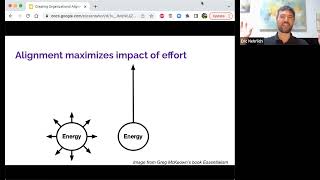
Great. Thanks for that introduction and thanks to all of you who chose to join me here today. I really appreciate you taking the time to hear about this talk on creating organizational alignment. So you already heard my background. Former software engineer, former product manager, former chief of staff. And kind of through all of this, one of my driving forces is how do I help people be more effective? How do I help them have more impact? Right now that plays out for me as an executive coach, helping leaders have more impact. But I've also always been curious about how to have organizations have more impact because I love teams. I want us to create things together. This talk is a chance for me to share a little bit of what I've learned along the way. Before I get started, I just want to be clear. This is based on my experience. These are frameworks I found useful in my own career and they've been helpful to my executive clients. I do refer to many ideas from others, but I won't say that I represent them. I just represent my own interpretations of their work. You are the expert on your situation, so I want you to take what's useful from this talk and apply it. If it doesn't feel useful, it doesn't feel right. Speak up. I'm going to leave, hopefully leave around 15, 20 minutes at the end for questions so we can have a conversation. And you can always reach out via email as well. And with that, I'm actually curious before we get started, what attracted you to this talk? Why are you here? What do you hope to learn? I'd love to get some answers in the chat if you're willing to share. Anybody? Okay, no responses. How do I like my leadership team? Well, that's what we're here to talk about. Anybody else? Okay, well, I'll go from there and if things come up throughout the time, so we'll go with that. More alignment across all the efforts in the org, from strategy to culture. Yep. Motivate people to change. Thank you, Jeffrey. Cool. So I'm going to share a little bit of what's worked for me and some stories along the way and let's hopefully I'll address them what you're talking, what what you are here to learn. But let's start with the advantage, which somebody just mentioned. I really loved this book when I read it several years ago and as a way of really understanding what makes organizations more effective. And Patrick Wancini says the single greatest advantage any company can achieve is organizational health or As I call it alignment, when its management, operations, strategy and culture fit together and make sense. I wish I could say this was easy. And instead, it's vanishingly rare. In fact, one of my first experiences, my second job after joining the workforce was with a company that completely failed on pretty much all those funds. Complete lack of alignment across the organization. It was a biotech startup. I was the first software engineer hired, and it seemed to be doing well, the work we were doing. The work I was doing shouldn't say I was doing. The work the technical team was doing was pretty amazing. We were doing stuff nobody else in the world could do. We were hitting all of our milestones. We were making great progress. That progress allowed the leadership team to raise $40 million in 2001 in the middle of the dot com crash. I was like, this is amazing. We're going to do something great here. A year later, that company was bankrupt. $40 million flushed out the rate of the year. How did that happen? Well, obviously some terrible business and leadership decisions. What it showed me as an engineer at the time was it didn't matter how good an engineer I was if the leadership was terrible. Leadership is a multiplier. If it's terrible, it can take all the great efforts and skills and contributions of its team and turn them all to zero. And that was devastating to me. I'm like, what's the point of being an engineer? Everything I can do could be wasted by bad leadership. And I often say that's my origin story as an executive coach, seeing how terrible that leadership was, maybe want to improve leadership, maybe want to either be a leader myself or help other leaders become better. And that's what I do now as executive coach. The other thing I'll say here is that a little bit of this talk was actually born out of a conversation I had with the chief of staff client about a month ago. She was trying to make sense of what was her job. She was like, I had this conversation with the engineering team, aligning them to customer problems. I had this talk with the finance team about budget, how we're prioritizing resources. I decided to talk to the marketing team. So I had all these little nudges, but I didn't do anything. What I told her and what I'm telling you now is your job as chief of staff is to create this kind of organizational alignment, this organizational help. All these nudges are to enable this to bring people together so they're lined up so that fits together and makes sense. You help to orient the team around what matters. So before I get into the meat of the talk, I want to talk a little bit about why alignment matters. I think most of you know this. I'm going to try to go through this pretty quickly. But there's this idea that most of us have that you work hard to get ahead. It's about building to get to the next goal. So in school, we work hard to get into a good college. At college, we work hard to get our first job. In our first job, we work hard to get that first promotion. And on and on and on we are rushing. Always saying, are we on the right track? Are we getting there? Are we keeping up? And there's always a question I have like, where's the there there? We're working so hard, we're pushing so hard. Sometimes people are just running in circles. Where are we actually going? What is the there we are aiming for? If we're working hard without a clear destination, we could very well end up running in circles. That's not impact. Another visualization of this is from the Greg McCune book Essentialism, where he talks about how energy can be spread out. If you take your energy and you spread it out in all directions, you work on eight different things, you only make a little bit of progress on each of those things at a time. If you take that same amount of energy, same amount of resources, and focus it like a laser in one direction, you have a lot more impact. I was fortunate to have a director explain this to me early in my time at Google. He was very impressive in the sense that he was just a director, not a vp, not an svp. But he had the ear of executives at Google all the way up to the CEO and cfo. He could walk into a room with them and change their mind about the strategic direction of the company. And the impressive part to me was that he did all that and went home at 6pm Everybody else I knew, including myself, was a workaholic at that time. I was working something like 8am to midnight most days. I'd occasionally take a Saturday off and this guy's walking home at 6pm I think he was playing in a band. I'm like, wait, how are you having that kind of impact without the level of effort I'm seeing from everybody else? So I asked him and he said, well, Eric, I come into work and I work on the most important thing first, and if I don't get to the next thing, that's okay. It wasn't as important. Seems simple, right? Seems almost too obvious to be true. But let me tell you what I was doing at the time. I would come into work at 8am and immediately start answering all the emails in my inbox from anybody that reached out to contact me. Then I go off to start my meetings for the day. I'd be in meetings all day from anybody to put time in my calendar. And then I get back to my desk 4 or 5pm, I answer all the emails that came in throughout the day and then it would be 6pm And I had them started on the one thing I had to get done that day, the one thing that only I could do, the most important thing. And I'm not starting on it until 6pm and that's why I was there till midnight every night. This guy, let me tell you, he didn't respond to emails, he didn't go to meetings that he didn't care about. And that's why he was able to have that kind of impact. And the hard thing about this, because I want to call it out, is like that meant to piss people off. People wanted his time and attention and they didn't get it and they didn't like that. And he was willing to endure that discomfort. He's willing to put up the bat because he knew the lesson of this slide. He knew that if you put his effort into the one thing, that's the things that mattered the most important things, he would have more impact. And he was willing to disappoint other people. He's willing to blow them off and have them be mad at him to do that. Keeping people happy wasn't his goal. Having impact was. So when we're aligned we can maximize our impact of the effort that we have. So let's get into what Lencioni actually says about creating alignment. He kind of has four high level points. Build a cohesive leadership team, which I'll talk more about in the next couple of slides and then create clarity. Clarity around purpose and vision. Where are we going? What is the most important thing we're doing? Clarity around values and culture. How do we do things here? How do we make decisions? How do we stay aligned? Clarity around the strategy, what's our method? What's our plan to get to our goals, get to move towards our vision. And once you create that clarity, you have to over communicate it. It's not enough to communicate at once, not to say here's the vision, keep it in mind, it has to be repeated more times than you might think is necessary. In her book the Making of a Manager, Julie Zhou, who used to write who used to run the design team at Facebook says, assume that for the message to stick, it should be heard 10 different times and said in 10 different ways. It's not enough to say it once people forget things, they say it once, you have to repeat it until you're sick of saying it and they're sick of hearing it. Then maybe the message you want is going to stick. And lastly, you have to reinforce the clarity. If your values, if your vision are not reflected in your operations and your process, you're not going to get what you want. Incentives matter. We all know companies that say, yes, we value teamwork, Teamwork is important, but they promote. The obnoxious asshole puts his teammates down. We know what they really value. When that happens, when things aren't aligned that way, it sends. It's almost more damaging because it's like, then we know there's a disconnect. We know that what people say can't be trusted. Creating this alignment between what we say, the clarity of vision, culture, strategy, and what we actually do in the form of process and operations is so critical because that keeps everybody really pointed in the same direction. One thing I'll say here is that again, this is the job of the chief of staff. The four things I have on the right side of the slide are the four pillars that were used to evaluate the chiefs of staff at Google. When I was there, they created a product operations ladder, career ladder for chiefs of staff. And these were the things they evaluated chiefs of staff on. Leadership strategy, create clarity, communication over, communicate that clarity. And operations reinforce the clarity. In other words, your job as a chief of staff is to create this alignment. So that's the message I want you to take away from this. This is really important. It's the single greatest advantage according to Patrick Lencioni. And it's your job to help create it. And you might be saying, like, well, I can't control these things. I don't control promotion cycles, I don't control resource allocation. I am not in charge of doing these sort of things. How can I create this kind of alignment? My answer is you can lead from anywhere in the organization by doing what you can towards each of these goals. Creating clarity. Maybe you have insight into what your leaders are actually thinking and you can translate that into what other people hear. There's a lot of value in that. Here's the story, here's why we're doing, we're doing, here's the trend that the strategy is designed to address the challenges or the opportunities and then communicating that outward Telling that story over again in forums, from one on ones, group meetings to all hands and the operations you do control, how can you make them align with that vision and strategy? There's opportunities to do this if you kind of have this mindset that this is your job to keep on working on this. So I'm going to start by going back to the first step here. Build a cohesive leadership team and talk about two different styles of leadership. One is hierarchical power. That's the one we all know. Command and control. The person in charge, the CEO sets the vision, they set the strategy, they tell everybody else what to do and it's passed on down the ranks. And the VPs tell the directors, the directors tell people and blah, blah, blah, all the way down. And this works. It's been effective for decades as a way of getting things done in our companies across America. But it has limitations. And I think we all know that if there's something that people are seeing and it doesn't get passed up to change, the decisions made may not be aligned with reality. That's what happened at biotech startup. I would say those of us on the front lines actually building stuff in the labs knew that what the leadership were planning to do wasn't going to work. But they weren't willing to listen to it, they didn't hear it. So they kept on making poor decisions that led to bankruptcy. And it's not motivating to be treated like a cog at the machine, to feel like your job is just to execute on the orders you're given and not be given a chance to contribute yourself. The funny thing I've learned is that after starting to coach CEOs and other executives is that they hate this model too, because they feel this burden, this burden of this guy who feels responsible to get the right vision, the right strategy, the right things to do. It's all on them. They feel the crushing burden of responsibility by doing this all. So it doesn't work for both sides. And what I call alignment leadership is much more inclusive. It's like let's pick a vision together. As a leader, I set out a vision and say, this is where I want to go. What do you think? Would you like to join me? And then each of us contributes a piece of the puzzle. Each of us helps move towards that vision together as an organization. Yes, there are times when the person in charge has to make a call because there's difficult trade off and we'll talk about that later. But this idea where everybody contributes, everybody's involved Everybody's treated as partners and moving towards this vision, I feel like it's so much more powerful and effective. And yeah, that sounds nice, but is it actually more effective? Google did a study where they studied almost 200 teams and looked at the highest performing teams to see what made them different. And what they expected to find was the people on the team would make the biggest difference. You put superstars on a team, you get superstar output, but that's not what they found. They found that how a team works together mattered more than who was on the team. These are the characteristics they found for high performing teams. Psychological safety is number one. Do people feel safe to contribute? Do people feel safe to take risks and be vulnerable in front of each other? Dependability. Do people actually deliver on their commitments? Structure and clarity. See that word clarity again. People have clear roles, responsibilities, plans and goals. They know who's going to do what. Meaning is the work important to members? Is the vision something they're aligned with and impact? Do they know how they're contributing to the puzzle? So it turns out this idea of alignment leads to high performing teams. And these are some of the steps it can take to get there. There's a lot more I could talk to you about here, but I'm going to move on to the second part of the talk of how do we create this clarity? How do we create it, communicate it and reinforce it? And let's start with purpose. This is Arlyn Hamilton, who's a black, queer woman venture capitalist. And that's not even the most amazing part of her story, which is that she decided to become a venture capitalist when she was homeless in 2015. She was reading business magazines, trying to figure out what she wanted to do next, and she saw venture capitalists investing in people that didn't look like her, people that all looked the same. White Stanford MBA boys. She's like, you know what? I think there's an opportunity here to invest in people that look different, people with different point of views, people that she calls underestimated. And now she's raised over more than $15 million and invested in over 170 startup companies led by those underestimated founders, people of color, people of LGBTQ people, et cetera. And in her book, It's About Damn Time, she kind of clarifies how she got there. The first step is to decide why you're doing what you're doing. Ask yourself, why do I care about this? What is my mission? Knowing what your intentions are will help you bring about your goals. You can't Reach your goals if you don't know what they are. Let me say that again. You can't reach your goals if you don't know what they are. What this is, create clarity. Where are you going to go? What's the vision? In her case, even when she was homeless, even before she'd raised $1, she wrote herself a press release saying she was going to showing that she had invested in 100 startups led by underestimated founders. She dated that press release, 2020. She said, I'm going to figure out how to do this in the next five years. She pulled it off in three. She passed that milestone in 2018. Super impressive story, and I'm just a huge fan of hers. Let's think about this. Why does your organization exist? What is your purpose? What's your clarity of where you're going and your mission? Some questions that might help you answer that are, who are you serving? Who are your users? Who are your customers? And what problem of theirs are you solving? I often say that a business isn't a business unless it's solving a problem for people that they will pay you to solve because you need money. And if you're not creating enough value and not solving a problem that's important enough for somebody to pay you, it's not a business. Might be a cool technology play, might be a fun hobby, but until you are adding value so much so that people will pay you, you don't have a business. So why does your organization exist? Are you clear about that? Are your leadership team clear about it? Can you repeat it in one or two lines to anybody at the company? Anybody asking, okay, that's fine, that's nice. Why does that even matter? How will that help me get things done? Here's why. Focus. Steve Jobs says people think focus means saying yes to the thing you've got to focus on. But that's not what it means at all. It means saying no to the hundred other good ideas that there are. In other words, without this clarity of purpose, without this clarity of strategy, without this of what's important, you're going to chase everything. You're going to go in all directions. Like that picture from essentialism. Every customer complaint is going to be a fire drill. Every problem you find is the biggest thing facing the company, and you're going to spend all your energy going in all directions, and that's inefficient. With clarity, with this alignment, you can say no to good ideas, things that could very well add value to somebody, but if they're not the target audience. If it's not the target problem, let's say, you know what, that's important, somebody should do that. But we're going to focus on this. This is where we are focused. This is how we stay on track to move towards our purpose together. And that's how you take the energy of going in all directions and you focus it in one direction. The other part of this is that when we're too eager to say yes, to show that we can do everything, we end up with too many commitments and we don't have enough capacity fulfill them. We take on 10 things and deliver five. And that's not great. That is not dependable using that characteristic of a high performing team. People can't rely on you to get things done. And that applies at the personal level, even as a chief of staff. And it applies at the organizational level. What are you committing to your customers, to your partners, to your employees? Can you deliver on that? And I've got to tell you, the way out of this is not to try to increase your capacity, Try to work even more hours, because you can do that for a while. And I did it, remember, 8am to midnight. And it worked until I burned out. There's only so much time and attention you have in a day, in a week, and you have to be thoughtful about what you're going to do with it. What is the most important thing? What can only you or only your organization do? And then the hard part is saying, no, I can't do that, or not, I can't do that, but I won't do that. That feels scary to say. Won't the other person be disappointed? Yeah, maybe. But I think of it this way. If I say yes to them in the moment and I make that commitment and then I don't deliver by the date they need it by because something else came up and I was too busy, the other person is screwed. They don't have options because they were depending on you. On the other hand, if I have five things on my plate and I can handle five things and something else comes in, say, you know what, that's important, somebody should do it. But I've got these other five things and those come first. The other person now has options. They can say, you're right, we'll find somebody else to do it. They can say, you know what, we'll wait. After you get done with those five things, I want you to do this next. They can say, you know, I looked at your five things and here's why. My thing is More important than what's on your plate right now. The key is you have that discussion up front rather than after you've missed the deadline, and there's no more option for the other person to employ or other options they can explore. So the key message I want you to take away from this part of the talk is clarify the purpose, to focus your commitments, to be able to say no. James Clear, who wrote the book Atomic Habits, has an article called the ultimate productivity hack is saying no. And in there, he has a killer line where he says, when you say no, you're saying no to only one thing. When you say yes, you're saying yes to every other possible thing you could do with that time, energy, and attention. So my message to you is, be frugal with your yeses, frugal with your commitments. Don't commit in the moment. Take some time, think about it before you make that commitment. One exercise I often give to my leadership clients is to go on a. I don't know, maybe a diet, but be able to never say yes in the moment. Basically never make a commitment in real time. So they're in meetings throughout the day, 10 meetings, 15 meetings, whatever. And said, don't say any. Don't say yes to anything during the meeting. Say, let me check my other commitments and I'll get back to you at the end of the day. And then at the end of the day, when they're not in the heat of the moment, they can look at everything they were asked to do that day and compare it to everything that's already on their plate and go, oh, wow, what can I actually realistically get done? And it's not everything. And if they'd said yes in the moment, they continue to be overwhelmed. So that's a little tip that maybe you can try if this is a problem for you, give me one second, take some water. I'm going to move on to values and culture. How we do them, not where we're going. And I'm inspired here by Ben Horowitz, who's one half of Andreas and Horowitz, the venture capital firm. And in his book, what you do is who you are, he says, your culture is how your company makes decisions when you're not there. It's how they behave when no one is looking. This is why culture matters. This is why values matter. It allows for operational efficiency. If you know how to make decisions, you don't have to go to your boss to say, what should I do here? Because you know, you know how to break ties. There's too many values in the world. There's too many things you could do and they're all good. And just like the Steve Jobs quote, what are you going to say no to to enable a yes to the thing that you're really committed to. One example of this is the Facebook motto, move fast and break things. Speed of execution is really important. It's great to have quality is really important. Not breaking is really important. And Mark Zuckerberg said, you know what, I want speed of execution over anything else. You can break things if you move fast. And they made that a motto. And everybody in that engineering org knew what to do if that came up. If there was a debate between values, do we move fast or do we risk breaking things? They're like, yep, we're willing to break things. We're willing to sacrifice quality for speed. And that meant you didn't have to go to the directors or VPs to make that call. Engineers knew it in their bones what to do and that allowed for faster movement. Similarly, I was fortunate to witness a culture setting moment like this early in my time at Google. It was the summer of 2009, at the depths of the great recession. Google had just delivered its worst quarter ever, 5% year on year revenue growth. And the leadership team of Google was trying to figure out what to do. I was in the room as a financial analyst because I was the expert on revenue forecasting and got to see this cool moment because the ads team came in and said, you know what, we can accelerate revenue growth. We can add a billion dollars to our revenue this year. Billion with a B. And that'll increase our year on year revenue growth rate by 5%. And so the leadership team says, well, that sounds good. What is this going to cost? And they said, well, it'll set us back on user experience by 2% according to our metric. It's about six months of progress we'll lose. And me and the fine as the finance guy in my head, I'm like a billion dollars for a 2% user experience hit that. Nobody will notice. Sign me up. Let's take the money. Eric Schmidt said, no, absolutely not. We will never sacrifice user experience for revenue, period. It was crystal clear. That's what he stood for as a leader. I still get goosebumps telling this story 13 years later because that clarity of values, that clarity of culture rang so true to me in that moment and it was so powerful to witness. And everybody in that room knew to go back to their teams like, yep, we're going to focus on User experience, focus on the user and all else will follow. That's what they did. To be clear, I'm not saying Google still runs with that kind of value, as clear as it was then, but at the time it really struck me. It was one of the reasons I was proud to work at Google for as long as I did so. Values and Culture how does your organization behave? What hard trade offs do you make? What shocking things will you sacrifice to get the value that you really that really matters to you? One way to understand what your organization rewards is. Well, one way to understand your value is to understand what your organization rewards. In other words, who gets promoted. I mentioned this before. If you look at the people that get promoted, that's what you're rewarding. You get more of what you reward. Incentives matter. So just think about that for a second and think about what are the values in culture that are exemplified by your leaders? How do they make decisions? What do they value? What are exemplified by your processes? What's reinforced by your hiring and promotion processes? I don't know the answer, but something to think about. What messages are you sending to everybody at the company with those processes? And again, you may be thinking to yourself, well, I'm just a lowly chief of staff. I don't have impact over all these things I don't have. I can't affect hiring, promotion, I can't affect what our leaders do. But what you do have is the power of conversation, of direct feedback, alignment. Happens one conversation at a time. So the example I just gave of like you get more of what you reward. Yeah, that's true with bonuses and promotions and stuff. But you know what else is true for positive feedback? Praise. This is one of the tools I used consistently as a chief of staff. Somebody did something that was really helpful to the strategy, to what the org was trying to do, I would let them know, like that was really helpful. Here's how that's advancing our strategy. Here's how your work has meaning, here's why it matters. People love hearing that. They want to understand the meaning behind their work. And you can deliver that as the chief of staff, you can translate the high level purpose and culture and strategy into conversations with a person, one person at a time. And you can also call out when things are misaligned. A military leader, General David Morrison, gave a speech a few years ago where he said the standard you walk past is the standard you accept. In other words, if you walk past, you let something slide. That becomes the new standard. Ben Horowitz leads off his book, what you do is who you are, with a story of that. When he was CEO of Loudcloud, he found out a sales leader on his team had been lying, cheating his numbers for years. And because that person had been promoted, everybody else in that organization had decided that cheating and fudging your numbers was the way to get ahead. Horowitz was mortified. He was like, that's not the culture I intended. But because he let it slide, he had never dug into what was happening behind the numbers. That's the behavior he got. The last thing I'll say here is, this requires, as I said, direct conversation, direct feedback. One of the things that one of my favorite moves as a coach is when a leader comes in and starts telling me a story about somebody else. They're like, this is what this other person's doing. This is what I'm worried about is going to happen. And if this doesn't change, I don't know what I'm going to do. Like, that's great, but don't tell me. Tell them I can't change that. I can't change their behavior. You have to tell them they have to change their behavior. And as soon as I say that, they're like, well, I could never tell them. What if they get angry? Or what if they get really upset? What if they say I'm wrong? I can't tell them that. I'm like, okay, so you're telling me that in your head you're worried about this thing happening and you're not going to tell the person involved what you're looking for, what you're expecting? Does that seem fair? You're going to judge them on criteria they don't even know about? I'll be honest. I don't always play fair as a coach because I'm pretty sure there's a right thing to do here that's to talk to people. So building on that, this is how I have kind of come to believe that you create alignment and trust with others. You set and communicate clear expectations. What do you expect of them? What output do you need? What do they have to deliver? I can't tell you the number of times leaders I've had a conversation with a leader where they're like, I just want them to show some common sense and do the thing. Who should do it? What does common sense to you in this case look like? As soon as I started asking these questions, they're like, oh, I guess I never made it clear what I actually wanted. Like, yep, set clear expectations. And then you have to secure commitments. I was never. I didn't really realize how powerful this was until I heard a podcast interview with. Robert Cialdini is one of the foremost researchers on influence and persuasion. He told a story about a restaurant that had too many no shows. Oh my God, somebody's at the door. Hold on one sec. This is embarrassing. Sorry about that head of delivery that I've been waiting for. And of course it came while I'm giving a talk. Cialdino was telling the story about a restaurant that had too many no shows for the reservations and he listened in to what the maitre d was saying to customers. He said, I want you to make one change. After you take the details of how many people and what day and time say, and if your plans change and you're not able to make it, will you please call us and let us know and then wait until they respond? Yes, yes, I will call. Waiting for that response. That one word, commitment lowered the reservation no show rate in half. That's how powerful it is. When we say something out loud to another person. We make a commitment and we are wired as social beings to follow through and hold that commitment. Ginny calls it the principle of commitment and consistency. So it's not enough to say, here's the vision, here's the expectations. Go do it. You need to go have that conversation. Will you commit to this? Are you on board with this vision? And if not, let's talk about that. The nice thing though is once you have that commitment, then you can hold people accountable. You can ask, what happened? Why didn't we get what we said we wanted? You said you deliver X by this date. It didn't happen. And I'm not saying accountability in like the high school football, you miserable person. Why didn't you do what you said you'd do? But I'm just thinking in terms of like, hey, what happened? What resources do you need? What could we have done differently to support you getting what you needed done? And I consider this a feedback loop because as you hold those accountability conversations, you can set new expectations that are more realistic, that are more in line with what they can actually deliver, more in line with their capacity. You secure new commitments and hold another accountability conversation. You keep going around this loop until everybody knows, has the structure and clarity to know what they're supposed to do and the dependability to deliver on their commitments. That's how you build a high performing team. So one last point and then I'll move on to questions. There's going to be misalignments there's going to be times when, despite all your work and trying to create the clarity over, communicate the clarity, reinforce the clarity that things still don't line up. As I was referencing in the previous slide, I invite you to start with curiosity. Start by assuming people are doing the best they can. Then the question I like to ask myself is what must be true in their world but not in mine? That would explain their behavior. That would explain why they're behaving differently than what I think. One tool that can help with this is something called the ladder of inference, which a guy named Chris Argarus came up with, which points out how many steps there are between what we observe, what we actually do. We observe lots of things on a day to day basis. So we have to filter, we select. What do we pay attention to based on a selected subset of what we observe, we make meaning of it. We tell a story. This is what this selected set of data means. Based on that, we draw a conclusion. Based on that, we make beliefs. Based on that belief, we take action. There's a feedback loop here because our beliefs then help us, then set what we filter for next time. What do we continue looking for? When I say in the final bullet point here, find the common ground. What I mean is work your way down the ladder of inference until you find where there is commonality, where you agree on what's happening, where you agree on the assumptions, the meanings. And from there you can figure out, like, why do we differ? What do I see that they don't see? What do they see that I don't see? Or what are their goals? Maybe their goals are different than what I thought they were. One story, that's for me, it was a revelation when I finally figured out that for the most part, salespeople care about how to beat their quota. And anything that I wanted them to do, if I could put it in terms of how it would help them beat quota, they would generally do it. It's embarrassing to say it took me like 10 years to figure this out, but eventually I got there. But this is true of almost everybody. If you understand their motivations, if you understand what they care about, and you can put what you want them to do in terms of what they care about. That's how you have influence. That's how you start building this alignment. To wrap up this talk, I'm going to refer to the great American philosopher Dolly Parton, who once said, find out who you are and do it on purpose. That's the basic message of this Talk Creating organizational alignment is critical. It's a key part of your job as Chief of staff. But to do it you have to create that clarity, find out who you are and then you have to do it on purpose. You have to over communicate it. You have to reinforce that clarity and do it at every opportunity by communicating directly your expectations to others so they know what you're trying to do. They know what alignment means. So that's it. I'm curious, what will you do next to create alignments in your organization? If you have any thoughts on this talk or anything, want to share what you've learned? I'd love for you to write me@ericomatrees.com and the slides are available at too many trees.com alignment so I've got about 15 minutes here for questions and would love to hear what you have to say. Thanks.
If you have a question, please feel free to raise your hand or just come off of mute and I'll spotlight you and bring you to the top. And of course Eric, if you know, if not, I'll be happy to coordinate you guys and make sure we get all this content over to you. Does anyone have any questions? This is actually absolutely great talk. Looks like we do have someone. Serena, go ahead and come off mute. And Eric, if you would like to unshare your screen, we'll bring the focus to everyone here.
Thank you.
Sounds good.
Thanks Eric. I'm going to stay off camera because my wi fi is terrible right now and so I've been cutting in and out. But this was really helpful Eric, and I'm curious how you've seen organizations drive alignment where when you're at that point of scale, what you're often seeing at the leadership team is that there's still some leadership development that needs to happen, especially when it comes to things like accountability, goal setting, being able to communicate communicate how their respective teams priorities may plug into the strategy. There's just a few things here and there depending on what leader you're looking at. So how have you helped bridge the gap? Or what are some tips of bridging that leadership development gap with where you're ultimately trying to grow and scale and drive your leadership team to It's a big question.
I mean the selfish answer is executive coaching. No, but I think the main thing is to actually call it out. What often happens is you keep relitigating the same issues over and over and over again and it comes up in every meeting between different functions. After that happens, a few times somebody has to call out, say hey, we keep having the same pattern, the same kind of disagreement. Can we talk about that directly? And you get the leaders of those functions into a room and you say like, can we get on the same page here? Because this is dragging both of our teams into the same disagreement over and over again until we get aligned at the top level. It's just going to cascade down to the rest of the organization and maybe that you're not able to, you know, induce that kind of conversation yourself, but that's where you can lean on your principle and say, like, hey, this is what I've seen. Can we, can we make this conversation happen? I don't know. That's my first thought. It's like, call out the pattern and address it directly rather than try to nudge around behind the scenes because otherwise it's too easy to just let it keep sliding. Does that make sense?
It does make sense. And I think that's where some of the more nuanced roles of the chief of staff come into play. You know, managing, you know, people's development path, people like respecting kind of where the accountability lies and not, you know, becoming the manager. But it makes a lot of sense. And I think they're defining when the principle needs to come in and when you can manage it yourself is key. So thanks for that.
Yeah. The other thing I'll say is, I meant to say this somewhere earlier in the talk, but like, this is one thing where you can keep bringing people's attention back to what are we all here to do? Why are we all here together? We're not playing for the marketing team or the sales team. What's the organization team trying to get? What's the organization trying to get done? Where are we trying to move as an organization? Having some questions like, how does this help us move towards our goals? How is this helping us move towards this organizational goal together? Kind of reorients people away from protecting their own turf, which is understandable. People get. When people are scared or insecure, they tend to go towards, let me keep what's mine, let me protect myself, let me get defensive. So there's also some work that needs to be done in that situation around vulnerability and helping people trust each other and believe that they're actually on the same team trying to get stuff done together. And that's a little harder to unpack as a chief of staff. Like that is the case where, like having an external facilitator come in and kind of lead some trust building exercises might be the right thing to do, but that's that's beyond the scope of this talk.
Thanks, Eric.
That's helpful. Sure thing. Anybody else? Okay. Quiet crowd here. Well, if there's anything else that comes up for you, you have my email address. Feel free to reach out. I'd love to hear from you. And thank you again for taking some time to be with me here today. Really appreciate it, Eric.
Thank you so much for your time. Thank you again, everyone for coming today. Obviously, we'll upload the session so everyone will have access to it. Eric, thank you for putting your contact and the slides up. We'll be sure to get it to everyone. Have a great rest of your week, everyone. Thank you so much.
Sounds good. Bye, everybody. Hi, Carol. Good to see you. Thanks for inspiring the talk.
Yeah.
I'm so sorry I was late. I. I was coming from another meeting.
I was like, oh, no, I'm missing out. No worries. We'll talk again soon.
Yeah, sounds good.
Bye.
More from Eric
Eric Nehrlich: You Have a Choice: Creating the Relationships & Career You Want, and Why We Get Stuck