5 Key Takeaways from My Experience as Chief Speaker at NIST University
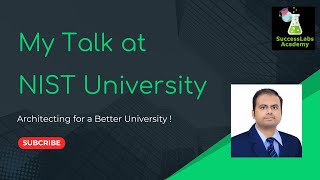
Dr. Niladri Bihari Nayak, who studied at NIST from 2006 to 2010, returned as keynote speaker to share his path through Wipro, PwC, Deloitte, and KPMG before founding Success Labs Academy in 2023. He credits the university's culture for his research mindset and offers students a framework of six Cs: curiosity, compassion, courage, community building, and commitment to care.
Questions this video answers
21 August 2006.
2006–2010.
About seven and a half years.
2018.
2021.
Chapters
Thank you sir. Thank you for inviting me for this occasion. So it's a homecoming for me. So we also met Alumni chapter meetup in December. Dr. Sukant sir was there and also entire team. So I was. It is my privilege to come here again and again. I was there also in 2016 when 20 year celebration was there. So I was part of that celebrations as well. Well so first of all thank you. Thank you for always remembering me. And also I remember all of you especially the faculties. I see no more. Many more faculties are not here. But still I can remember Jenna s there. Then recognize also pun and also other teachers Rakesh Roshan sir. So whoever has taught me during that point of time, right? So with that note so welcome. So I welcome all alumni who are here in present. So to start with first of all thank you Mr. Dr. Sukanth Mahapatra and Darshan sir vice chancellor BPT. I also product of BPUT at that point of time NIST was a part of BPUT so 2006 to 2010. So I was. I still remember that day 21st of August 2006 when I was here for orientation. And I was. NIST was not planned because my father actually thought I would be pursuing medical. I prepared for medical. And if you're not getting medical like these days also I can see some parents still doing that. So they're pushing their kid to either only two choice given Medical or engineering. So medical. If it's not happening then go for engineering. That's a default choice at that point of time. Now things are changing. But I will say that was the tradition. So traditionally people. Now people's mindset have changed but that was the default choice. I was not prepared for engineering at all. So I meanwhile I joined BSc Physics Honors at Calicot University at that point of time. But somehow I got a J rank and139. So my father told no, no no I will not be leaving to you and others district. Because I was born and brought up in Varampur itself. So NIST is there why to go for any other colleges here. So that was a choice. And I studied 2006 to 2010 and my electronics communications. And at that point of time I will say what NIST at the point of time I have seen lot of new changes happening here. It's not only in the Vision Mission that board. I was reading that yesterday. Vision Mission core values. It was always there but it is now reflected inside the campus. We can see that. And also I was looking at my. Your branches like Electronics, Communication or it's computer science. I can see the clearly mentioned program objectives, program outcomes that really I was very much impressed about it. It is not only the technology you are learning but also what the outcome of that at the end of the day of the Completion 4 Years program, right? So when I start after my completion of btec I got through Wipro as a campus placement from the campus itself. Then I started as the SAP abap. So people who knows it is a coding language SAP abap. So I started my career there. So and after that after having spending two and half years in Wipro I got in Hyderabad location and with Bangalore locations and multiple locations. Then I learned I was not more interested to coding. I was electronics communication guy more. I was looking more of a not that much interested in coding. So I thought what could be the better options for me. So I choose a mentor in the industry in Wipro itself. And I decided I will be pursuing MBA. And I pursued MBA from Manipal along with my job because it was going full time is not a choice because of financial constraint at that point of time. So I pursued my MBA from Manipal University parallel with my Wipro work. So I spent three semester in Manipal along with my job in SAP. Then I moved to as a part of the people say that distance universe, distance colleges or universities doesn't have a value okay at that point of time. So I part time job, part time studies doesn't have a value. But you have to create the value. I created a value for myself. So when I joined after through the through after completion of MBA along with my job. So I got through the first consulting options I got an opportunity from PWC Kolkata. So I see that PwC is hiring these days. But these those days PwC was not hiring directly from colleges like us. They were going to Premier colleges like IITs, IIMs, XIMB, all those Premier colleges they're very much selected. So many of my friends at the point of time asked me how do you got selected to PwC? They do not hire from NIST. I told them the DNA was always there the kind of. But I created the value for myself. So from the mba, whatever I pursued from Manipal and all. And that was my first breakthrough coming from small tiers, tier 3 cities like this and coming from other college like this. But I created the value for myself and the thanks to NIST for nurturing me, giving that mindset, giving that values, giving that kind of. You know. So I still remember those days continuously. Three summer courses I have done Oracle. I did Oracle I did second year, I did vlsi third year I did ccn. MMM medalists there SARS are there still. I remember those days. Those are kind of rigorous, those 100 minute sessions, very long 150 minutes lab sessions. So we that kind of academic rigor, the kind of you might not be liking now, but the students who are here. But you will feel that kind of consistency, that kind of focus. Okay. So if you are there then definitely it will be helping you in the long run. So whenever you are going for any research work or I'm pursuing now, currently I'm pursuing my corporate research along with my venture. So I will be coming to that point. So I after spending 2 years in PwC then I moved to Deloitte. So because those are the big four, you know, they compete with each other for the talent. Just like TCS enforces Wipro in the IT sector. So similarly with the big four, we have names like PwC, your Deloitte UI, KPMG. So I'm fortunate to work three of three of them. So after spending seven and a half years in Deloitte, I worked. I learned a lot from whenever I was working with Deloitte. And I will quote one of my quotes from the director who was human capital consulting director from Deloitte. He always because I was into SAP a lot of time the product evolves every six months. We used to have innovations. A lot of research also happened whenever you're offering a consulting solution. And I was part of primarily HR technology consulting. Like organizations who transform their digital HR from a paper based organization to a completely, you know, digital transformation for their entire organization. So that kind of a transformation when I was working. So the director used to say to Entire team of 180 people if anything comes to research, he is the go to person, go to Niladri and he will solve your problem even if it's a midnight. So that. So when I told that with a lot of gratitude from my core of my heart I will say that the kind of research mindset it was all thanks to nist. So without that kind of upbringing here just like child nurture, nurturing mindset. Like I would say that every the term nurturing just like you put a seed and that grow into a plant. Right? So that kind of as a faculties or as a coach we are like nurturing our next generation as a. It is not a hunting mindset. So there are two kind of mindset. I will tell hunting means it's quickly getting the results like hunter mindset, immediate results. But that may not sustain, but if you're a gardener just like you, I will say that use the term gardener as the faculties members I will say that the kind of nurturing they have done I still remember jennas are teaching rdbms teaching those concepts still relevant even if there's a lot of changes. But those core principles still I'm using in my SAP, right? So some core principles will not be going to change a lot. But that kind of mindset shift will definitely help you in the long run. Whether you are pursuing an employment or you are going to any kind of entrepreneurship in the future as well. So that thing really helped me. And after working with Deloitte Almost for 7 and a half years, I moved. I decided SAP is good, SAP is doing good. I will continue. But still I wanted to learn something new. I do not want to restrict myself into only HR domain or it is only a particular industry I want to enhance. So I upskilled myself in an area called as. How many of you have ever of enterprise architecture by the way? Anyone have heard about it? Any students? So you're alumni, you definitely must be aware of. But that is actually there's a discipline that is missing in our curriculum. So which is actually I'm currently working with Ministry of Education at Delhi New Delhi with They're also designing. There's a concept you might be, you might have heard about it called AS indea. It is not India I N D E A EA stands for enterprise architecture. So whatever the government is doing, you must have seen the success of upi. You must have seen all the digital transformation, especially after 2014. Whatever is happening in this space, it's an iconic state the government has taken. And also I'm closely working with the closed war groups of togaf. Toga do not know. It's an open group architecture framework. Okay. It covers your not only look at the product, but also over a technology agnostic, industry agnostic philosophy. So that kind of a curriculum. Actually we are working with senior leadership from different forum and I have been contributing to that as well. And I'm trying to bring that to the university as a back right. So that is really helpful for the next generation of our students. Now after doing my completing my tenure at Deloitte I got certified in 2018 but there is no opportunity. I was looking for opportunities. Where can I implement that enterprise architecture skill? I learned SAP, I learned togap. But during this Covid days there was opportunity came from KPMG and they wanted to hire someone who is a mix of SAP plus Tokyo in the market there is nobody, especially very few people who are in that particular practice. And they were offering three to four times of salary at that point of time 2021. So I took a bold step and I joined without having any industry experience. And also it is a risk because I'm an SAP person. How can I go there and learn something which I never done it my previous. Although I've studied academically, I qualified, I got certified. But still I took a leap of faith and joined. And in that two years, two and a half years I worked with different CTO CIOs of different organization of multiple different industry. Whether it is a hospitality, I worked for Saudi government ministry there. And a couple of significant projects I executed. Then after a, and and a half years, I decided that I have to move on to entrepreneurship. So at the same time I was also building my. Because I also in the during college days I still remember some of you might be during semester days. So you used to be a student teacher. So I'm not saying student and teacher, I'm saying student teacher. That means already your faculties members have already taught some subjects. But during semester exams some. Some of your friends might be come to you not your faculties because you have already learned that you will be rather explaining some small trick, some small examples. You've been citing that and students those your friends will be cracking the exams maybe so that kind of student. I was always a student also I was. I'm not always teaching also. So that was my passion. So I decided that I will be also continuing to move into coaching and consulting both. So I started Success Labs Academy and 2023 and now it has been close to one and a half years the journey has been more into coaching and consulting. I provide SAP ERP Success Factor related all the coaching and consulting in that area. So now coming back to I will be giving you another that is my has been a professional journey. So if I don't. I didn't have any, you know, planned for entrepreneurship. I never. I never thought of. Right. So if I can do it, definitely you can do it also in the future, right? So that has been my message. And also I would like to say moving the gear to the next segment of it after my journey. So nowadays a lot of transformations going on the current education policies and also we have. So in this context I will say let's go back to the spirit of Nalanda. So Nalanda as a university still we can remember those days from 5th century to 12th century, right? So although every so after there's lot of struggle and it has been no more day these days, although now we are trying to revive and new universities came up is a Nalanda. You must have heard about it. Now the new Nalanda University came up, but it is trying to bring up so that it's not about the university, but the kind of spirit. Can NIST be the next Nalanda? Can we attract students globally? Not only our students going to the other university, other colleges, other states, other countries, how can you bring students from students from other universities? That kind of cross collaboration, that kind of, you know, student exchange, Right. So if that is going to happen, so that is something we can think about it. And with that, so also we can see that the term Nalanda, what does it say? Na Alam D. So what is the meaning? The Sanskrit, if I decode it, it is a no stopping of gift of knowledge. Everybody who are here, we have gift of knowledge. We are learning from different sources. Whether it is formal learning in the classroom or we are doing any experiential learning. So we are learning every day something. So are we also going to give back to the society? Right? So that is a concept that, that kind of a spirit with that Nalanda was built long back, right? So it was having a student of 2,000, 10,000 students, 2,000 teachers, right? So that kind of spirit we have to bring in whenever you're designing or redesigning our universities in that context. So as I say in the future of university, I was talking before this talk with Vice Chancellor and other distinguished members here. So that kind of a model, it was already there. But we have to in the digital era, still the spirit is active still we can bring in that spirit and we can develop all kind of collaboration. We never had a boundary. So Dr. Sukhan sir, also telling that we will not be having that kind of boundary. People will be moving the cluster based learning. Like you will be people who are there studying yoga, they were studying Buddhist philosophy, they were also studying the heart technologies as well. So how we can infuse those, all those elements, okay, into a single package. So it's all about the packaging. So whatever the content we have, but it has to all about packaging, it should go well and should be meaningful for the society as well. So whenever we are talking about the society should be having nobility factor should be there definitely. And the learning should be holistic. It should not be only like we can see the news of suicides in IITs these days, right? So that kind of pressure, that kind of, you know, I will achieve that Much so we have to also look at our well being of our students. We have to see holistic well being of our students as well. When I say to this topic and also never forget whenever you are doing in industry, any kind of curriculum we are designing it should be industry integrated. So nowadays things are evolving for whatever topics even for the faculty members. I have a request. We have actually are trying to integrate whatever you are teaching, whatever the subject may be just to touch upon how it is going to impact in their how they are going to utilize that technology or topic in the future. So those kind of infusion we have to bring in and also we have how it is going to impact. Right. So already professor talked about innovation, integrity and impact at the same time. Are we going to create a social impact to the society? I am happy to see that NIST is doing a very wonderful job especially reaching out to the local communities, local government, school and colleges. They are reaching out. They are conducting different contests throughout the year. I have been following the websites and all your social media keep on doing that and whatever the help required redo help there. So other than that I will say make it cross disciplinary. I have seen that yesterday I was looking at some of the projects which are there in atrium. It is not siloed brands. People from different branches that coming together and they are working on an idea and that idea they are actually trying to execute and they are showing the real prototypes. So I'm very much happy to see those yesterday. And we have to do a lot of those things in the coming days. Right? So that is something I will say to continue whatever you are doing well. Right. And with that note I will say we will. I will tell some of the areas my students I will advise not about the time management. It is always about the focus. Even if you're studying three, two hours, three hours how much you are doing focus study that matters and it will be helping you also in the future as well. Okay. So also be focused fall in love with the problems in the AI days. You must be agreeing. It is very easy to get the answers. Okay. So I don't know whether the faculties are struggling to prepare questions because all the questions you're preparing, all the answers are available in they will go to CHARGPT or any other AI to they will be getting the answer. How you're framing the question. So for faculty is also a challenge that these days I was going through a lot of similar seminar in EdTech space especially for I have attended many of FDP programs for faculties as well. So we have to fall in love with the problem statement. Whenever you're going for any kind of a research work, it defines how much the problem statement, how well defined. The well defined problem statement is half solved. So how you define that problem, that is you have to learn, you must be a first principle thinking should be there. That is something you should be thinking, thinking. And also you have to think from a holistic way. Not only think only coding, but how it is going to what are the areas it is impacting. So this is where your enterprise architecture principle is coming into picture, right? So that EA principle will be definitely help you and whoever actually. So just like say whenever you want to learn swimming, right? You cannot see YouTube and land swimming. You have to jump into the your swimming pool. Similarly, anything you are doing to practice coding, right, you have to do actual coding. It's not by reading a blog or seeing a video that will help you, but you have to rein hands on. Okay, so that is something I will be say that and magic happens in the intersections. Any as I say, multidisciplinary approach. Whether it's a science humanity. So nowadays you must have heard, must have said TCEP carrier. Whereas you are having a breadth of knowledge and also at a specialized area. Now it has been changed. Now it has came with a model called piecelift. So how to shape a pie. You can see two verticals, one horizontal. What does it mean? You should be having a domain knowledge. You should be having your discipline knowledge on the top of it. You have to have an artistic lens. That is where also NEP has talked about art integration. That means whether whatever you are building on, whether it is looking as a. We are looking as an architect, whether it's aesthetic value, whether it's having any value, whether it is having any kind of impact for the society. So you have to think not only science. So here for the reason I call it a BICEP model. And we have to follow that kind of a model. We are evolving from TCEP to BICEP model these days, right? So with that note and I will be end off with six Cs for my all of you students who are here. So I will say that I'll be sharing this affirmation. I call it affirmation. I follow affirmation. Gratitude. All those listings these days following my principles. So first principle I will say beyond code. C for code. But you have to think code plus plus. So think beyond code, right? Which will be definitely with having a meaningful solution and serve for a greater good even for AI. We Have AI for social good. There is forums for that how it is impacting. Okay, so second C will be curiosity how curious I am. So as a child we are very much curious but over age we think oh, that curiosity question actually decreases. Okay, but you have to have that curiosity mindset throughout the life to become a lifelong learner. That will help you a lot. Third will be basically compassion. So whenever you're doing any solution or whatever you are doing, you should be also thinking of humanity whether it is going to enhance any kind of experience for the all the human connections. You think about it then fourth thing is courage. So courage is all about taking the next step. So for me I will say I was never I was an introvert by the by nature I never thought I will be building something in my life. I will be throughout my My father personally told me why don't you try SBI that bank opportunities that government opportunities. But I have seen that his life and all it's okay But I was never into I told him I will never pursue any kind of government services with a due respect to the government organization Although I'm doing it. So he also attempted but that kind of courage and I am the first entrepreneur in my entire family. Everybody is into either education or public sector or a medical like that. So for then I will tell fifth C is for community building. So I can see all these ethos in our vision and mission statement of NIST. I'm just trying to integrate whatever the six Cs I'm talking about right? So you have to start strong community forum. So participate in all the activities I can. I'm happy to see now in my time around 78 clubs were there now it has been gone double digit. But taking advantages of those clubs it will definitely build your confidence build your networking not only inside NIST also invite whoever the alumni collaborate with them take to the next level. So then last I will ending up with basically the commitment and care. So whenever you are doing anything so be like a sun and create more stars. That will be the end note what does it mean giving back to your alma mater whatever you can. So after do not never forget your alma mater. So even in during this I'm fortunate to have I meet because I am product of government high school medical campus as well. I studied 10 years there 1993 to 2003 and here 2006 to 2010. So this although I've studied multiple other colleges, other universities throughout my career but these two special place in my heart. So I always without any invitation also I always come back and reach out to my faculties and all how it is going on. I will always monitor the social media forums and how other people are doing how other students, other juniors are doing it. So with that note I will end my note here. Thanks. Thanks everyone for reaching out and definitely we will meet again and again so you can find me. You know where to find me these days. LinkedIn. LinkedIn is the best way like how the professional forum people get network Send her a request. I'm happy to connect with you and also I'm offering a lot of industry integrated, you know case studies because I'm into consulting. It's all about case studies. We talk about case studies and all. I'm happy to collaborate with faculties and students and definitely we will be working together in future. Thank you. Thank you everyone. Thanks for once again for this opportunity. Please share my experience. Thank you. Thank you sir for your enlightening and motivational words. Now coming to the next to introduce our.
More from Dr.

SAP Procurement with SAP LeanIX x SAP Signavio Webinar | Architecting the Future of Procurement

Global Compliance Navigator by Dr. Niladri Bihari Nayak | SAP LeanIX Sep 2026 Contest Entry

SAP LeanIX to SuccessFactors integration Webinar | Architecting the Future of Work

2027 Leadership for Enterprise Architects : What Changes ? | Architecting the Inner Transformation


Reporting in SAP LeanIX Webinar | Architecting the Future Autonomous Enterprise



20 SuperLabs for Architecting the Future Autonomous Enterprise (Business Arch & Enterprise Arch)

