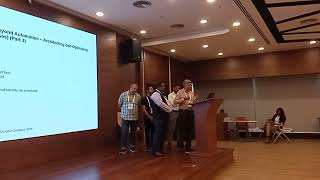
Speaker A describes a procurement/supply-chain case study emphasizing data integration and application/integration automation as the foundational layer. On top of that, optimization models determine inventory availability, lead times, supplier readiness and price to automatically trigger procurement orders. The speaker highlights ethical considerations (impact on employees, customers, partners, society) and organizational change management (training ~12–15 personas). A reported case involved ~5,000 stakeholders and a claimed reduction in procurement cycle time from 2 days to 0.57 (unit implied as days). The talk also notes cross-border compliance requirements (EU, Japan, Brazil) and enhancing existing RPA solutions toward industry best practices.
Questions this video answers
December 8, 2025
Approximately 5,000 stakeholders
12 to 15 personas
From 2 days to 0.57 (units implied as days)
Chapters
Primarily focused given the time. Right. The data and the application architecture focus or integration focus is what primarily was there. Obviously when you have to optimize your entire cycle time, the correctness of the data. The integration or the automation in terms of the integration is the first foundation that we need to focus on. And then on top of that the models for optimization to kind of sense in terms of from internally, how much is the inventory from where you can procure, you know, the material that you need, what is the lead time within which, you know the partners are ready to provide you that material and what is the price point. Right. All these aspects are considered and then you know, in a self automated way the procurement order could be initiated. That's basically the concept that we have applied here. Couple of things to consider from, you know, are the ethical aspects, the organization change management aspects here. One of the simplest way to look at the ethical aspect is any decision or any implementation from an AI perspective you are taking how does it affect your internal employees, how does it affect your customers and partners and how does it affect the society as a whole? Right. That could be a very simple way to look at it. If we look at this particular way where we are trying to apply it, it's basically nothing to do with, you know, any, any particular. Okay, race or anything like that. Right. I mean we are taking these decisions purely on, you know, the material that is being handled. So ethically it is justified. The, the concerns about the employees could be handled in terms of doing the organization change management. That's basically the option. Will not get into the details of IT findings or the challenges etc. Obviously data integration, the, you know, the ethical aspect of it, that's something that is important. We feel it's doable, it's quite possible and it is probably we should implement in this particular case given the ethical aspects have been. That's it from my side. Thank you. So this is a kind of a case study. We took it for 5,000 and 5,000 stakeholders which is like around reducing from the two days of a procurement to the cash to 0.57 so making it really 90, 99%. We normally state it in the boardroom and table but it is not really viable there. So it also includes the cross borders because. And also supply chain management and also the. The governance model. Let's say the vendors are existing in the EU region. We have to look at the DOTA perspective. If it's from a Japanese region, we have to look at from a Japan perspective. If it's from Brazil, let's say it's a Brazil perspective we look at from compliance perspectives also and make them align in the OCM perspective with the 12 to 15 Personas, train and mentor them. And whatever the existing models of RPA or beyond RPA solutions which is already embedded there, we're enriching them towards the best in class situation in the industry standards. Thank you. Thank you.