Why ERP & AI Projects Fail Without Business Architecture Learn the What, Why & How of Business Arch
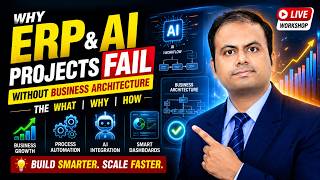
Dr. Niladri Bihari Nayak explains why ERP and AI projects fail: departmental silos, strategic misalignment, poor user adoption, and weak governance. Business architecture acts as a blueprint connecting strategy to execution, aligning capabilities, processes, and technology. He outlines a five-step framework and emerging architect roles commanding premium compensation.
Chapters
So welcome, welcome everyone. Thanks for joining in. So let's then get started. And we're talking about the business architecture. So before we start, as I said, this is an initiative which we have taken, and we are talking about, uh, every day we are having a session specifically focused on different streams of, uh, theme, different stream, different themes you can say. So we have started this with Workforce Monday dedicated for HR and workforce transformation, hire-retire cycle. Revenue Tuesday focused on lead to opportunity, focusing on customer experience, both side of it. Then Finance Wednesday is all about your financial transformation record-to-report value stream. Then on Thursday we had a procurement and Friday with a supply chain and today Saturday being enterprise and business transformation. So this is more of a focused on— initially we focus on business architecture, and as we move on, we will be focusing on your typical, uh, your enterprise architecture side of it. Okay, so that is the intention. So now with that note, let's then get started. And this will be a 90-minute webinar, and, uh, so stay till the end for a specific bonus we have for you. So you'll be getting the entire one cloud playbook we have designed for you exclusively for entire strategy to execute, how we can prepare the entire planning and everything. So it will be helpful. And also from my career perspective, this is pretty much helpful. Okay, so this is not a tool-specific session. So there are— I know there are so many tools in the market exclusively for business architecture, enterprise architecture. We do have SAP LeanIX, Signavio, ArchiMate. We have TOGAF standards. Okay, we are following the standards, but actually we are not tied to any of the tools, vendor agnostic, technology agnostic, we'll be going for. Okay, so with that note, then, then get started with our today's session. And so today's sessions and upcoming sessions in the Transformation Saturday, you will be having, uh, the themes will be different every week. It could be business architecture, enterprise architecture, sometimes governance, standard operating model. It could be Designing, some transformation, execution, value realization, those topics. Sometimes Agile. So these are possible topics, and if you need any specific topic, you can also send your request. And any specific topic of your interest, you can— or if you're watching the YouTube, you can share your details, what kind of topics you're looking for. And looking forward to those feedback, and, uh, according to that, we will be working upon. Okay, and with that note, let's then get started with this topic. With, uh, like a specific pertinent topic, that is why ERP and AI projects fail without business architecture, right? So this is today's topic, and we're learning what, why, and how of your business architecture in 90 minutes. So this is, oh, promise, if you have seen many of the project, especially, uh, traditionally, you must be thinking you're spending a lot millions of dollars, yet why they are failing, right? What is the primary cause of— is it something, uh, like mostly you will be seeing up to 75% of the ERP implementations, they underdeliver. They promise something but they deliver something, right? Especially from the original business case, if you're trying to trace what the— what was mentioned in the RFP and the request for proposal and what is exactly the customer is getting, there's a huge difference. From my experience, and also this is scientifically also, there is research-based unifying all those things, right? And AI is now everywhere. This is chaos. It is created and tools are deployed like XYZ without any— this is like a competition, like X company is doing that, I also will do that without having any clear alignment. What exactly the customer wants, what are the business goals of the customer, the priority of the customer, right? They don't care. So that is actually is also going on. So second thing, then also departments that I also have seen, I came across a lot of companies, every department has their own specialization tools in terms for tools, and they don't talk to each other, right? They take their own decision and their department buy something, and maybe they are influenced by the vendors like some conference and all. So those kind of things also going on. So they create friction instead of a flow, flow Flow is required actually for this, but you have created a friction for it, right? This is a silo transformation we talk about. And also coming to the strategy point of view, technology, whatever the investment is happening, this is disconnected. There's a disconnection between what exactly the enterprise is looking for, what is the reason, value, those factor. But the strategy, whenever it coming to the specifically investment point of view, there is no clear alignment on that. So these are the 4 things which actually thought of sharing that why actually enterprises spending a lot, but they do not get the results in the AI era, right? Now, what exactly does technology alone can, can transform? No, technology alone cannot transform the entire business, okay? It is a universal truth at this moment as we speak. So if you think about SAP, SAP just an example I'm taking because I had been a consultant for a long time. So, but it is also applicable for same, uh, other competitive products also. It could be Oracle Workday or similar product, Salesforce, similar thing. You can take any name, okay, any other bigger, any major ERP if you talk about, right? This is a powerful platform, right? So globally, almost 97, 98% of system, you will be seeing that directly or indirectly they're touching an SAP system, right? You name it, you will be finding it, especially from the Fortune 500, right? So you'll be finding, uh, a powerful platform, but actually as effective as the design behind it, but you have to think about the design part of it. Similarly, SAP is not the solution. Only technology will not be giving a solution. Similarly, AI, okay, so you are doing automation but you do not have an alignment, right? Then it will be definitely whatever the dysfunction it will be having, like garbage in, garbage out. So similarly, whatever dysfunction it is having, it will amplify the dysfunction rather than it will be simplifying your thing. Right? So technology will not be only going to solve your problem. Any kind of a transformation, it requires a lot of other effort. So automation is also not the solution. You can doing a lot of automation, you might be doing and speed, but we do not have a direction, right? And you will be going where? So definitely accident, right? So that is actually to be giving in this context, it will be giving you a wrong outcome if you're having a speed but the direction is something else. You have to go in the north direction, you're going south, or you are going east or west, right? That will not— you will not going to reach the destination, right? So technology— so what we understood, any ERP is not the solution, or any AI is not the solution, or any automation is the solution. So here SAP, I'm using it a symbolic way, but any ERP— whenever I'm saying SAP, it will be think about any ERP, right? So now what is the solution then? If these three are not the solution, what is the solution? The solution is your architecture thinking. That is the solution, and it is the missing layer between S2E. When I say S2E, strategy one side and execution one side, right? So it is a missing layer, okay? If it is not happening, the analytical thinking is the actual solution in this case, right? So now coming to this, uh, little bit about me and people who are watching me for the first time. So you will be, uh, seeing me across social media, LinkedIn, YouTube, and all. So I have started my career humbly in 2010 from campus placement in SAP ABAP. I was in SAP ABAP, doing SAP ABAP coding for initial 2 years. Then slowly I moved towards functional and I worked with Wipro first, then started with Wipro, then went ahead with PwC, Deloitte, KPMG, all the leading Big 4 companies. I worked there till 2023. So across ERP in the sense SAP had CM, SAP SuccessFactors. Then I got to STOGAAP certified into year 2018. And then I moved towards enterprise architecture opportunity during 2021. I got at that point of time just focused on HR platform because my background has been always in MBA HR and followed by postgraduate diploma in supply chain management. And after that, recently last year, I finished my doctorate program and from Swiss School of Business Management in strategic management. Okay, so that has been my education. And coming to the work side of it, primarily SAP-focused transformations, multiple countries, multiple transformation projects, uh, and, uh, across the industry like your utilities, energy, then your retail, uh, you name it, education. Almost all major sectors, major geographies, and that has been my experience. But from my experience, I will say overall I have seen the transformation fails not because of the tools or technology or the consultants. It's all about— it's a combined with a strategic architecture lens. So you have to— being a postgraduate and being a doctorate in strategic, you know, management, strategic management, I can completely say that So it is a strategy architecture lens that is actually missing in most of the cases. Even I have seen business not taking— especially the senior leadership also cannot take decisions because of those kind of a lack of those understanding, okay? So you're in a safe space to understand this topic in depth. And, uh, this is also not pretty much, uh, encouraged in many of the organizations. People think that, oh, business analyst, why we need it? Business architecture, why need it? There are different, different There are differences among all these roles, right? But people think, oh, this is like something very theoretical, okay? So it is not like that. So you will be seeing such a kind of a roles exist. And in the— I have seen in European countries and US and all, but in India I have seen it is still leading companies are doing it, but not that much, okay? So it is a, you know, a role which is actually ignored, okay? The role of business architect and all. Okay, so, uh, I have, as I said, uh, worked on multiple deep implementation project and program and enterprise transformation, mostly solution architect, multiple project. We are a mason of architecting experience for a better world. So you want to create better experiences for people, process, technology, planet. Okay, so across, and also I have been involved in multiple volunteering activities, uh, created by Open Group here in India. And those are the things I can talk about, but this is not about me. This session is all about understanding the side of it, business architecture side of it. So what exactly will be learning today in this session? So we'll be learning about what business architecture is actually, okay? So it is a blueprint language of the enterprise. So what is the language, blueprint language of the enterprise? We'll try to understand. Then why enterprises need it, okay? Because this is strategic gap. The strategic gap is there. If nobody is talking about it, so this is something really we need it, okay? Then also we talk about why an ERP and AI projects fail, what are the different root causes behind so much of expensive failures, and how transformation actually works, okay? There will be proven architecture-led framework we'll talk about. Then also, uh, career opportunities, what are the different career opportunities at present highly on demand, and those roles are emerging right now at this as we speak, right? Those career opportunities we will talk about, and also how you can start your architecture journey, how to start building that skill set today, okay, with a guided approach we will talk about today, okay? So stay till the end, and you have also surprises to the end. You'll be— if you're watching the YouTube, if you are watching, like to point out, in the recording side of it in my platform. So stay tuned. And before we start, I would like to have a check, like, who are in the room today. So are you a SAP consultant or are you simply any IT professional or a business analyst or a manager, leader in any of the industry, any of the sectors? Are you a professor? Are you a student? So you can just type. Are you AI curious? Okay, so just type in the chat and we will be knowing that. Or if you're watching the YouTube, you just put in your comment section, right? Who is in the room today? So now with that note, we will be going ahead. So I see that many of the students and many of the managers also, people have joined from different geographies. Good, good to see that. And now let's understand the problem— why actually digital transformation fails, right? So there could be multiple reasons. You can type what is— what do you think, right? So you can see there could be multiple reasons, okay? First of all, the silos. When I say silos, different departments work in different, you know, isolation. They do not talk to each other, okay? Second thing is strategic misalignment, okay? IT business goals they are not in the same direction. They're in a, you know, opposite direction. They are not aligned, right? I think third one is a poor adoption, okay? So adoption is a bigger problem. So if the users, the end user, actually whatever they have been using for the last 5-10 years, they will be saying that we have been using for the last 5-10 years, we're comfortable with this. And so that from that, the resistance started. Okay, so there will be a poor adoption of that, uh, you know, whatever the initiative you have taken, right? So that will be happening there. And fourth one is the no governance. There's no accountability or oversight of that, any of the— there's no regulations, nothing, right? So that is also another reason why the digital transformation fails. There is no technology challenges, but all these are human challenges or process challenges you're finding. People think tech first, okay? They do not think business first, okay? Before the problems are even identified, they will think about the tools and technology, all these things. Even I have seen this, uh, tools and technology companies also, they collaborate and they make friendship with our friend, to be honest, uh, with the— they influence, by the way, instead of coming to the Enterprise Architect and Business Architect or IT, they directly go to the business and they sell their product and they prepare RFP for them, okay? To be honest, and they will be saying that we have these features, XYZ, 10, 20, 30 features, and you'll be getting that benefit, this benefit, and all. Then the business start building their, you know, requirement. It is not a requirement. They do not know what they actually, they need it, okay? But they will be coming up with, they need this, then sometimes get incentivized for that, okay, secretly. So those kind of things really happens, okay? So if you talk about, there are so many things, stories you will be finding in the LinkedIn and any other, uh, blogs, okay? So you feel like horror stories, okay? Those kind of story really happens, okay? The reality. And most transformation programs fail. As I said, the technology is not a problem, right? But this kind of a business design, this is missing out. It's all about if you're having strategy people and system, if they are not well architected, right? And even if the best of the best tools you're bringing them from the market, right, still it will produce chaos. Okay, so 70%, as I say, I'm not saying this is McKinsey company, they're saying, and they're saying that so 70% of digital transformation initiative failed to meet their own objectives, part of the objectives they're having. It's a huge number, right? It's not 10%, 20%, 70% of that, right? So this is what exactly we'll be seeing. Now let's, uh, the real problem, what is exactly. So companies always try to optimize their system, but they ignore the business design behind it, right? So what exactly company focus? They focus on implementing any modules or deploying AI tools, automations. So they take the credit for that. They get awards in the different, different, you know, events and experiences and conclaves. Okay, they talk about it, they post nice pictures in the LinkedIn. Insta, all this social media, take pride on that, right? So that happens, that's the reality. But actually what gets ignored— so entire capability gaps, value stream misalignment, process redundancy, strategy context, okay? These are the actual things which actually gives a technology its purpose, right? So if you ask, these are things that missing more and more to the project, digital project strategy and all of this. So these are on paper, by the way. I'm not saying these are not there, but these are not People do not leave these experiences. They actually just, uh, it could be there, but people do not leave these experiences. They do not leave whatever they say, right? So that is the reality. So this strategy to execution gap is where exactly the billions in transformation investment disappear, right? And business architecture, the job of business architecture is to bridge that gap. Okay, so that's the bridge the gap. So that is why exactly the business architecture is really, really need of the power today, right? So that is something I will highly recommend to go through. And what is the missing layer? If you try to understand more in, in depth, so they say, so organizations have different, different islands. I will definitely say the islands, okay? Functional islands, you like HR, finance, supply chain, IT, sales, okay? Any company go, these are, you'll be finding them, right? So these are like different, different islands, and they each operate their own tools, okay? Processes, modalities, okay? There is no connectivity, okay? I'm not saying in every company, but that is the common thing, okay? What is missing actually? So missing link is your entire business architecture, okay? The entire business architecture is something missing layer that connecting actually your strategy and technology piece of it, right? So that is what exactly we have to understand, how we can actually have those things in place, okay? So HR, the talent process is disconnected from the capability needs. What exactly the business needs, business capability, most of the cases. Finance, budget decision happens without any kind of an architectural context, okay. Supply chain, the optimization local to function but not the enterprise value delivery point of view, they do not think about it, right. So these are very common things, the missing layer, I will say. Now after understanding the missing points, missing link and all, now let's come to the the topic. What is exactly the meaning of a business architecture? People think that, oh, it is just a modeling, just a business modeling, doing that, uh, in a business model canvas diagram. Is it the business architecture? The answer is no. So we will see that the business architect, the bigger picture is it's a blueprint of how a business creates and delivers the value, aligning the strategy, your capabilities, your processes, your data, and technology into a coherent design. Okay, so I'm saying, repeating the term coherent design. I need to be aligning everything whenever you are talking about the business. It's all about the value and aligning all of those factors, whatever I've discussed. Okay, it's like master plan that every great enterprises or transformations are built upon, on the top of it, right? So that is a business architecture. So now we will be understanding, like, uh, suppose I'm a non— and I do not understand this. Let's say I always prefer an analogy. An analogy will be definitely help you to understand much better way. So let's think about an architect designs a house before the construction begins, and business architecture designs the enterprise before the transformation starts. So just like that, so you can see, so if you see the example of a house, you have, you have typically have a blueprint like house planning will be having, that is your strategic plan, okay? That is your typically business architecture document, right? If whatever the rooms you are seeing, right, the rooms, there's a kind of business unit, or here in business architecture terminology, capabilities Okay, okay, so this may not be perfect analogy, but let's just try to understand it. Okay, plumbing, it could be like information flow process and value streams out of any kind of wiring happens, right? That's the kind of a technology layer. So in this case, that application infrastructure, any kind of foundation. So how is foundation? So foundation is based on your culture and governance in enterprise, and that is an org design. We have a, an org design is a very popular topic. You must have studied in your, people who have worked in human capital advisory, because I have seen those people I have worked with those kind of people in, uh, before consulting. We have separate stream, but actually the organization design from that context, okay, very, very important here. This is actually one of the elements in the business architecture, okay. This is not only a part of human capital or HR, rather that is also talk about the organization design point of view. So now the 5 core concepts we will be trying to understand mostly, okay. So capabilities, so we will start with the capabilities. What exactly capability in the sense, what exactly business does Okay, whether it is a procurement, customer service, recruitment, payroll, what are the different things that what a business does. Okay, so as a first element, then we will talk about the value streams. Okay, so value streams in the sense how the value flows to the customer starting from your need. You need something, then there was a service happened, then it was fulfilled by the service. You can think about anything. Okay, any of the value delivery right, from a customer point of view. Then you also get a continuous support from the vendor or the whatever, wherever you have actually raised a request, okay? That's the value stream we'll talk. So we'll be going deep in each and every elements in the upcoming session. So today being an introductory debut session, so we'll be having going through a glimpse of it, everything. Then we will be going details, okay? So capability as it is, what a business does, but how that is done, that is a process. Okay, so what is all about capabilities, how it will be done, that will process, okay, the step-by-step execution inside each and every capability, that is your processes. That is an example of the processes, okay. Then comes your organization and governance, who owns what, what are the roles and responsibility, accountability and decisions, rights across the enterprise. If you talk about that is the organization and governance, okay. So there are many more, but we will be focusing on this today, and many more other topics will be going in depth in upcoming days. Now comes your technology alignment. So how actually your system is supporting your capabilities. It could be any of the product, SAP, Salesforce, Oracle, AI, automation, analytics, right? So those things also we will be understanding how is aligned. Okay, so this is a key concept, but really there are many more we will talk about in the upcoming days. Okay, so now let's talk about the typical, uh, stack, the business architecture stack point of view. Definitely strategy at the top, you can see that the reasons and the goals. Okay, and capability, as I said, what process is all about, how. Okay, and applications, we have series of applications like ERP, CRM, whatever you are having. Data is your information assets. And so this is actually typically from vision to infrastructure. So business architecture sits at the intersection of your strategy and execution. You can see that. So strategy and execution, it will be in between that, it will be sitting. Okay. In the top you are having strategy and below you're having your typical infrastructure and all. Every layer of the enterprise is aligned and purposeful. Okay, so that is what exactly job of business architect. So strategy, it is all about the why, vision, goals, and business drivers. It's not on the paper but the actual thing, right? What exactly the vision. Capabilities mean the what. Okay, so strategy is why, capability is what, why, what, and processes are actually how. So for the reason today's session title was also to understand why, what, and how of our business, right? Then we have a technology. Technology is just an enabler. It's an enabler of system data and infrastructure, right? So in this way, we have to understand the entire thing. Now, is it a new topic, or is it— why it is actually, it's a matter. So it has been a long time, it is there, it is not very new topic, okay? ERP, definitely people who are actually— they are powerful engines. So they will automate your all the processes, okay? Whether it's SAP, Oracle, whatever it may be, Zoho, okay? They're very much powerful engine, but without a design, will they able to automate, okay? If it is, then they will automate the things, wrong things at a speed which is a disaster, isn't it? So it's for the reason we require architects. So business architect will be aligning that enterprise. It ensures Every system, process, and investment is designed to deliver that particular real business value. It's not only a technical output. Okay, that is what exactly we will be learning. So business architecture, why now, right? Because everybody is talking about AI, AI, AI, AI everywhere, right? It is saving almost every industry, every sectors, every geography. So it is reshaping the entire every enterprise function. So without architecture, So whenever any adoption is going to happen, it is ungoverned and risky. Okay, so for the reason the AI era, the business architecture has, you know, the importance has actually increased. Okay, and also there is rapid change in the business models. So the way it is, uh, people, time compression happening. I will say my mentor always say that the term, use the term time compression, right? Whatever happens to happen in 3 months, it is happening in 3 hours. Okay, so thinking like a coach. Okay, so whatever that's in a those things are happening, right? Rapid change is the key thing here. The— all the business models are evolving faster than actually the legacy architectures, whatever it can adopt that, right? Similarly, complexity point of view. So as we are having more systems, more vendors are coming into the onboard, so you'll have more data. But if less coherence without a unified design, if you're not having a unifying design, this is actually going to be disaster, right? Then all the digital business models, they're also evolving. It's a platform, whether it is a subscription method or your ecosystem models, they demand architecture-first thinking. Okay, so you require architecture-first thinking, then only you can move ahead. Now, what are the key benefits if you are implementing? Okay, so what are the key benefits of the business architecture? We'll try to highlight. First of all, every project, whatever the investment you are doing, there will be proper strategic alignment so that it is linked to a business output. So business would think that if they're investing on XYZ amount, what is the outcome? Okay, so this should always think about the outcomes of it, right? Then second thing is the transformation. So many change management programs are there, they're designed, uh, but they don't— I have seen that They're not improvised dramatically because so there are some issues happens here. Okay, so they are not improvised. Okay, improving the success rate. So business architecture will be helping you to do that for a better transformation, right? Then also overlapping systems. Maybe you might be having multiple product, multiple tools and technology, but doing the same thing, and you have to identify those overlapping systems in your system from your landscape. And also there is an exercise generally in enterprise architecture projects we do, we do a rationalization of your application, application portfolio rationalization we do. So generally that is very interesting topic and we will be there, talk about that use case maybe some other time, right? But all kind of overlapping system redundant processes, they're either identified, they're eliminated in this entire journey. So this is the benefit, the third benefit, to remove or to reduce the duplication. And also, if you're having all the things in place, you will be able to have a clear ownership— who is owning what, okay? So that you can take right decisions. And also, you'll be increasing your accountability across the organization so that you can have a better governance across. So that is the key here, right? Then comes your innovation. So if you're having clear clarity here, a capability map, it will be showing where exactly innovation will be the highest impact. You can trace all of this. So it's all about the tracing, okay? It is not about having a documentation. It's not about having those, those meaning those fancy diagrams in any of the, any of the, your typical architecture, business architecture, EA tool, enterprise architecture tools. Okay, but having the, you should be able to trace those impact. Okay, where the innovation will have the highest impact. If you're having innovation office, you can think about, but you do not innovate everything. You may be having 100 ideas, okay, but we do not implement all those ideas, right? So evaluate those ideas, prioritize those ideas based on your, you know, your multiple factors, okay? So that is what exactly innovation management happens, right? So that is something we will be also trying to understand. So that is also key benefit. So you have a clarity. Once you have a clarity, definitely you'll be doing your best, okay? So that is the key here. Then how does it actually work, right? So there are 5-step architecture framework in this process. We will see it can be practical, repeatable method of architecture transformation from strategy to execution, right? So first of all, you have to understand your goals and priorities of your organization and strategy. Then you identify the capabilities, that means the catalog required for skills and assets, you define it. Then you define your value streams, like visualize end-to-end value delivery, how we're going to deliver the values and all. Then based on that, you align your processes. Yes, you connect all process and system accordingly. So each step, whatever you are seeing here, you actually build up on the previous. So we cannot ignore the previous one, we cannot go randomly direct to the fourth one before we have set up those goals and priorities here, right? So that is the key we will be talking about. So they're going to ensure your transformation. So I have also seen organization setting up PM office, like you must have heard about it. Just like with a PMO office, right, project management office, a group of project managers, project program managers, account managers sitting together and discussing all those topics. Similar, there are also— I have seen a series of, of many of the industries, many of the tech companies, they have started a transformation management office, TMO. Okay, so it is very popular these days, uh, you must have heard about it. If not, you can do a Google or an AI on this, any of the— now Google nowadays there, so they You can go and check it out. Okay, the transformation management office also people hire for transformation management officer, something like that. Those kind of the roles are also evolving. It's a kind of another name of this kind of roles only. So whatever happen if I doing all of these things in this way, so your transformation is grounded on the business intent. Okay, so try to understand the term business intent. What is the intention behind doing this activity? We also do that, right? So at the personal level also, what is my intent of having this, right? Once the intention is set, that the rest of the things will be taken care, right? So the personal level. Similarly, from an organization point of view, if I'm thinking I have to have a very much straight business intent, what is my business intent, right? Then the technology assumption will be taken care, right? So not the other way around. Now, from a strategy to value, What are my key steps? We'll talk about, right? So strategy itself is a big topic. So typically it is all about businesses trying to achieve what is the growth, what is the cost optimization you're doing, what is the market expansion, how they are doing. So everything starts with an intent. Okay, so architecture also begins with an intent only. What is your try to achieve it, right, in this particular you know, for the particular strategy. So to understand the strategy, you have a very— you should be very clear about your intent, right? So then next comes your identify the capabilities. Now your intent is already clear, it's very, you know, so whether you are a profit— for-profit or not-for-profit organization, you have a very clear intent what exactly you're going to achieve. Now you have to identify capabilities, whether you are having those capabilities or not. right? So you have to map what the business must be able to do to execute those strategies. Now, strategy, from S we are going to T, S to E, strategy to execution, right? So there is a very nice book I will actually, and I have covered, so means I have studied long back, so there is a very much popular strategy, I will highly recommend So this is written, Strategy to Execution, you'll be finding. This is, uh, you would be finding, this is the book. So I will say that there is a very nice strategy execution book by Wendy, Wendy, I think. Yeah, so you will be finding there is a nice book, okay? And this is available. And so there are— this is a book I was talking about, right? So I have a hard copy of it also. Generally, you be finding. So this is a book which I usually refer, and this is a very good book, especially for the beginners and all. It's very nicely actually explained. This is the book and strategy, especially who are studying. And also there is a lot of YouTube videos also in this regard where the author is actually talking about— actually author has also came to SAP community and he has also a video he will talk about. So I would recommend this video you should watch. Okay, and you'll be having more clarity. So how you actually the vision to execution, mastering your strategy, which this is something as homework I will give to you. You watch this, although it was done in SAP conference, not just conference, say SAP community, but there is an enterprise architecture SAP community. Okay, there's the YouTube channel, and in that you'll be finding the more details about it. Okay, so this is pretty much an exercise for all of you. Okay, you can do it, and maybe we'll be having a quiz on this. Okay, and the book is whatever I'm recommending, this is the book which I will be recommending that, uh, uh, this from this author, Vindi, uh, so she has published a book titled Strategy to Reality, and this is very good book, okay, people who are starting actually, okay, and also for veteran also, it can just refresh, okay, uh, your revise and take up those points, okay. Maybe we'll be having a book club sessions and where exactly we will exchange our ideas after you read, okay, and how exactly you'll be applying those concept in a real time, right? So that is what exactly we'll talk about. Okay, so now coming to the identifying the capabilities, we also, let's say we have identified and we have already prepared our capability heat map. Okay, then that is a foundation and that is based on that everything will flow. That is the second thing you have to do. Third thing is you have to identify the capabilities, uh, strategy capability, then map your all value streams here. Okay, so you have to visualize how actually your value is flowing from customer need to the customer outcome. Okay, so this is the book actually. Yeah, so I have— so this is what I was talking about, the Strategy to Reality book. Okay, this is a very small— not very small book, I will say around 300, uh, approximate 270-271 pages, but, uh, it's very interesting. Okay, you will be finding very interesting. Another book actually I referred from another leading influencer This is also very good book from Aaron Rouse. It's called Design to Win. Okay, so these are the two books actually when I started, I have gone through this, but again, still I'm referring these books in my, uh, area. But it's very fundamental, so your fundamental will be very sound. And also there are so many books in the market, but I don't have time to go through. But actually I'm following these two books. Other than that, Business Architecture Guild, if you are aware of— so I will talk about this later point of time. This— I also have a paid membership, a premium membership. I usually attend those. This is the kind of community, close community. They also have volunteering opportunities you will finding across and all. So that is how. Okay, so this is where you can also map your value streams and you can value flows from customer need to customer outcome. You can identify what are the friction, handoffs, gaps exist across the enterprise. Okay, so that is exactly You will understand the entire strategy to value. Now the next one is your design to delivery. So now you already those things, the step, next step is a design to delivery. So think about any of this example. If the business architecture is centralized, anywhere it's focused, okay, then definitely everything will be taken care. So the fourth step is aligning your process and system. So let's say your technology landscape is having SAP CRM, AI, analytics, okay, and they are actually aligned to the capabilities they must support, right? So that if what will happen, you will be having exposing what are the gaps we are having. It could have any redundancy, any kind of misalignment is happening before the implementation itself. You will be able to catch up, okay? So that is what exactly the step number 4. You should be able to align all of your process and system. Then step number 5 is all about a transformation roadmap, and based on that, the outcome is, uh, this is my favorite, right? So you will be creating a sequence of all of this initiative. You prioritize the capability, like what is exactly the business important happen, and it should not be done by IT project calendar. It has to be driven by the architecture team. Okay, if you have not hired any architects, start hiring, start involving the architect. It's because this is not what a project coordinator or a project manager can do that. Okay, so they will drive the roadmap, not the other way. So this would not be driven by a roadmap means what the project manager is saying. So project manager I expect, but at the same time this will not drive all of this. Thing. So there should be dedicated team of architecture. They should drive the roadmap, and based on that, the project manager or product manager, they should listen to the architects. Okay, so that is the thing. Then capability-based planning is now the clear standard in every organization who are executing anything in the AI era transformation to do. This is from a design to delivery cycle. We must follow this kind of a thing. Now the next part is, uh, seeing the full picture. So we talked about the business architecture side of it. As we progress in our upcoming sessions in this series, we will be having a full picture of what exactly. Also, we'll be moving towards enterprise architecture also. This is business architecture, this is one domain, right, within the entire broader domain of EA. EA means Enterprise Architecture Discipline, okay? But it is the strategic foundation, that is the foundation actually required. So without foundation, you cannot go ahead, right? So business architecture is the, that strategic foundation. This other domain will be other architecture depending upon that, okay? So it is, as I say, there are not so many things, but actually the capabilities, value streams, processes, org design, they are key thing. Then we also have application architecture. So application architecture in the sense they will be talking about ERP, CRM, SaaS, custom applications, all of those things, okay? Then in the data architecture we talk about data model, governance, master data, analytics part of it, okay? Talk about it. Then when it comes to technology, we talk about Intra, security, cloud integrations, all those topics. Okay, so this is how you will be seeing the bigger picture, and we'll be talking about it more often in the upcoming days also. So what is actually the mistakes now after understanding this? What is the common architecture mistakes you can avoid in this entire journey, right? So we'll try to understand So you should not be obsessed with any of the specific technology or anything, you know, like it could be SAP, LeanIX, Signavio, Salonim, and all of these things. They're cool, very good tool. Even I have, during my doctorate program, I have used, I have taken your academic license of LeanIX to execute my project because it was purely practical, it was not theoretical. I have to present with the end-to-end solutions and the prototypes I have designed. For my people who do not know, you can go and check it out, uh, ResearchGate, and you'll be finding, uh, just to search ResearchGate and my name, my thesis, Dr. Niladri Bihari Nayak is publicly available. I published my thesis, it is already publicly available. and you'll be finding that, um, SSVM— so that is my college university name— so you'll be finding that, uh, entire thing in the ResearchGate itself. Okay, so if you go to ResearchGate, and, uh, even my MBA was also project-based. Okay, I have done a— I didn't do any kind of full-time MBA, or even my doctorate is also online. Okay, but I have created value out of it. Okay, so this is something I will go and check. So you can basically go and you will be seeing there. So publications. So now we have 6 citations. I do not promote much, but more than 14,000 students, more than 14,000 reads happened. And this was my PhD just last year we have finished. And you will be finding the entire— this is my full text thesis. You'll be able to find out here. My MBA was also in a similar way. So Effectiveness of SAP Headchart in 2013, which is more focused on SAP, that you will be finding there. But in case of your typical, your reason to venture, so that was my thesis. You'll be finding the entire thesis, you can download, you can read, okay? This publicly available, okay? And you will be finding the entire, entire thing. So we have used LeanIX are there. And for my entire thing, you'll be finding those pictures here, okay? Because it was an education, you'll be finding education-related initiatives like digital learning tools integration, community-driven school transformation. In Odisha, it was called Mo School Abhiyan, right? My School, you know, movement, I will say. Inclusive learning, Dream School, all of this. You'll be finding about this in your typical, uh, if you download it, and you will be finding all this initiative, all the sample examples you will be able to find. This is my evidences. Because the PhD was not like a typical submitting all those things, rather having a proper, you know, thesis and proper— we have taken a survey method, we did it, and survey performance, everything we did it. So basically the entire text is available. You can simply go and download it. You will be easily, you know, you will be able to find out this entire thesis. It is publicly available in the ResearchGate itself. Okay, so there are ideas, programs, projects, technique. It's very interesting. You'll be finding, I am sure, you will find very, very interesting. And these are the different fact sheets, we call it, okay? People who are like coming from LeanIX background and all, right? It is very interesting. And, uh, it took me almost 4 years, although I supposed to complete in 3 years. But, uh, you will finding very interesting. This is my favorite, I will say. But, uh, I'm still working on the next level of it, how we can be going to— it can offer social impact cause and different things you will be having it. But you just follow that, you'll be finding here in the ResearchGate. If you search, you'll be finding all of this material publicly available. Okay, so now with that note, we will continue our transformation journey Saturday. So we talk about the, uh, tool obsession side. So I have used Linux because it was for me, it was, um, being a PhD, being a doctorate student, it was free for that limited time. And, uh, so you should not be obsessed. It's one of the great tool, but there are also many, so many tools in the market. But the thing is the mindset here again. So what you need to model if you do not know, okay, so you will be doing all of the experiments in Linax, Signavio, but it will not be giving you the results, okay. I'm sure because you might be having the same pool, same technology, but one organization will be having a 20-30x results, but you may not be having, okay. So it all depends upon how you do it, okay. So that thinking required. For that reason also we conduct sessions on SAP Signavio, SAP Linax. Lot of training programs we do on those topics, the tactical evidence-based learning. It's not like a theoretical, otherwise there are so many content available in your— if you go to focusing, although I'm not focusing on SAP for specific, but being SAP consultant earlier, I will say that they have separated now this suite. Previously it was not there. Okay, if you go to sap.help documentation in the help portal itself, just like there are different, different streams for your financial management, spend management, supply chain, HR, business technology. We have a segment here, this Human Capital, Sustainability, Customer Experience. There is a segment called Business Transformation Management. Okay, so if you go inside it, you— there are very much particular tool-specific, but I will recommend before you go to tool-specific, try to understand the principles behind it. SAP Sigma VIO, this entire business process management, EA management, enterprise architecture management is done purely in the LeanIX. And there is a complete tool chain, SAP Cloud ALM, there is adoption-specific tools. Okay, we have WalkMe. Okay, so many things are here. Although we will be working on SAP-focused technologies and tools, but you have to understand the principle behind it. So there's a readiness check, we'll be doing all of these things. So if you go here, so how do you read it about actually? So let's say we'll talk about SAP Signavio, okay? So when you go here, do not think about what this tool is doing. Rather, you understand what is the process behind all of this tool. So you can see there are 9 segments, 9 product actually they're talking about. For SAP Signavio, forget about the SAP Signavio, you think about what is the process intelligence first, okay? What is the process manager will do? What is the process modeler will do? What is process governance will do? What the process insight will do? So all these things you have to first of all understand in a technology agnostic way, product agnostic way. Then you come to this tool and technology, then you will be able to relate to it. Okay, so that is my advice and I've been following in the same way. Okay, I never— whenever I do any kind of research, okay, so I usually follow this approach only. Okay, and recently I was also doing an experiment with this and one of the tools. I will be quickly show you that. And in the one of the tools, so in the recent research I was doing in activities, here we have a project. So this is a kind of my research project, I will say, for academia, for teaching. I've been doing a lot of research or different, different sectors and all, right? And you will be finding, uh, especially let's say Let me show you that. So you can design all of those things, especially understanding the process. So let's say I try to understand what is the process inside, and what I have done, I have put it to AI, specific prompt, okay? This prompt I'll be sharing at a point of time. But what is the meaning of the process inside? So whatever the 9th thing which you have studied, right? Because, because before I go into the tool, rather I try to understand the principles behind it, right? These are 9 things we talk about. Process intelligence, still the process insight. But what exactly process insight mean? Suppose I'm focusing on energy sector, right? So you can have multiple different sectors. So we have a material sector, financial sector, healthcare, IT, communication sector, utility, real estate, based on the— your requirement, based on your sector. So you will be seeing here, this is process insight exclusively for the energy sector. So what is the possible So if you— this will focus on this 9th thing. You will see that what is inside point of view. The inside could be you— it could be predictive failure, okay? What it will detect? It will be detecting assets likely to fail, not saying asset fail, rather predictive way, okay? And quality anomaly, you are having some unusual pattern that may indicate a problem, right? So what— how we will be checking those pattern? So there will be some example. So from energy sector, we have taken an example. So we will see this in other sectors also, and I will be sharing all of this here, means whatever the my findings and all in all of them in the upcoming, uh, maybe a book series or something like that with the real examples and some of the relevant scenarios from industry point of view. And also we'll try to talk to a different industry leader also, sector leader also, and we will take their insights. And based on that, uh, very soon, uh, we are planning for a series, book series, uh, in Amazon. And based on that, we will talk about— so you have to understand all of this in this way, okay? What is actually deliverable? Process Transformation Manager is deliverable. What are the deliverable for a process inside? Okay, process inside, it should be having this kind of an inside. You can convert it to a diagram, dashboard, whatever you like it, right? So this is the way, okay, you can continue your learning, okay, like this. What are the key deliverables? Suppose you'll be asking what are the key deliverables for it? Process Insight. This is AI-powered. Yeah, what we are actually empowering, right? So that is something you should ask. Okay, and what are the deliverables? Okay, suppose I'm saying the deliverable. So this is deliverable for process transformation manager. I was talking about the TM office, right? The transformation management office, right? You should be having a roadmap, business case, ROI model, change management plan, work stream plan. Okay, performance dashboard, lessons learned repository, right? So these are the typical things you might think like a project manager, but they call it transformation manager. Okay, so those kind of deliverables you'll be finding. Similar process insights also, you can ask basically what are the possible, uh, you will be having the deliverables. Okay, so deliverables for process insights. Okay, so you can ask it. Okay, so then only you would be able to understand, uh, why it is required. And, uh, for process insights, uh, tool, if any other tool like Signavio, I'm not mentioning too many. But you can mention that what are typical deliverables for Process Insights tool? It will be explaining me with that detailed tools, what are possible tools for that, right? So this could be any kind of reports, predicting reports. It could be anything, you know, like this kind of reports or button like optimization recommendations. All these things you're getting. So I'm not going there, but the idea is to understand, okay, what kind of— whenever talking about tools, we should not be to mean selecting the tool before defining what exactly you need to model. First of all, you focus what exactly the model, think on a paper, okay? So think in mind, think on paper, then you go for the tools and technologies, whatever is the best fit your— to fit your requirement like that, okay? So that is something you have to think about it. So in the meanwhile, I will— in the next session might be I will be talking about that. So more governance, architecture, artifacts, created, but actually if you're not maintaining and hold or enforce, right? So then it is just on the paper only. Your rules, regulations, everything is the policies, procedures, everything is on the paper, but nobody's following it. There is no point in having that, right? So the third one is a poor business involvement. So architecture done to the business by IT, not with the business, right? So this is very carefully you have to learn, okay? Architecture done to the business by IT, not with the business. What does it mean? So you have to involve business. Okay, so in this entire case, okay, it's not very IT project typically. Okay, so we have to involve from the beginning. So because many times people do not involve the, you know, business too much, they do not do those kind of sessions for design thinking, they do not understand their pain point, all those things. Okay, those entire journey of journey mapping, journey modeling, whatever we call it, right? Then also siloed implementation. As I said, each department will be having their own thing. You should not do that, right? So it will be— instead of focusing, it is fragmenting. So do not fragment. Focus, focus, focus. So it should be— keywords should be focused, okay? So you should not fragment your departments like that. Multiple departments, multiple different strategies. It should not be like that. Now, how this architecture thinking, okay, so it is only the thinking It's a thinking which will separate your leaders from the executors. Okay, if you're executing, executing, executing all of these things, but you are not a leader at the point of the— at any point of time, right? So the professionals, from a career perspective, if you understand enterprise as a system, it's not a collection of tools and technologies. It's not like that. Actually, the one step in the future of transformation we talk about. So that architectural thinking is very, very important. So today's key takeaway, even if you learn one thing, That is, I would say, the focus on architecture thinking. Okay, so to develop that skill, it is a skill. It's not like straight you will be developing one day or two day. Even everybody's learning, even including me. Okay, so that is what exactly really require. Now in the age of AI, in the era of AI, how they will work together, we'll try to understand. So AI will be changing every enterprise. Okay, so there's so many news is coming up, so many every day some layoff happening and all. So people are going towards AI-native enterprises. Organizations are redesigning everything around AI agents. They're not just adding an AI layer to it. They are going AI as a foundation, AI not as a layer or extra thing adding to an existing process. They are becoming AI-native. Okay. And recently, people who are following Sapphire SAP, so they have also published a thing. You might have seen that. You will be finding that in the architecture, specifically architecture, I think learning.sap.com, SAP Architecture Center. Okay, although I'm talking a lot about SAP, but as I said, be agnostic, okay, of any of the technology product. But you will be finding, so there is a North Star architecture. They have AI native. I was talking about AI native, right? This is one of the good example. It's a very good read. You will be finding very interesting. I have not read it 100%. I'm in the process of reading it, but, uh, I have met this person in one of the TechEd, okay? So for that reason, I'm very much confident it must be good one, okay? So you simply go to the download PDF and you will be getting this paper, okay? So this is called SAP AI Native North Star Architecture. What does it mean? And, uh, maybe we will be having a quiz on this in upcoming days, okay? Definitely you have to go through, okay? So this is, uh, I will say, I recommend to go through this. Okay, so I will be saving this document in our, uh, Drive, and you should go through this particular document. Okay, and it is— although it is, uh, you read it like, okay, detail. Okay, so that you'll be understanding, uh, what is the meaning of it and how it is done in the entire way. Okay, so you will be finding that, uh, North Star Architecture, what SAP calls it. Okay, and how actually— and so this is also same thing we find in other product ERPs or any of these things, but take the principle out of it. It is not like only specific SAP, but you just try to understand this topic. You can see very detailed, there are different layers, what is their vision, right? So a lot of things, I'm sure you don't have to go through in detail, but you'll be finding the direction how the AI native features are working. Okay, so you will be finding, okay, so from different user groups, they are having also taken their input, community champion from different, different reason. Okay, so how the stack is actually evolving, you will find the authentic experiences from a community commoditization to value. Right, from AI-first to AI-native. People are calling AI-first organization, now they're saying AI-native. Okay, so just like mobile-first to mobile-native, right? So this is a switch is happening. System of record to system of context, everything is now a context. Okay, app boundary to now you are having a landscape boundary. Okay, software as a tool, now actually software that does. Okay, so this is, this is how the directions we are going. It is pretty much very interesting topic, and now everything is now autonomous. You will finding agentization, appification is happening everywhere. You can see agents are there, apps are there, right? The data is actually— you're having it. So this is pretty much very good document. I will recommend when you get some time, okay? So go through this document and you will find very interesting perspective, okay? And also this, how it is exactly— this is actually from SAP point of view, but also non-SAP. You can see non-SAP also if they are in the landscape. Definitely every organization is not only having SAP, okay? You But what are the knowledge API, how it is they will be interacting and all of these things you'll be finding like, okay, all of this thing. Okay, so I recommend have a look into this. It's very interesting topic, interesting document which you can find very useful. Okay, for entire end-to-end stuff. I talked about business intent, right? So you can see the intent term is coming here also, right? So this is surprising. I didn't see that earlier. In today's session, we talked about the intent, right? So it's everything. Whenever you're designing any solution also, they do not say business requirement anymore, they call it business intent, okay? Because what is your intent? Based on that software, this agentic solution will be designing all those things. So it's a coincidence, whatever we discussed today, it is matching to— that means we're in the right direction, okay? Business intent, then actually a product requirement document, then you go for specification, then you code, then you deploy, right? This is actually the entire thing you'll be finding, okay? So I'm not going through the entire document, okay? So it will take some time to digest and go through. People who are doing the learning integrations architecture for the first time, okay, so this is something you will find a lot of food for thought, okay? So this is really, really, uh, you know, comprehensive document covering— although it is SAP specific, but actually very well presented, okay? So this is what exactly they talk about. Context engineering, harness engineering. I heard for the first time, by the way. Okay, I never heard something called harness engineering to ensure reliability and governance. Okay, similarly, specification engineering to define and improve the behavior, right? And there also we are going to AI golden path. Okay, so this is what exactly I also— it touched my heart. Okay, so this is actually the author also, series of author, and SAP also everywhere now. They in this from the Sapphire onwards, if you must have heard about it. Earlier they were talking about Intelligent Enterprise, but nowadays they're talking about the Autonomous Enterprise. Okay, SAP, with this SAP, this becomes the foundation of Autonomous Enterprise for systems that learn, help ensure that each interaction strengthens the intelligence, and that outcomes, not features. Okay, not for features. Okay, people are focusing on the features rather than the outcome. This is anxiety that defines the value. We talked about the value also, right, today, right? So that is exactly that, the shift is happening and we have to reflect upon it, okay? And in this context also, another homework I will be giving you, okay? So even I have to do that homework myself as a student of myself, okay? So that is the homework you have to do, although specific, but you should do that. Uh, you will be having a session, means there is a free learning thing called as, uh, you, you'll be finding here. Okay, so called as go to any of this search. Okay, so simply I will just zoom it a little bit so that I can see much better. So you'll be finding the learning, and if you go to any of the certified— get certified section— if you browse any of the certification, whether it's a finance or HR or anything. Okay, so let's say you are going to any of the certifications. So let's say I will go for Finance, okay, uh, you will be finding— I think they have not mentioned here, so we— you go here in the certifications, go by product, okay, any of the product you pick up, okay. So let's say Financial Management, I will pick up. So you'll be finding that, uh, there is a, a new course they have launched recently called Discovering the Autonomous Enterprise, okay. So previously we must have heard about a lot about the Intelligent Enterprise. Okay, so now with this addition, you'll be finding this is actually the 2026 strategy based on how AI enhance application, deal process, and human, right? Based on AI collaboration supported by AI portfolio tools and governance framework, enabling context-based industry-specific intelligence for reliable autonomous enterprise operation, measurable business outcome. You can see that the term business outcomes, right? Everything is business-driven. Okay, so that is exactly— even this will be 1-hour course. I think in the one sitting, you should be fairly set. Okay, then also get the badge and you can tag me. Okay, you can tag each other in the LinkedIn. Okay, so this is a very interesting topic. I think it is on my list. Okay, this week to finish and definitely we will be learning a lot. So with that note, as I was saying, we talked about AI native enterprises, right? So organization designing capabilities around the AI agents, not the other way around. So hyper automation, so it also understand the end-to-end process automation, combine AI, RPA with the decision making Yeah, governance will be there. Architecture will be giving you all the framework responsible, but who will be accountable? Okay, all those things also will be discussed in a large-scale deployment scale. So without this, okay, just like a salt, okay, you may have a prepared— I'm just giving a food example. You might have having a lot of food materials, food preparation already prepared, but salt is not there in anywhere. It's like that salt, okay? I'm just giving a— it just came to my mind. Okay, so without business architecture, whatever adoption you are doing, it will be creating intelligent chaos. Okay, so it will be creating chaos, it will be creating intelligent chaos, and powerful tools, whatever you are having it, to amplify your misaligned process, it will create more and more chaos. Okay, that is very, very, you know, I will say disaster. Okay, so AI is good, but exactly these are the things we have to also talk about. Okay, now talking about the skill set roles for tomorrow. So the future high-demand future skills is the system thinking. It was always there. Architecture thinking, capability modeling, and AI governance. So all the 4 things you have to be aware of from this context, and which kind of roles will be evolving, because this is not something you can replace because it requires a lot of thinking, lot of decision-making, lot of human, uh, intervention, all of these things. Okay, so business architect, enterprise architect, Transformation Lead, which I was talking about, Transformation Management Office, AI Transformation Architect. Okay, so this kind of roles, they focus— roles whatever we previously focus in repetitive operational activity, those roles will going away. But this kind of role will definitely evolve. So for the reason you'll be seeing that just, you know, people who are doing certification, business architecture, the business architecture, business analyst certification, business architect certification, enterprise architect certification, is now increasing the demand. Nowadays. And this is how AI expands all of these things, so also role will grow. Now what is next? The next section we talk about is career opportunity. So you are no more longer only executing a particular T-code in any of the SAP environment or any other transactional job. From an executor to a— you're becoming an advisor. You are becoming advising to the CEO, CTO, CXOs, all because, uh, you they will not be taking any decision. So beside, without you, they may take decisions, but actually they have to be some data-driven decision they will be taking, right? And based also then from the experience, everything will be taking care. So for that reason, Office of CTO, Office of CIO, Office of CEO, okay, there are also a lot of demands there you will be finding, and they will be taking the strategic advisory, especially from the architects, okay? So now you don't— you have to shift that thinking. If you're still doing the typical executive jobs, your I will not say, but it will be— career will plateau there, it will stop there, because we are not going to master any specific tools. We are actually going to master the thinking, okay? And that architectural thinking will be changing that trajectory entirely in this case, okay? So from a technical support ticket and ticket-driven tool-dependent tools, but implementation consultant, project delivery, process function expertise towards business architecture. So stepwise, okay? So business architect will be doing all kind of capability design, value stream mapping. So to understand how it exactly done, in upcoming session we'll talk about it. And also the strategy transformation advisor, that should be the north star for you. Board level influence, you build, work on your branding, career branding, which also we teach in our off sessions. Okay, board level influence, enterprise design in the AI era, leaders flow. Okay, so those kind of a thing. From a salary point of view, so this is just from a research, recent research. How actually it is paying in India. This is a business architect typical roles in N1, N2, N3 goes to the top enterprise, okay, with some experience of let's say 10 to 15 years, uh, or in that range, okay, and 50 lakhs plus. And if you talk about Middle East, it's $90K USD, especially in the UAE and KSA market. If you talk about European market in the DSEH region, it will be around $110K And if you talk about United States, the Lead Enterprise Architect, they will be having a compensation around $180K starting point, or an average in that range you will be finding. That is just an estimate based on different search and all, okay? This is depending not the beginner level, by the way, mid to senior level I'm talking about, okay? So all these people who are in the transformation architect, because this kind of roles usually at the beginner level, uh, people do not give because it requires some kind of an experience, okay? You have to Okay, and, uh, at least you can have a mindset of that, but, uh, people will not be giving you this kind of role at the beginning of your career, right? So that is what exactly they can command depending on their experience and all. Significant premium benchmarking above this benchmarking also. This just an estimate, you can get a double of it also depending on the demand and all, right? So then why actually professionals get stuck even though they know everything, right? So, so they actually invest a lot of years in any of the learning, any module at all, but they code, they do analytic tools, but there, there's a hit, a selling point of time at any point of time. The reason is always the same, that is you have to have architectural thinking, tool agnostic, then only it will be future-proof, okay? Then it will be growing your value, okay, as the technology evolving in the way, right? So you have to have a business thinking. If without business thinking, even if you are expert in a tool, it is not going to survive. In the market. You have to also have a strategic exposure— why we do what we do, right? So then only you to understand, okay? Only how to configure a step 1, step 2, step 3— that is not going to help you. You are just an executor, okay? That is where most of the people stuck, okay, today's date. And tool dependency— do not depend on the tools. So if today what are the tools you are using, let's say tomorrow it will be changing, right? So what happened actually recently, right, in SAP point of view we are talking about So there are a lot of tools, they keep evolving, especially I'll be giving an example of SuccessFactors because I work most of the time there in that area. The recruiting model got replaced by the recent smart recruiters, right? So that tool changed, the process remains the same, right? So the tool will change, keep on changing, you cannot control that, but the— okay, so but your skill was not a tool, okay? So I was repeating, your skill was not the tool but the thinking behind it, right? So that you have to always think about. So, you know, today is never been advice. Even if I got the same advice from my mentors when I was working with PwC in those days, even in Deloitte also, many of my mentors, I got very good mentors there also. Okay, and they always used to tell you, you're not only a configurator, you're a consultant at that point of time. Okay, so do not focus only on the configuration, rather you understand the process or the value you are delivering, right? So I really, really appreciate those people. Uh, they're very, uh, good times and all. So I really appreciate. I still a lot of gratitude from the core of my heart. So really, really, they're very much particular about that, that kind of thinking. So really required those kind of mindset. Okay, it's all about the mindset. Okay, so you have to also think about— I'm just passing it on. So that is how. Now coming to the end of this, so we will be in the section 8. We'll talk about how we can support you. Right, so we are on a mission to drive the same thing at Success Labs Academy as a founder. So we are also offering, focusing on this kind of area. So architecture for a better world, that is our one of the central mission and statement we say. And also we have designed the entire learning ecosystem built on that, okay? Whether whatever ERP, whatever AI you are having, transformation professional who can think about it, who can operate at architectural level, not just an implementation level. Implementation is good, but actually you are thinking at an architectural level, right? So your journey will be starting— we are actually having a membership-based model. We do not charge course by course and all. So we can start with— we are also conducting a lot of boot camps based on different, different— the business architecture. And primary focus is the business architecture and enterprise architecture at this moment. And we'll be expanding upon this to other streams of architecture. There are 12 streams of architecture which you are having in our platform. If you go in the paid platform So you will be having a— we've already designed those things. You will be finding like this and all the live sessions. Every day we have conducted some, some kind of sessions where you will be having— there are different kind of architecture streams you will be finding, starting with enterprise architecture. Then we have talked about— so here people get text, all those things, and materials, tools, templates. Okay, we discuss practically all of this business architecture stream. We have data architecture, application architecture, technology architecture, AI. Security, we have UI/UX, infrastructure, integrations, domain, industry, lot to learn. Okay, so you may be an expert area in one area, right? But you can also navigate to the other area. And not only that, we are already understanding this, this I call it WOW, that is World of Work. And this is based on your typical GICS model. Okay, so people who do not know GICS, what is GICS? You can simply search it, you will be finding a detail about it. GICS Industry Classification, there's a poster You may take a print of it and you can put a, you know, you'll be seeing this, okay? This is how the jobs are there, okay, across 11 sectors starting from energy to material to industrial, consumer discretionary, consumer staples, healthcare, financials, IT, communication service, utilities, real estate. And under 11 sectors we have 25 industry groups, 74 industries, 163 sub-industries, okay? This is a standard, okay, people use. It's a 4-tier structure, hierarchical industry classification rule, okay? Sectors, industry groups, industry and sub-industry. Okay, this is pretty much— and while designing the courses and every curriculum, all the case studies, everything we follow, this is a North Star for us. And based on that, we offer the case studies, and that actually helps. Okay, so in any of the boot camps, if you want to go for it, you should be having— you'll be getting all the ready-to-use capability maps, transmission roadmaps, and architecture. We also advise to students and who are participating different competitions and the hackathons, especially especially from a point of view for the last 1 or 2 years. And also we conducted a lot of hands-on sessions happen, live workshop happens, okay. Okay, we provide a structured career roadmap for those people from a business architect or we are becoming an enterprise architect. It's a purely community-driven program, okay. And so we have a global network of different transformation professionals across the globe, architects, practitioners who are actually living and breathing the architecture principles day in and day out. Right. And also we conduct those kind of live sessions. This is one of the sessions I'm conducting, and this time we'll also utilize some of— sometime other— some having some hands-on workshop based on this topic, right? So this is the way, and I will recommend that future will belong to those people who are enterprise thinker, okay? And I will highly recommend the era of tool-centric period is ending. Do not focus on the tools anymore, okay? So tools learning can happen in the 24 hours, okay? I will say even in my bootcamp, my students are learning and they're completing the entire— even if they do not have any background, any of the tools, they are completing within 2 to 3 days. Okay, that will not take much time in this today's AI era. But the architectural-led thinking, that would take time. Okay, so you have to understand that is a skill today. And whether need or not, it is a— whether, okay, ready to begin. So you can type architect if you're watching it through my YouTube or you are seeing this in our learning platform, you can just type architect. Okay, so that understand that you are going to start your architectural journey. So the website is there, Success Academy. You can connect with me and follow our architectural insights. We're very good, powerful communities across. And you simply go to Success Labs Academy and we have all the details, programs are available. Or if you have any queries, don't reach out to me and our platform, right? So here we have our entire platform. So successlabsacademy.com. And here we talk about the journey. Okay, there's offerings, there's programs. So the program, we call it Architect with AI. Okay, so also we do have a different membership program, masterclasses. We have all of this thing, right? And you can start anywhere, go everywhere. That is what we call Architect with AI, because nowadays everything we focus on AI-based architecture. sysacademy.com. And you can start with a very basic bronze to start with, and you can also follow if you need more support and all. Basic you can go with. And here we talk about based on AI-driven architecture we are doing, right? And you have different plans and all depending upon your need. OK, you can start anywhere, OK, whether you want to discover, you want to learn, apply, build, but it's all AI-driven but focusing on architecture side of it. It's technology agnostic, product agnostic. Although we are giving examples, whenever examples we are giving, this is just an example. Example are SAP, Oracle, Workday, Salesforce. Whatever examples we're utilizing, it's product-specific. But the thing is, we're thinking point of view, we're agnostic to any other product, right? So that things actually will be understanding people who can start to grow their self up. Maybe they can go for if there's a need. Okay. So it is not a certification program. Rather, I will say that especially professionals who want outcome of it, and this is not again all the FAQs are there, how does membership work and all those things. So just to go through it, architecture.successlabsacademy.com, because today's session was focused on architecture side of it. I just thought of sharing this. Okay, if it is meaningful, uh, connect with me. I will be happy, more than happy to connect with you and all of this entire, this journey, and we will take this journey together with you. Okay, so with that note, uh, if any questions, I can take it up. Otherwise, you can post your questions in the chat. I, I'm very active in all social medias, and I can take up those questions. If any career queries, or if anything related to that, your struggle Okay, we will talk about that. So with that note, signing off here. Looking forward to the next session in the series, and take care. Bye-bye. Goodbye.
More from Dr.

SAP Procurement with SAP LeanIX x SAP Signavio Webinar | Architecting the Future of Procurement

Global Compliance Navigator by Dr. Niladri Bihari Nayak | SAP LeanIX Sep 2026 Contest Entry

SAP LeanIX to SuccessFactors integration Webinar | Architecting the Future of Work

2027 Leadership for Enterprise Architects : What Changes ? | Architecting the Inner Transformation


Reporting in SAP LeanIX Webinar | Architecting the Future Autonomous Enterprise



20 SuperLabs for Architecting the Future Autonomous Enterprise (Business Arch & Enterprise Arch)

