Choosing your learning experience
Amy Guy breaks down how to design a learning experience as an educator. She walks through six formats (beginner courses, one-to-one training, masterclasses, tours, retreats, coaching) and what to consider: your niche, pricing, length, whether it's in-person or online, and what happens after. Pick one audience to start.
Chapters
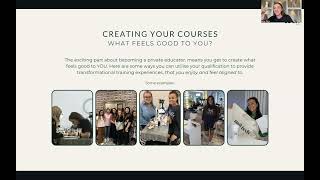
Now, one of the most underrated, exciting things about becoming an educator that people just don't seem to mention is that the possibilities are endless. And I cannot wait to share this lesson with you because it's so easy as an educator to think. You need to put yourself in a box and think to be an educator, you need to teach beginners. That is not the case being an educator, and I've used this language throughout this program. I use this language in my educator diploma. Like, being an educator is not teaching beginners. Being an educator is leading other people through an effective learning experience. And that could look like so many different things. And this is why it's so important to understand who you are, what's important to you, what your values are, and also your long term goals and the life that you want to live. Because if teaching beginners day in, day out is not what you want to be doing, then that's absolutely not what you need to be doing. But if it is something that you feel called to, then amazing. So I'll put together this lesson just to share with you what possibilities you actually have and so that we can kind of map out your learning experience and create a course that feels good for you. Now, at this stage, you might be thinking, I want to launch five courses or 10 courses. I want to teach everything in beauty. There's so much that I want to teach to other people, and that is amazing. You are going to be kept busy for a very long time. You've got a lot of courses to create, and we're going to be able to launch them to our ideal audiences and really turn their heads when we do. But one thing I will say to you right now is that you can do everything, but you can't do everything all at once. And what you don't want to fall into the trap of is thinking that to be an academy, you have to have more than one course. And so release the pressure right now that you need to launch more than one course at once. And for the purpose of this training, I want you to just focus on one, because you will have a different audience for each one of your learning experiences. So let's say you do a beginner's course for nails, you do beginners course for eyelashes, you do a beginners beginners course for, I don't know, e file, right? Each of those people are completely different, ideal customers. Because the beginner who wants to learn a gel nail course has never picked up a brush before, right? So they have different pain points, they're at a different level of awareness to what other customers might be. They're at a point in their life that you need to get really clear and focused on. They're not yet a part of the industry. But if you're going to teach, say beginners E file, that's a totally different audience because they're already a qualified nail tech. They already have certain skills, they have a different set of pain points and different understanding of any file so far. And we need to understand that in order to create the experience around them and then market it. Right. So trying to launch all of these courses at once is going to be so difficult because they are all for different client, different ideal customers. So what you want to do is choose one experience that you think either it is something that you are the best at, it is your niche, or it's something that people are asking you for all the time. If you don't know what that is yet, then this lesson is going to help you. So this is the part where you get to start thinking about what feels good to you. The exciting part about becoming a private educator, as I've just explained, is that it means you get to create whatever feels good to you. So here are some ways that you can utilize your qualification to provide transformational training and learning experiences not only that feel good to other people, but that you enjoy and feel aligned to you too. So here are some examples. First of all, you've got beginners courses, right? These are the obvious ones. These are the ones that most people. People become an educator because they want to teach other people what they've learned themselves, which essentially is to become a nail tech or whatever else it is that you are qualified in. Amazing. So beginners courses is one option, but you also have things like one to one training sessions and specialist master classes. So if the thought of doing a beginner's course in person puts you off because you really don't think you'd be good in a room full of people, then you have the option also to do one to one training. So you could still do beginners courses, but you could do them on a one to one basis. If you do, that means you can charge a lot more for that because one person is getting all of your time and energy. Or you can do one to one training in the things that you are good at. So maybe it's French manicure, maybe it's builder gel, maybe it's E file, and maybe if it's it's for someone who is already qualified, but you just want to give them your way of Doing things or that extra bit of skills and knowledge that you know is going to take them to the next level. And then the same thing with specialist masterclasses, okay? Take the one thing that you are good at and then turn it into a learning experience for a group of people that are struggling with that one thing or that would love to work with what, learn how to do that one thing or love to get better at it. So it could be a specialist masterclass in nail art. Could be a specialist masterclass in application or French or wherever you want it to be. And again, that could be in person or online, just like any of these experiences could be. So just to make you see that this is possible for you, here is an example, or some example, sorry, of me doing every single one of those things at different stages in my journey, depending on what felt good to me, depending on my skills, my knowledge and my confidence. Okay, so the first one here was I think, a nail art masterclass that I did in my salon. So I had a model come in and you can't see them on this picture, but there was all people sat around my desk and they were watching me do different nail art techniques and then they got a full day with me to implement what they'd learned to practice on each other, to use my products and things like that. Okay, so that was an in person specialist math class in nail art. And I did that at a time when not many other people knew how to do the level of nail art that I was doing. So the hand drawn nail art and all of that, it wasn't big back then. This is going back many, many years. So it's about thinking, what is other people not teaching right now? What have I got that isn't necessarily the done thing? Or is there a way that you do something that you can bottle up? So there could be something like the Amy Guy method that I could create that is my way of applying build a gel. No one else can teach that, only you. And because it's exclusive, it gives people fomo. Like if I said to you, oh, tomorrow I'm doing a math class on the Amy Guy met, you'd be like, oh, what's that? I've never heard that before. So you can create a method as well around what you actually do and, and package that all into a math class. Here is an example of me with my beginner students. So I used to have six students on a course that one person's cut off on the end there. I used to have six students on my course. They used to come into my training academy and they would all bring a model in with them but they model wouldn't come until the afternoon and they would learn how to. Well they would essentially learn to become an air technician. They would le with a qualification in that. Then I used to do one to ones in nail art. So it was a four hour lesson. The student would come in, they will get to choose from a menu which designs we covered. They would cover it in that four hours and I would give them as much of my knowledge as I possibly could and they would leave with all of these new skills and these new nail art looks that they were able to go away and do. Which means they can, you know, charge more for their experiences and their nail sets because they're now applying a higher level of skill. This actually one of our lovely, she's a member actually Stacy who is from Ireland, I was from the uk. She actually flew over from Ireland twice to do two separate one to ones with me. Okay, so that is the possibility for you. You could have someone who just loves learning with you and continues to come back and come back and actually that's what we want, that's what we would want to try and create. Then you've got a nail art tour that I did. So I was teaching nail art. I was noticing that a lot of people were traveling to me so I did a tour of the uk. So put all my stuff in my car and I went around the UK doing different math classes in different locations throughout different months of the year. This was an opportunity for me to reach people that couldn't necessarily travel to get to me. It was an opportunity for me to connect with the online audience that I have built and it was really, really successful. And then last but not least, the nail tech org and I teach each and every day inside nto. I use my qualification to show up every Monday morning inside members club and coach other nail techs on business support and topics that I feel that I'm an expert in. I also create events and retreats. Something that was never done before in the industry was my retreats that I absolutely love doing. I've been able to create that because I'm a qualified educator and I know how to lead an effective learning experience. Off the back of that I've been able to create match free masterclasses for people to be a part of members days where we do different levels of training. All the tutorials you see this video that you're watching right now is only possible because I went on my educator journey Right. So all of these things are also possible for you. You get to fit whatever it is that you want to teach into a way of teaching it that fits your life, your business, your purpose and your ideal clients. What I am doing right now isn't what I was necessarily doing when I first launched, because when I first launched I had a physical property, so I wanted to use that to turn that into a training academy and get people to come to me in person. So I really focus on making that in experience. Amazing. Doing things that other people went to and leaning into my strengths. Utilizing social media to build a community and connection for people who would travel in the uk. But right now that wouldn't serve me right. I now don't live in the uk. I want to travel more. I want to be able to teach other people and still create the same impact whilst also being able to take things off my box that I want to do, like travel. So the nail tech allows me to do that because it's online. So don't put yourself in a box. Think about your opportunities and what you are able to do as somebody who has an educated qualification and all these skills and pieces of knowledge that are inside your head. Now I want you to think also about how you would like your courses or experiences to run because you also have two options now. There are so many different nail brands out there that are looking for educators. So what you can do is go ahead, get your qualification, your insurance and all those things. But then you can apply to work with another brand or you can create your own private courses, which means you also need to create your own manuals, but then they will be solely your own. So you've also got a decision to make around whether you know you want to do all the work yourself and you want to really establish yourself with this key educational brand, or whether you want to use your personal brands to then go and work with another company and create income that way. Okay, so think about what is the goal? Is the goal to have impact? Is the goal to grow your income? Is the goal to be able to do it from anywhere? Is it the goal to not have to market your courses because someone else will do that? Like, think about what's important to you. And then lastly, the other things to think about at this stage when you're deciding what type of experiences you want to host is things like training environments and facilities. So what facilities do you have right now if you want to do in person courses but you don't have the space, don't let that put you off, look at me. I was doing courses and master classes in other people's salons all over the uk. So even if you don't know where that is yet, you can still create in person experiences. You can also hire, you know, know, function rooms, hotels, training rooms, things like that, corporate spaces, all of which you will be able to host your experiences in. So you have options in that sense. Costs and pricing, which we'll come on to in next lessons, the length of the course. So how long do you want it to go on for? Is it a full day? Is it half a day? Is it multiple days? Is it all done online? If it's done online, are you going to give them lifetime access or you're going to limit their access so they have to do it in one month, two months, three months to keep them accountable, keep them engaged? What emails do they need before they start? Or is there anything we need to post out to them in the post? Kit items. So are you going to provide them with a kit or are they going to come in and use your kit and then go away with a shopping list and buy their own? Any resources you might need, like printing and your manuals, where are you going to get those printed? Are you going to use someone local? You're going to use something online? Do you need manuals? Do you need something else, like leaflets and handouts? Is there something you want to be on their desk when they first walk in, or something you want to send out to them in the post? Any additional stock you might need. So if you've got students coming in, the likelihood is if they're practicing while they're in the seat, they're going to use a lot more product than what you would if you were just with your clients. So just understanding how much stock you will need for each of the demonstrations and the practices that you'll be doing with your students and also keeping in touch afterwards. Like, how are we going to keep in touch with our students? Do we want to create a bit of a WhatsApp or Facebook group for these people to communicate in? Do we want to create our own little sort of private platform for them to use? Do we want to just give them our email address and let them know they can reach out to us on email or Instagram? What does that look like? So these are all things, you don't need to have them nailed out yet. Nailed down yet. Sorry. But what you do want to start thinking is like the bigger picture and this will help you to make an idea. Like if I was saying some of them things, and you were like, oh, God, I didn't want to have to think about that. Well, then think about the experience that you're offering and how your packaging it and what that gets to look like based on what you're trying to create. Because remember, you're. You are in control of what you're building. You have all the options. Don't create something that backs you into a corner that you don't want to be in. Create something that sets you free from where you are now. Create something that gives you the stepping stone to reach those bigger goals. Create something that moves you in the right direction of where you want to go at the same time as creating the impact that you want to create.