Understanding KPIs for Salon Success
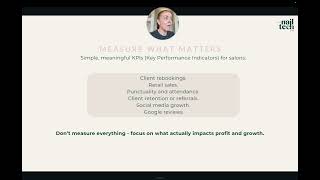
Amy Guy breaks down which numbers salon owners should track: client rebookings, retail sales, retention, referrals, and Google reviews. Assign each KPI to a team member, keep scores visible, and reward progress instead of punishing misses.
Chapters
So, as promised, now we're going to talk about something called KPIs, which are key performance indicators. Now this might be something that you may have seen in a corporate job that you might have been in, or a previous role or something like that, or you might have never heard the term KPI be used before, but either way, it's fine. I'm going to explain it in a way that's broken down, easy for you to understand and easy to understand also how you can use this in your salon environment in order to keep your team motivated, keep, keep them working towards new goals and actually keep them involved in the growth of your salon so it doesn't feel like it's just all on you all of the time. So a motivated team doesn't just happen, right? You're not just going to hire new people into your team and they're going to burst into work every single day and go, I cannot wait to grow this business for you this morning. Right? It doesn't just happen. It's built, but it very easily can be built. And one of the best tools that you have as a salon owner is, is KPI's Key Performance Indicators. So they show your team where they're winning, where they can grow, and they keep everyone focused on the same goals. Essentially, KPIs are numbers. They are the numbers that measure the success in your business and in your salon right now. So not all numbers will you need to talk about with your team. Right? Because if I was to dissect your salon business right now, there are so many different numbers that we could talk about, that we could discuss, that we could look into and things like that. And not all of them will be relevant to your team members in terms of keeping them motivated, keeping them a part of the salon growth and keeping them going day in, day out. Some of the KPIs that are a part of your business are there just for your understanding as the business owner so you can make informed decisions, prioritize, make budgets and things like that. But some of the KPIs that I've pulled together that I feel like are important for you to be talking about with your team members. Some of the numbers that I think you should be including in things like team meetings and team check ins are these here. So first of all, client rebookings. Now if you are going to employ a team member and you are worried about how you're going to make a return on their investment, so let's say, for example, this is your first hire and you have a Wait list. And you're thinking, right, I think I'm ready to employ someone as a nail technician in my space. But I'm really worried that, what if they're not fully booked and I've still got to make their wage? Well, actually, that shouldn't just be your responsibility to worry about them being fully booked. If they are in that role, that should also be their responsibility. So let's say you hire this person and you bring them into the business. You will give them a clear role profile. Okay? So welcome to the business. This is your job. Your job is to make sure that you are carrying out really professional treatments. You're following these SOPs. You are answering the phone if it rings, you are doing X, Y and Z, Right? The KPI that you are responsible for is client rebookings in your column. Okay? So what I would like you to achieve is at least 85% booking rate week on week. If you don't hit those KPIs, I would like you to understand what maybe you could do differently or start doing in the time that you've got not doing clients to help boost those rebookings. I want you to come to me every week and tell me how many rebookings we've had and whether or not we're on track. If we're not on track, I'd love to know what it is that you're going to be doing in that week ahead to help us get back on track. Right? So all of a sudden you've gone from taking on all the responsibility yourself to taking that KPI that is a part of your business and giving it to the person who essentially is responsible for leading that. Not only does that give them something to work towards, it gives them a measure of success. So then it's your job to reward them when they hit that KPI, give them your time if they don't, and to really ask the right questions. Because you both know what success looks like in that role. They're not being brought in just to sit at a desk and do nails. They're brought in to grow the business. And how do they grow the business? By looking at this rebooking number and making sure that that is being managed and monitored every single month. What you measure, you manage. Okay? So if something, if there is a number that is being looked at every single week and measured, then you're going to be able to manage that. But if you have KPIs in your business that you're just ignoring, how do you ever expect them to get bigger okay, the other numbers you can look at is things like retail sales. So maybe this is something for your receptionist or your salon manager or you to take hold of. But what are our retail sales week on week? How much are we making from the products that we're selling in the salon? If we're making not a lot, how can we make more? Can we push them on social media? Can we push them in emails? Can we add a little section on the bottom of our confirmation emails that upsells certain, you know, items? Can we move the position of the retail box in the shop? Like, how do we make this better? Punctuality and attendance of your team members. So maybe it's that they are employees and you would expect a certain percentage of punctuality or attendance and if that wasn't met, you would ask them why. You know, we're all humans, you've got a family. I expect that you might be late on one or two occasions, but if it happens more than three times throughout this year, I'd really like to understand why. And if there's any support we can put in place. Maybe we need to change your work and hours, maybe they don't work for you, etc. But it's a KPI that they should manage themselves. Client retention or referral. So if someone is referring to their friend to come to you, that's amazing. Social media growth. So we should be tracking how many followers have we got, what's our engagement, how many inquiries have we had through social media? Every single post should bring us an inquiry. If it doesn't, why not? Do we need to change up the content? Do we need to get everyone on board with that? What are we doing with that KPI and also Google reviews? So if we rely on words of mouth and we rely on Google, maybe we're not so social media focused. Then maybe we really want to put the focus on Google reviews. So how do we incentivize those? How do we give that KPI to our team members? So they're driving Google Reviews. They're the ones who are with the, you know, with the clients. And how do we all also incentivize when we get great reviews? How do we make our team feel, you know, rewarded for the reviews that we are getting? So you don't want to measure everything, you just want to focus on what actually impacts profit and growth and this will be linked to what your goals are right now. So if your goal is to be, let's say you're already fully booked, you, but you want to go from, you know, having a really small, solid business to actually building a brand that is known. So maybe if that's the case, I will be focusing on social media growth and Google reviews. Or maybe right now you aren't fully booked and you need to get more bums on seats. Then I will be focusing on client rebookings and client retention and referrals. Or if you are fully booked, you feel like you've got a great brand but you want to actually grow your profits, then I'll be focusing on retail sales. Right, so it depends on what your goal is as to what KPIs you're really going to focus in on and who you will give those KPIs. KPIs too. Now, there is transparency in sharing the numbers. So a lot of people might be worried about sharing certain KPIs within the team because it might drive the wrong behaviors. But transparency in sharing the numbers actually allows your team to understand exactly what is going on. So I would really urge you to keep the main KPIs visible to the team so you don't need to share the ins and outs of how much the salon's making and the profits and all of that. But. But they need to know if the salon is successful or not because essentially that will determine their role and whether they still have a place in the business. You want to present your KPIs and your numbers positively, not negatively. So even if they aren't where you want to be, you still don't want to frame that as a negative. You want to share that as in, this is where we are. How do we really look to grow this? Because we know that grow and this is going to help us create the vision. Another example of how you could share that is, guys, we hit 75% rebookings this week. That is amazing. That feels motivating to the team rather than we only had 75% of rebookings and our goal is 85%. Right. Makes people feel rubbish. Let your team own their KPIs and let them bring their KPIs to your meetings or update any trackers that you have themselves whilst taking ownership of the results. If you give them that as a responsibility, it will drive great behaviors in your team. It will help them to take ownership and help them to feel a part of something. The most important thing you need to think of within your KPIs is how you are recognizing your team when they win. Use your KPIs as a reason to shout about your team members. Recognition could be things like verbal praise. So in a meeting, really shouting them out. It could be a social media post to share how well they're doing as a part of a team. It could be a small reward, a fun team incentive, a voucher, a day off, an afternoon off, an hour off and a massage, anything. Think about what the person in your team values and how you can give them that. Everyone will be different. One person will value an afternoon off, another person will value an extra 5050 pounds in their P packet. It just depends who they are and what motivates them them. That's why it's important to know your team. Another example could be, you know the top retail sales this month get a free product of their choice. So it's just constantly incentivizing the wins KPIs on punishment. So frame them as tools for improvement, not criticism. Use them in your one to ones to have important coaching conversations. So here's where you're really strong. Here's where you've got the opportunity, opportunity to grow. And this creates a culture of development, not fear, which is how it should be. Remember, it's not about pressure, it's about progress. When your team sees their numbers and feels supported to grow, they are going to be more motivated, more engaged and more loyal. Remember, what gets measured, gets managed and gets improved. So the more KPIs you have that are being measured, the more opportunity you have to grow, improve and stay motivated as a team.