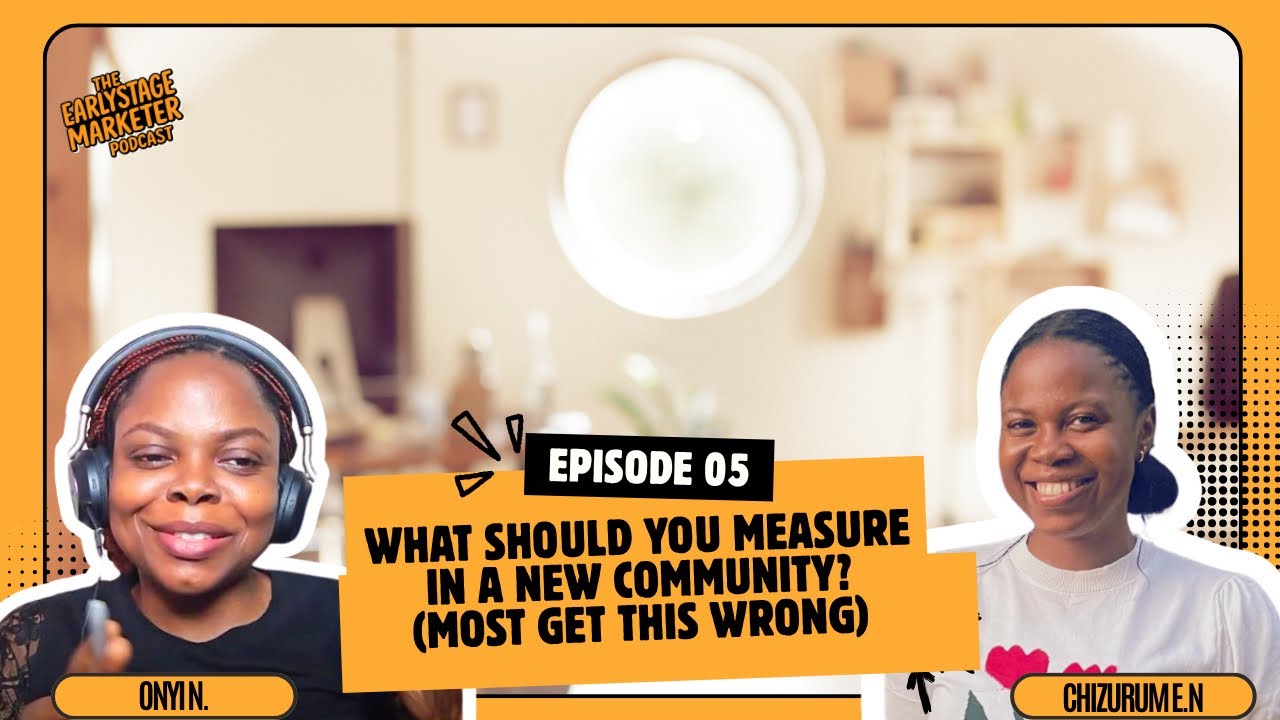
In this episode of the Early Stage Marketer Podcast, the host asks the community expert what core metrics should be tracked in the first three to twelve months of a new community. The guest stresses that measurement must be driven by the community’s purpose and the company’s business goals. For a support‑focused community, the expert suggests tracking the number of complaints, issues raised, and the extent to which community members resolve them. For engagement‑oriented communities, metrics such as daily active users (DAU), monthly active users (MAU), event registration versus actual attendance, post‑event engagement, and the conversion of “lookers” (lurkers) into active participants are highlighted. Growth metrics like new member count, referral sources, and link‑share traffic are also recommended. The guest notes that intangible outcomes such as trust and loyalty are harder to quantify but still important. Ultimately, the guest argues that any metric must tie back to the community’s underlying goal; otherwise, the data won’t indicate whether the community is delivering value or should be discontinued. The episode ends with a call to action for listeners to subscribe and share.
So what I want to ask is, in the early stage, so let's say we've started a community 3 months down the line or 6 months down the line, but ideally less than a year, what should we measure in those early days? What is just one or two core metrics to measure in those early days? Yeah.
Um, so, um, it goes back to that spaces model that I talked about, right? So what you're measuring depends on what your goal is. You cannot just measure, you know, just randomly. So, for example, if, let's say, my community— community was set up for support, one of the measurements or one of the ROIs that I'll have to look at is over the past 3 months, how many complaints have come, how many issues have our users had, and then to what degree have community members helped them.
Yeah.
So, it tells you, oh, that points to me— if you have people that have issues and committee members have come to their aid, it points to you that your community is actually beneficial. is useful and it's something that you should scale for the coming years or for the coming months, right? So it's what you're looking to achieve, and then you tie it back to what you're measuring. So I gave that support, for example. So if it's engagement, for example, a community is measuring daily active users, that's DAUs, and a community is measuring monthly active users. Oh, they might actually even measure the number of people that register for events and the number of people that turn up. And then after that, you can actually even register— oh, 1,000 people registered for an event and say about 300, 400, 500 turned up for that event. Even after the event, did engagement increase in the community? Did you find out that people who are lookers— so lookers are just basically people that just join a community but never participate. They are just like onlookers, you know. You're trying to see, oh, did a looker maybe attend this event and then this looker actually saw the need to fully participate or be part of the community? Did engagement increase after this event?
Yeah.
Did engagement tank after this event, it gives you an overview of the things that actually resonate with your community. And if those things that resonate with your community, you know, are in alignment with your business goals— because also something I forgot to say is that every community has to align with business goals. Every single community initiative has to align with business goals. Your events have to drive towards a goal. Now, I'm not saying that all events should be salesy, but it should be done or it should be executed with a goal in mind. So even while you're doing those things, you're measuring. Again, as I said, some of the results results are measurable. For example, why people join your community might be trust, right? Um, people might join your community because of loyalty. Those things are intangible and it can be a bit hard to measure it. But there are other things that you can lay your hands on, right? Oh, community growth is actually even a measure, right? Are more people joining your community? And how are they joining your community? Is it that members are recommending your community and you're seeing that your links have been shared and you're tracking where the traffic is coming from? These are some of the things that you can measure. But in a nutshell, What you measure has to be in alignment with the reason why your company has a community. You cannot just measure, you know, just at random. It has to tie back to a goal. And that's how you know whether your community is useful or if you actually should shut down your community, which is another conversation altogether.
Yeah, I like that. Thank you. Thank you for that. Thank you for listening to the Early Stage Marketer Podcast. I hope today's story gave you something to reflect on. Or even something to try in your own work. If you enjoyed it, please subscribe, leave a comment, and share it with someone who might find this helpful. See you next time!