*A Kind Rewind* Freed to Flourish Together: Growing a Healthy Church in Freedom and Unity

Rod, a Freedom in Christ leader, discusses building healthy churches through grace, spiritual authority, and unity. He explains how congregations can support their pastors using three biblical questions, why small groups matter for church health, and how unity multiplies the church's impact across 40+ countries where Freedom in Christ works.
Chapters
Welcome, friends, to Stories of Freedom, a podcast about discovering and embracing who you are in Christ. On each episode, we'll visit with people who have overcome obstacles, gained freedom, and found abundant life in Christ. These conversations will highlight the goodness of God woven throughout the lives of His people and teach us as His children to appreciate that very same goodness in our own lives. We will journey together, growing to better understand how to live this life free and fruitful in Christ. This is a multi-part episode. You are entering a conversation already in progress. Enjoy.
I do want to look a little bit more at the book Freed to Flourish together and tell our audience What is a little bit of what is in it and why it would be beneficial for their church. My wife was so good. I used the words cognitive dissonance in a sentence, and she said, describe to me what do you mean, or define for me cognitive dissonance. And she could see me going, you know, preparing for a big long answer. And she goes, in 2 sentences or less. I'm like, now I have to—
Holding 2 contrasting thoughts at the same time.
Yes, there you go. That's one phrase.
I know exactly where you can find that definition. Hello.
What page?
Hello.
Yeah.
Chapter 1.
So talking about cognitive dissonance and your definition of it, holding 2 opposing thoughts at the same time, from Freed to Lead, your book Freed to Flourish Together, talks about how as a congregation sometimes we have to hold what seem to be competing thoughts or the opposite ends of the spectrum. We have to hold those at the same time. So let's go to chapter 5 because that's giving grace without giving in. What do you mean by giving grace without giving in, and why is it so crucial to healthy Congregational life?
Well, we have to understand with grace, everything we have is a gift of grace. God has given us grace upon grace upon grace. Every good thing in your life is a grace, a grace gift of God. My wife is a grace gift. The spiritual gifts I have is a grace gift. My ability to preach is a grace gift. And so God is just Constantly giving us grace, giving us grace, giving us grace, and God wants us to give the grace that he gives to us to other people.
Amen!
So I want to give all the grace that I have. So when I have a relationship, the fact that I am here is a grace gift to you guys and to the Freedom in Christ audience. You know, I am giving this as a grace. I don't get anything out of it. I just want to give. And so every conversation I have with somebody is a gift of grace. Everything that we do in the life of the church, when we greet each other on a Sunday morning, when we shake hands, when we give to the offering, when we serve one another, we give each other a cup of coffee or tea, all of that is just giving grace. And a healthy church we'll have a group of people giving grace to each other. And that also means, too, giving grace also means thinking the best about other people.
Yeah.
So if one day I hear, Dan, you say something to me, and I think, wow, did he just call me fat? I don't know. Or was it dumb? Was he saying I was dumb? I don't know. You have a choice at that moment. I can either say, You know what? Dan is the worst person I've ever seen as a leader, and I am going to let him have it the next time I get within a couple of meters of him. I'm going after the guy. That's not grace. Or I can say, you know what? Yeah, he might've said that, but I'm going to give Dan grace because frankly, if he said it, it would be out of character. And if he said it, and it is a character flaw, then you know what? God's going to deal with it, and just as it's God's kindness that led me to repentance, I'm going to give Dan kindness to lead him to repentance. That's giving grace. We have to be giving grace all the time, but giving grace does not mean that we give in to sinfulness.
I was going to ask what you meant by that. Like, what is that not giving in part?
So the problem is with most Christians, I hate the word nice, and most Christians are way too nice. You know, so if somebody is rude and miserable, they just kind of take it instead of saying, you know what, that seemed rude and miserable to me. And by the way, if somebody is rude to me, if a brother in Christ is genuinely rude to me, And if I say, and I look at him and say, you know what? That felt rude. Doing that is an act of giving grace.
Without giving in.
If I withhold that, I'm withholding grace. And so what you do, you're not giving in to sinfulness, and you're not giving in to character flaws, and you're not allowing the weakest, most immature person to dominate the group. And this is what happens time after time after time at churches. We see it all the time with with City Temple. You get somebody coming in, maybe they come into the service, and they're like, you know, in the middle of the worship. And what what do people want to do? Everybody wants to go around the person, and they want to comfort them, and they want to encourage them. And what you need to do in that moment is have somebody who's trained in this, one of the elders, go sit next to the person and say, "Hey." Hey, I notice you're crying. Is there something you need right now? And then to say, you know what, if you need to cry out loud, then you need to go into a different room. You're free to do so. You're welcome here, and we'll minister to you after the service, or we'd love you to stay in the service, but if you stay in the service, you need to pull yourself together. And there will come a time when we will minister to you and serve you. And a lot of people would never even think about doing that because we've got to give in to that person in that moment. And all of a sudden, the person, the person who can be the loudest, the person who can be the least mature, the person who can be the most immature will control the group. So you give grace to the person, but you don't give in to their bad behavior. And you put boundaries around their behavior so that you minister to them in the way that God has called you to minister with the gifts and skills that you have as a congregation. And giving in to them that moment doesn't help them and it doesn't help you.
Well, and in that chapter, you talk about spiritual authority. You define it as our freedom to act effectively for the benefit of others as God's representatives in accordance with God's will, right? And so even in that sort of illustration, an elder coming alongside of saying, hey, you know, they're acting not out of insecurity, right? Their security in Christ, their acceptance belonging in Christ, acting with spiritual authority for the good of that individual but also for the good of the congregation as a whole.
Yes.
And bringing health to the situation. So let's go to the—
Key thing there that you say, Dan, it's really important. You cannot sacrifice the health of the congregation for an individual. It will never work. It will never work. You always have to preserve the health of the group. That's the only way The individual will be helped, which is by doing it.
Yeah, which is again why I'm trying to figure out how to say this. So Amanda, we may need to edit this or cut out part of this, but my immediate thought was even if that individual is the pastor.
Even if the individual is the pastor.
Or especially.
Yeah, so especially, which is where we bounce back to the, it's so important for leaders to be healthy, right? The crux of the health of the congregation starts with the leadership.
Yes, essential.
And then that exercise of that authority for the good of everyone else. But a lot of our listeners are not pastors or leaders. There are some of them. They're not necessarily pastors in the church. Many of them are in leadership positions of one sort or another. How does How does a congregation member help their pastor, giving them grace, but also help challenge them to greater health? In your experience, how does that work?
It's a difficult thing if the pastor doesn't want to be healthy. I mean, there's no easy solution to it. One of the things, but if you are going to do it, one of the things is the pastor has to know that you support him. The pastor has to know that you're for him.
Amen.
3 important questions that David asked the Benjaminites that came to him: Have you come in peace? Have you come to help? And are you willing for your heart to be united with mine. And every pastor needs to know that the person who's talking to him has come in peace, has come to help, and has their heart united to his.
Man.
If that's not the case, the pastor will not trust you. And in those cases, sometimes the best thing to do is just to find a church with a healthy pastor. And so, and it needs to be not only a healthy pastor. Healthy pastor has to have a healthy team of leaders around them.
Mm-hmm.
Another thing to do in a church, if you're wanting to begin to develop this and you're not the senior leader, is to be healthy yourself as a leader. Know who you are in Christ, say with the Freedom in Christ course, And then start to bring, whether it's a small group or Sunday school class, whatever it is, bring others around you and start to build a healthy group. And you can use Freed to Flourish together to do that. You know, say if you're a church that has small groups, make your small group, make it your determination. This is, I'm going to be the healthiest small group leader, and this is going to be the healthiest small group in the church. Because health will attract health. So healthy people will be attracted to healthy things. And so when people see that, they will be attracted to it. And so there might be other small group leaders, for example, in the church who say, wow, you're really healthy. Your group is really healthy. How do you do it? Well, here, let me tell you, this is how we do it. And then eventually the pastor, the elders might say, wow, These 2 groups are so healthy. How are you guys doing that? Well, we're living out this Freed to Flourish together, the different things it's telling us. And, you know, quite frankly, I think this would benefit us as a church. And if the pastor, again, and the leaders know that you're there in peace, you're there to help, and that your heart's really united with theirs for the well-being of the whole congregation.
Mm-hmm.
And that's And you have— that's why you have to have your identity grounded in Jesus, because that's the only way they'll know it. If you're trying to build a big small group to feel good about yourself, ding, ding, ding, game over.
They'll know that too.
So that's right. Yeah.
So, um, yeah, and those are 3 great questions to ask. You know, having been a pastor and actually at one point, um, in, in the year 2000, leaving ministry for a time, saying to God, I never want to be in ministry again. I just want to go in and support the pastor of a church. Those are 3 great questions to help a congregation member know how to approach a pastor. Where do they find that in Scripture?
Oh, gosh, it's somewhere in 1 or 2 Samuel.
I remember reading it in your book.
2 Chronicles.
Yeah, I remember reading it in your book, but— I'm sorry, I can't see your notes here.
Where's the David story?
Amanda, you can put it in the show notes.
Y'all are funny.
Is that when Saul was pursuing him?
Saul's pursuing them and David's hiding out in the cave.
Yeah, in the Benjamin's cave.
Yeah, the men of Benjamin come to David. And David is like, oh, I don't know about this. Okay, 1 Chronicles chapter 12 starting with verse 16.
Okay, 1 Chronicles 12.
So there we go. I knew we could get it eventually.
We got there. What great framework for people to understand what a pastor really needs, a leader, right? David was a leader. People were coming to him. and he wanted to know those things. That's awesome. One of the things that—
I find this a lot. It's such a key question, these 3 questions, because many people fall down on one of the 3. You know, there's some people that they're in peace, they want to promote shalom, but they don't really want to do anything. Well, they're kind of useless long-term for the health of the church. There's some people who are there who talk about shalom, who want to help, but they have their own agenda and their heart is not really united to ours and to mine. It's okay. I'm not ashamed to say your heart needs to be united to mine for this church.
Yeah.
God's put me here and God's given me the heart for this church, and I'm not dictatorial about that, but But I know who I am. So people should examine themselves about the church they're in, and if you cannot answer yes to all 3 of those questions, you need to find another church.
Yeah, which is okay, and as a minister, you're okay if they answer no and go somewhere else that's a better fit for them, right? Because then they can be a healthier part of a healthy congregation supporting and encouraging their leader toward health so they can reach their community in healthy ways.
Yeah.
As opposed to being in a situation where they're in conflict with you as God's appointed leader in the congregation that he's put you in. And so one of the other chapters, chapter 6, again, there's so much in this book that I thoroughly enjoyed, but You know, you talk about maintaining unity without losing integrity. Tell us, you know, well, let me ask a couple kind of questions. Give us, give our audience just a taste of this chapter. What's our unity as the body of Christ across the world? And then I'll have a follow-up question.
Yeah, we need to understand our unity as a church and our unity globally as the people of God. One of the single biggest mistakes I hear people do all the time is to say, we got to work for unity, we got to build unity, we got to work for unity, we got to strive for unity. Actually, that is false. Our unity is a gift. It's a grace gift of God. Jesus prayed for it. In John 17, and his prayer was answered when he breathed into the disciples the Holy Spirit, and when the Holy Spirit fell upon the disciples on the day of Pentecost. And from that day— and Paul echoes this in 1 Corinthians chapter 12—
Mm-hmm.
Were we not all baptized in the same Spirit and given the same Spirit to drink?
Mm-hmm.
Unity is a gift we already have. When you are saved, you are united with Christ in that moment. Jesus Christ's Spirit comes, lives inside of you. You are united with Christ, and in that moment, you are instantly united with every other believer in Jesus Christ everywhere.
Mm-hmm.
And that unity is a gift. We don't work for it. We don't earn it. We don't strive for it. The Bible commands us to maintain the unity of the Spirit in the bond of peace.
Yeah.
So every time someone says in a church, for example, oh, we need to work for unity in this church, what they often are saying is that, you know what, we all need to agree with one another, and we need to have general consensus in this congregation. Consensus is not unity.
Yeah, and you—
it's forced agreement.
And you describe in the book what are these false ways of trying to achieve, quote unquote, achieve unity, right? So that's in that chapter. But living in London, a very diverse cultural city, you've had to maintain unity without losing integrity? What's that balance look like?
Well, in the context of the church, that means being an authentic follower of Jesus Christ, knowing who I am in Christ, and making sure my behavior outwardly is reflective of what I have on the inside. That's what integrity is all about. And I have to maintain my personal integrity. In the context of a local church, if, say, I was a member of a church and the pastor was saying something— I can't give an example off the top of my head, but something that I disagreed with— then I'd have to decide, okay, either I choose to go along with this, and if I can maintain my integrity to do that, I will, or it's time for me to find another church, and that's okay. I won't do it with acrimony or anger. It's— you just need to do it. And then that works in the context of a community or a city in the same way. So each church needs to find its own integrity. Who are you together as the people of God? What is your identity? How has God gifted you and called you? Some churches are very evangelistic. Others are very pastoral. Some churches are like centers of teaching. You know, there's all kinds of diversity. So you need to know who you are. You need to know what you believe. And then you look to work with other churches. And so if I'm a pastoral church, then maybe the church down the road is, is more of a teaching church, uh, and we'll work together on things that we can agree on. But each church, we respect the integrity of each church. So I don't expect another church to become like mine.
Yeah.
Uh, and I won't allow them to make me like them.
Yeah.
And if we respect each other's integrity, then we can maintain our unity.
Yeah.
And if we respect each other's integrity, that also means we can work together with churches that we don't agree with. So maybe you believe the gifts of the Holy Spirit died, you know, with the apostles, and you've got a Pentecostal church that says, no, they're all for today, and you think, oh gosh, how can those two work together, well, you're still going to have lots of points of agreement. You know, Jesus died on the cross, rose from the dead. You can still agree that our city needs to know the gospel of Jesus.
Amen.
So how do we work together respecting our individual church integrity, but at the same time demonstrating that, hey, we're all Christians together? Yeah, and that's the challenge.
Yeah, and you delineate some of how to live that out in the book in that chapter. Why is unity so essential to the fulfillment of the Great Commission?
Well, that's— you have to ask Jesus on that. That was his prayer, that out of that unity there is— it's hard to answer without sounding super weird, but I think that there is a spiritual synergy that happens in our unity that magnifies what God is doing through us individually into a corporate dynamic that has greater spiritual power in the city, in the area around us. So it's a multiplying force.
Uh-huh.
So as an individual, I have a certain amount of spiritual power and spiritual authority, but if I'm together with my church, It's not additive, it's multiplicative, if that's a word. It multiplies. It doesn't add, it multiplies.
Exponential.
Right, it's exponential. Thank you, there's the word. It's exponential. And the same is true across the city. You know, as we're working together with other churches, there's an exponential increase of our united corporate authority in Christ Jesus because we are already united in Christ.
Amen.
It's already there by the Spirit of God. If you're not united with Christ and united with other people in Christ, you are not a Christian. Fundamental definition.
And you talk about, and we experience this even in Freedom in Christ because we're in 40-plus countries around the world on all 6 major continents, unless somebody's doing a Freedom in Christ course in the Science Center in Antarctica, which I don't know about, but No, but we're across the globe in all these different settings, and we've been working on the expression of that unity while allowing for the differences and working with people in very different settings than where we're at. But it is key to Sorry, I lost where I was going with that statement. So, Mandy, you can leave that in if you want to.
We're doing it.
Yeah, yeah.
Duh! Why would I get rid of gold like that?
Yeah, but it's essential for the gospel, and we do talk about, we do talk in the Freedom in Christ Course and the Grace Course in our materials about how, you know, Jesus prayed for it. as an expression of our unity with him, our unity of him with the Father. That's a tangible expression to the world, which the god of this age has blinded the minds of the unbelieving, 2 Corinthians 4:4. Psalm 133, how the Lord brings blessing where there is unity, even life forevermore.
Amen.
And so we tie that unity to our witness to this world. And how often have we heard it say, I don't want to be a part of church, they can't even get along with each other, right? And so, but you also earlier said that actually takes more work and it's hard work, but what you're seeing is it's worthwhile work.
Mm-hmm.
To help people know who they are in Christ while allowing for their differences And the differences from church to church, which are absolutely necessary for reaching a city. And you spell that out in the book. You know, no one church can reach all 7.5 million in the greater London area. So Rod, if you were to encourage leaders to read your book, what would you say to them? How would you encourage them to do that?
Well, that's a good question. To say, if you want to be a healthy leader, I think you need to get Free to Lead. You need to get what we're talking about, and if you want to have a genuinely healthy church, you need to start thinking of your church as a unit, Not as a bunch of individuals. And you need to think, I need to disciple my church collectively, corporately, just like I would disciple an individual, to recognize its personality, to recognize its quirks, its strengths, its weaknesses, not to scold it because of its weaknesses, but to help it to focus on its strengths so that my church as an individual, as an individual unit, a people system, can become all that God intends for it to be.
Yeah.
And I think as a leader, if you're healthy in yourself and you start to make your church healthy, what I've discovered is, boy, it's so much more enjoyable.
Amen.
You know, the working together becomes easier. After all that we've gone through, City Temple for 15 years has been a very high-trust environment. It's extraordinary to see it, and it's so fun to be a part of it. Golly, how God works through us, how we trust each other, And we make mistakes. So what? You know, we're going to make mistakes. We're not— none of us are perfect. Let's wait till we get our new bodies, you know, and we see Jesus and become exactly like him to start talking about that. But, you know, in the meantime, and that's the thing, leaders, most leaders that I've seen just don't have a clue. They really have not thought about the corporate identity of their church. And the difference that that can make. And consequently, what leaders tend to do, they tend to become very reductionistic about the church. Like, the church is for evangelism. The church, you know, I'm preaching, that's teaching. We need to worship. And even we'll say worship, we have a worship. Well, what's the word? Well, that's singing. And then we got the teaching. What's that? That's preaching, but it's like teaching. And then we got the evangelism. What's that? Oh, that's where we go out on the streets. And we've got this other helping ministry. What's that? That's when we pass out some food. And we tend to atomize the church and reduce the church to a collection of things that we do.
Mm-hmm.
And that's a bit like me saying, hey, Karen, Karen's my wife, Karen, you know, you're such a great cook and I love the way you clean. And boy, oh boy, it's really good when you make me my favorite dessert. And, you know, and those other benefits that we have together that, you know, won't mention on a family podcast, you know, all of this stuff. And, you know, what do I do if I talk to my wife like that? I have just instrumentalized her. I've, you know, she might as well be my cook or my cleaner, but she's certainly not my wife.
Sure.
You know, I don't love her because of all these things that she does. I love her because of who she is.
Amen.
And if I didn't know who she was, I wouldn't appreciate what she does.
Amen.
And that's where, especially in the States, almost every single church I see in the States, has a reductionist attitude toward the church. They don't know who she is, and it's worse than the way I just talked about treating my wife, because imagine, Dan, if I was treating your wife that way.
Preach.
Oh, Jen, I love it how I want you to cook for me, and I want you to clean for me, and, you know, your value as a woman is all about what you do for me. What have I just done? I've just insulted your wife.
Exactly.
Wait, who is the church?
Exactly.
The church is the bride of Christ. So if we instrumentalize the church, if we reduce her to what something she does, we have just insulted the bride of Christ. And I don't know about you, Dan, But if you can insult me till you're blue in the face, and I don't care. You insult my wife, and we have issues, and we have serious issues, and I will not back down from those issues.
Right.
Yeah.
I mean, that's just— you just don't do it. Yeah. Now, if I feel that way as a human being about my earthly wife, I wonder how Jesus feels about His bride.
Amen.
And maybe it's time we start to recognize who she really is.
Amen.
And not look to what she can do for us, but value her for who she is.
Yeah.
And start to see her in relationship to Jesus.
Yeah.
And once we come to that reality, it changes everything.
Yeah.
Amen.
That's huge. I mean, Honestly, it reminds me of when I was a nice guy and, uh, and, and a counselor actually asked me, would you allow any other man to walk into your house and say and do those things to your wife? And I realized he'd be lucky to get out alive.
Yeah.
And If I feel that way, you know, yes, how does a holy and righteous bridegroom feel about the one who, as you talk about in your book and as we talk about in Freedom in Christ, we want to help the bride prepare herself in those robes of righteousness.
Amen.
Right, and that starts with the leaders, flows down into the congregation, and affects communities for the spread of the gospel, for the glory of God and the good of everyone that we reach. That's why Jesus has set us free, right?
Amen.
Yeah, that's right.
And put us together to walk in that unity that he has secured for us. Well, there is so much— In a sense— Yeah, go ahead, go ahead.
I was just gonna say, in a sense, the book is answering that question. How does the bride make herself ready?
Yeah, yeah.
Hey, you know, that's one of the ways to look at the book. How do we do that? How does the individual bride that is your church make herself ready?
Yeah, and it's, uh, yeah, there's so much more in here that we could have talked about, but we didn't. Uh, they'll have to get the book and read it for themselves. It is a great read. with a lot of material in it. Amanda, how do you want to wrap us up?
Well, I want to say just a couple of things. Number one, super, super excited about Freed to Flourish, super excited for this conversation. I'm not sure that there's a way except through submission to Christ and obedience to him alone and however he wants to order our time We could really have 3 podcasts. We could have— there is no way that we could have done justice to all the conversations that we could have over this. And so I have to just be honest and say that I feel some sense of forlorn for all the questions I won't get to ask because Free to Lead— Of our resources is my favorite second To Victory Over Darkness. I love the textbook. Often when we're talking to people on this show and we're talking about their stories of freedom, right, we know that there's this overarching story of freedom. We know in the Bible there's this overarching story of freedom, and that is told in the million stories told, right? Those million stories of freedom, of the Lord showing himself, proving himself to be real, coming in contact with us, all of those things. When I took this job and we were deciding how we were going to do things and we were talking to people and gaining privilege to hear their stories, to sit with them in their stories, to be part of the function of telling those stories of the Lord's goodness, I was just like, Lord, this isn't my field, right? Know yourself. This isn't my field. You haven't called someone already equipped. I had to learn every single thing. Everything that we're doing, I still don't know half of the things I'm doing wrong yet, right? But again, it doesn't tell me about who I am. I, when we're gathering people's stories, one of the things, one of the most compelling thoughts is, I'm not sure that I could make it if I had even one bit less revelation from the Lord, right? Like, I'm barely making it in this life. And, and And that's all by way of revelation, everything that he's taught me along the way, right? I don't even know the ways I'm not making it yet. And so there's not a bit of freedom I would have said I didn't need that to get through this. When I came and took this position with the podcast host, I was like, why did they pick me? Why did the Lord pick— this is too much pressure. Like, I don't even know what I'm doing here. Why me? And I had to say, Lord, you knew who you were choosing when you chose me, or when you had them choose me, right? I'm going to have to trust your choice in that. And so then I went back to the things. I don't know what I offer, but I can submit to the Lord, right? Even in our conversation today, you're releasing this book, this Freed to Flourish. It's so exciting to me, but I actually know that There's some part of this conversation that your camp may want to utilize in marketing your book, right? And I even know that that's an objective, and yet I can only come here and have the conversation with you today that the Lord hopefully wants to have today. And so I hope that it's beneficial outside of that, but my desire is to obey the Lord. And so I'm thankful for the freedom that the Lord has given me. I'm thankful for the freedom and the revelation. that the Lord has given you along the way, all of the trials, all of the different sufferings, right? I am really thankful for your time.
Thank you.
I'm thankful for more than your time here telling us stories today. I'm thankful for your long-term submission in a million private conversations with the Lord. I know that you would not have come here without a long, Succession of obedience, right? And so I appreciate you because I, I know how hard this is to learn, for me to learn it, for you to have learned it and then to have written it down so that other people after you who also didn't know might learn a little more. Super cool. Super cool.
Yeah.
When I read Freed to Flourish, so I get super nerdy about Freed to Lead because I've needed it so much, right? I've need— I was such an unhealthy person and leader. I needed all the million conversations in this. So when I found out that you had written Freed to Flourish and I read it, I was so excited. The first thing I did was text my partner in the US, Craig Bess, who we've done a bunch of teaching through Free to Lead and our online courses. And I was like, this new book is so awesome. It's like having a friend you love so much and then meeting their sister and she's super cool and even more accessible. I can't wait to introduce the sister to all my friends. Right? I think it's amazing. I think the things that come out in it, the conversations, take these big thoughts and make them very approachable. It's, it like takes the thing that we talk about and it says, here's, here's kind of a map. Here's, here's how you might do that. Here's how that might look. And I love that. And so it makes me excited to give it to others because I think they'll be able to take it and do something with it. And what good is a tool if it doesn't help you, right? Like if it's not helpful, right? If it's not productive, then why would you lug it around? Right? And so I thank you for submission, long-term submission to the Lord that allowed him to give us tools through you.
Mm-hmm.
By which to seek his face, to love him, to know his love for us, to participate In the chain of other people, all of that.
To really experience that transformation, right? It's not just a book to read, it's a book to absorb, process together, and apply for the transformation of a congregation to become healthier altogether, and really to motivate and inspire the leader to do that, which, by the way, Amanda, we knew you, you love to have authentic conversations, right? And so that's one—
Willingness to look dorky in front of people.
That's right. Number 2, and willingness to learn all the skills it takes, right? What an illustration though of, hey, you didn't know all the skills it would take to do this, but you're willing to learn those. Other leaders are going to need to learn the skills it takes to do what you've done, Rod. And you had to learn them the hard way in many ways. Some of us do and appreciate— It's a hard life. Like Amanda was saying, yeah, the people like you who have gone on before and help us in that learning. But also, Amanda, you were living out your freedom and growing in maturity into Christlikeness. And so, you know, and recognizing your need to submit to and depend upon God. So those are a few reasons why we said there's a leader worth putting in this spot.
It's really all about me, boys. You knew that before, didn't you?
I almost said that.
I called this off here, but those who don't know this, Dan is my actual boss, not only in this podcast, but in the US, my actual boss, and by way of international, I'm sure there's some way that Rod could make trouble in my world because Rod, you are affiliated, not just affiliated with Freedom in Christ, right? I mean, I don't want to bury the lead, but— I mean, you're no slouch in our organization.
I'm pretty slouchy. I'm the chairman of the International Board of Freedom in Christ.
Yes.
And I'm also on the United Kingdom Freedom in Christ UK board. And just so people know, all the proceeds from Free to Flourish Together and from Free to Lead go 100% to Freedom in Christ. I don't get anything out of it. I don't get royalties. I've done it for Freedom in Christ. It's a gift to Freedom in Christ.
Amen.
And all the glory goes to Jesus. I mean, it really— these are things that I really feel like the Lord commanded me to write, and certainly all the learning and stuff that he's given me. So I don't take credit for any of it. All the glory goes to Jesus, and all the money goes to FIC. So buy, you know, buy several copies, please.
And where do we send the complaints? Wait, wait, wait. The glory goes to Jesus, the money goes to Freedom in Christ, but complaints, we send those to...
Dan Stutt. Dan Stutt. You can contact me. I'll give you his email address.
I love it. This is my favorite.
I don't even know how to close after that.
But were there any— okay, Rod, as you sit here with Dan and I and Jesus, duh, as you sit here with us all together, Was there something you were hoping that we would ask that we have not asked that you have a burning desire to make sure that you don't leave our time together without telling people?
No, not really. Just remember, healthy leaders building up healthy churches, making healthy disciples who are reaching their communities in healthy ways. That's how we're going to change our communities. That's how— that's God's strategy. to change the world. Freedom in Christ is an important part of that strategy, but that's the one thing people need to remember because it's essential.
Awesome. Thank you. Thank you for your time today. I thank you also for committing to the 100 private conversations that we're now going to have to have so that you can explain the whole new book to me because I'm very excited. Anyway, but thank you. Thank you, Dan. I feel like you did the lion's share of the holding down of the conversation today. I was just like a learning girl. I just showed up for school, got my books in the back right there. As you see, I read proof right there.
Yeah.
And so thank you, boys, for showing up. Saying really cool, true things that we can take to Jesus.
Yeah, well, thank you, Amanda, for making it possible.
Thank you.
As I started by saying, hey, I'm always better by sitting in a conversation with Rod, and I believe our audience can say the same after listening through this. Thank you, Rod, for being with us today.
Oh, thank you. Very kind. Thank you.
Awesome. All right, boys.
That's it.
Thanks for listening to this episode of Stories of Freedom. If these conversations have blessed you and you want to partner in the work that we're doing, we would love that. Freedom in Christ is a donor-based ministry, and so we need people to feel led by the Lord to join us in the work He has us doing. Could that be you? Go to ficm.org/give to see and find out.
More from Neil

FREED TO FLOURISH TOGETHER - ESSENTIAL READING FOR CHURCH AND CHRISTIAN LEADERS





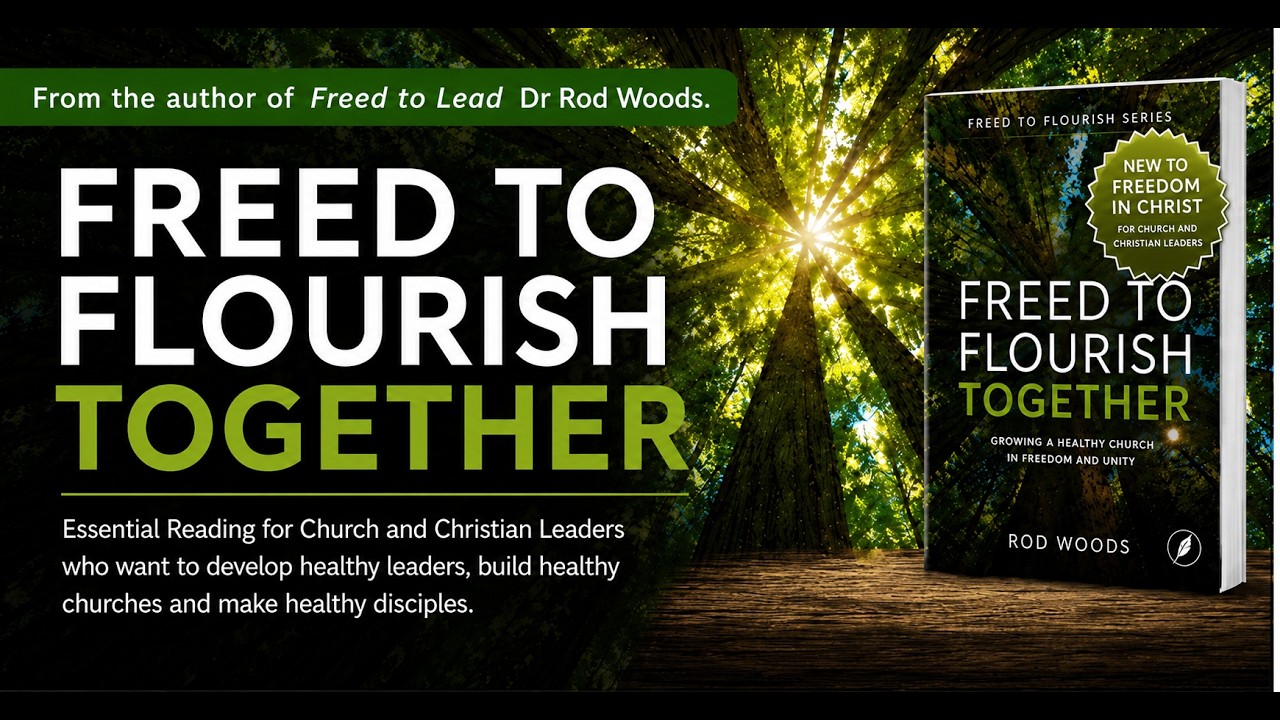
NEW from Dr Rod Woods comes Freed to Flourish Together - for church and Christian leaders