A Conservation With Penny Zenker, Author of "The Productivity Zone" [AUDIO ONLY]
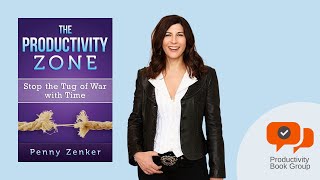
Penny Zenker, author of The Productivity Zone, defines productivity as where efficiency meets effectiveness, not just speed. Her system has 10 drivers across three categories: Championship Psychology (purpose, self-talk, focus, self-care), Winning Strategies (planning, process, prioritization, adaptability), and Sustainable Results (reflection, measurement, foresight). She credits morning gratitude, avoiding news and email, and regular exercise as daily habits that keep her in the productivity zone.
Chapters
Welcome back, personal productivity book lovers. I'm Ray Sidney-Smith, your host and facilitator of Productivity Book Group, and today we're going to do something that we do occasionally, which is the author interview series episode, which means that I'm joined here today with Dr. Frank Buck. How's it going, Dr. Buck?
Great, great. Good to be with you as always.
Always a pleasure, always a pleasure. And so also with us, we have a productivity expert, which is what we do here on the author interview series. So we like to expose you to new and interesting productivity books books and their experts behind those books. And so today we'll actually be interviewing Penny Zenker. Penny Zenker is the Productivity Zone author. She's the author of The Productivity Zone: Stop the Tug of War with Time. And so welcome to Productivity Book Group, Penny.
Thank you. Hello.
Yes, welcome, welcome. And so with that, I'm going to turn the microphone over to— metaphorically over to Frank, and he's going to interview Penny.
All right, thanks very much. You know, one of the real pleasures is when you're able to talk to somebody that has the same kind of passions that you have, in this case, the passion for productivity. As we're recording this, we have just turned the calendar on 2020, and we're all looking forward to a productive year. I first read The Productivity Zone, gosh, months and months ago, recently reread it. Ray and I have talked, and we said we just got to get Penny on the show, and we're able to do that. I'm going to let Penny tell you a little bit of the backstory. One thing, as I started to read the book, she really pulls the curtain back on her life, highs of her life, and there's some really high highs, living in Switzerland, selling multimillion-dollar companies, and the lows and how to bounce back from those. So Penny, welcome. And if you'll give us a little of the backstory of how you got here.
Yeah, absolutely. Thanks for having me. So, you know, my love for productivity probably started when I was, when I was very young. I was always a workhorse, you know, so like my dad had his own accounting firm. And I would go in, you know, as long as I can remember, I would go in and I would add up those columns of numbers, you know, because it was a while ago. That dates me a little bit. And I would do yard work and I do lots of, you know, lots of odd jobs around the office. And, you know, it was just natural for me to see, you know, that entrepreneurial lifestyle, right? My mom also was in real estate. So, it was her own thing as well. And Unfortunately, when I was 19, my father was killed in an accident while my parents were on vacation. And those times more than any time make us step back and really assess what's important to us, as well as created a sense of urgency. I mean, I feel like I already had that a little bit, but it really created a sense of urgency as what was I going to be creating in this life? And I better get on with it because we don't know how much time we have. And, you know, and that's what took me to Switzerland and kicked my butt and just had me always wanting more, wanting to create more and do more and be more. And so that's, you know, that's where my love of productivity came from.
Right. Wow. Yeah, productivity, you know, that's such a buzzword. It's such a— it's a word that everybody throws around and we all agree we want to be productive, but everybody seems to have their own definition of what productivity is. So Penny, what's yours?
Well, my definition is where efficient and effective meet. And I think it— I do believe it's really important for us to define what productivity is because I had a radio show a number of years ago, and for 2 years I asked every single guest, you know, what was their definition, and I never had the same definition. Right? So it's important as we work with one another that we are setting that as a baseline to understand what we're working from. And so that's why I define that in my book and I create a framework so that people can see that the productivity zone is where efficient and effective meet.
You know, today we are so obsessed with speed in our culture. You know, we drive fast, we eat fast. To so many people, productivity is getting lots of things done fast. Why are we so obsessed with speed?
Right. It's about getting things done and just checking them off the list. Right. Check, check, check. You know, I read a book a number of years ago. I think it was called The Stuff Americans Are Made Of. And that was really an interesting book. And it talked about our cultural beginnings and that speed was always something that was a success factor for us as Americans, that we wanted things. Not only we think big, but we wanted it now. And so that created a sense of urgency. But I think it's tipped the scale with the Industrial Revolution and all the technology that we have that enables us to be faster. We're not, we're so impulsive anymore to just be fast and to not think through things clearly. So we're getting things done, but we may not be getting the right things done. And we may be sacrificing That's why I say efficient and effective, right? Speed is only one side of the puzzle. We may be making a lot of mistakes or missing the point entirely. So we have to be effective in what we're doing and efficient. So it means more purposeful and less impulsive.
Yeah, as I started to read the book, you know, so many books, they hand you on, you know, this one thing, you know, that if you get this in place, your life is wonderful. You talk about 10 different things. That work together, and you categorize them as some things regarding psychology. You call it championship psychology, winning strategies, and then sustainable results. So could you maybe walk us through those 10 things and how they work together?
Yeah, definitely. But I, I do want to go back to that one thing, right? Because I think I felt in my life as I was building my business and You know, I was looking for that one thing that was going to make me more productive, that was going to solve all my problems. And I realized at some point, I was never going to find that one thing because there isn't one thing, right?
We're all—
and I think anybody who says that puts it into— I believe in simplicity, but that's oversimplicity. Because, you know, I have to take care of myself. I'm in a family. So, I've got a partner. I've got my kids. I've got my parents. You know, and, and then I've got friends, I've got a business to run and so forth. So, and maybe I want to be involved in the community as well. So there's, there's a lot of things to balance. So the question is, as I'm balancing all these things that are important to me, how do I go about it? And it comes back to that impulsive thing again, right? Instead of being impulsive and doing this and then getting distracted and doing that is how do we be more purposeful? And really get in the zone and stay in the zone. So that's why I came up with these 10 drivers. They're like levers that when we focus on any one of them, depending on where we are and what's most important at that time, it'll help us get back in the zone if we're out of zone, or help us to stay in the zone. And they do have those 3 categories. So I'll go through each one of those and what the components of them are.
Yeah, so first you talk about Championship psychology. So, but what's that all about?
So championship psychology is made up of 4 factors. So the first one is the purpose that drives our motivation, that gets us, you know, to work through challenges regardless of what's ahead of us, is to be motivated. And then the second one is our self-talk, our inner dialogue, the language that we use. And being able to understand how that has an impact on our, our psychology. And the third one is our focus. Are we focused more on the problem or are we focused on the solution, right? And, and where's the direction of that focus? And then lastly, how are we taking care of ourselves, our self-care and physiology? Because when we are able to manage our physiology and get more sleep, for instance, we're going to be more focused and be, you know, be more clarity in our mindset. So, it's about what are the factors that really create that championship psychology. And I call it championship psychology because if you think about sports, right? They've got to have that mindset. They got to take care of their body. They care about what they eat and the amount of sleep that they get because it's important to how they show up in the game. And then, you know, all of those other things. If I fumble and I'm the quarterback and I am beating myself up for it, then I'm gonna screw up the next play too, right? So our self-talk and where we're focused and all of that motivation, those are what really determine how we show up for anything that we do. And that's the basis.
And I guess it goes, it's kind of that thing of you have to be good to yourself before you can be good to anybody else. Kind of have to get your own house in order before you can really contribute elsewhere.
Absolutely. Especially if you're going to influence others, right? You've got to be the example.
Exactly. Exactly. It's like your, your, your actions speak so loudly I can't hear what you're saying sort of thing. Exactly. Secondly, you talk about winning strategies and you've got 3 things that go underneath that.
That's right. So once you've built that foundation, if you've got the right mindset and attitude and you're bringing the right energy, Now you can take a look at your planning. Are you stepping back and planning and really setting milestones and clear goals about where it is that you want to go? You know, set the direction. And then the second one is the process that you're going to follow, creating some structure, you know, so that you know the steps that it's going to take. It's, you know, in some ways it's breaking it down, but it's also, if you're working with a team, and you're, let's say, producing a product, right? It goes through a series of steps and you do certain things in each of those steps. And you can, once you have a process defined, then you can also refine it. So it's important to have that as part of your strategies to follow a process. And then lastly is prioritization and being able to set priorities and make clear decisions based on your goals and your process. And also to be able to reset, right? It's important not just to get so stuck in this was the plan, things change. And so, you also need to be able to be adaptable. And that's where those winning strategies come into place and fit on top of the championship psychology.
And just looking at some notes that I took as I was reading the book, as you talked about planning and everything, planning creates focus. Because, you know, that's one of the buzzwords. We all want, you know, we want to focus on the right thing. And, you know, how do you focus? So as I was reading, you know, the section on planning, that, okay, well, that, that's it. Good planning is the thing that allows you to focus. Another thing I jotted down that just really jumped out at me, I wrote this in my notes, and I can't remember if this was an exact quote or my paraphrase, but in the absence of trust, the number of rules goes up. Could you talk a little bit about that?
Yeah, it's a total oxymoron. It didn't— when I, when it came to this conclusion, it didn't make sense to me. I was like, wow. But at the same time, it explained everything. So, there's a framework that I share in my book that I came up with, which is communication is the balance between expectations and intention. And trust is the line that goes in between. And you know, when it's nicely balanced and we have trust, then we have the right balance of what our expectations are and the intentions. But when trust is removed from a situation, so I was working with this CFO. And it seemed like as our work together on the management team is he was just concerned with his own issues of wanting to be CEO and saw me as the competition. So, we had all this resistance. And through that, I had lost a lot of trust in our work together. And I realized that I had more and more expectations. And that's where my focus was. Well, he better do this and he's got to do that. And this, you know, and And I realized that didn't make any sense, but at the same time, I was putting up all these barriers that in order for him to prove himself to me, right? And this happens in all relationships, right? Especially male, female, right? Or any type of partnership in that way is that when, you know, there are these expectations that are set and they can destroy a relationship when you're too focused on expectations. Because that's— it's either going to erode trust or trust is already eroded. So to see the opposite side, I'd like to share a little story too because it helped me to realize the opposite side of when, when do we focus mostly on intention and give the other person the benefit of the doubt. And that's when trust is super high. So when you trust someone implicitly, then your focus tends to be more on the intention side and less on the expectations. And I realized this when in the same management team, I had a lot of troubles in this particular position. I was working with— because we were doing a business turnaround. So, you know, emotions were high. And even within the management team, it was challenging. And I had come in to reorganize one of the divisions. And there was some resistance with that. While we were reorganizing the division, a new HR leader had started. And he was doing a lot of exit interviews as people were leaving the organization from this division. And they had a lot of not so great things to say about me because I was leading up this reorganization and change was not something that this company was familiar with. So, you know, months went by and he and I had this really like difficult relationship. I felt like when we would talk, we It would be very hard to come to conclusions and decisions together and to move forward on projects. And then one day he comes into my office and he said, Penny, I owe you an apology. And I said, what do you mean? And he said to me, you know, I realized that, you know, all those months ago when people were leaving the organization, that I was influenced by their exit interviews when they had things to say about you. And he said, I apologize. That was wrong. And you can count on me going forward. Blown away. I mean, right? Wow. I was blown away at the personal integrity of that because he could have just gone on and changed his behavior. He didn't actually need to identify to me that he realized that. But the fact that he was so vulnerable and authentic in sharing that with me made me— I put him on a pedestal as the highest level of integrity. And he and I had like the closest relationship from that point forward. And it was easy because our meetings just went like that. Idea generating projects flowed. And I had no expectation if something didn't go well. Oh well, it wasn't meant to go well. Or I always gave him the benefit of the doubt. So I focused on the side of intention because I had such a high level of trust. So that's, that's how I came to understand this, this balance in our relationships and how critical it is to be aware of it so that you can do something about it.
And I think it took a lot of courage on his part to be that honest. You know, as you said, he could have just changed his behavior. He didn't have to tell you what had influenced him and that sort of thing. And I think it was a good bit of trust that you would take that in the spirit that it was intended, to let it go no further than the two of you, and to go forward with a very positive relationship in the future. Very, very powerful.
So just to chime in for a second, so you can see how some elements of championship psychology come in there, right? Like you said, I could have focused on, you know, either side. And, and also, it enabled us then to, to work really effectively together on the, on the strategies. Right. And also then the last segment, which was creating that sustainability together. Was, was huge. So that had an impact on all of those areas.
Yeah. So we got the championship psychology, we've got winning strategies, and then sustainable results.
Because that's what we want, right? At the end of the day.
Mm-hmm. What, what, what are the results? And of course, so often people want results, but they don't know how to get them. And as we can see, before you got to the results, there were 1, 2, 3, 4, 5, there were 7 different things that had to come together before we could even start to talk about Sustainable results. And I guess I kind of look at it as, you know, the winning strategies, that's launching the rocket, and then the sustainable results. How do we keep that satellite in orbit? How do we keep it going? What's the attention that it needs to get?
And I don't know if we shared it. Let me just share what the 3 elements of sustainable results are. So it's the progress, right? It's really knowing and reflecting on what's working and what's not working and not jumping ahead to the next thing without celebrating and patting yourselves on the back a little bit, right? So that's the progress element. Then there's measurement. You can't manage what you don't measure. You really need to set a baseline to be able to measure and be able to see that you're getting the results that you're looking for. And then lastly is being proactive, staying a couple of steps ahead. Even though it's challenging to do so, it's imperative to be able to think ahead.
Penny, aside from the book, tell us about your work. If we were to follow you around for a day, for a week, month, a year, what do we see you doing? One, in your personal life, the hobbies and that sort of thing, and then professionally, what are all the different sort of facets of your life and your career?
Well, thanks for asking. Well, I did unveil a lot, you know, in my, in my book, and, and I talked about a lot of things that I like to do. I don't do them as much as, you know, so I'm a big mountain bike fan, and I love to, to be on the bike more, like through the trails and things like that. I like to be in nature, hiking. So I try to get out to, to the mountains doing some, some hiking or biking of some sort. And, you know, those are things that I enjoy doing, and I enjoy doing them with my family and with friends and going on, you know, I love to travel and go to places. So I combine that. So if you were to follow me around, I'm, uh, I'm also doing a lot of public speaking and working with organizations, doing workshops and keynotes. So, you might find me traveling to different cities, right? And if I can, I'll stay overnight the night before and try to get a feel for the city a little bit. And, you know, taking these concepts and building on them even further is something that I enjoy doing. I actually do that for fun, right? So, when people are— and I think this is indicative of people in this space. Like, I don't read crimey books or fantasy books and things like that, except for my boyfriend is a writer and I read his books. But I tend to read more self-development types of books, and they give me new ideas and bring them into, you know, into my next book or something like that. So you'll see me listening to podcasts and, you know, reading books and just getting new ideas, listening to TEDx and TED Talks. I actually did one myself also in 2015.
Yes, you did, a very good one too. I did watch that. Yes, thank you.
You'll also find me, uh, you know, working out. And, uh, and every morning what I do consistently in my routine, what I do and what I don't do— so I, I write down for 5 minutes, I write down everything that I'm grateful for every morning. And that actually came from my divorce process because I wanted to help to make sure that I start every day focused on and the love that I have in my heart and be able to access that better attitude and focus on what's good. So that's something that I do every morning. And what I don't do every morning that I think is more important for people than what they do is I don't listen to the news. I don't fill myself with negativity. I don't check my email first thing in the morning because I don't want to be reactive at the start of my day. Because that's really what you're doing if you're checking your email. And, you know, so keep in mind, right, those are some of the things that you'd see if you followed me around.
Fantastic. Now, of course, I know you have the podcast. In fact, I appreciate you having me as a guest on your podcast. I understand that Ray was recently also a guest on your podcast. Tell us a little more about that sort of who the guests are. Of course, I guess it's really, from what I've heard, because I've listened to it every week, from all across different careers.
Absolutely. Well, it's called Take Back Time. And, you know, the idea on, on my aspect of productivity is really to look at how you can save time, money, energy, and effort. And, you know, there's a lot of different ways to do that, right? It's not only about time blocking and certain more prevalent aspects of productivity. But it's also, where are some strategies? I just had somebody on who talked about media and how to film videos and put yourself out there as an expert in that context. Because when you do that well and you follow best practices, it'll help you make an impact in the marketplace more quickly, right? So that's also taking back time. So there's lots of different aspects, and I want to, you know, I want to bring a lot of different strategies to people so they can get best practices across different dimensions in different areas.
And I know we'll, we'll put the link to the podcast in the show notes so people can start listening and subscribe to that. Of course, they want to go and check out The Productivity Zone: Stop the Tug of War with Time. For me, I know I was able to get it from our public library. So it's, it's, you know, it's out there. And then I guess wherever books are sold, as they say, Amazon, Barnes Noble, you name it, it's going to be there. Where else? Any other URLs for those who want to know more about you and keep in touch?
Sure. They can also go to pennyskeynote.com. That's where I've got other little video clips that they can watch about things that I speak about. If they are having any kind of event for their organization. You know, there's some topics on that page. But there's also links to the podcast, links to other books that I've written because I have a whole series of workbooks called the Accelerate Series. So, I have Accelerate Communication, Accelerate Productivity, Accelerate Resilience, etc. So, across the board, how we can accelerate. Not only about speed though. Remember, it's about efficient and effective.
Exactly. It's not just about speed. Well, Penny, this has been a pleasure. Again, you know, for two people that enjoy productivity as much as the two of us do, and of course, Ray, the three of us, it has really been a pleasure. Penny, again, thanks. This has been Frank Buck. My website, frankbuck.org. And Ray, let's turn it back over to you to kind of wrap us up here.
Thank you, Frank, and thank you to Penny Zenker. Thank you for being on Productivity Book Group.
Thanks for having me. It's great.
You guys Fantastic. That was Penny Zenker, author of The Productivity Zone: Stop the Tug of War with Time. And so check her out, and we will put all of the links that we talked about in this episode in the show notes. Just a couple of quick items. If you guys are looking for the upcoming book discussion dates, feel free to go over to productivitybookgroup.org, check out upcoming books. If you're interested in joining the Productivity Book Group community, go to productivitybookgroup.org. Bookgroup.org/community. So again, thanks to everybody for listening to this episode of Productivity Book Group. I'm Ray Sidney-Smith. Thanks to Dr. Buck for joining me here, uh, on Productivity Book Group and the interview with Penny Zenker. And with that, here's to your productive life.
More from Raymond









The Checklist Manifesto by Atul Gawande MD Productivity Book Group Made by Headliner

First Things First by Covey Merrill and Merrill Productivity Book Group Made by Headliner
