First Things First by Covey Merrill and Merrill Productivity Book Group Made by Headliner

Raymond Sidney-Smith hosts a book group discussing Covey and Merrill's First Things First. The group compares the clock-versus-compass metaphor and the four-quadrant matrix to Getting Things Done and Atomic Habits, and debates whether the book needs a maintenance layer for routine tasks.
Chapters
Welcome everybody to Productivity Book Group. I'm your host and facilitator, Ray Sidney-Smith. Welcome to this group discussion of the book First Things First: To Live, to Laugh, to Learn, to Leave a Legacy by Stephen R. Covey with A. Roger Merrill and Rebecca R. Merrill. And just a little bit about the, the book and the authors before we get into our dialogue. And so reading here from the book description, Stephen R. Covey's First Things First is the gold standard for time management books. His principle-centered approach for prioritizing gives you time management tips that enable you to make changes and sacrifices needed in order to obtain happiness and retain a feeling of security. First Things First takes Dr. Covey's philosophy and, uh, includes easy-to-understand, uh, concepts like getting more done in less time, develop and retain rich relationships, attaining inner peace. Creating Balance in Your Life and Putting First Things First. So with that, the author, Dr. Stephen Covey, with Rebecca and Roger Merrill, they wrote the First Things First book. Stephen R. Covey is, of course, the deceased but renowned leadership authority, family expert, teacher, organizational consultant, and of course, the founder of Franklin Covey Co. He's authored over 20 books, uh, 7 Habits of Highly Effective People, The Eighth Habit, and many, many others. And so with that, let's get into the topic of First Things First. And what are your experiences? Have you read the book before? Is this a second reading? Is this a first reading? And what are your general experiences with this book this time around? Who wants to get us started? Go for it, Pietro.
I reread First Things First recently after first having read it in the late 1990s. I had read 7 Habits of Highly Effective People just before that, and that was also in the late '80s. I was surprised at how much I forgot about the book and how much of an impact it had on me, um, close to 25 years ago. Um, as I was reading the book, given now that I'm familiar with David Allen's works, um, I just recently finished the topic Habits, or in the last little while, and we I've noted that there are things in David Allen's work, in James Clear's book that hearken back to Stephen Covey's writing. So for example, in Atomic Habits, James Clear gives examples about you know, a plane being on course to a particular destination. But if the measurement is like just 1 degree off, the plane is going to— it's going to go off course. And that, of course, is mentioned in First Things First. James Clear talks about tiny improvements I guess the analogy of a bamboo tree not growing until 5 years later and then all of a sudden it shoots up 60 feet in days. That's also in First Things First. I don't think it's a coincidence that David Allen recommends that you do your getting things done weekly review of 30 minutes. That's what Stephen Covey and his co-authors suggested in First Things First. And fairly certain that's what Stephen Covey recommended in 7 Habits of Highly Effective People. Other than that—
I'm not sure how many people get their weekly review done in 30 minutes. Yeah.
Yeah. Yes, yes, well, that's why the wrap parties are scheduled for 2 hours or so. I think the only other things that I'll mention is that, you know, in my mind, putting the big rocks in your calendar is akin to David Allen's emphasis on projects and advancing your projects. You know, maybe at least one next action, you know, at a time, week by week. Because, you know, if you see yourself in a particular role, you know, for Stephen Covey and the Marrows, um, you're gonna focus on what are the big important projects in my life and how is my advancing, uh, these projects step by step, day by day, week by week, going to result in high leverage, high quality results, results in your life. So I, I like the idea of scheduling important projects in your day, in your week, in your month, in your year. I know that David Allen says enough to do that in your calendar. Just put time-specific, date-specific, um, you know, events in your calendar. Like, um, I'm— I've been leaning more toward, uh, trying to put, uh, time blocking, you know, um, as a, as a, as a strategy.
Infrastructure, and I would, I would, and, and especially my week, right? And I would just, I would say that I don't think David Allen says that. I think people misinterpret David saying that, you know, nothing goes into your calendar but the 3 items, uh, you know, appointment-based items, time-based tasks, and reference-based tasks on a day. But then he also makes the very clear, uh, presumption that he doesn't know your world, and so you need to do what works for you, right? So if that time blocking is working for you, Pietro, or anyone else listening, absolutely do it, right? Like, that's the idea of best practices for the people that David helps in his business does not mean that that same best practice is going to work for you. And so I think that, you know, just because I think some people take Kanban, GTD, and maybe are a little too aggressive with it. But really, if your big rocks are there, a la first things first, and you need to represent them in time-space or space-time, by virtue of a calendar or something else like that, absolutely do that. Frank, what are your initial impressions of First Things First?
Well, I had read the book many years ago when it first came out. I thought it was kind of neat to see one of those habits being taken out and a book made. But because to me it was like, this is sort of the way to get all of the other habits to happen when things are scheduled. And, and this was like, this was the true plan for how to make the things kind of the getting things done before there was a getting things done. But I read it the second time. One thing that jumped out to me was the title. The book is titled First Things First, not First Things Only. I think there's a lot that's been written in time management literature about, oh, you know, only do those big things, only do those important things, delegate everything else, automate things, get rid of things, only do the important things. This only says first things first. Now, somebody's still got to empty the dishwasher, and that somebody just may be me. You know, it's not a quadrant one, it's not urgent, you know, where does the thing fit? But things have got to be done. It's just we can't fill our schedule with only those things and use that as a good excuse to put off the big things. So, you know, I think I got even more out of it the second time. You know, good reminder of the roles, the goals, making success happen through other people, with other people, than, you know, totally by yourself.
Definitely. Hey Vish, don't worry, you're muted.
I'm sorry about that. I did not read the full book, but I listen to books a lot. So I listened to the summary of The First Things First, I think last week after I came to know 3U guys. And of course, I read recently The 7 Highly Effective People also. And there is a lot of connection between those two books. And I think it changed the way I thought before. And recently, of course, last week I learned you know, the methodology of GTD, and I had a hard time organizing my mind or capturing my mind before. So after reading these two books, it's like this book, I think, gives me a sense of, you know, a vision. So it's more strategic in nature, like what is the big thing that you have to focus on, your mission. Vision, goals, you know, and organizing them into quadrants. But getting the things done, I think, is done by the GTD methodology more on the tactical level, in my opinion. It's like, you know, you have a lot of things in your mind based on these visions and everything that's going on in your life, but how do you get to them, right? That's when I think the GTD methodology can help me. So, then I started kind of organizing, you know, my own, you know, things, you know, into to-do lists and everything and started like getting rid of, you know, things from my mind to the list. And then, and hopefully it'll help me in the short term as well as in the long term.
I couldn't agree more, Vish. I came to that same conclusion. I was a Stephen Covey acolyte for many, many years. I still am. I absolutely adore Covey and his work. And so I had my Franklin planner. I was, I was a hardcore cubby person. And in 2001, I've told the story before, but I was in a Barnes Noble in Arlington, Virginia, outside of Washington, D.C. And I picked up the Getting Things Done hardcover book and it changed my life, right? It, it showed me that I could have the 7 Habits of Highly Effective People and this concept of first things first, managing the mission, vision, and driving force for what I needed to do in my world. And then on the tactical, the ground level, as David Allen calls it, the action level, I now knew that I needed to identify next actions in order to move my week-to-week progress. And Dr. Covey had, and the Merrills had kind of opened that up, but they really hadn't fleshed it out in the same way that David had on that real tactical level. I will always and will continue to keep doing this, which is to recommend that if anybody wants to figure out those upper-level, high-level pieces, to check out The Eighth Habit by Dr. Stephen Covey. The Eighth Habit is that real macro-level work that needs to be done. And if you can do that work in line with the 7 habits, it really brings those pieces together, including first things first, and really helps us to understand how to, how to make our lives more meaningful in a way that that endures in a way that's indelible to our, you know, eudaimonia, really, you know, not just happiness, but eudaimonia. And so I really, really appreciate First Things First for what it did for me back in '96 when I picked it up for the first time as well. It was already material that I had absorbed through reading The 7 Habits, and this reading through was a reminder, a refresher. It was refreshing. In a lot of ways to read it again and to also recognize the areas where Covey and the Merrills faltered in maybe some of the pieces in my mind. Maybe they aren't in anyone else's. But for example, you know, they talk about the four quadrants, the important urgency quadrant, or what I call the Merrill-Covey matrix, not the Eisenhower matrix. But the Merrill-Covey matrix is, I think, is the appropriate name because it gives the people who created it credit. Dwight D. Eisenhower did not create the matrix. He just mentioned the idea of urgency and importance, but the Merrills and Covey created the concept of the four quadrants. And so for anybody who doesn't know, the four quadrants are urgent and not urgent, important, not important, and each of those creates quadrant one through four. And so the very shorthand to that is that quadrant one is is urgent and important, the things that you need to act upon right now. There's quadrant 2, which are those things that are not urgent but important, and those are the things that you want to plan and execute as slow burn stuff. Then there's quadrant 3. Those are things that are urgent but not important. Those are things that are needed to be delegated for the most part, but we should defer to delegate those items as much as possible. And then quadrant 4, which is just like time wasters. Those things are not important, not urgent, and we should try to eliminate them to some effect. Now, I think there is a missing element in the Merrill Covey matrix, and that is maintenance. There's a real important component to maintenance, and some people would have put— would put that perhaps into quadrant 2, right? That would be a not urgent but important aspect of things in the planning perspective. But planning is not the same as maintenance, right? Maintaining your lists, doing your weekly review à la GTD or your weekly review à la First Things First. That is a maintenance level item. Making sure that you are reviewing your calendar and getting your calendar up to date, making sure that you're processing your email and making sure your email inboxes are in control. Not even talking about inbox zero, right? Making sure your web browser tabs, what I call tab zero, keep getting all of your, you know, your browser tabs and windows to a manageable level and under control. Those are issues of maintenance. They are not urgent. And not important on one level, but they are not urgent but important on another level. And I feel like that's a missing element and has always been a missing element in most productivity methodologies that I've seen. I think maintenance is so important, and yet we delegate that to a place of being, oh well, you know, my assistant can do that, or technology can do that, or it's not important enough for me to give time to. And so that is the one element I always feel like when I read this book or other books that miss that particular piece, maintenance is the ground-level activities that keep— it's like filling in the potholes, right? You can still drive on the road. But when a pothole gets big enough, you're going to start ruining your suspension, you're gonna start popping some tires, breaking axles, right? And you really don't want that in a lot of ways. And so I feel like we need to remember that in, in light of this framework, which is very powerful, we do need to maybe put a central circle in the middle, which is maintenance, How do we maintain all of these systems, all of these tools, because it takes up space and time in our world. And I feel like that's kind of a missing element. So that being the case, let's talk about some of the— does anybody else have any first impressions that they want to share? Okay. So what I wanted to do was to talk a little bit about some of the primary concepts and we can touch on them. If you have thoughts, feel free to jump in and share your thoughts. So Covey talks about the concept of the clock and the compass. And he talks about this from the perspective that the clock itself represents our appointments, our schedule, our goals and activities and so on and so forth. Whereas when we think about the compass, the compass are our vision, values, mission, principles, conscious and direction. And this is a very powerful paradigm for us being able to understand that we have things to do. But then we have a direction in which to coordinate and direct our lives. Did that resonate with you? Did you have questions about it? Did you have feelings about that in any way?
You know, and in there when they, they talk about, you know, your 80th birthday, you know, how do the things on your list shape up to what impact will have, you know, when you're 80? You know, so that all of the things that are on the list or that are on the calendar that are moving you toward, you know, due north or whatever. You know, we're getting all these individual things, but what direction is the whole thing moving us in?
Now, I frequently utilize this in my own GTD-inspired productivity system, which is that I always think about the fact that, you know, when I'm 80, I want to be able to, you know, run around with the— if I don't have children, you know, it would be great grand or grand nieces and nephews, whatever they're called. But I want to be able to have my nieces and nephews' children, you know, scampering in the front yard, throwing around the ball, kicking the soccer ball, whatever it might be. And so today what I can do about that is I can eat healthy, I can exercise, I can attempt not to injure my shoulder in CrossFit. But, you know, I could do all of those things.. And I know the reason for, I know absolutely today why I'm doing this workout because it ties to that upper horizon. And to a great extent, that is where Covey and the Merrills are really talking about this, that where that compass is there, because I know what the future, I want the future to look like. And the future is directly connected to what I do in the present today. It's slow burn and it doesn't feel significant in the moment unless you tie it to the significance of the future.. And it doesn't have to be the distant future, like 80. But I also use this principle very, very well in my day-to-day life when I get frustrated with people, which is something that happens. I'm a fairly patient person, but, you know, still frustration happens. But I always think, will I be frustrated with this person 40 years from now because of this? The answer is frequently no. And 40 years is just the right amount of timeline for me where I'm like, Oh yeah, this is an ephemeral issue and I can just ignore it. It's not going to be an issue. But if I say, you know what, the way in which this person has disrespected me or the way in which this person has abused someone in my world or something like that, that will resonate with me in a very long period of time. This person needs, I need to take action here. I need to do something about this. Perhaps removing the person from my life being the most aggressive, But, you know, maybe at least having a conversation with them at the, at the least and saying, hey, this, this really harmed me or people that I care about. And can you not do this? Right. And so it's, it's, it helps me gauge because of that timeline, you know, like, when we think about it from that very, very long, long-term view, things become perspective changes on how we respond to things. And I think that really helps me from being the New Yorker that I am, wanting to say what I really think versus what really should be said and what's the appropriate healthy response to activities. Any other thoughts on the compass? Go for it, Vish.
I thought you live in Pittsburgh, I think, based on the information on the website. Say that again. I thought you live in Pittsburgh, Pennsylvania, not in New York.
Yeah, I'm from Brooklyn. I live in Pittsburgh. Gotcha.
Yeah.
So I'm here in Pittsburgh, Pennsylvania. So we've got a few other Pittsburghers around as well.
So just, just talking about the clock and the compass, I think the way he says actually is the clock is the efficiency and the compass is the effectiveness. Right. I think you have to kind of know, find the right balance to really, you know, see where you're going. I think that's kind of the idea I got from the book.
Absolutely. Yeah, he very much explains that concept. And, you know, this, this leads into, you know, you have this split paradigm between the compass and the clock. And then he, he goes into the four quadrants by explaining the, the concepts of the four human needs. And the four human needs is the subtitle of the book: to live, to love, to learn, to leave a legacy. And so, you know, obviously we have the physical need for food and shelter and clothing and so on and so forth, kind of Maslow's hierarchy of needs at the bottom of the, of the, you know, typical analogic, analogous pyramid. We have those base needs for food, clothing, sex, shelter, and so on and so forth. Then we step up a level to love. That's the social need. And so all of those social aspects, we then are are talking about leveling up to the mental needs of learning and growth and development. And then of course, at the very top of the apex of his pyramid concept, or his 4 needs, is that spiritual need, that desire to create meaning and purpose. And so he takes those 4 needs and he translates them to the quadrants in terms of this importance and urgency. I say they because it was Covey and the Merrill's who developed that concept. And so they kind of bundle those pieces together so that you're able to focus your energies both on the 4 human needs, but also the 4 quadrants being a place where you can place them at any given time, and that they change, right? So I typically use this as a pie analogy. Or if we have these various needs in our life, we have various categories of life, life domains, whatever you want to call it, you have the ability to basically shrink, expand, and shrink the parts of the pie as your life changes, right? So at some point, maybe your spiritual needs will grow. At maybe some point in your life, your spiritual needs will become more efficient and therefore take up less of your time and attention, your focus. And so it's not that it's less important, it's just that you don't need to give as much time to it. So like, say for example, if you're like, I don't know what religious belief I am, you're going to spend a lot more time trying to figure that out, doing the research and looking at different religions around the world and whatever else. And then you might decide on one and say, I'm going to be Episcopalian, right? And so then you go to an Episcopal church like Frank does, and you're going to then, you're then going to just go to church every Sunday, you know, and do your thing. And it goes on kind of autopilot. And that's the thing about life is that we're going to have to take an inordinate amount of time at some point to highly focus ourselves on efficiency and effectiveness in that space. And once it becomes highly effective, it actually becomes also much more efficient. It takes up less of our focus and time and energy, and therefore it takes up a smaller piece of our time pie. But it doesn't necessarily mean that it's less important. And I think that comes through in the book a lot. And I think that's really helpful for us to take, take to heart. Did anybody have any additional thoughts there regarding the four quadrants or the four human needs? Did that touch touch you in any way that was, that was interesting or novel?
Go for it, Pietro. Right.
I—
you first mentioned the clock and the compass, and I didn't know whether you wanted to get into a discussion about Stephen Covey and the Marrow's explication of using our conscience to guide us. In a number of respects, not the least of which is determining what you're gonna get done in your life. So I, I enjoyed the book. It took me a long time to reread. I was averaging about only 20 pages an hour. And it's because I really, really wanted to integrate what it is that I was reading. I don't know about the others in this group who read the book, but what I found easier to read were the anecdotes. You know, whether they were about working with clients for their, their they were about home life and dealing with children. But at the risk of being provocative, I found some of these anecdotes contrived. So in the book, there are two anecdotes that made me pause. One was where Stephen Covey was on a university campus, and I believe he was at a frat house, and he was talking about the importance of using conscience to make moral decisions. And he asked people just to be quiet and to think about a particular issue. Without mentioning what this issue is. And miraculously, he was able to sway, you know, one particular young man and, and other people in the room to realize that they no longer thought the same way they did on a particular issue than they did in the beginning. I'm not saying people can't be persuaded. Even college and university students. But the reality is that, you know, young people in America who are in universities and colleges really are the way of the future, and they are listening to their conscience, and they do espouse values that run counter to conservative values. Let's say, in the rest of the country. Second anecdote was one about third alternative solutions. And he was— Stephen Covey was present with 200 MBAs, I believe it was. And the issue was abortion. And again, you know, he wanted the two sides, you know, in this issue to think about what the other side thinks, put yourself in the other person's shoes. So we don't know the gender of both representatives because he wanted two people in particular, but he does mention he. As being the gender or male or biological sex of one person arguing. And I'm thinking to myself, you know, abortion is such a hot-button issue, especially now in the United States. And I don't think he and his co-authors even thought to themselves Well, maybe this isn't a great example because they don't even mention a woman being one of the two representatives, the two sides of the issue. And so, look, I understand that there are things that work when it comes to managing your time and producing high-quality results. And obviously listening to your conscience is important because, well, you'll use it to figure out whether you're going to waste your time on frivolous, mindless activity, or you're going to end up in quadrant 2, for example. But this idea that there are foundational principles I mean, here's something that I struggled with when I read the book. Not the first time when I read it in the 1990s.
And I just wanted to mention. Yeah, I appreciate that. And I think that, you know, our sensibilities, our sensitivity to these issues have changed over time. More of the population is aware of some of these issues than they ever were in the past. Communication has expedited and therefore we all have differing opinions and growing opinions about particular issues. And I think some material just doesn't age well, especially written by certain people. We've read books together where we're like, ooh, that sounded really sexist, or that sounded really just like cringey. So that just happens. And I think it's important for us to recognize that and to be aware that, you know, that's something that we should check ourselves on, especially with these anecdotes. I will say that, you know, Dr. Covey, having, I have seen him in real life present on occasion and he could sell ice to Eskimos, right? This is a man who he just has that charisma And, and so I can see him in these circumstances and I, and I witnessed him do this kind of, you know, exercise with people and not the ones specifically that you're talking about, but trying to show empathy from two different sides. Uh, he clearly had a hand in the Harvard Negotiation Project materials and, and learning about them and, and, and talking about synergy and, and working people toward, uh, a third alternative. And the idea of zone of possible agreement, of the ZOPA concept within the Harvard Negotiation Project. So he had a lot invested in helping people understand that. And since his material isn't specifically focused on just task management, just, you know, getting things done, it was on this whole idea of, of the whole person achieving in life. And so it's just like, for me, it's like one of those things where I can see where he was in good faith going, both the Merrills and he were going. But obviously, you know, some material just doesn't age well. So, but I appreciate your— I certainly appreciate your bringing it up and talking about it. Do we want to talk about any of the kind of mechanisms that were discussed in the book about getting to developing ourselves? You know, he specifically has a series of of tasks that he thinks you should do, like developing a mission statement, a personal mission statement. He talks about the use of personal journaling as a mechanism for being able to move forward with your world. What are some of the things that you kind of excised from the material that you thought would be useful for yourself to use?
Yeah, to me, that was among the more favorite parts of the book. I'm a very tactical person. You know, so the, you know, the roles and that sort of— I'm sort of, okay, how do we do that? How do I wrap my head around that so that I know what to do in the next hour to make progress on some of that? I guess that's one of the reasons that David Allen appealed to me when I ran across him in like 1997, before he was ever getting things done. And You know, and to continue talking about David Allen for just a second, it sort of stood out to me as being the opposite of Stephen Covey, you know, that Stephen Covey is talking about mission. And then we eventually get down to the tactical where David Allen was going the other way. And then they both sort of meet in the middle, you know, so they really weren't opposite after all. It was just a different approach. But, you know, I really enjoyed where it talked about, all right, well, we do have these different roles. Sit down and nail down exactly what are yours in your life. And that's not a question anybody else can answer for you, but it's important that you answer it for yourself. Okay. And now what are the things you're going to do about each one of them? It, you know, it made it doable and, and really helped to connect the what's my overall planet, you know, what's my purpose for being on planet Earth with what am I going to do today?
Go for it, Alaina. I'll chime in there because I also really liked that part about the roles. I'm not going to lie, that actually, that part actually, when it kind of arrived, was like a little bit of a relief. For me because I had sort of an existential crisis at the beginning of the book, um, just faced with that idea of like what's most important. I'm just one of those people that's just like always got my hand in about a thousand pots, and, um, I'm a mother with a young child that demands a lot of my time, so I'm constantly feeling that, uh, pressure to, you know, that sense of there's never enough time, that scarcity mindset kind of a thing, and also that societal pressure of like Well, what do you value more, family or your work? When I'm really passionate about my work and I have to work a lot, right? And so I'm always kind of balancing that. So existentially, I was having a bit of a moment there at the beginning just trying to get on board. But finally, when we arrived at that, at that part with the rules, that helped me feel like, okay, you're right, we are returning this idea of like balance and the fact that, you know, focusing on what's most important can actually be spread across a variety of contexts, um, which is how I like to think of it, right? Like, I like to think about being, you know, and obviously in the moment you triage what's truly important, and a lot of times family does win out. But generally, when I'm planning for my life and my tasks, and I like to have that balanced approach of looking at the different roles I, I play and, uh, you know, trying to make progress and move the needle with all of them. So I really like the part about the roles as well.
That's I can agree more on that topic. Right after I finished reading or listening to the book of 7 Habits, you know, I was going through a rough time that time, about 6 months ago, right? And then I spent some time reflecting on myself and I did some homework about thinking through that process. Like I wrote down my mission, vision, personal, you know, business and family, finance, you know, and that gave me an opportunity to really see where I am currently and where do I want to go. But now if you ask me, I think I forgot about it, and I think it's a matter of like, okay, I have done it, but how do I keep it up? You know, with it, you know, on a regular basis, right? Because, you know, as, as Elena said, you know, have family situation that's going on, you have, you know, urgent things that are coming along that you're kind of knocking the tasks out and all, but still, you know, losing this mission, vision, and everything. And I think for me, I need to remind myself on a regular basis saying, hey, this is where I want to go, or this is what my mission is or focus, you know, should be. And then constantly remind myself so that I am more, you know, accomplished and more successful than just, you know, sticking to my urgent things that I'm doing on a regular basis, you know. I think it is time for me to again do another reflection and update, you know, some of the things that I have done in the past so that at least now I have more information. And after I read this book of David Allen, and I know how I can get things done now, so I think I can combine these two approaches to become more productive in my life.
Linda, and then Petro. So, I've been quiet because I did not finish the book, but I do have a question. So, this is to bounce it off of what you said, Elena. So my question is, isn't— is the idea like the first things first is your value across your roles? So it's not like one thing is really important to me and everything else is possibly going to suffer in wake of that, but like I have a certain value, like I don't know what it would be, but because I have no clue what I'm doing here, but, um, I have one certain, certain value that's important and I— and in all the roles that I play, that is what comes for— like let's say it's honesty or I don't know, integrity or some kind of value that is really important, authenticity, and then across all my roles, that's what's primary? Or is this a completely different thing and I'm completely confused?
So that's a question. Linda, do you want to tackle that or do you want me to respond? You can go for it. So this is how I would explain it, Linda. From my perspective, we go back to integrity, right? Basically, all of your values, within your mission statement or otherwise, or vision statement for that matter, need to be integral, right? They need to be integrated with, with one another. So they cannot be in conflict with the other. That does not mean that you have to prioritize. I mean, if you prioritize everything, you're prioritizing nothing, right? So you must be able to put forward a priority at a time or a few things at a time. For which you are going to make concerted effort toward an end. At that point, like we talked about earlier, it's like you put concentration into an area of your life, a life domain, and then that becomes under kind of— it goes into maintenance mode, right? You do the maintenance items, and it stays in that space. And therefore, now you have enough time and attention to give to the next thing. So it's not that the other things are suffering. They're just in maintenance mode where they are at while you improve, while you optimize the thing that you're focused on. Right? So I'm in an education program. My education needs to be prioritized. And that means other things in my life need to go into maintenance mode. I cannot improve those other things in a focused way because I'm focused on this one thing right now. The exception to that is that rising tide lifts all ships in a way. So if I'm fixing my efficiencies with regard to studying, taking tests, attending class efficiently, those kinds of things, then that's going to make me better at all the other parts of my life that may have been lagged. And so, so I'm going to get better at getting better by virtue of all of those things anyway.
So it is a, it is a, it is a temporary first things first. So the first things first is this is what's important right now and this is what's in the focus. And then the other things, like you said, are on maintenance until—
so it is actual like a goal, first things first, not a, not a, a value. Yes. And that's where my whole concept of a major projects queue came up. So the MPQ concept, and for anyone who wants it, I can, I can share it. But the, the major projects queue was that I saw my clients consistently doing too much at once. And I didn't want them to think that these major projects in their world, right? These are not just like 3 action items. That's just like, I have 3 next actions and then the thing's going to be complete. It's like, I have a major project that has its own individual projects with lots of milestones. And it needs to be done. But I have 4 other major projects ahead of it. So we need to put this somewhere so that I'm not losing sight of the fact that these are important to me. But I'm deferring them to later. I just happen not to be focused on them right this moment. And the critical piece is that we identify the condition precedent for activating that next major project. So we are, we are always in a view that as soon as this thing happens, this next major project comes onto the deck as an active project. And so you're not losing any sense of its importance to you because you know when it's going to be activated and you can reduce your stress or distress because you're not constantly pinging and dinging your conscious mind about that project because you have a place to park ideas. You have a place to put all those notes and reference items when they come, and then you can come back to it at a later point. That all came from this notion that there's a point in time where you do have to park what you're doing, put it in maintenance mode, and really move forward on the things that you need to focus on. Or put it on hold.
Yeah, that's basically what—
I mean, I— It's basically you're putting pause on it.
While you were talking, Elena, the thing that came up for me was Leonardo da Vinci. Who I think accomplished a lot but had a lot of unfinished things, right? And took, took a lot of time. I don't know, was it 12 years it took for the Mona Lisa or something? But I assume he probably intermittently worked on that, right? He focused on it and then got tired of it and moved on to something else and came back to it, you know? So like that kind of what you're saying, right? You know, if your life is about being a Renaissance person, you can still do what you're talking about. It's just you are putting things on hold as opposed to necessarily accomplishing everything all, you know, and then moving on to something else.
Okay.
Thanks. Wonderful.
Yes. And I think there's a lot of wasted motion. You know, when you got too many things going on at one time, the moving back and forth and where are we on this thing and where are we on that thing and other people aren't seeing the results. You know, they're seeing you be very, very busy, but there don't seem to be any deliverables. Where if you can move one thing to the finish line and then concentrate on something else and move it to the finish line, or take a few number of things and, and really, you know, get those so that they become valuable to other people. Yep, the Mona Lisa is of no value to other people until it is finished and it is put out there for others to joy, and he could have gone ahead and done that and then gone on to something else.
Well, I will argue there's a lot of unfinished work in museums that people, you know, things that have been left unfinished.
And honestly, I would love to get to the end of my life and have both many deliverables and many things as works in progress, right? Like, I don't mind dying with unfinished business because It means that I was living and being fruitful up until my very end. If I closed out all my projects and just stared at the ceiling and waited for myself to die, that isn't living, right? And so I might as well die at that moment as opposed to continue living and continue creating and being generative in my life for as long as I have it. You know, and as far as I'm aware, I have this one life and I'm gonna take as best advantage of it until the end. And so, I want to have unfinished business when I pass away because that will give me that satisfaction that my generations after me will have known that I was active and in pursuit of something and creating meaning for myself until my dying day.
So Pietro. So Ray, you had asked us in terms of mechanisms, What is it that we're about to implement as a result of reading First Things First? So I definitely started journaling, not once a day as Stephen Covey suggests, but I am going to try to start doing it once a day. And, you know, people are thinking, well, you know, in a day you have so many things to do.
Do.
You're, you know, I'm always complaining about, or at least I used to complain, not being able to get all of these things done. My, you know, next actions list too long. How can I possibly spend time, you know, or afford the time to use this in personal journal? Well, it's, you know, it's about, uh, the clock versus the compass. And, um, that you're going to need your compass, you know, actually exercise the use of the compass, that you are going to set aside some personal journaling. And I think as a result of doing that, let's say it's first thing in the morning or, you know, at the end of a good day, you'll realize that it's something that was really important. Really putting yourself first, you're putting journaling first and bringing up a different perspective about, you know, all of those items that are on the hex action list. In terms of using some type of organizer for your to-do lists, your Mux extensions, I'm surprised when reading Tristan's post about how often Stephen Covey is interrupted during And the point I wanted to make is that, you know, Ray, you know that, you know, I'm a hybrid paper planner and user, uh, to-do list user. So I use a paper planner, I use Google To-Do, and a digital task list. If I were to be interrupted, imagine Stephen Covey was, during the day, and would have to erase or cross out stuff that I had in my paper planner. Because, you know, someone came to me, you know, with a problem and that's going to impact me because I'm supposed to be doing this. It's in my paper planner. I put the big box in there and now I have to move that. You know, I would find that very, very frustrating. And it goes to the point about the strength of digital calendars and task management applications, whether we're talking about mobile apps or something that you can use, you know, in your browser, in a web interface, it's really easy to move things around, right, Ben? And be able to— and be able to see clearly, you know, what it is that you still want to do, but you have to get rid 5, or 8, or 9, or 10, or 11, or 12, or 13, or 14, or 15, or 16, or 17, or 18, or 19, or 20, or 21, or 22, or 23. That said, I know that the Frightened Cubby book imprint, you know, like publications, the planners, the organizers, I think that's sort of separate from, you know, the main core of Frightened Cubby organization today. But I mean, does the organization still want people to buy Franklin Cupping Time? You know, I think what they should do is, and I think they made earlier attempts, I think what they should do is they should develop, you know, an app on our own towards Franklin Cupping Time so that people can use it digitally.
Yeah, good. You know, I've got thoughts along that same line. I'm wondering if both Getting Things Done and, you know, First Things First, along with The 7 Habits, were written now, how they might be different in an age where we do have so many digital tools. I know way back when, the thing that we all hated about the Franklin Planner or the Daytimer was whatever you didn't get done, you had to rewrite on those pages tomorrow. And, and then you had the Time Design Planner, which was the one David Allen had used that had the whole next actions idea where here were your next actions on a page that just, you know, you pulled it out and you moved it from day to day to day to day. And, and there's so many things out there now that if you wanted to design something around, say, the the quadrants that, okay, everything gets a due date and I'll use the priority field for quadrant 1, 2, 3, and 4, you know, with each of the priority fields being one of those 3 things. So there's so many things out there where we could adapt whatever software's out there to, you know, a, that, that Merrill Covey Quadrant approach if that's what we wanted to do. And we never have to rewrite a thing. So, so easy now for, you know, if we are interrupted and we're not able to get to what's there, that it's, hey, it's okay. I could just with a click of a button move these things for tomorrow instead of at the end of today I'm going to spend 45 minutes rewriting all the stuff I didn't get done today and punishing myself.
Well, I think the Franklin Covey Company is still very much dedicated to paper, and I don't think they're going to— they're going to change all that much. I know that that is the Franklin Planner Company. And so, you know, their Franklin Planner is, is independent of Franklin Covey, although they are the exclusive licensee. Of, you know, from, from Franklin Covey for that, for the planner. But they have so many different paper products. And I believe Covey has tried their hand in producing some level of technology in the past and just really hasn't had a lot of success. There is a really great Franklin Merrill Covey matrix-based set of apps in the app stores. So I guess they also probably are competing with the fact that, you know, the idea is out there and people are already producing it. But we are coming up on time. And so I wanted to make sure we had a little bit of time for everybody to let me know, based on having read this book, would you recommend the book? And if you, if you would recommend the book, then kind of what's the archetype of the person to whom you would recommend that book? So I'll start. I think this is a really, again, it's one of those books that is is canon, right? It's foundational to so much other material. I would highly recommend that they read The 7 Habits of Highly Effective People first, then read something like First Things First, you know, because then they would have a foundation for really the Covey concepts of where this fits in line with things. And I think the person who would be open to it as somebody who's fairly new to methodologies, personal productivity methodologies, you know, at large, and giving them an opportunity to kind of see one kind of methodology being implemented. That's a more high-level perspective. So that's where I would go.
Frank, how about you? I would definitely recommend this to, to any— well, to anybody And the person I think who would get the most out of it would be the person who's already fairly well organized to start with. You know, if, if you said, okay, Frank, you got Getting Things Done and you got First Things First, in which order should somebody read them? I would say first reading Getting Things Done so that you've got the framework for the tasks And then now how to implement the compass. You know, you've got a way to handle the paperwork, you've got a way to handle your emails, you've got a handle on all this. Now let's move it toward the why and what's the purpose of my life. So I think that person would then be able to read about a mission and, you know, my overall values and go, mm-hmm. I now have a way to connect all the little things I'm doing during the day. You know, what's the old quote about? If, um, doing, uh, keeping your eye on the small things while you're doing the big, big things, or keeping, keeping in focus the big things while you're doing the small things so that all the small things go in the right direction. I know I still didn't get that quote exactly right, the old D-Hawk quote. But I think having sort of the getting things done tactical approach first, then this other makes so much more sense in terms of I can actually do this.
I'll agree with Frank almost word for word. I'll just add that, you know, I'm a counselor, so I'm often working with people. And if I have someone who's neurodivergent, maybe with ADHD or really struggling with like the executive functioning skills, I would definitely kind of like Frank alluded to, still send them in the direction of Getting Things Done just because I feel like it really explicitly teaches the nitty-gritty of some of those executive functioning pieces and how to get some relief really quickly from that overwhelm. But if you have somebody who's maybe dipping their toes into personal development, um, or productivity and just trying to maybe look at the bigger picture and also maybe really focusing on what to do next, right, like that one, that engagement piece of GTD, what, what to choose.
This really expands upon that. Anyone else? I will, I will close out by noting that for those who want to get started somewhere with regard to the tasks, one of the major things that Covey and the Merrills advocate for is doing the mission statement. And there is the mission statement builder at msb.franklincovey.com, and I'll put a link to that in the show notes. But that is a tool you can use. It helps to build a personal mission statement, you can build a team-based mission statement, and you can also build a family mission statement all for free utilizing the MSB tool there on franklincovey.com. So it's a really great option and addition. And so with that, I want to thank all of you for joining me here for this conversation. This has been a lot of fun. And with that, this brings us to the end of our book discussion of First things first, To Live, To Laugh, To Learn, To Leave a Legacy by Dr. Stephen R. Covey and Roger and Rebecca Merrill. A few comments and announcements before we end this episode. One is that we host these quarterly live discussions of personal productivity books, just like the one we just discussed. And of course, you're invited. Simply head over to productivitybookgroup.org and visit the upcoming books page for details. You can also go to productivitybookgroup.org community, and you can join our community inside of Personal Productivity Club. And there inside the community page, you'll see the event with all the details to be able to both engage in conversation before, during, and after the live call, but also the details to join us for the live call. On the upcoming books page as well, there is a handy little Google Calendar so you can subscribe to it and you can subscribe from Outlook, all the other calendars, and just grab the URL that's That's the subscribe link, and you can put that in your own personal calendar, Apple Calendar, Outlook, or otherwise, and then we'll automatically put those events into your calendar when they're published. Also on productivitybookgroup.org, you'll find all of our past book discussions, our summary review episodes, our author interviews. They're all under the episodes tab in case you can't find a specific episode in Productivity Book Group inside of your podcast app of choice. So, uh, feel free to go ahead and share Productivity Book Group with your friends and family. We always love to have new listeners and of course new readers in the fold. And so with that, I'm Ray Sidney-Smith. Thank you everyone for listening to this episode of Productivity Book Group. Here's to your productive life.
More from Raymond









The Checklist Manifesto by Atul Gawande MD Productivity Book Group Made by Headliner

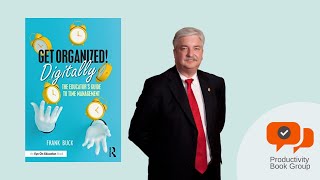
A Conversation with Dr. Frank Buck about his new book, Get Organized Digitally