Improving Your GTD Weekly Review

Ray Sidney-Smith, a GTD practitioner since 2001, breaks down the Weekly Review into five acts: preparing with a personalized checklist, getting clear on your inbox, reviewing projects and horizons, brainstorming new ideas, and re-entering work. He stresses showing up with an empty in-tray and ending on a pleasant note.
Chapters
Hello everybody, and welcome to the Task Management and Time Blocking Summit 2022, to this session, Improving the Weekly Review. I'm Ray Sidney-Smith. For those of you who don't know me, I am the community host of Personal Productivity Club, which is a digital community dedicated to all things personal productivity. So it's really dedicated to personal productivity enthusiasts, and I'm just really pleased to to you today all about improving the Weekly Review. And I have been a GTD practitioner since 2001. Really, as soon as the book was published, I picked it up off the shelf in Barnes Noble, and I have been an advocate and an acolyte of the GTD practice ever since. Today's session is going to be pretty straightforward. I'm going to be talking about improving the Weekly Review in 5 acts, so to speak. We're going to talk about approaching the Weekly Review the 3 stages of the weekly review as defined by David Allen in the book: getting clear, getting current, and getting creative. And then a little bit of discussion at the end about departing the weekly review and my own parting thoughts. So not to get too deep into the weeds here, but I wanted to talk about approaching the weekly review in a couple of different paradigms and a couple of different perspectives. For many of you, if you are GTD practitioners, you know the weekly review, and perhaps you haven't been particularly utilizing the Weekly Review in its most advantageous ways. And so through this talk, I wanted to give you some suggestions on how you can level up the Weekly Review in that sense. And to do that, we need to approach the Weekly Review with the proper definition of what the Weekly Review is. And so the book defines the Weekly Review, and I'm reading out of the Getting Things Done: The Art of Stress-Free Productivity, March 2015 edition. There in the appendix, there is a Glossary of Getting Things Done terms. And as David Allen defines it, quote, the best practice recommended of regrouping at an operational level once a week, bringing up the rear guard by getting clean, clear, current, and creative to sustain week-to-week control and focus. So there you have it. That is the Weekly Review defined. And what I find to be quite interesting about this is, as we talk about approaching the Weekly Review, we also have to remember that the Weekly Review As he notes, is on the operational level. This is supposed to be practical. It's an opportunity to do inventory and practice mindful limiting of our work in progress week to week. And if we can do that, then I think that we're going to be so much better off being productive during our weeks when we spend this little bit of time making sure that our past, present, and future are in that level of control and the appropriate engagement with the things that we need in order to be our best selves, in essence. So I really love this definition for a lot of reasons. The one thing that I frequently have struggled with is the getting clean part, because getting clean doesn't really sound right to me. But at the same time, I understand what he means in terms of the sense of it. I get what he was trying to get at in terms of that getting clean piece. And so what I, what I think when I think of that is really how do we get ready for the weekly review? Getting clean part for me is how he talks about approaching the weekly review, getting ready for what is going to be this undertaking. And for me, that means not showing up with an overflowing in-tray, or if you have several in-trays in your world, not showing up with overflowing in-trays. What I mean by that is that if you show up with hundreds of items in your in-trays, in your email inbox, boxes and otherwise, you're not going to have an effective weekly review because it's going to be a slog. You're going to have to get through all of those particular items. And it's just going to take hours and hours of your time. And that's not what the weekly review is for. It's for review. It's not for this level of clarifying and organizing. So I frequently say to people, if you show up with an overflowing in-tray, you're really going to struggle with your weekly review, because you're going to spend the majority of your time dealing with that. And that's not what you signed up for. And you really want to be focusing on the things that you need to be doing. So really set aside time for clarifying and organizing those in-trays so that you're capable of showing up with things in your in-tray, sure, but not necessarily all the things in your in-tray. And all of a sudden, your weekly review becomes clarifying and organizing time almost exclusively. The next thing I recommend to folks is that that they really personalize their weekly review checklist. I highly encourage you, I invite you to personalize your weekly review checklist. I give you permission to do so. What I mean by that is that David Allen's weekly review checklist, it's available as a download from the GettingThingsDone.com website. It is a PDF, it's 11 points, and it's broken up into the 3 sections, get clear, get current, get creative. As soon as you start practicing the weekly review, you should recognize that it's no longer David Allen's suggestions of a weekly review checklist, point by point. It's your checklist for you to get clear, get current, and get creative. And so I highly recommend that you actually look at the checklist and think through what are the things that you need to do in order to get clear, get current, and get creative. Maybe there are things on the checklist you don't need to do during your weekly review. For example, maybe you need to to review your projects on a more often basis, on a more frequent basis. And therefore, that doesn't actually belong in your weekly review because you're, you're checking your projects, say, on an every other day cadence. Or you need to be able to do some deeper reviews on— for me, for example, with regard to my business, I'm checking data analytics, I'm checking those items for myself and clients. I'm looking for all kinds of other reporting and other items that I review during my getting current stage of the weekly review. And so I've tailored those and I actually, in my weekly review checklist, place the exact things I'm going to, to review and links to them if it's possible. So I'm gonna link directly to say my Evernote notebook for that particular item so that those things are waiting for me in those places and it's just a click away for me to be able to get to that when I get to that checklist item. So really personalize your weekly review checklist. The other thing you can really do to level up your weekly review is as you're approaching the weekly review time, commit to not engaging during your weekly review. This is one of the most difficult things I have with the weekly reviews because I see all the things that need to get done and I want to do them. And that is not the time. It's not the appropriate time to be doing. This is the time to be reviewing and reflecting on your work. It's, it's a planning time. There's a bit of reflection time, but most of it is a planning time. It's prospective. So you are trying to figure out what is going to happen in the, in the next week and then identify the work that needs to be done to make those things become reality. So your outcomes visioning, and then you are identifying the physical next steps that you're going to need to take in the coming week to be successful, for it to be your definition of success. So commit not to engaging during your weekly review is not committing to not engaging any other time. It's actually the inverse. You're committing to engaging the rest of your week by virtue of committing to not engaging during your weekly review. What that means is, is that many times when you show up to the weekly review, there's a whole bunch of stuff going on in your world, right? I know I do. I show up to the weekly review and I realize, oh gosh, you know, that report needs to be done and that client needs that thing to today, and so on and so forth. And you know what, I really need to talk to my spouse about this particular issue. Great. All of those things are valid and understandable, and we know that they're happening in our worlds. What you need to do is you need to park those issues at the door. You need to do something to the effect of a little bit of journaling. Maybe you take down a checklist of just quick action items that you need to deal with. Whatever you need to do in order to be able to park those things at the door, you need to do before you show up to your weekly review. If you show up with that baggage, you're not going to be fully focused on weekly review, and the weekly review is ultimately going to be less enjoyable. The less enjoyable the weekly review, the more likely you are to not show up to it the next week and the week after and the week after, which is, as David Allen talks about, kind of the gift you give yourself each week. This weekly review is really a gift to you. Then finally, getting ready for the weekly review is all about senses and environments. What I mean by that is that this should be a full sensory experience to pull yourself into focus on the reflecting and prospecting, right? The prospective planning that needs to be done. And so what you need to do is you need to engage all of your senses. We have 5 common senses. You want to engage all of them. That may be having your favorite drink. It may be having your favorite tools that tell you that this is for the weekly review only. That may be possible, may not be. It may be where you are. Location, you may choose a specific location in order to make your weekly review most appropriate and enjoyable. And doing all of those things, you know, you may use your favorite pen and favorite notebook for the weekly review, whatever it is that gets you engaged. I have a particular profile I use on my laptop, and when I open it up, I log into that profile and it has my weekly review checklist in the background as the wallpaper, and it just silences all the notifications. It's all set up for me to be able to know that I'm doing my weekly review. That's a very nice experience for me to be able to jump into the weekly review and know that my senses and my environment are all designed for the weekly review right now. And there's no better place for me to be than here doing my weekly review. So on to the 3 stages of the weekly review itself. Now that you've approached the weekly review with all of the things set up so that you can get clear, get current, and get creative, let's talk about some of the ways in which you can improve getting clear. Getting clear requires a couple of things, and the thing that I think about is, as we are showing up to get clear, one of the items on the checklist tells you to do a mind sweep if you, if you want to. I understand the, the need and the want to be able to do a mind sweep, right? Just thinking through all the various items that might have been lost in the shuffle throughout the week. But I think some people take this as an opportunity to start raking out the cobwebs in their attic. And the reality is, is that if you do a minesweep and all of a sudden you have hours and hundreds of items that you're capturing into the minesweep, what you're really going to be doing is creating a lot more work for yourself to get to the actual reviewing within the weekly review. And that ends up being counterproductive. The Weekly Review is not the time to be doing a substantive mindsweep. It really is for that very cursory picking off the leftovers of what's, what's been not captured from your past week. And if you're doing the Weekly Review consistently from week to week, then you shouldn't really have that much coming out of your mindsweep. So if you do, that's okay. What I recommend to folks is that they recognize that this may be an opportunity for you to practice the skill of capturing and clarifying. It is usually those two skills that are really causing you the most challenge because, because you're not capturing and clarifying effectively throughout the week. You're getting to your weekly review and choosing that time, just like clearing out your in-tray and spending, you know, hours of your weekly review just clearing out your in-tray and then getting it to an organized state. That's not the time. And so capturing and clarifying is this process that you need to be able to do and work on outside of the Weekly Review. And then you'll show up to the Weekly Review with, you know, a few items coming out of your mind sweep. I normally do, but it's not going to be tons of things and overwhelming and causing you to want to run away. Next is the idea of what I call the overflowing in-tray syndrome. If you really show up to the Weekly Review and It's fine. You know, as I said before, making sure that you have overflowing in-trays is a practice for approaching, but you know, life happens and you show up and for some reason this week you just have so many items that you just weren't able to capture and clarify. What I highly recommend is to overcome that issue, create a clarifying and organizing session in your calendar for what I call waits. It's like, you know, it's kind of makes you jump. And I like to schedule time to do these kinds of clarifying and organizing sessions. And I'll tell you this, in my own productivity system, I have calendared items throughout my week. And I get a heavy amount of, you know, inflow in essence from email because of work. So what I'm doing is I'm setting up dedicated times throughout my day. I'm routinizing, basically making it a part of my routine to do clarifying and organizing on a regular basis. So I am getting pre-commitments showing up in my inbox, and I have not yet committed to them, so they're pre-commitments. But at the same time, I need to clarify and organize very quickly and often throughout my day so that when I show up, I can overcome— I can overcome the overflowing inbox, the overflowing in-tray syndrome. And so this is really helpful for me because I'm capable of doing that by scheduling these clarifying and organizing sessions throughout my work week. All right, so then we get on to getting current. Getting current is really where the review and weekly review comes into play, right? You're just getting the stuff caught up from the last week. That's clearing the, getting, you know, clearing the rear guard, so to speak, you know, bringing up the rear guard, as David Allen says. But getting current really is now where we're going to be doing the prospective planning so we can actually look, forecast, see what's going to happen, predict, think of our outcomes, and come up with an action plan to be able to get there. First and foremost, I think that when we are getting current, reviewing your upper horizons is a really good idea. Going through and looking at your projects, looking at your various areas of responsibility or areas of focus and accountability, going up to goals, vision, and purpose and principles. All of those are really great, and looking at each of them and identifying, okay, does this need to be looked at this week, and are there things that are in those upper horizons that are going to generate new projects, and ultimately new next actions for me to be able to do in the upcoming week. That's good. I fully support that. However, this is not the time for in-depth planning, right? You wouldn't sit down and say, okay, well, during my weekly review this week, you know, week number 52, I'm going to do an annual, you know, review within the weekly review and I'm just gonna unpack everything in all of my horizons. That really should be set aside for another time. And, you know, if you go from week to week and you throw these landmines, in essence, of huge planning methods into your Weekly Review, it really morphs the Weekly Review in a way that I think ultimately competes with your ability to actually show up to the Weekly Review and do the best Weekly Review as opposed to monthly, quarterly, or annual review. So Put those aside, put them in the calendar if you want to, and set them aside and say, okay, this is going to be our annual review and I'm going to do this and these are the things I'm going to review during that time frame. But otherwise, the, the upper horizon should be done in their own planning and in their own way. This leads to project planning. I think project planning, especially during the weekly review, is great. But if you are doing more project planning than just identifying the next actions for the upcoming week, I really suggest moving that all to a Natural Planning Model session. If you don't know the Natural Planning Model session, it's identified in Getting Things Done, and there is a project planning triggers list, and it gives you a really great method for being able to set aside time and identify by going ahead and brainstorming, then organizing your, your thoughts and working through the process of getting, identifying, Next actions for a particular project, right? And these are typically bigger projects than just the smaller kind of objective-level projects, right? One or two actions to complete a project and you're, you know, that's okay. That's, that you can identify in the weekly review. But these bigger ones that require, you know, multiple sub-projects and multiple, you know, pieces and multiple resources being brought together for an outcome, set that aside to, you know, a 30, 60, 90-minute natural Planning model session and do that. Now, of course, you're going to say to me, but Ray, now I have, you know, 40 or 50 project planning sessions in my calendar. And that's a sign that you have too many projects that are active. Some of those need to move to someday maybe, and they need to, they need to come off of your active deck. If you start seeing a bunch of project planning sessions in your calendar and it's overwhelming to you, then you're not going to actually be any better off once you identify all of the next actions that need to be done in order to get those things done in that timeframe either. You need to push those off into a later horizon or an upper horizon, which in essence is just a later timeframe. All right, that leads us to getting creative. And I'll give you a little confession. I don't really do getting creative in my weekly review. My getting creative is really limited and it's limited to only one particular thing, but I think that it's not a bad thing to do during your weekly review. It's just good for some people and not necessarily as useful for some people. I'll say that I get creative in my most mundane times, you know, when I'm going for a run or when I'm in the shower, I get my ideas in those places. And so the idea of getting new ideas and being creative about things tend to happen in those contexts, not necessarily when I have fixed a time in my calendar and said, okay, I'm going to do creative right now, I'm going to be creative right now, you know, that's, that's not how it works for me. And it may be different for you. I will say this, though, During getting creative, I really appreciate and enjoy the ability to sit down and give time to how can my productivity system be better? And I think through where am I feeling the hiccup points right now for me and my world and how can I solve for those? That's a really good time to ideate ways in which to solve, problem solve the problems you might be having across any of your systems, right? Your productivity system is actually a systems of systems, right? And is a system of systems in the sense that you have many different subsystems running your world, right? You have a way that you manage how the kids get to school. You have a way to manage how you prepare and plan meals for the week. You have a way that you prepare and take care of your home throughout the year. Those are all different systems, and you have different ways and approaches and, uh, infrastructure for being able to handle those things. Next is bring creative supplies. If you do really plan to be creative, think about what supplies you might want. Maybe you want some drawing paper, maybe you want some crayons or pastels or whatever. Do the things you want to do in terms of what you need to do in order to be creative. I also find that changing the environment can also be helpful when you're in the getting creative stage. For some people, that might be good. For some people, that might be, you know, difficult. But I think that sometimes a change of environment can help spur a little bit of creativity. I actually find that the getting creative for most people, when I talk to them and explain this to them, it then becomes a lot easier for them to do the getting creative piece of the Weekly Review, which is to think about Horizon 2. This is really the time to start thinking, how, how can I maintain an area of focus and accountability? And so if you start doing that, you can either mind map or brainstorm in the Horizon 2 space, and that actually becomes generative. That becomes a way for you to think expansively and creatively about those areas of your life. So Horizon 2 is, I think, a really good place here to be able to spur getting creative. All right, so you've gotten through the weekly review, but the story doesn't end there. The story is still going. And in Act 5, we want to really now come back. And I don't know if you know Shakespearean literature, but in Shakespeare, you have this point where in leading up to the acts, especially Act 5, Act 5 is where the lead actor or actress come back into the story. They've taken a little break. Because usually they've been acting for now several hours, and they want to be able to take a little bit of break. And they come back in Act 5. And I feel like this is where you as the protagonist in your own story need to come back into the real world, you need to come back into the play. And so getting out of the review is actually as important as approaching the weekly review, you got to get back to work, you have to get back into the real world. And the review is this, is this fun, safe space. But we need to actually work our way out of that space and into an appropriate mindset to be able to get back to work. One way that I feel like doing this is to close out my weekly review in a couple of ways. One thing is that I keep track of my weekly reviews. What I try to do is I track the completion date. I actually do some commentary, kind of like a mini journal entry next to my completion date so that I identify when I've completed my weekly review and what my thoughts were. It may be my emotional state, my, you know, my affect in essence. It could be my general thoughts about it. Maybe I felt like there was part of my weekly review where I did a weak job and I need to come back to that later and think about how I'm doing my weekly review from week to week and if that really makes any sense. So I'm tracking that about this. It's a little bit meta where I'm tracking about the weekly review within the later stage of completing my weekly review. But I like to do that. I actually start my weekly review with the GTDQ, which you can access from going to the Getting Things Done website. And at the end of my weekly review, I actually look at that to analyze it. So I don't try to analyze it up front because I don't want to, I don't want to get myself mired in that. But once I'm done with my weekly review, it's kind of a little treat for myself to look at it and consider the items there that I've unearthed. And I look at the back GTDQs and see comparison, like where have I been for the past few months? Is this a good sign? Is this a sign of me needing to make some improvements somewhere? I think re-engaging with your world should also be thoughtful. So just like approaching the weekly review, you do those things. What are the things you can do to engage your environment, your location, and your senses in order to be able to tell you that you're coming out of the weekly review? Do you change drinks? Do you change location? Do you change your logins? You log into a different computer profile so that now you're back in your normal profile. Like, what are the things you're going to do to be able to get yourself out of the weekly review and back to work as quickly and efficiently as possible? I'll also say this. There is a— if you're a man and you've had a colonoscopy, if you're above a certain age, the colonoscopy is actually a fairly unpleasant experience. They're putting a camera and they're putting it in there and it's a very discomforting experience. But the funny thing is there's a research study that talked about the pain and the experience after that of thinking about the colonoscopy. Well, the way in which this works is that if you give the person just a little, they do the colonoscopy and then they provide a lack of stimulation, basically do just a little bit of nothing at the end so that it feels like nothing happened. Patients after the fact actually have a much better perspective on all of the pain they experienced during the procedure. And so what turns out happening is that what they posit is that we experience our memory of something based on the recency of the emotion we had with it. So if I, if the resonance I have about an experience ends pleasantly, then I will think about the experience more pleasantly than if it ended with a bad experience at the end or negative emotion at the end. So if you can end the weekly review here with something pleasant, then all of the other stuff that was maybe a little bit just, you know, dry, mundane, and maybe a little bit difficult, those actually get kind of like whitewashed in a way to give you a perspective that your weekly review was fun and interesting and you want to show back up to it again next week. So end with something pleasant. And I think that will actually really help you feel like, oh, well, you know, the weekly review was great and I want to do this next week. So with that, I have some final thoughts for you as it relates to the weekly review. And I hope this helps you with improving your weekly review. One is prioritize you and your weekly review. What I mean by that is that if you have your weekly review set for a particular time of the day, then you should show up to it, right? Like prioritize you. This is for you to benefit your future self. And if you have something that impedes upon that weekly review, I usually recommend, if possible, moving it earlier than later. And that's just really just prioritizing you, right? So if you have your weekly review set on Friday morning or Friday afternoon and the meeting comes up, then you would move it to Thursday afternoon and therefore do your weekly review before that other commitment. I just think that it tells yourself something unconsciously, which is that you're more important than other people, and you should be the most important person to you in your life. And so prioritize you and your weekly review. It's really helping you make sure that your self-efficacy is something that you are supporting fundamentally. Something that I also think is important is that not every review for every person should be this dedicated time each week. For some of you, you may need smaller reviews that happen more frequently throughout the week, and it may just be that the idea of sitting down and doing all of this work all at once is too overwhelming. And so more smaller reviews, I think, can be very effective for some folks. So don't think that this has to be just all or nothing in terms of do the weekly review in this one way and that's the only way. Not at all. Do what works for you, and you'll know it's working for you because you're getting things done. That is the metric. If you're getting things done, then you know that your reviews are working. And then last but not least, I invite you to find accountability. I think accountability is one of the 4 pillars of getting more done and not just getting things done, but optimizing the process of personal productivity. Accountability can be found in many different ways: self-accountability, one-to-one accountability, that is me plus someone else, then group accountability, and ultimately public accountability, and that is grand statements to the world and letting the world at large know that I'm going to be doing something and you're holding yourself accountable to that larger group of people. But I think that accountability can be really useful in the one-to-one and group accountability for weekly reviews. If you need it, Go find that accountability. I note that I run a Friday Weekly Review Accountability Party, as we call it, or WRAPs, you know, wrapping up the week. The Weekly Review Accountability Party happens every week inside of Personal Productivity Club, and you're more than welcome to join us each week and do your weekly reviews with us. And so that happens on Fridays at 10:30 AM Eastern, and we all join video, we mute ourselves audio-wise, and we just do our weekly reviews through the getting clear, getting current, and getting creative phases. And so I I just think that accountability, however you look to it and find it, can be so, so useful to you in so many ways. So good luck with that. And so with that, that brings me to the end of my discussion with you, my little talk here at the summit regarding improving your weekly review. I hope this was helpful for you. If you have any questions or any comments or anything else like that, you can reach out to me in any, many numbers of ways. My email address is on the screen. You can also join us in Personal Productivity Club and contact me there as well.. I'm on most of the socials, but I'm mostly a Twitter person. So if you want to tweet at me, you can see my Twitter handle there as well. But either way, I hope you all have a wonderful rest of the Task Management and Time Blocking Summit. I'm Ray Sidney-Smith, and here's to your productive life.
More from Raymond









The Checklist Manifesto by Atul Gawande MD Productivity Book Group Made by Headliner

First Things First by Covey Merrill and Merrill Productivity Book Group Made by Headliner
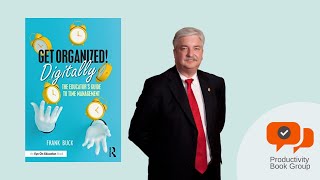
A Conversation with Dr. Frank Buck about his new book, Get Organized Digitally