A Conversation With Grace Marshall, Author of "Struggle" [AUDIO ONLY]
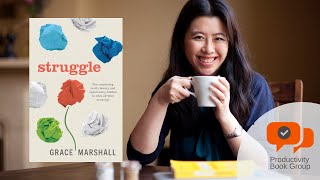
Grace Marshall, author of Struggle: The Surprising Truth, Beauty, and Opportunity Hidden in Life's Shittier Moments, argues that struggle isn't a productivity problem but a source of innovation and growth. She structures her book around three shifts: Smarter, Braver, Stronger, and offers curiosity as a healthier response to stress than fight-or-flight.
Chapters
Welcome everybody to Productivity Book Group. I am your host and facilitator, Ray Sidney-Smith. Productivity Book Group has an author interview series that we do, which brings readers and listeners in touch with new and interesting authors. They may not be necessarily new to you, but they are just new to me necessarily for us to have them in and on Productivity Book Group. And so with that, today we're sitting down with Grace Marshall. Grace Marshall is known for her refreshingly human approach to productivity. She is head coach and chief encourager, love that title, at Grace Marshall .com. She's also a productivity ninja with global training company Think Productive, and she is the author of award-winning How to Be Really Productive: Achieving Clarity and Getting Results in a World Where Work Never Ends, published in 2015. Her new book, Struggle: The Surprising Truth, Beauty, and Opportunity Hidden in Life's Shittier Moments, is available now. Some of you may know, and I'm just going to take a quick divergence here to say that some of you may know, I host several other podcasts, one of which is Anything But Idle. It's a weekly commentary show curating the best productivity and technology news. And in March for Women's History Month, we created a poll for our audience to vote on the top 10 female productivity technology and organization experts. And lo and behold, out of the hundreds of votes, Grace Marshall won first place. So all of our experts are winners, but it's nice to be recognized as number one, of course. And so welcome to Productivity Book Group, Grace.
Thank you so much, Ray. Really pleased to be here.
Yeah, this is so fantastic to finally meet you, uh, having connected via Twitter and folks telling me about this Grace Marshall who I should know. And, uh, and then you had this book coming out and I thought this is really just an amazing opportunity to talk to you and get to know you. And really in this author interview series that we do on Productivity Book Group, it's really just about getting to know the author. But of course you have this book out, Struggle, and so I do want to, for us to like talk through it a bit. And I wanted just to start with just If you can give us a general background, kind of who you are and how did you get to the world of productivity? What led you down this pathway to this strange and wonderful world of personal productivity?
Sure. So, um, I graduated from university with a Modern Languages and Management— International Management Modern Languages degree. Um, so I was— I guess I was prepped and primed for the corporate ladder. A lot of my fellow cohort went into big, you know, corporate names, big names, oil and gas companies, accountancies, consultancies, that kind of thing. I fell into a tiny little startup working in renewable energy, and I was the marketing assistant in a team of two where there was a marketing director who made all the decisions, and then there was me who made everything happen. And what this gave me was actually a very quick learning curve, a very steep and very quick learning curve that led me to realize that that particular type of marketing was not for me. And I had my midlife crisis in my mid-20s and decided on a complete career change. Took some time out to start a family, went through an identity crisis, and then retrained as a coach and started up my own coaching business. So ironically, I now do marketing every single day of my life. But that led me into working with people who were juggling business and family. And too much to do, not enough time, how do we fit it all in was the number one challenge for everybody I was working with. And I had two kids as well, and my business is like my middle child, so it was very much pressing me. For me, I'm naturally disorganized, so I wouldn't have picked productivity or time management as my thing, but it picked me because it was the number one challenge facing all of my clients. So, um, I just started to— eventually I started to go, okay, just answer the question, Grace. Like, how do we do this? How do we do it? And the more I dived into it, the more realized, ah, do you know what, it's not just about getting super organized, it's not just about time management. So much of it is about what goes on in our heads. And that kind of psychological side of it is what led me to get really interested in productivity. So that led me to write my first book, 21 Ways to Manage Your Stuff, The Stuff That Sucks Up Your Time, in 2012. And then that also led me to working with Graham at Think Productive, and I became their first female Productivity Ninja in the same year. And then the other books. And clearly, one of my strengths is not choosing short book titles.
So those of you who are listening to the podcast may not notice this about Grace, but you are Asian, of Asian descent. And those of you who maybe don't know me very well, or even if you know me very well, you probably don't know this about me as well, but I also happen to be of half Asian descent. And I'm always curious about how being of Asian descent really factors into the productivity game because at least the way in which I was raised, my mother's British actually by upbringing. And so it's really interesting to be an American with an Asian mother who also happens to have been raised British. So it's just for you having grown up British or English, I'm not sure which, but growing up that way and experiencing your own Asian heritage, how did that really factor into your own perception or view of productivity?
Such an interesting question. So yeah, I'm British-born. Both my parents are Hong Kong Chinese. They both came over to Britain to study and then ended up staying there. And so, I think in our family, Education is king. In fact, so I met my husband when I was on a gap— not a gap year, a placement year, so it was part of my degree, but it was a year in industry. And we met there and we were engaged just before I finished my final year. And the only thing my grandmother wanted to know was, you are going to finish your degree, right? It's like, hey, I'm engaged. She's like, I don't care, are you going to finish your degree? So I think education was a big thing there. My family tend to have quite a traditional view of jobs. So there are, you know, it's kind of doctors, teachers, and my dad was a consultant environmental engineer. So I think they weren't quite sure what was going on when I quit my job and I then went into coaching and started up my own business. I think it's not until I published my first book that my dad went, oh, okay, she's an author. I know that one. How about you?
Yeah, they're definitely binaries, aren't they? I think you and I shared the same grandmother because all my grandmother could talk about was your education, what are you doing about your education, and making sure that she had 5 daughters, inclusive of my mom. And so all she wanted to do was make sure that when she came to the United States that all of her daughters got educated and 2 PhDs, multiple master's degrees among them. She just wanted to make sure they were all set for life, and that meant education. And so I I really appreciate you sharing that insight into your background and history because I think it's interesting just for everybody to understand that we all grow up with different perspectives on productivity. The perspectives that we have on productivity are indelible in many ways and they make their way into not just our work, but our work with others and the way in which we perceive the world. That takes me kind of my first question here. I like to ask authors about this who are in the productivity genre about how you define personal productivity because you do this in your work and on your website and elsewhere. How do you define personal productivity? We're all kind of on the same playing field in terms of how you see it.
Yeah, absolutely. I like to say, often people think about productivity as efficiency, and sometimes people go beyond that and think of it as effectiveness. So efficiency is doing things faster, doing things better, but effectiveness is doing the right things. But I would go a bit further and say, actually, I think it's about the whole work-life experience. Because I think it's about doing good work in a way that does you good, as well as the good that you do out there in the world. So for me, productivity is as much about how do I feel when I'm working, and how is this experience for me? So things like work, I don't like using the word work-life balance, but that work-life experience, our life at work, our life outside of work, and yeah, the whole thing around burnout, for example, that fascinates me when it comes to productivity. Because if you see productivity as just about getting as much stuff out there, that's the quickest route to burnout.
Right, because there's nothing recharging you, right? And I frequently talk about this notion of rejuvenation, right? And rejuvenation is such a strange thing to people, but I always say that it's actually the expending of energy that helps to recharge you. Because if we're just talking about rest, rest is just you sleeping. Rest is you not being inert. And your internal world is doing a lot of stuff. Your brain's working when you're sleeping and resting and so on and so forth. But rejuvenation is this activity of really doing things that help recharge you. And so I love that about your perspective on that matter. Let's dig into Struggle: The Surprising Truth, Beauty, and Opportunity Hidden in Life's Shittier Moments. Let's talk about what led you to write a book about struggle, of all things, struggle. And I think that it's a fascinating topic just generally, and perhaps how you see them different from, say, other terms, whether in psychology or outside of psychology. Angela Duckworth, another great Asian researcher out there in the world, and she is all about grit, and we hear resilience and perseverance. So can you tell us a little bit about the history of what led you to write the book Struggle and why this topic? Topic?
Yeah, so for me, this was a topic that just refused to go away. It felt like it was kind of on the periphery of productivity. And it almost felt like a taboo because, you know, in the world of productivity, the kind of conversations that I have with people, when they start saying, I feel like I'm struggling, that's almost people's way of saying, I don't feel productive. So it's almost seen as the opposite of being productive. But I don't think that tells a full story of struggle or of productivity, because actually when you come to think about it, Sometimes when things go wrong, when something's not working, when there's a crisis, when there's a global pandemic, yes, that can have a negative impact on productivity, but it can also open up doors to innovation, to creativity, to better ways of doing things, because the way our brains work is we're wired to, we're biased to the familiar. So that's why we like routines, because it's like, oh, I know how to do this really, really well, and so I can refine that routine, I can get efficient at doing that, And so we tend to be biased to the familiar, and often it's not until the conventional route is shut and not until we can't do something that we tend to go to the periphery and start to go, well, what, how else can I do things, or how else can I look at it? So struggle can often be the spark for innovation, but I think also it's struggle— sometimes we read it wrong. So sometimes when we're struggling with something, say for example writing a book, I am convinced there is no such thing as an easy book to write. So writing a book is something we will always struggle at doing, but it's a very worthwhile thing to do. Equally, when we're working on something that's new, when we're stretching ourselves, when we're developing, when we're learning, or when we're going into new territory, whether that's a new business or a new area or anything uncertain, new territory, is going to involve some kind of struggle. And when we think, when we tend to think of struggle as, oh, it's a sign that something's gone wrong, what we will instinctively want to do is to either get rid of it or get away from it. And neither of those allow us to be really present and fully immersed in the work itself. So what that looks like sometimes is people go, I'm really struggling with this and I've got a ton of other stuff I need to do. I've got all these emails I need to answer. I've got these quick wins I can tick off. I will feel more productive if I do that instead. And so therefore, I'll procrastinate on writing the book or whatever it is that's the kind of harder struggle.
You see struggle as a symptom or a cause in the pursuit of productive ends? Like, do you, do you see it as its own productive component, like its own thing that we should do as a part of being productive people? Or do you see it as kind of a symptom or a cause in that sense? I'm curious where you're, where you're kind of placing these things in, in the book.
I think for me, I see it as part of the territory. Um, and you know, and I think we can make it worse by struggling with struggling. So we can, you know, if, if we feel like struggle means— I think it's to do the meaning that we attach to it. If we feel like struggle means that there's something wrong or there's something wrong with us, um, then we make that much harder to get through that territory. It's almost like we're kind of just going eyes shut, hold on as fast as possible, just try and ride my way through or run away from this, this particular stretch of road, as it were. But actually, I think there is a lot of— I call it treasure in the book— there's a lot of treasure that we can find on that road if we can go through it with eyes wide open. And so I don't know if that's— it's a cause or or a symptom, but I think it's part of the territory.
For years and years, I have had this quotation in a myriad of places in my world. It's by Harriet Beecher Stowe, which is an American writer and abolitionist, and she wrote, quote, "When you get in a tight place and everything goes against you till it seems as though you could not hold on a minute longer, never give up then, for that is just the place and time the tide will turn," end quote. And It's so funny, when I was reading your book, I was just immersed in the concept of struggle. For those, again, you don't know me as well and folks listening may not know this, but I have a background in Buddhism. And so having been a Buddhist in training, so to speak, I don't consider myself necessarily a Buddhist today either, but having studied Buddhism and being really immersed in that idea that life is suffering and that the more we can bring ourselves to the moment and to the present allows us to be able to really be expansive in our being. And that, of course, can eliminate this concept of suffering. There's a little bit of that in the concept of struggle throughout the entire book there. This is this thread that we can actually be productive. And as you said, like, the tapestry of life is about struggle. Humanity's existence is about struggle, right? And, and so there's a lot of this kind of stuff wrapped up in it. And I'm curious, you structured the book in 3 parts: Smarter, Braver, and Stronger. And can you talk to us a little bit about what those 3 terms meant to you as you were creating the narrative arc for the book?
So the, the 3 terms actually came from a Winnie the Pooh quote. So it's, um, you remember, you are smarter than you think. Um, I, I always forget it, I always need to look it up, but you're braver and stronger basically than you realize. Um, and for me it was recognizing that the smarter is about about how we see struggle. So if we learn to see it in a different way, or if we learn to think about it in a different way, we can change our relationship with it. Braver is about trusting the process. So just because you know that something good is going to come out of it doesn't make it— it doesn't make it easier. It's still tough to get through, and sometimes it will still take time to get through as well. And I think often in productivity, we get caught up in speed and chasing speed and just wanting to get through things quickly. And yet sometimes what happens then is that we don't give ourselves— maybe we don't give ourselves time to make mistakes. We don't give ourselves time to risk getting it wrong because that feels like a waste of time. But equally, we don't give ourselves time to rejuvenate and to rest and to let things catch up with us. And so that kind of almost recognizing that you're trusting the process means that sometimes things will be slow and it will be hard and will feel like tree coal. And again, it doesn't mean that you've gone wrong or you're doing it wrong. So that's about kind of trust and courage, I guess. And then the third part, stronger, is about growth. It's about the resilience that we develop and how we strengthen through struggle and also how we grow and transform. And one of the things I noticed when I started looking into that kind of metaphor is how we often have this view of transformation that is all about the beauty and the glamour. It's like, look at the beautiful butterfly that comes out of the cocoon. And we forget that actually, when you look into— so there's a quote I include in the book that actually, when you cut open a chrysalis, what you find looks a lot like death and decay. You find a rotten caterpillar. And so we sometimes forget that there's a lot of, of death and decay and letting go of things and things breaking that come as part of that transformation.
Yeah, and a lot of, of our world is mundane and also struggle that people don't see. I think especially with social networks today, on Facebook everybody has kind of their front-end world that they're sharing about their life. Everything is great and wonderful and good on the external side, but behind the scenes there are like, "Yes, I sit on the same toilet and I wash the dishes." And there is drudgery along with all of this. And kind of in the the Stoic perspective, if you enjoy those moments, fully immerse yourself in those moments, they become less struggle. They become more interesting. And it's not to say like out-of-body experience or anything like that, but there is this idea of the observer concept, right? You become a third-party observer of your own work. And if you are observing yourself working and really involved in things, then you become kind of almost enjoying the things that you're doing. And I hear that kind of sense in the book, that is, struggle can be a knife that cuts both ways, but you can use it and sharpen it to your own effect in a way. And I really like that notion. People should read the book, but I want to dive into a few components within the book. You talk about the idea that you learned about productivity and were interested in it from kind of the mental, emotional perspectives, kind of what's happening on the inside. And so you talk a little bit about the fight or flight response, and I'm curious why that came up for you, how you saw it as struggle being another way, kind of this third way for you. And can you explain that for folks who are listening?
Yeah, absolutely. So I think instinctively, because we see struggle as a taboo, because we see struggle as a sign of wrong, you know, that something's wrong, we often respond to it with a fight or flight response. That's kind of our first response. It's like, And I basically call it "oh shit," like, "Oh shit, something's happened." And fear will basically say, "Oh shit, something's happened," but actually, if we can come out of that fight and flight response and go into curiosity mode, curiosity will look at that same thing and go, "Ooh, something's happening. That's interesting." And so fight or flight, basically what it does is it just puts us into a very limited perspective. Because in that moment there is a threat and we need to decide, do we fight this threat and overcome it, or do we run away from it and make ourselves safe that way? So either way, there's a threat and our goal is to make ourselves safe. Now, if you translate that into productivity terms, the work that you're doing, if, um, you know, if writing that book is making you feel unsafe and, you know, all you need to do is either just get through or run away from it, that's not going to help you write your best book. So it's useful for biological threats, it's useful for physical threats, not so useful when it comes to often social threats and threats to our identity, threats to our confidence, which is often what we get into when we're in that kind of mode of procrastination or you're struggling with our work. But for me, it was a good way of articulating what happens when we're struggling, the kind of things we end up saying to ourselves and how we make it worse. So how we then go, oh well, that must mean that there's something wrong with me, and you wouldn't— and all the kind of things that we attach to that. But actually also it helped me to recognize that actually if fight and flight is about our fear response, then maybe curiosity is the antidote to that. And it can look at exactly the same thing and see different things. So rather than seeing friend or foe, rather than seeing safe or dangerous, it might start seeing what's interesting, you know, what's maybe a diversion, what's maybe a new route, what's maybe just like less traveled. And, and so we start to see a wider perspective rather than just black and white, good and bad. You would just start to see many more possibilities that way.
There is so much to unpack here. I'm really, really curious about all of these pieces, right? Curiosity intended to be stated. And that is you're talking about fight or flight response. And so in traditional psychology parlance, there are kind of 3 responses that we can do. You talked about the first 2. The 3rd, of course, is freezing, not responding. And I know that I see this in my own work with— I work with small business entrepreneurs. And so I see them all the time kind of in that state where they feel fear, right, from whatever function is happening in the business awry. They decide to freeze. They are procrastinating or they are just petrified by what could happen. And I'm curious, the thing that you're talking about, which is curiosity, is a childhood, like something that you see in children. You see this sense of curiosity and we tend to think of kids as being somewhat foolish, right? They'll run out and do things that are completely dangerous, right? They'll jump off the couch. They will They will go touch the stove. Their curiosity gets ahead of themselves, and that's actually very powerful. We kind of unlearn our curiosity as we get older, and this binds together both psychological safety, but also reframing in psychological terms. What can people do to nurture their curiosity in that sense, to be able to kind of build their struggle muscle?
Yeah. I think it's to do with questions. It's asking questions. Sometimes it's channeling your own inner 6-year-old. So for me, having kids really helps because I kind of go, you know, I notice questions that they ask and I go, oh, that's such a good question. So sometimes it's doing that. It's asking like, what would a curious 6-year-old say about this or ask about this? But I think even just like going, okay, so what would curiosity say? And just even that helps us to kind of step outside of our experience and go, oh, there's another way of looking at this. Um, so I think it's, it's definitely, it's a noticing thing and it's an intentional thing. Um, so even just kind of going, I'd like to activate curiosity now, and maybe having some questions to ask is, is often a good place to start. Um, but also asking that question from a place of curiosity rather than judgment. So like, say for example, if something didn't go well and you go, "Why did you do that?" or, "Why did that go wrong?" It can feel a bit like, "Whoa, I'm being judged here," and that can still be very fear-based. Whereas maybe asking, "Oh, what happened there?" or, "How does that work?" Maybe that can be a better way of getting into the curiosity side of things rather than judgment.
And I also always recommend to people to feel their, like, sense where their body's at. And having been a longtime meditation advocate, I always am aware of, am I feeling tightness in my stomach? Am I feeling tightness in my chest? Am I clenching my shoulders or my hands in certain environments? And those feelings are things that if we release them physically, we tend to also feel the release mentally and emotionally. And There's another kind of exercise that people can do, which is that if you feel your body going into fight or flight response, which is that your body then lets out a bunch of chemicals in order to be able to get you into that mode, if you just literally feel that sensation, it's actually the same sensation you feel like when you're super excited. It's the same response. So worry, anxiety, and fear-based response is almost identical to the joy, elation, excitatory response. And so we can kind of use those things to our effect. And so I love your suggestion about having some mechanisms to be able to like ask ourselves questions and be aware of those things, be aware of your body and where your mind is at those times as well, I think is a great component there. You talk about— oh, go ahead.
Just from what you said there, I think asking ourselves like, what does this mean and what am I making it to mean? Can often be the difference between, is this fear and anxiety, or is this excitement and joy? Because it's often our belief about what's happening to us that changes what that looks like. So, I had exactly the same, that kind of situation with my daughter and some of her friends when they were doing a running competition. And one of her friends was like, "Oh, these nerves, you know, these butterflies in my stomach." And I said, I was like, that's great, cuz that's your body preparing you for this race. So you can channel that energy into your legs. She's like, oh yeah. And all of a sudden she wasn't worried anymore because originally it was, I'm feeling nervous and I'm worrying that that means that I'm not ready for this or I'm not cut out for this. But if I go, oh, I'm feeling all these feelings and that means it's my body preparing me to do this, but that's fine. I don't have to worry about it. So yeah, that, that's, that's a great way of, of kind of shifting it from anxiety to excitement.
Yeah, or if you're not struggling, then you're not doing it right. Like, you know, your, your body is designed to tell you whether or not there's things that are going well or not going so well. And sometimes it tricks you, as with a child maybe feeling anxiety, and that's your body preparing itself for something that's important. But I love that. I love that. In the book, you talk about the idea of chaos. And control and the binding of those two pieces. I'm not sure that they're necessarily polar opposites, but can you talk to me a little bit about how chaos and control connect to each other? And I've heard in other interviews— I did listen to all of the other interviews you've done before in preparation for today because I'm an A-class nerd, and so I wanted to be prepared— and you talked a little bit about What I heard was a little bit of maybe GTD lingo here, Getting Things Done lingo in there in some way, shape, or form. And so I'm curious how the idea of chaos and control make its way into maybe some of the terminology that we use in Getting Things Done or GTD lingo of control and perspective. How does that make its way into struggle?
Yeah, so I think there are a couple of thoughts I have on this. The first is sometimes what happens when we feel out of control is that we look for control. So in the book I talk about the toilet paper moment, so the moment in the pandemic where there's this virus, nobody knows anything about it, we're pretty sure it's not a stomach bug virus, and yet the response is let's go out and buy toilet paper and make sure we don't run out of that. And I think that we see that a lot in different guises, in different, you know, ways that we work, that we respond to things, is that we often go I don't know what I'm doing here, or there's something uncertain and ambiguous. There's a sense of chaos. There's a sense that I'm not in control, and I feel like I need to be. So I'm just going to go and grab something I can control. And sometimes it's, you know, it's something as silly as toilet paper, but sometimes it actually, the thing that we go to control makes everything worse. So it could be in a tricky conversation where we go, hang on a minute, you're not listening to me. So therefore I'm going to try and make you you rather than, oh, I'm— something's not right, we're not understanding each other, maybe I need to listen more. So, um, so I think there's definitely something around us feeling like we need to have control that can come some— sometimes come and be unhelpful. Um, and so one of the things I talk about in the book is, you know, what if we don't see chaos as something that needs to be controlled? What if instead we see chaos as potential as your untapped energy. So there's a whole load of energy there, and yes, it can be scary. It's a bit like a storm, you know, I can't control this. But what if there's a way of seeing the beauty in that and the energy in that and going, well, how do I channel this rather than how do I control it? So one of the stories I tell in the book around that is, um, a lady called Elaine who had, um, has a child who has lots of, um, various learning difficulties and various neurodiversity, and a lot of his childhood felt like a real struggle of trying to contain all of these elements that were part of his personality. And a lot of what he went through in schooling was all about control, trying to control his behavior. And actually, when they realized, when they started looking at it differently and start looking at how do we help him to thrive rather than how do we control him, then that completely changed how they interacted with him, the environment they created for him, but also changed how he understood his behavior as well. So they started to understand that his behavior is communication rather than something to be punished or controlled.
It's so funny, I'm a big fan of Arthur C. Clarke, and in Profiles of the Future, he's often quoted as saying, any sufficiently advanced technology is indistinguishable from magic. And what I hear you saying is that chaos is like magic. We don't necessarily see its true intelligence, and so we then try to control it, try to tame it. And in reality, that is not quite how it works. And it's funny because I tend to talk about chaos and things that are kind of out of control. Life is messy, I usually say. And you just have to learn how to navigate in that mess. And it sounds a little akin to what you're saying here in struggle. And I really appreciate that. It's something that I can manage when I know that I'm not supposed to control everything. And like almost every conversation in my household growing up was someone trying to gain control of what was happening. I grew up with a lot of siblings, so it was a big household. There were 6 of us. And everybody's trying to, you're not listening, you're not listening. When in reality, what we should have probably done is used our ear-to-mouth ratio, which is listened a little bit more and spoke a little less. So I really, really appreciate that. Is there anything that we haven't talked about yet that you wanted to talk about as it relates to struggle? Was there any other piece in the book where you felt like this was really just such good stuff that you wanted to share?
Maybe, but I just had a thought actually when you were talking about, um, that, that kind of situation in your family. Um, and it relates back to when we talk about fight and flight, and you said the third thing is freeze. There's actually a fourth one as well, which is fawn, and it's basically the people-pleasing gene. And, um, you know, and, and it's so interesting that, you know, sometimes actually that's our response to to fit in and to toe the line and to kind of shrink ourselves down in order to not make waves and not to create that chaos. So, you know, maybe there's something around that, actually recognizing when we're doing that and, and not being afraid of our own chaos, not being afraid of like the, the bits of us that don't fit in and the bits of us that are too much or not enough. And, and kind of, you actually, if we made space for that how much brighter we can all shine individually without feeling like we all have to conform and all fit into these neat little boxes.
I really appreciated that insight. I think it's so fascinating for us all to really take heart to the fact that we don't need to all fit in in order to be able to feel full and to feel like we are where we need to be. And I think a lot of struggle has to do with that, us feeling like we're pushing against some invisible barriers to entry into the game of life. I really appreciate any material that really helps us understand how to be both the best us, but also being comfortable with who we are, where we are, when we are. I really appreciate you joining me here on the show, Grace. How can folks keep up to date with you, learn more about you? I'll put these links in the show notes so folks will have links to them. But if you could just tell people who are listening, uh, how they can keep up to date with you.
Absolutely. So if you want to get in touch with me, then you can find me at gracemarshall.com. Um, I'm on all the usual, um, social media places. So I'm Grace Marshall on Twitter, Grace Marshall Ninja on Instagram because Grace Marshall was already taken. And you can find me on Facebook and LinkedIn as well. And if you want to know more about the book, then strugglethebook.com. Is where you'll be able to find out about that.
We'll have links in the show notes to all of those things. That was Grace Marshall, author of Struggle: The Surprising Truth, Beauty, and Opportunity Hidden in Life's Shittier Moments for Productivity Book Group's author interviews, uh, an author interview series. Again, thank you so much for joining me here, Grace.
Absolute pleasure, Ray. Thank you so much for having me.
Just a couple of quick announcements. Our next Productivity Book Group reading discussion will be The Home Edit by Clea Sherer and Joanna Teplin. That live discussion call will take place on June 30th, 2021 at noon Eastern. Full details are available at productivitybookgroup.org by clicking on upcoming books. Finally, all Productivity Book Group podcast episodes are archived at productivitybookgroup.org under episodes. So if you missed a call and you want to review it, feel free to head over there. Thanks for listening to this episode of Productivity Book Group. I'm Ray Sidney-Smith. Take care. Here's to your productive life.
More from Raymond









The Checklist Manifesto by Atul Gawande MD Productivity Book Group Made by Headliner

First Things First by Covey Merrill and Merrill Productivity Book Group Made by Headliner
