The Future of Evernote: A Conversation with Ian Small, CEO of Evernote
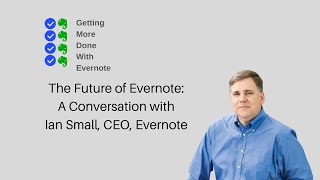
Ian Small, Evernote's CEO since 2018, rebuilt the app from five separate codebases into one JavaScript/Electron framework to fix years of technical debt that blocked new features. He's shifting Evernote's focus from "remember everything" to an "external brain" for tasks, with plans to ship updates much faster over the next year.
Chapters
Hello and welcome to Getting More Done with Evernote, episode 11. I'm your host, Ray Sidney-Smith, Evernote user since 2009, Evernote Certified Consultant, and Evernote Regional Leader for North America. As you can imagine, I love Evernote, and with Getting More Done with Evernote, I hope to help everyone love Evernote, or at least enjoy digital note-taking in it, a little more with each episode. As you may have noticed, if you use any of the Apple iOS devices, the new Evernote App was released. In honor of the release and forthcoming releases of these new Evernote apps across mobile and desktop, I have a special guest for you. Ian Small is CEO at Evernote, the app that launched a personal productivity movement for knowledge workers around the world. Under Ian's leadership, Evernote has found the courage to get back to basics, launching a new era for the company and building upon a decade of growth. Ian brings more than 25 years of global product technology and business leadership experience to his current role. Trained as an engineer, Ian's career has evolved from designing and building user experiences at Apple into product leadership and large-scale business management as CEO of Talkbox and Global Chief Data Officer for Telefonica SA. In addition to his current role at Evernote, Ian sits on the board of directors for Lumentum and is an advisory board member for Alphabet subsidiary Loon, which is a graduate of Google's X Lab. He holds a Master of Science degree in computer science, a Bachelor of Applied Science degree in engineering science from the University of Toronto, and has earned more than 10 patents. Welcome to Getting More Done with Evernote, Ian.
Thanks, Ray. Pleasure to be here. I'm not entirely sure that person you were just describing is, but I suppose that might be me.
Well, let's get right into the questions. I have so many questions for you, and I, I'm hoping that the listeners can get something really valuable out of our time together today. I know that you took over Evernote as CEO in 2018 at really a pivotal point in the company. What was going through your mind? In taking on this role?
Probably two things going on in my mind. The first was like, oh wow, that sounds like it could be a lot of work, but that also sounds like it could be a lot of fun. I had just come off a pretty long stint at a previous company and had kind of started slowing down a chunk. And so deciding to come back in full-time to take on the CEO role did, did take some thinking, but ultimately I did it because A, I like a challenge, B, I was an Evernote user kind of way back when, and I actually got unhappy with Evernote and left. So when I came back and started thinking about doing this, that's when I kind of became, I entered my second marriage with Evernote really is sort of the way to think about it. I think I just was really taken by the challenge. You know, in Silicon Valley, when CEO jobs come up, it's usually because there's some kind of a challenge that the company has to take on. And the real question you have when you're looking at something is, you know, do I, do I think this challenge really lines up with my skill set? Do I like the company? Do I like the product? Do I like the people? And if all those things are yes, then it's a pretty good fit. And I think all of that was going through my head at the same time that I was looking at it going, that's a lot of work, but if we can do it and we can do it right, there'll be a lot of users who are spectacularly happy with us.
What were you most excited about when beginning at Evernote? I mean, you know that there was, there were challenges. You knew that there were things that were going to come about that were going to be difficult, but what were you most excited about? I'm just really curious.
Ultimately, both the board and I, and I've known some of the folks on the board for a very long time, and it was one of the reasons why I was kind of comfortable taking this on. The thing we're most excited about is the potential. And I know that sounds strange because it's like, wow, Evernote's been around for a long time. And in a lot of ways, it's realized enormous potential. Millions and millions of people, you know, use it every day to actually like help them get through their lives and to become more productive and to become more effective, as we like to say, to remember everything and accomplish anything. And yet, in the midst of that, I think there is still an enormous amount of unrealized potential at Evernote.
You talked about some of the Challenges. What did you think were the biggest challenges facing Evernote when you did begin? And really, do you think those challenges still exist today?
Well, I think the biggest challenge really was that we were stuck. If you think about it, Evernote really invented the personal productivity space in, in like way back when, 15 years ago, and had built this enormous business, had built this incredibly successful company. And yet, you know, while we were the leader in terms of scale, we weren't leading anymore in terms of product innovations. The biggest challenge for that really for us was that the architecture and the infrastructure which had really powered our, our success up until that point had slowly but surely built up product debt and technical debt. And it had ended up like basically really constraining us in terms of our ability to move forward. And if you want to be able to lead, you need to be able to move ahead. You need to be able to ship software. You need to be able to ship innovation and bring new things to your customers on an ongoing basis, right? Motion is what keeps software alive. It's a lot like a shark. Sharks have to swim in order to survive. I think software companies are kind of the same way. And we were being held back in a big way by our architecture and our infrastructure. And we needed to address that, and without a doubt, that was the biggest single issue confronting Evernote.
Now here we are, 18 months later. Evernote has rewritten itself from the ground up with this fresh new Evernote product suite, and it's now entering the market, which I'm super excited about, by the way.
I am too.
But, but doing a little bit of retrospective, one of the things that you all decided to do was to use the Electron.js framework, and this runs many other applications, so you're in good company. Trello's desktop app, Slack, Discord, WordPress's desktop app, WhatsApp, many others use this for their Windows, macOS, and Linux apps. And I'm, I'm curious, what were the discussions? How did you all arrive at a decision to do this?
I talked about the fact that we were stuck, right? And we were stuck because of tech and product debt, but it's actually really hard to grasp from the outside what that really meant to us. You know, on the inside, we had 5 almost completely different code bases for each of our 5 products. Our cloud infrastructure was both old, was not a modern architecture by any means, but more importantly, it was out of room to scale. And so it was very difficult and in some places actually completely impossible for us to make changes. And I know the word impossible sounds absurd, but actually it really was in some cases impossible. For some changes, we would have had to take the service down for a day in order to make those changes. You don't get to do that when you're running a live service like Evernote. It's just not an option. And so when I came aboard, there was a feature in development. It was something that was like super cool. That Evernote users would really have liked. And the design for it was pretty slick. Everything was good. I was really happy. It was like, I wasn't expecting that to be something I discovered as I came aboard, like, oh, that's cool. Let's build this. Yeah. And over the first 90 days I was with the company, I watched as sort of week after week, that feature set got cut back and it got cut back because of limitations in our infrastructure and what we could do. It got cut back because limitations in our apps and what we could do. What also got cut back was our ability to ship it actually across all the devices we supported, because we didn't have enough bandwidth to write it 5 different times, all at the same time and get it all out to market. And when you think about it, one of the things that we charge for is the ability to use Evernote across multiple devices. So it's kind of insane not to be able to ship a cool new feature across multiple devices. All at the same time. What I watched basically was a great idea and a great design slowly but surely get compromised so many times that it was being turned into a feature that was now broken by design. When we shipped it, people would say, well, that's a bug. And we're like, no, that's actually how it's supposed to work. And like, well, that's crazy. Yeah, but that's the best we could do. And it's like, that's— you just can't do that. You It's just not a great place to be as a company. So we knew we needed to solve that. We didn't need to solve it for that feature. We need to solve it for Evernote. The thing that we wanted to be able to do was reduce the number of times we wrote software, reduce the surface of software we had to QA, all because we wanted to ship software faster so that we could bring more users to— more features to our users, and also so that those features could be more reliable when they shipped. I don't think actually anybody who was looking at the circumstances and really on the inside, anybody who was looking at this seriously, would conclude that there was anything else that we could do. And that meant we had to start looking at frameworks. What kind of frameworks could we use that we could run across multiple platforms? And this is the place where, as soon as you start looking at frameworks, ideology creeps in. And ideology is all about which framework is better than which other framework because every framework you choose comes with trade-offs. And depending on what you fix as the most important things for you as a user, well, your ideology will take you to this framework bad, this framework good, right? And no matter what, if somebody like goes down a path on a framework that you don't like, all you're gonna see is the stuff that's bad. So when we looked at the things that were important from the standpoint of what Evernote was trying to do and where we were trying to go, JavaScript actually ended up being at the center of our discussion. And so because JavaScript ended up being at the center of our discussion, Electron actually ended up being a vehicle that made sense for us on the desktop. Now, a lot of people go, "Ooh, JavaScript, that means you're a website." You can't, it's like, no, JavaScript is a language. It's like C, it's like any other kind of language. It also has pros and cons as a language. But you can write anything you want in JavaScript. And so, you know, we can run a full desktop app that integrates the desktop and runs offline and does all the things you would expect and still use JavaScript. That's perfectly reasonable. And so, so far, I'd say we are quite happy with the results. Still very much a work in progress. And of course, you know, there are some things that any framework makes harder rather than easier, and that is certainly true for us. So there are things we're having to invest more time in, in order to get them to fruition than we would otherwise. But overall, when I look at the big picture, I am absolutely sure that for any user who looks at Evernote, not just today, but like 9, 12 months from now, when they see how far and how fast we've been able to move Evernote on top of all these decisions that we have made, they are going to see why, without a doubt, these decisions were good ones and why these decisions were in the best interests of our users. And that's, that's really, I think, where, where we're coming from on this.
And just to give some clarity here for folks listening, that means that the code base, what you guys are calling the conduit, is really this centralized code that's running much of what needs to be done for Evernote. But in the individual applications on the desktop, Electron is really gonna be its container. And then on the iOS and Android ecosystems, those are gonna be individualized apps. And the one you released is basically a completely rewritten version of Evernote for iOS.
The one we released is a completely rewritten version of iOS, but it has exactly the same conduit code inside it as the Mac release will, as the Windows release will, and in fact as Android release will. So that's a place where we have one set of plumbing that runs exactly the same way on all of our clients. And actually, if you really want to bend your mind, it also runs in the cloud. Now that's not something that people see, but for us, the ability to have exactly the same code base running on the client as in the cloud allows us to talk between client and cloud in new and different ways than we've been able to do before. And so that's— those kinds of portability issues are some of the things that architecturally, when we looked at this, were super, super important to us.
I want to take us on in the conversation to really— you chose this framework, you chose this conduit model, and all good there. I'm curious that beyond just your ability to ship innovation, what does this mean for Evernote's ability to compete in the marketplace? I'm actually really curious about where you think Evernote competes in the marketplace. We traditionally— I always say, you know, it's a powerful note-taking software. But we all know that it's so much more, you know, it's productivity software as a whole. And so like, what do you think Evernote is, not specific products, because I can get into a full argument with anyone about whether or not Evernote actually is competing with any of these other applications, but really more to the effect of like, what vertical is it really championing? And how is this framework really gonna help move Evernote forward in that?
I think as you point out, labels are hard. And I think we see that with the revitalized competition that exists in the market these days. I mean, I view the fact that there are apps out there doing interesting things in the productivity space as actually being a good thing, because I think frankly, 3 years ago, people would have said the personal productivity space was tired and now it's kind of getting back to wired. I'd like it if we were the ones who'd made that happen, but, you know, the fact is, you know, we weren't. We've been pretty quiet for 4 or 5 years, especially from an individual user standpoint. And you can't leave that kind of void and not expect something to happen. And what I think is super healthy is that the different players are really taking different points of view on, on what they think is important. And I think that makes for a vibrant marketplace, and I think that's good. I do think that we have a very strong point of view at Evernote around, you know, this idea of wanting to be your external brain. And that was something that Stepan Pachikov set up really as the vision for Evernote from day one. And, you know, as a CEO coming into a company, it's a vision with a lot of running room in it. It's not a small idea being, you know, being your external brain. And I think what is really interesting because of the history and the length of tenure of the company, I think when we started, this idea of being your second brain really quickly got turned into a mantra of, you know, remember everything. Because one of the things that a brain helps you do is remember stuff. And we got really good at that. We got really good at remembering everything. And that's one of the reasons why Evernote has so many ways to bring information in and so many ways to capture information. And it is today, to this point, probably the single strongest differentiator of the company is the number of ways that you can get things into Evernote so it can help you remember everything. But it turns out, right, that your brain does more than remember things. It helps you get things done too. And so if you start from note-taking and you start from remembering things, that's a great place to start. But I think more and more as we move forward, we are gonna start to shift and augment that vision of remembering remembering and adding to it this idea of accomplishing. And the reason that accomplishing is important to us is that one of the things we always say inside the company is Evernote isn't that important. What's important is what people do with us. And, you know, there is a world of things that people do with us, right? There are literally people doing cancer research, keeping notes in Evernote, keeping track of the— helping organize their research, etc. People are actually doing that with Evernote. People are organizing their work life. They're organizing their home life. They're creating new works of art, right? They're like everything in between in the spectrum of things you can do. People selling things, people buying things, people like, you name it, it's all in there. And so it's never to us being the fact that we are important. What's important is what people do with us. And we know more and more that people are trying to turn this place where they put everything they trust into something that helps them get things done. System called Get Things Done, not necessarily with the capital letters, but they're really trying to move into this world of accomplishing. And I think as you look at where we go as a company ahead, you will see more and more of a thread of the things that we introduce in Evernote reflecting the way people use Evernote today, but with an emphasis on looking really hard at the places where people are trying to turn their notes, their content, their web clips, their, you know, recordings, their whatever it is, their scans, their photos, into some kind of action, trying to turn that into getting something done in their lives. And that's really where we are going to be focusing in the months ahead, um, on the back of this new set of apps that we've built.
I just recently interviewed David Allen of Getting Things Done, uh, fame, and I will be asking David what he thinks about the Evernote apps very soon, because I know that he does use them on the iOS platform. In line with that, I'm curious, or am I reading this right, that Evernote in essence in some of these veins are going to become more opinionated toward the production side of things in terms of managing the creation or the production side of your life. And now that you have this pool of data, kind of for a lot of people Evernote has become a junk drawer, right? And taking that junk drawer ordering it, and then allowing you to actually turn those things into actionable results.
Yes, I think you're going to see us start to connect Evernote to more and more parts of your life, not for the purpose of pulling even more information in, but for the purpose of helping you accomplish things.
Okay, tough question. I know there are some frustrated Evernote users out there. I have spent time in the Evernote support forums. I've spent time in the Evernote discussion forums. I've spent time in Reddit. And, and so I've heard and seen it all. And my whole job, I feel like, in my role as an Evernote Certified Consultant, but also as the Evernote Regional Leader for North America, is to provide information and try and help with workarounds and whatnot. And I know that some of those folks have ultimately left Evernote for other tools in recent years. You talked about the fact that some folks are innovating in that space. What's your message to the frustrated Evernote user or to those who have left, but may consider Evernote again now that you've started to roll out these new apps?
I mean, I think the first thing I would say is I feel your pain and I understand why you're frustrated, and you're not wrong to have been frustrated with us. When I first started at Evernote, in my first 3 months, you know, I, uh, I put a blog post out there that basically said, hey, we know the apps are broken. And the amount of churn that generated in Silicon Valley, just in terms of noise, it's like, hey, Evernote said its apps were broken. We were like, well, look, everybody knows who uses Evernote, they still are using it, but they know it's freaking frustrating. So why can't we just call it what it is? Just name it ourselves. And I think the biggest thing that I would say to those users who are frustrated or have been frustrated, who are left, who have left, is we understand and we're fixing it. And not only that, we're starting to move it ahead. And, you know, if in that process, not necessarily today, maybe not even 3 months from now, maybe not even 6 months ago, But just keep your eye on us because what you're going to see is a company that you haven't seen for years and years and years moving at a pace with a point of view, um, focused absolutely on what our users are doing with us and how we can help them do it better. Uh, and I just think that that is going to look very new and very different. And while every single person's frustrations are kind of different and unique, and you know, there's only so many things we can get to at once, and only so many problems we can address at a time, I think the idea that we are once again a dynamic company moving forward, shipping software, delivering new features, listening to users, Fixing long-held complaints, you know, slowly, methodically working through this and improving the software with every passing month makes us once again an interesting company, an interesting software product for those people who have been frustrated and have left us to consider maybe giving us a try again.
Continuing on kind of our hopeful note, pun intended. As we come near to the close of our conversation together today, I thought we could talk about a bit about the future of Evernote. I know that you've touched on this a little bit in terms of vision, but I'm really curious, what is your vision of Evernote in the next 6, 12, 24 months? What do you want to see not only the software do, but how do you really want the business to grow in terms of direction? All of those pieces, kind of where do you see Evernote moving? Where do you see the elephant, you know, stepping forward toward?
Well, one of the things that by now people will have figured out about me is that I'm really good about keeping my mouth shut about the future.
Oh, I know, I know.
And part of that is because I think fundamentally, as a software company, our software should do the talking for us. And, you know, we're getting to the point we can now start to actually have that happen again. I know what we have sort of in the hopper that is already in engineering and in development. I know what we have on the boards in terms of designed and starting to actually think about building. And I am 100% confident that over the next 12 months, you will see us ship more than we've shipped in the last 5 years. And, you know, and I think that will fundamentally change how our users once again see Evernote. And I think that will once again allow us to lead in the marketplace. Do I think that there is going to be a tussle in the marketplace over different points of view and you know, what's the right way to move forward and what's not? Absolutely. But I think that's healthy and a good thing. I don't, I don't see that as a, as a bad thing at all. But I will go back to the fact that when you look at the longer term, the thing I want to go back to is our vision is unchanged. We still have the vision to be your external brain. We're just expanding our ambition as to what that actually means and expanding our viewpoint as to what we're prepared to take on to actually get there. And yeah, at the end of the day, if we are successful in shipping software that is relevant to our users, if we are successful in shipping software that helps people remember everything and accomplish anything, then I believe that translates ultimately into growth. The way to grow is to have software that people love, and, and the way to have software that people love is to be able to innovate and to lead, and to do that while being extraordinarily customer-focused and listening to what our customers are doing. And I think actually those are all things you're going to see from us over the next 12 months, and I think that will translate into growth as a business, which is good for everybody because growing businesses are happy businesses. And the whole point here is to have a business that is around for a very, very, very long time.
So I've just started a new segment with this interview called Quick Notes.
Quick Notes? What's a quick note, right?
And so these are just some rapid-fire questions I thought I would throw at interviewees, and actually due credit is given to Stacy Harmon for doing this. So this is for you, Stacy.
So let me check this out. This means I'm the quick note guinea pig? Is this correct?
That is correct. That is correct.
I will get in touch with my inner guinea or my inner pig, as the case may be.
All right, here we go. What's your favorite operating system to use Evernote?
Oh, well, that's an easy one today, iOS.
Fair enough, fair enough. What's your favorite Evernote feature?
My favorite Evernote feature is search. And that's new, it didn't used to be my favorite feature, but it is now my favorite feature for sure. I think search has come a long, long way. In these new apps, and you can see it in iOS, but you'll see it in other platforms as they come out. So search, number one feature for me right now.
Great. What was your first Evernote note?
That's actually a more complicated question than you think. And these are supposed to be quick answers, right?
Yeah, that's okay. It's all right.
So the reason it's more complicated than you think is that I used Evernote a long time ago, and I got so angry with them that I fired the company, and I don't actually have those notes. That was literally like 8 years ago. So I don't actually know what the first note was then, but I rejoined Evernote as a user before I joined Evernote, obviously, to work here. And you will laugh, but— let me just check to make sure this is right. Yes, you will laugh, but my first note, the one I made, not the one that Evernote gave me, the first note actually says, "Does this thing really work?" is the title.
It could have been "Hello World," right?
And it was literally a note while I was starting to poke around and look at the product again for the first time when I was thinking about coming on board as CEO.
How many notes do you have in Evernote now that you've been back in Evernote?
So, uh, I have about 1,000, um, you know, personal notes across my work world and my home life that I've made over the last 2 years. But my Evernote instance, like, has right now 5,200 notes in it. That's because I'm a part of the Evernote EB instance. That number goes up and down between maybe 4,000 on the low end and about 20,000 on the high end. Depending on which spaces I'm dipping in and out of at different points in the cycle. Right now we're kind of at the low end because I've cut everything back so I can focus on the, on the launches. So, but I think the real answer is 1,000 in the last 2 years.
Yeah, I'm a note consolidator, so I like to have as few notes as possible. Okay. Uh, what do you think is Evernote's most underrated feature? What's the, what's the underdog in Evernote features?
Um, I think the underdog is actually something most people don't even know you can do. So that's probably makes it underrated, is if you're a premium user, you can mail stuff to your Evernote account. So the ability to mail content to your Evernote account and have the notes show up in your Evernote account in the place that you want them to show up, that's like a super slick ability to be able to be in mail and just forward a piece of mail to this, to your personal Evernote super secret email address and have it show up. That's a, that's a cool feature.
Anything else that you wanted to say to Evernoters that I didn't ask you so far?
I think I will always, when I'm asked this question, I will always say something close to the same thing, which is thank you. And that thank you has many dimensions, right? It's, it's Thank you for your passion for the product. Thank you for your patience with us while we've been through this process. Thank you for sticking with us. Thank you for caring enough to tell us what we get wrong. Thank you for being a part of the beta programs, you know, for both the pre-beta releases and the beta releases. And thank you for trusting us, you know, with something that is so important in your lives. I have said for the last 2 years that our goal is to work hard to really earn that trust that people place in us, not to just take it for granted and assume it's there and it's always going to be there. I think every day we have to earn that trust, and I hope that this set of releases coming up will go along, gives a big step towards that. And I really look forward to the next 12 months because there's some great stuff coming, and I think And I think people will be super happy with us.
Thank you so much for joining me here on Getting More Done with Evernote, Ian.
Thanks for taking the time. I really appreciate it.
Absolutely. So everybody, that was Ian Small, CEO at Evernote. That's all for now. To learn more and to follow me, go ahead and visit gettingmoredonewithevernote.com. I'm Ray Sidney-Smith, Evernote Certified Consultant for Getting More Done with Evernote. Here's to your productive life.
More from Raymond









The Checklist Manifesto by Atul Gawande MD Productivity Book Group Made by Headliner

First Things First by Covey Merrill and Merrill Productivity Book Group Made by Headliner
