The Home Edit: A Guide to Organizing and Realizing Your House Goals by Clea Shearer & Joanna Teplin
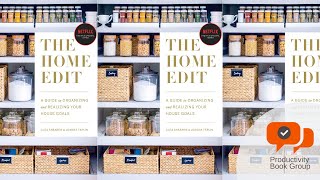
Raymond Sidney-Smith hosts a book group discussion of The Home Edit by Clea Shearer and Joanna Teplin. Readers praise its visual appeal but criticize the focus on expensive aesthetics, Instagram photography, and promoting containers and a Netflix series. The group compares it to Marie Kondo and Julie Morgenstern's methods, debating whether color-coding and extensive labeling work in small spaces or on tight budgets.
Chapters
Welcome to Productivity Book Group. I'm your host and facilitator, Ray Sidney-Smith. Thanks for joining here live or listening in on the podcast after the fact to Productivity Book Group's discussion of The Home Edit: A Guide to Organizing and Realizing Your House Goals by Clea Sherer and Joanna Teplin. We'll talk a little bit about the authors and then a little bit about the book, and then we'll get into the conversation. So Clea and Joanna are both California transplants. I'm pulling this from, I believe, their website or the Amazon description. I don't remember where I actually lifted this from, but I'm quoting here. Clea and Joanna are both California transplants currently living in Nashville, brought together by a mutual friend. It was friendship at first text and business partnership immediately thereafter. The goal in starting The Home Edit, or THE, was to reinvent traditional organizing and merge it with design and interior styling. While every project is rooted in functional systems that can be maintained for the long term, there is just as much emphasis placed on transforming the space visually and adding their signature stylized aesthetic. End quote. Then about the book, it says, quote, from the home organizers who made their orderly eye candy the method that everyone swears by comes Joanna and Clea's signature approach to decluttering. The Home Edit walks you through paring down your belongings in every room, arranging them in a stunning and easy-to-find way—hello labels—and maintaining the system so so you don't need another do-over in 6 months. When you're done, you not only know exactly where to find things, but you'll also love the way it looks. End quote. And so the book is structured in 4 parts, well, 3 big parts, and then they have a final chapter. And so it's the edit, the assembly, and then the upkeep. And then they have a final chapter called How to Stay Inspired. And so let's start off with What did you think of the book generally? What were the things that kind of sparked interest and intrigue with regard to the book? And we can start kind of there with your initial thoughts about the book. Frank, do you want to get us started?
Sure. Um, first of all, it's just a beautiful book. Just the look of the book with all the pictures in there, uh, you just want to salivate as you look through here. And it's one of those where you don't have to read the whole thing You know, you can just dive into where you're having a little problem and even just looking at the pictures and going, oh, okay, I could go do that. So that's what struck me first. And I'll let someone else chime in.
I'll say this, that I started with the audiobook and my intention was to just listen to the audiobook. And so I definitely learned and I recommend to anyone that you actually do get the physical book even if you are listening to the audiobook along the way, because I was listening for at least, I don't know, the first part of the book, and then I realized that they were talking about photographs that I was not seeing. And so then I got the book and then it all started to make sense to me because they were clearly utilizing photographs of their work and explaining that. And, you know, I had the book playing on maybe 2.5x, 3x, so I would just I was just listening along and having a good time and realizing that I was just a little bit confused as to why their material was maybe just very direct. They were just describing things and then moving along in very clear wordage, which was efficient, but I wasn't digesting. And so I had to double back and say, okay, there's something wrong here. And that's when I went and got the book and then realized there are all these photographs they're referencing here. And then as they make their way through the book, they then note, yeah, we're referencing this, or go back to our Instagram feed and you can see the archive archive of these images, and that's going to be more useful to you. And so the book and the images in the book are actually really necessary for you to digest what they're really talking about here. Anyone else with thoughts? I see Usha joined. Hi, Usha.
Hi, Ray. I was trying to unmute myself.
Sorry. No worries.
Yeah, I got a phone call just before, and I shouldn't have answered it, but anyway, it was from family, so I took the call. So overall, I'm sorry I missed the introduction here with everybody, but I did not care. I'll throw it out there, and I'm trying to find my notes. I read the book a while back, and I read the paper copy of the book, and for various reasons, it didn't appeal to me. And I'm trying to pull out my notes so I can look at it. Very rarely do I not like a book that I read. It's almost always that, you know, you find some value in it, but this one did not get to me. So I am curious, which is part of the reason I wanted to make sure I joined the call so I could see what the rest of you were getting out of it and thinking, you know, am I missing something here? Anyway, enough on that. I'm trying to pull up my notes. I'm going to go back on mute till I find my notes here. Yeah, yeah.
And I'll be curious what your notes are on this because the thoughts I have are perhaps that there was maybe something not novel about the book that you didn't recognize the value in it because it wasn't novel information or that, you know, it wasn't presented in a way that spoke to you. I'm very curious about all those pieces because, you know, it's always good for us to be mindful of books that speak to us and ones that don't, and so that's always a good thing.
Anyway, I found my notes, I found my notes, so let me know. I'm in with the notes. You know, this is interesting, this is interesting from a tech standpoint. I captured the notes on my phone under the Notes app so I would have it no matter where I was. You know, during this phone call. And I looked on my computer— I'm at my computer right now— and I looked on the computer and the notes on the app on the computer, it doesn't show up, but on my phone it does. So there's something about the syncing. I think I gotta look. But anyway, yeah, so is this the right time you want me to chime in, or maybe I should wait till the rest of you talk first?
No, no, go for it, go for it.
Okay, so I think this is what— this was the reason, um, it turned me off early on. My first few comments were, don't recommend it, meaning I don't recommend it. It was written more from their point of view versus the customer. I think maybe that was the biggest thing for me. I see Frank nodding. I don't know if, you know, you picked up on something similar. And then the other one was the Netflix episode was a turnoff. So I watched the Netflix episodes. I think I watched 2 maybe. And in fact, I thought to myself, if I had seen the episodes before I'd read the book, I probably would not have even touched it. So I think it was— now it's coming back to me a little bit, you know, it's the giddy, starstruck— yeah, I can see Linda laughing here. But, you know, all of that I think was just— I mean, again, I think it depends on who the book is, uh, targeted towards as an audience. If it's the people who really You know, if it's the broader public that you think you want to be able to reach out to people who may really be struggling with it, they want to improve, you know, their life in many different ways, then that's not the way, you know, you would approach it. That seemed to be something more along— but maybe this is not a good comparison, but, you know, kind of like the Kardashians. I've never watched it. All I know is what I hear about in the media. As soon as I hear the word, I change the channel. But, but, you know, it was almost like that. So let me go through a couple more here very quickly, and then I'll pause so the rest of you can talk. And then, of course, it's really, as you said, no new concepts for me. And then it also advocated spending a lot of money on supplies, which would bring them revenue. So to me, that seemed very self-serving. It's one thing to say, hey, you know, these kind of containers or whatever will help you. So, you don't have to search around, but you could also use, you know, X, Y, and Z. That would cater to more of the general public. But it, again, to me, it came across as it's all self-serving. It's all about me. How can I make money? You know, and that was a huge turnoff. And then the other thing was two other comments. They talked about, in my mind, it was like first world problems, talking about lattes and champagne. I mean, that's not going to appeal to the majority of the audience. So again, it's, you know, who are you targeting the book towards, right? And then last but not least, and I've got a whole few more paragraphs of it, but the last was that most closets aren't that big. Most closets— people don't have the luxury of having the big closets, especially one dedicated to, you know, come on, let's be realistic. If you're going to just throw that out as an, you know, as a funny humorous thing, that's fine. But for most of the other people, they don't have closets that big. In the suburbs, I'm fortunate, I do have big closets. But for people who don't, even with, you know, homes that are over $1 million in, you know, in asset value or whatever, when they don't have that, then this becomes not very practical. And again, you could say, well, how many people living in New York City would this appeal to? But then I'm back to who's your target audience? So enough on that. I said a lot.
I dumped a lot. Yeah, I also had watched some of the Netflix. I was really looking forward to it, but then just got into the first episode and it was more of a lifestyle of the rich and famous sort of thing. It seemed to be targeted more toward who was the star rather than here are concepts that the average person can use. So I think seeing the Netflix was a, just as for you, was a minus rather than a plus. And I did read the whole book, liked the book a whole lot better than I did you're watching the Netflix. One, one thing I did notice about this, you know, Ray, we did Marie Kondo, and that philosophy was you sort of need to organize your house all at the same time. You pull the books from everywhere in the house and put them together. And this emphasizes, you know, just start somewhere. If you just start with a drawer, start with a drawer and just work little individual sections, which I think is easier to digest for the average person.
But it also said, you know, you have to empty all the contents of the drawer and—
right. Yeah, you know, that kind of thing.
Yes, but, but it, but it definitely is more chunked down in that sense. There's a lot of KonMari method built into what they're talking about throughout the book as well.
Yeah, well, I think, I think the KonMari method is more for people with small spaces because I don't even think she addresses kitchens in that book. I remember looking at it going, where's the Does she not cook? Do her parents cook for her? What's going on here? Uh, but I think it's like this— I have this apartment that's this big and I could just dump like— on my bedroom I can dump everything on the floor and do it in one day or whatever. When you have an actual house and closets— and this is probably more for people who have large houses who have space to display their— so I'll give you my impression. I was disappointed in the book too, Usha. I, um, my disappointment was that this was a $25 book and This, this is the content. I mean, page 58 is when we stop with actual content and just show pictures, which I could just see on Instagram probably. So that was, that was a little disappointing. But I, we have a lot of, we own a lot of books in my house. And so I don't have a problem buying a book with pictures because we have lots of those. But my problem with the rest of the book was it's all the same white aesthetic of total boredom to me. It's like I wouldn't follow any of this aesthetic. This is not my aesthetic. It would have been to me much more interesting to show different people organization as opposed to all the same person. Like, this is the only page that appealed to me. I was like, oh, something not white. Not that there's anything wrong with white, but I personally wouldn't decorate my entire house white. That's not my aesthetic. It was difficult for me to, you know, I kind of got bored. I was like looking at the same picture over and over again of the same— I mean, label everything, put it in a closet is— you don't need 100 pictures to show that. It's a simple concept. But, um, I did, I did find like some things helpful. I mean, I'm not a Marie Kondo person. I'm definitely more of the Julie Morgenstern type. I don't dump everything out in the house on the floor. Otherwise You wouldn't be able to see me right now. But the whole thing about the— where she— where they, excuse me, classified the rooms and spaces as hard, medium. I thought that was interesting. Easy is do a drawer. I thought some of the stuff in the front was helpful, but it wasn't. I think you're right, Usha. This is not a book for people who have studied organization. You know, if you've been reading organizing books for the last 30 years, this is not a book that's going to be like, oh, I got to go out and get that to learn something new. This is for people who probably haven't organized anything and need to know how to start. It's pretty much a basic, I think, book. Um, and maybe there's stuff I missed. I read it 3 months ago, so there might be things I forgot. Um, but I read Julie Morgenstern, what, 20 years ago, and I remember those concepts.
So Linda, if I can chime in here very quickly, you're right on. At the Morgensterns, again, I remember stuff. And more recently, recently as in, I don't know, in the last 3 or 4 years, I came across some old podcasts of hers and I listened to it. And, you know, there's always stuff there either that you've forgotten or it's a good refresher or, you know, it's something that you say, ah, I want to, you know, share this with somebody else. So yes, that I thought, you know, appealed in a broader sense. But there was one other comment. Let me just share this. I'm looking at my notes and then I know there's other people on the call. So I'll hold back from the rest of my comments. In one place she says in this book, they took 8 suitcases for the 2 of them on a trip, and that blew my mind. And I don't know how many of you follow Rick Steves, but if you heard about his traveling all through Europe, he highly recommends carrying 1 carry-on and a backpack for a 3-month trip to Europe. And Rick Steves' organization skills, I mean, are incredible. So, I always feel like I'm learning new stuff and trying new things, and he sets the bar high for us. And I'm contrasting that with one carry-on and a backpack for 3 months in contrast with 8 suitcases for 2 people on a trip. I know that would be straight to divorce court for me if I took 8 suitcases or 4 suitcases on a trip.
Yeah. I think this ends up being who is this book for? And it's clearly not for you, Usha. It wasn't written for you, and it was written for a very, you know, like probably upscale suburban environment and one in which that aesthetic of like, you know, the thing I liked about the book was actually the focus on kind of the Roy G. Biv style of styling. And that's something that I have adhered to for my entire, since I can remember. I just like ordering things in that sense. And so like that makes— that was just very logical to me and it wasn't new to me at all, but it was like, oh yeah, that's like, that's the way it should be. And I'm not particularly like a white walls person, although we have very light gray walls in our home that haven't really been painted since we moved in. We will eventually paint the walls, you know, some color, but But the things that I found interesting about the book were that I felt like the book itself was kind of a coffee table book, something that you would have kind of in your living room, people would flip through and they'd pick out a couple of things while they're sitting having coffee or drinks with you at a cocktail gathering. That's what that book was for. And it really wasn't for you to digest a lot of material, and it was really about them. In the sense of telling their story and what led them into doing what they do. It really is a calling card. I feel like this book is a calling card to their services for the elite and giving people enough to know that they know what they're talking about and that, you know, you have that capability. And, you know, I come from a business marketing space where writing a book is a calling card. And so You're giving enough information to be useful to people, but not enough that you are going to do it all yourself. You either realize that you're overwhelmed by the project, and so you're going to hire somebody, and this is going to prompt you to do so. And hopefully, by virtue of reading that author's book, you are going to hire that person to do that work. So I saw it through that lens, which again, Usha, you're talking about the kind of commercial intent of the book. And that didn't detract for me in that sense, but it was certainly present. I knew it was there. And again, just going back to the aesthetic component, I would recommend to anybody who did see the book and saw a lot of what Linda was talking about in terms of just white walls and whatever, go to their Instagram profile because they do have such a complement of different designs and different pieces that they've put together. And it really is a well-curated Instagram profile.
That's interesting. Why didn't they put that in the book? I mean, I literally got bored. I was just like, I cannot look at one more. I mean, if you have a whole chapter of— let's see, what am I looking at right now? Office. I mean, you have a whole chapter and they all look exactly the same. It's like, what's to be gained from that? If they— I mean, they do have pictures that are different. Why don't they put in the book? I don't get that.
And I would imagine that it was a design choice, that they wanted to— they wanted to keep the book kind of that aesthetic throughout the—
yeah, I felt like it was an Instagram book. It was like, this is like the kind of stuff you see on Instagram. And there's nothing wrong with the style, it's just like, it's the only choice in here. So it's like, you can't look at different ways people might have organized their papers because they're all the same.
And, and to be honest, like, they, they They gained success through Instagram. So I guess maybe part of that is built into this in some way. They have 5.4 million followers on Instagram as the time of recording. And it's astonishing that the business started as an introduction between a mutual friend that they met on Instagram. And 6 years later, here they are with a Netflix special and millions of followers on Instagram and doing really well in that sense. Obviously, there was a celebrity component here that I'd like to talk about also, but I feel like because of their Instagram influence, I think that's why the book is informed by that background. And yeah, that's why when I listened to the audiobook and then got the physical book, I realized, oh yeah, this is a coffee table. This is like a photo book. You know, like it's not a— this wasn't meant to be like a really in-depth, like Miss Minimalist or Julie Morgenstern or what's the name of the FlyLady or any of those. It's like it's not rich material. It's just light-touch stuff to be able to give you enough.
Well, I think you hit the nail on the head, though. I mean, Usha's question about who are you writing to? They're writing to Gwyneth Paltrow. And her colleagues and letting them know, I can make your house look like this, just call me. I mean, really, I think you hit the nail on the head. And that's great for, I mean, but it didn't really help me because Gwyneth and I are in a different bracket.
But even otherwise, it's back to, you know, does it fit your value systems and base, right? So, let me just add one more comment, and then I know Rhonda at least seemed to be trying to say place. So I'd like to give her a chance to speak here. One other comment that hit my eye was where they talk about color-coordinating toy shelves, including books. And I'm thinking to myself, when was the last time you had kids who worked with it? Because I don't spend that much time with my grandkids, but when I do, it takes less than 10 minutes for all the books to be out of the shelf, no matter how well organized it is. And then it takes hours to put everything back. And unless you have a full-time help, and all they're going to do is organize it back for color coordination. Or if you're going to stage your home for something, you know, then it makes sense.
But color-coordinated books are only for people who don't read. True. Literally, how do you find the book if you have 12 books on a shelf and you're really aesthetic and you really don't read? Color-coordinate your books. If you have 12,000 books, don't do it. You will not find your book again.
Or you have to shuffle everything, you know.
I mean, we have entire bookshelves dedicated to certain types of books. If we color-coordinated books, they'd be lost for good. I mean, you have to have a card catalog.
Yeah, the Roy G. Biv thing, Ray, that you mentioned, that was kind of the biggest takeaway for me. I had not seen that before, you know, the suggestion that you organize, you know, whether it's books or whatever it'd be, according to the rainbow, that you put the, you know, the red, orange, yellow, green, blue, indigo, violet to line them up in that order and that it's more appealing if you do that. So I thought, well, but I agree, you know, if it's books, that's not going to help me find the book and it's just going to make putting the book back more cumbersome.
Well, if you could convince the publishers to organize books by color, like their covers, it would work, but that's not how it works.
The A's could be red and the B's could be orange. Yeah.
But then the colors would match, but the size of the book or the height of the book wouldn't match. That would be more of an eye That's what I saw for me.
Yeah, it's actually— so there's a couple missing elements there that they don't necessarily talk about, which is really important, which is that white isn't represented. All the browns are kind of like in that middle ground space there. And so that's not represented. And then of course black. And so when you do ROYGBIV, you have to decide where whites, browns, and blacks go in that organization.
And I've chosen to put it in the yellow space for white, and then over on the far end do browns and blacks. And so my colors, like in my closet, have that order, and that's just the way I've decided. So it ends up being, you know, Roy, white, and then Biv, and then brown and black. And that's kind of like the order in which I've chosen to do that. But then it's also about size order, which is you want things to kind of flow from— and this is a Marie Kondo talks about this in her KonMari method of like having a flow of sizes as well so that things kind of have a nice visual organization flow-wise. So if things are going to be out of color, they should at least have a, a size flow.
So you're doing that within— are you categorizing them and doing the ROYGBIV within a category, or are all the clothes just Yeah, so pants together, dresses together. Pants are all together and then they're by color.
T-shirts together. Yes. And, well, because, you know, I don't want to—
It makes sense for clothes because you select your clothes a lot of times by color, right? What you want, colors that are going to go together.
Exactly. Exactly. I don't see myself doing that, say, in my pantry or in those kinds of places. I'm not one to want to visually organize things by Like, of the things I have in canisters in the kitchen that are clear glass are like our coffees, some of our grains, some of our flours, but those are done for purposes of sealing out air, you know what I mean? They have that little suction thing, so it helps us pump out the air to keep it fresher. It's very functional. I'm a very functional person. So I'm you know, like I don't lean into the aesthetic as much, but I did lean into that for clothing. Definitely.
Like it stood out for me that it's functional for clothing and for art supplies. There's certain things that color matters and it is functional for that. But for books, it doesn't make any sense to me because books are not about the color of the spine.
Yeah. And I don't order them, especially when most of them are brown. Yeah. You don't even fit in. Yeah. Yeah. Um, Rhonda, did you have any thoughts about the book that you wanted to share?
Well, you know, it seems to me to be a big advertisement for The Container Store, like rush out to The Container Store, buy every little sorting container that you see. So there's definitely a lot of cross-branding going on with the consumer market. And there, you know, she does have a section that she says the top 5 things to avoid doing so that you don't run out of space. So that's like her, you know, contribution to sustainability of what she's doing. It's like, you know, you can buy everything you want and put it in the containers, and that's your limit. And, you know, that's as limited as it gets. It's not— but, you know, it's something. It is something. And then the other thing is about the packaging, like when you take the spaghetti out of the package, you don't know anymore is it Ronzoni or something else. So you lose connection with the brand, so that's not so good for the companies who want people to know, you know, what company this spaghetti comes from. Now, like I personally you know, prefer to buy things in bulk. I go to the health food store and I go to the bins and for $1.99 I can get a lot of stuff. But this is not the crowd that she's catering to, people who are, you know, tight on a budget, but tight, you know, like have to keep to a tight budget. But it sort of introduces people to that thinking, you know, separating the brand from the spaghetti, let's say. That all this is really is spaghetti and you're going to put this into this Container Store bin. All these are magic markers and you're going to put this into the bin. So in a way, that is a message, you know, about being simpler and having more simplicity in your life. So, you know, I see, you know, I see that there are some things she does mention about sustainability, without throwing the word out there which might turn off a lot of her customers.
Absolutely. Yeah. One thing that you said really also triggered the fact that I use the packaging, the UPC barcode on packaging for tracking food and also for my grocery app. And so I am frequently— You should go for this book. Yeah. Scanning those labels. Like if I eat something and I put 5 ingredients into it, I can just quickly scan it and then it helps me build inside of the nutrition app the things that I've then eaten and I can then know what my caloric intake is and I can tell what macronutrients I've eaten. I can't do that if they're all dumped into containers that I don't know thereof, you know what I mean? And like, you know, grains or beans or those kinds of things, that's easy. You could say a cup of of lima beans or a cup of red beans or whatever, the system knows those things. But there are some really unique products out there that are not easily identifiable. If you have a mixed product, like some kind of mixture of things, how do you know what the calories are for that thing and what are the macronutrients available? And it's only through that UPC barcode that you can really quickly identify it. And so, I wouldn't do that either. I'm just not inclined to increase the amount of work to identify like, "Okay, these 5 pieces of quinoa and these pieces of arugula together equates to 110 calories," or whatever. It's just too much work.
It's also kind of assuming you have a staff to degrocery your food for you. I mean, really, groceries is like, if I were to take everything I bought in a bottle or container and put it in a new container, which to me is not ecologically sound, right? Because it already has a container. Why am I putting it in a different container? I need a staff to do that. I need a kitchen staff to do that each week. I wouldn't do it myself.
Now see, if you were Gwyneth Paltrow, you wouldn't even have to think about it, right?
I know, but I don't sing and dance as well as she does, so I'm stuck here.
Yeah, well, I want to piggyback to what Rhonda said a couple of minutes ago because one of the comments I wrote down— oops. And my phone's going to screensaver mode, so hold on a second. I've got to pull it back up. Somewhere in her book, and I read this a long time ago, so bear with me, she— the authors talk about printing all of the email. And I don't know if you remember that part of it, but to me that sounded a little archaic in this day and age, and especially considering, you know, environmentally friendly and, you know, not cutting down trees and things like that. That didn't sit too well with me. And I don't remember the exact context for it, but I just wrote that down.
Where did you read that? I didn't catch the—
was in the book. Something about printing.
So in this book? Yeah, in the book. Yeah. Okay.
I didn't remember. I didn't— it was— I'll tell you exactly where it was also, because I've got the before and the after. It was after the 8 suitcases, but it was before the office snacks were nicely arranged. So it was right in between somewhere there. So those of you who have the physical book can look at it. I borrowed the book from the library. So that's what I've gotten to doing. It's because kind of like you, Linda, my house is filled with books. And right now I think what we have to do is get rid of a lot of books before we bring new ones in. So unless it's fantastic, I tend not to buy the book, just get it from the library or do ebook.
Well, this is the project I'm working on right now. It's organizing my house. So I was very excited when you picked this book because I was like, yes, yes. I did appreciate about this book the talk about letting go of guilt and all that kind of emotional stuff. And if that's an issue, they don't really tell you how to do that. They just say don't feel guilty. Um, I, I will advocate for Julie Morgenstern's, um, Organizing from the Inside Out, which is a very old book, but it tells you— actually gives you a way to go through the emotional things that are holding you back from organizing your space. So, um, she actually goes through that. In that book, but I appreciated that in this book. And there were moments when I was like, oh, that's helpful, that's helpful. But I kind of wish that there was more of those moments and less— You were picky. I love pictures, so don't get me wrong. And I don't, it's not that I don't like this aesthetic, it's that it's just too much of the same thing for me. I like more variety. Give me, you know, something. That's why this picture of the gray closet was like very exciting to me. I was like, oh, it's all in gray. Still monochromatic, but it's all in gray.
You know, I wonder if when it's, um, you know, the pictures we see that once everyone leaves, what it looks like the next day, the next week, you know, does it always look like that, or did it just look like that for the picture?
Well, they, they, they do advocate the idea that this is supposed to be a long-term solution. I, I find that to be, you know, they even said in one part of the book, you know, we came back and made sure that the, the work we did stayed.
And, uh, you know, they come back periodically and fix it for you. That's why I like Julie Morgenstern so much, because of the kindergarten, uh, concept, which is basically things go where you use them. So you create stations, like you have a baking station and you have a whatever— it depends on what your activities are. But for each activity, you group the things. And that really helps me because I always ask myself Why is this thing here? And where am I using it? And that's what I learned from her was like, okay, this is not in the right place. And efficiency-wise, like, okay, I have to walk, you know, 20 feet to get something to do this when I should have it stored right where I'm using it, you know, right where I'm using it. So that kindergarten method to me is, is gold. And a lot of these new organizing books don't do that. They just basically say put things back where they belong. Well, if they aren't where they— if they're— if their home is not where they should be, if their home is wrongly placed, it's never going to stick. The home has to be the place that you're actually going to put it. So if you're always setting something down on the counter and not putting it back where it belongs, maybe it needs to be somewhere near that counter, um, have a home because that's where its home should be. Anyway, I'll finish mine.
I think that the easier it is to maintain, the better the chances that it will be maintained.
But if you have a staff This will be maintained, don't worry. They're being paid to maintain it for you.
So it's easy. Well, one of the first things that I ever learned from David Allen and then ultimately learned from the concept of mise en place from Work Clean by Dan Charnas, which goes under a different title, I forget, Everything in Its Place by Dan Charnas also, was this idea of having everything that you're doing work-wise in arm's distance and that you shouldn't have to cross your arms in order to access things that you use with one particular hand or the other, right? And I, yeah, I've really worked hard to make my working environment like that so that everything that I'm doing has, even to the extent that having, you know, the extra, I have an extra laptop that is up on a stand here that I can reach here and type on it. And so I put it on an arm so that I could bring it closer to me because it's is not my primary device, but I still want to be able to utilize it when I do, but I don't need to be reaching, you know, and moving my body, you know, in a way that's inefficient and potentially dangerous for me. And I can pull out my back and those kinds of things from just like hyperextending. Having it in a place where I can access it easily and comfortably and fluidly is just really, really important. And so I've really thought that through with regard to my desk layout, and this conversation is kind of prompting me to think about that in really other paradigms, certainly the kitchen, because I just don't— I don't think that I have organized the kitchen in such a way that is as efficient, you know, considering the mise en place concept is about cooking and, you know, how chefs and cooks organize their space to be efficient. But I've thought about that very much in my working environment, but I haven't really thought thought about that in my kitchen. So that prompts me to think about that.
Can you repeat the name of that book? Yeah, Work Clean. Work Clean.
Work Clean by Dan Charnas. I think it's probably one of the best organizational and productivity method books next to David Allen's Getting Things Done.
Hey, maybe we can read that book next. We did already.
Well, actually, yeah, we read it earlier. Oh, we just have to listen to the podcast. Yeah. Yeah, Ray and I did an episode on that.
Yeah, but we could circle it around maybe in 2022 as a book discussion for the group. It's a really, really good book.
Okay. Could you put the name in the chat box? Yes.
I was gonna say I did appreciate about this book the emphasis on labels, because I think that, you know, and it wasn't new to me because ever since I read David Allen, I have gotten more obsessed with labels. Um, but yeah, I appreciated that part of it because I do think that's really important. We were talking about food, and like, I found the perfect curry, and, you know, I bought it in bulk, so I had to put it in a container. And you— I put the name of that curry on the label, not just the word curry, because I don't want to forget the name of that curry. It's the best curry in the world, right? It's perfect. So, you know, it's like labeling is just is, is so helpful, and I appreciated that in this book.
Hey, on the note, on the topic of labels, I looked at a few labelers, at least the reviews, and like anything, I've seen a mix of reviews, none where people were happy or raved about it. If some of you have labelers that you've been really happy with, could you put that in the chat box, please? Because I Definitely need to go. Thank you. Yeah.
You know, and out in the garage, my goodness, to have that little bag that has these screws in it, you know, that label that says that these are the extra screws for the bed in the guest bedroom. You know, you know that when you put them in the little bag, you don't know that 5 years later.
So, right. That's so true.
Taking the 30 seconds to label something so that you or somebody else will be able to look at it at any point and go, okay, yeah, that this is what these are for.
Yeah, I tend to put them in the box that they came in, but then it drives my husband crazy because now we've got all these empty boxes sitting around. So I've gotten into the habit of putting them in Ziplocs or whatever with the date and what it is. Yeah. So that's sort of the compromise we struck in between. Yeah.
And I think when you have, you know, David Allen will tell you, when you have a nice labeler, then you're more inclined to label things than when you're looking around going, oh well, let's put a piece of masking tape on it and here's a magic marker.
Yeah, and I think too when you have a labeler, you more liberally— liberally— late— okay, we can't say that, but you know what I'm saying. Because, okay, I'm going to label it, but I can always go back and pull that label off and relabel it. I mean, those labels come on and off easily, and you— or you can go over the label if you're doing it on paper and it's going to tear, but it just makes it like if you're writing on a file folder, a lot of times I've seen where people don't write anything on the file folder because it's not permanent. So they don't want to mess up the file folder. But if you put a— it's— I just think a labeler is— how does— how do people live without a labeler? That's what I want to know.
Gold. I mean, yeah.
So one thing that there, there is, and I, I'm guessing you can find that at The Container Store, uh, or buy it through their website. Yeah, right, exactly. No, you could probably find this in many places, but they have these labels. And actually, Michelle Gunn from the GTD Virtual Study Group is the one who introduced me to them. She came to a GTD NYC meetup once, and we were, we were doing something, and she pulled out these labels. And they allow you to use a Sharpie to write on the label, and then you can just use an eraser and erase the label off. So there are these, like, labels you can put onto file folders, onto drawers, onto any number of things, write on them, and then erase it basically. Like a dry erase for Sharpies. Yes, exactly, exactly. And so I then purchased them for our name tags because we would have people coming in and going and, you know, from the meetups many times they would have a label, you know, they would have one and whatever. So people who came regularly, I made regular ones for them, but for our guests I then had the special label, they could write it on there. They didn't come back the next time, fine, erased it and the next person could be using it. And that way we didn't— we weren't, you know, wasting paper for no reason.
So does it stick like a Sharpie or does it stick like dry erase? Because I know dry erase, if you touch it, it's gone, right?
It's on there.
It's on there until you take it off.
Yeah, you have to use one of those art erasers, you know, the ones that kind of like Yeah. Like, it's the white version, like the— not the cream or beige colored ones, but that, you know, heavy-duty eraser. But like you erase it and it comes right off. And you can use any number of color Sharpies. You can use silver Sharpie, black Sharpie, whatever. And that's been really useful. So, if you are thinking about labeling things, but you're concerned about the, you know, permanence of that label, and/or it changing, you can use those labels that are available for that.
I would love to get the name of those. I will find them. Maybe on PPC.
Yeah. And yeah, so labeling of course is a huge component of what they talk about. We talked earlier about them talking about the component of really emptying everything from whatever space it is that you're working on and then and organizing from there. And I think that's a pretty tried and true process. And then we also kind of touched on the idea of paring down. This notion of deciding on what it is that you actually need and doing things with them that will help you get rid of things more easily. I like in the book, they talk about the idea of what do they call it? Like stuff purgatory or something like that where they, you know, the kids have not played with something in a while, just put it in some purgatory, some space where it's not going to be accessible. And then if they don't play with it for the next few months, they don't ask for it, they aren't bothered by it, then you can easily go ahead and discard of that by going and giving it to Goodwill or putting it on eBay, whatever you want to do with your stuff. But I like that notion that if you haven't touched it in a year or 3 years or whatever, you probably don't need it unless it's a family heirloom.
You're not going to miss it.
Right.
Exactly. Exactly. And I did it—
again, none of these are new concepts to me, but it was a refresher of the point that there are probably some things that I have that I should just go through and it'll be just a nice opportunity to say, "Okay." We've moved in the last year and a half, so we've already done quite a bit of getting rid of things in that process once we got here. But stuff accumulates very fast, especially during a pandemic. So, I want to go through and just say like, "Okay, what did we buy during the pandemic that was just kind of like, this was a comfort purchase? Like, oh, I'll buy, you know, just to get this," and then decide on what things need to go. Certainly in my own clothing, I know that there's a lot of things that need to just be organized and then purged. And thankfully, we have a Goodwill like 2 blocks away. So, I could take it right over there. But that was a reminder in the book to kind of think through that process.
I have to say that, and I don't think they talk about this in this book, but the most helpful thing that I've learned recently is to— and I learned it from you, Ray, so I think you're the person, I'm 100% sure that it's you— to map your house. Because I have a large house and we have a lot of things, and we, we basically have the equivalent of an art store in our art studio. You want to do a project, you don't need to buy anything. It's all there for any kind of art that you want to do. You want to be a potter or anything. So, um, yeah, so we mapped our studio and have not had a frustrating moment since. We put it on Trello and we have pictures. It's just amazing because there's like, oh, where's the crepe paper? And just search for the word crepe in Trello and it shows you everywhere that that is and all the pictures, and you can just see what you have. So I just highly recommend for people, people I guess who would read this Home Edit book, people who have large spaces with lots of stuff and, you know, not someone who has a tiny space, that mapping your space is very helpful if you have a lot of things that are not visible to the naked eye and need to be stored away.
Yeah, I'm recognizing that now that we've moved into a place that is technically larger, not the same— it's the same amount of living space, but still larger because the space is just like oddly organized. And just mapping out where everything is in the house and then making a determination to tell everybody that these are where things go. And, you know, like because they're, you know, not everything works flow-wise for us, unfortunately. There are just like closets in weird places and lacks of closets in places where there should be one. Uh, like where's the coat closet in this house? You know, like just, oh right, it's up two flights and in some back hallway. It's just very, very weird. Uh, and so, you know, having the ability to map it out and say, okay, this is where those things go and we're all just going to agree. And this was in the book actually where they talked about it. Like, okay, everybody just agree that this is the way we're going to do things. And that we think about that when it comes to the utensil drawer in the kitchen. We have a utensil drawer, the forks are going to go here, the knives— Everybody agrees. Yeah, everybody agrees on that. And so let's do that on a macro level. And I thought that message in the book was one that I actually hadn't heard before. And you triggered that for me, Linda, which is like, oh yeah, that's right. If we can do that on this macro level, then we can do this on this micro level. We could do this on this macro level as well. And in our place, we don't have cabinets in the bathroom. They're all drawers, which is a very weird design choice on the part of the architect. And so we have all of these drawers in the vanity. And so like medication, everything, you know, all of those like things have to be in drawers. And it's just weird because they're deep drawers too. So it's like, how do you— you know, so we had to get like stacking bins and that kind of thing. And so So I'm, I'm in the process of actually mapping it out in a similar way so that we can say, okay, all the Band-Aids need to go in this bin, right? Let's not put them in 5 different drawers in 5 different places. Raymond wants to find the Band-Aid he's looking for in one place. And so let's just, let's just all decide to do that. And so I think it's a really, really powerful notion there.
And you know, if you've ever organized and then you couldn't find anything, That's because you've broken the habit of where that thing normally is lying about or whatever, whatever. And your brain can't remember all that. It can't remember every place that you put everything. So mapping it, or if you have multiple household members and somebody's organizing and the other person isn't, a map is really helpful because they don't need to come and say, where'd you put the— where'd you put the— why'd you put that there? You just look it up and it's— and they find it, as opposed to, you know, having that conversation where it's like I really wish— Where did my whatchacallit go?
You moved it.
Yeah, I really wish my parents would do this to their house. Linda, building on to what you just said, one of the things I did a long time ago was in the refrigerator, mark the different sections for where the breakfast items go, where the salad dressings go, and where the cheeses go. Because inevitably we'll have houseguests and they look for something and they put it back somewhere else. So they'll say, oh, where's the jelly? And, you know, I just did that to my pantry over 10 years.
I just did that to my pantry, labeled the pantry shelves. I reorganize the pantry probably every 3 months because it gets messy. And it's ever since I labeled it, it's the same as it was the day I organized it. 'Cause everybody knows where they're supposed to go and we're just putting the things back where they belong. But when it was just kind of like, oh, this stuff, this stuff goes here, this stuff goes there, but there was no label, people didn't follow it. If you see it, it was like there's something in the brain that says, okay, it says, you know, nuts go here, you're gonna put the nuts there. But if there's nothing there, yeah, it's kind of, you know, My pantry is just shelves. I don't have boxes in there. It's just shelves. I don't have Gwyneth Paltrow's pantry. Sorry.
But it brings up a couple of interesting pointers here. One is that I really believe in having your digital and physical world match up. And in some way, shape, or form, you need to be able to create that synchronicity so that if you are organizing, say, documentation associated with your physical space, make sure those things are those things actually line up as best as you can as well. Titling them the same, those kinds of things can be really helpful. And also using iconography, you know, just like using emoji in your mapping can be useful because that will quickly trigger for you where things are that may be not as readily, you know, identifying for other members of the family. Also remember that if you do do a map digitally, that allows you to be able to put different names. So for example, I might be looking for walnuts and I may not think to look for where the nuts are, or maybe I decide to be fancy and be like legumes and put legumes as the area in the pantry that it is. But you're like, no, I'm just looking for the nuts and you keep typing in nuts and they're not coming up. And you're like, where the heck, where did Linda put them? Now, if you just put different reference of the terms in the digital document,, then you can quickly filter to those and you're not getting lost and frustrating the other people. I know that one of my clients, the two different people who lead the organization think about their worlds so very differently. And so, they organize everything in different ways. And so, I just told them, you need to just cross-reference, create an index or whatever so that when someone puts something in something, look up what they would put it as and now they have a master extra document and it's basically a legend, right? It's an index for the way the other person thinks about terminology and organization. It's like it's a map to help you translate the other person's organization pieces. Now it's remarkable, all of the fighting. I would come to this organization, they would always be fighting. Where'd you put this document? Oh my gosh, so-and-so put it in this particular place. It doesn't belong in there. It belongs in this fifth subfolder in this other place, right? And now that they have this document, they both know when they put things in their own place, now they know how to translate that. It's really, really helpful. But I just— yeah, I like iconography and I like the idea of making sure that you're using terms, you know, just even an index so that you're capable of searching for those things, especially in a digital space, and then synchronizing them. Color is really helpful here. And something that, that was triggered also in the book for me was the, the idea that while to date I have had things like green in the ROYGBIV has been for my finance and money folders for time immemorial, but that's not where they show up in the order of things in my color system. And so if I reorganize everything as ROYGBIV, then I'm interested to see whether— because I only have 13, maybe 15 categories at the high level— if I reorganize those as ROYGBIV, different shades going down that line, and then I matched it up with, say, the way in which I do my clothes, or, you know, other areas where I do have color coordination— calendars, you know, Google Drive, Dropbox folders, local drives— all of those are colored in the same ways. If I reorganize them as ROYGBIV, I wonder if if they'll actually be easier for me to find going forward because the colors are not in a logical order. They're just in the same order because I chose that, you know, productivity is orange, you know, uh, money and finances are green, you know, blue is for home, you know, I just made those, those decisions and they were random. So creating some level of order there, I feel like will be interesting to me. All right. We are coming up on our time together and I wanted to make sure we just do a quick round of recommend or not recommend. Usha is a not recommend, so that's a hard no. Dr.
Buck, how about you? No, there are better books.
I wouldn't spend the time on this. Anyone else? I'll say if you can get it from the library or borrow it from a friend, flip through and it might inspire you or not. But I did like their suggestion how to keep your entryway clean. Don't have kids, check.
Rhonda, did you want to chime in?
Well, I mean, if you have space in your house for it or on your Kindle or something, I'd say, you know, go ahead and get it. It's inspirational. It's a very colorful book and, you know, would fit well, maybe not forever on your coffee table, but maybe for a month or so. Then I'd get bored of it.
I would say that this book is good for a number of things. One, yes, definitely as a coffee table book for this era, like the 2020s, late 2010s, early 2020s. This definitely is for someone who is in interior design. This is an archetypal book of what happens when Instagram meets literature, in quotations. And so that's one thing that I think is really interesting from a design perspective. It's historical record in that way. Two is the authors are irreverent. They poke fun at themselves. They're incredibly funny people in real life. They clearly have a good bond with each other, and that comes across in the book. I really felt a sense of the authors and their perspectives on both design and professional organizing, and that these are really smart business people. They're competent, they're capable organizers, and they're good business people. They've built a really powerful business behind and underpinning the whole Home Edit, the Home Edit brand. And so I can't knock them for doing something that is successful for them. It may not have been the best book for learning about organization and organizing yourself, but there there are some really good nuggets in there. So I would say that if somebody is interested in hiring a professional organizer and want just like, they want to know what they don't know before they hire an organizer, this might be a good touchpoint for them to be like, okay, these are things I don't like aesthetically. These are things that I do like aesthetically. And these are questions that I should actually ask the organizer before I hire them. This would be probably a good primer, you know, on the subject for for that individual. And so I would recommend it to those people, but not particularly to the personal productivity enthusiast, those of us who are very steeped in organizational material. This would be a refresher, but it really wouldn't be a deep dive in that. And so I want to thank you all for joining me here for Productivity Book Group's discussion. We've reached the end of this book discussion about The Home Edit: A Guide to Organizing and Realizing Your House Goals by Clea Sharrow. And Joanna Teplin. But before we go, just a quick reminder about a couple of things. We host quarterly live discussions of personal productivity books just like the one we just discussed. And of course, you're invited. Simply head over to productivitybookgroup.org and visit the upcoming books page for full details. It has all the dates for the year. It has a handy Google Calendar that you can subscribe to in your own that will automatically put the events into your calendar. They're also on productivitybookgroup.org. You'll also find all the past book discussions, our review episodes, and author interviews under episodes in case you can't find Productivity Book Group episodes in your own podcast app. You know, sometimes they cut them off at a particular limit. For our next reading, that'll be in September 2021, it'll be September 29th, 2021 at noon Eastern. We'll be discussing The 7 Habits of Highly Effective People by Stephen R. Covey. Dr. Stephen Covey, the late Dr. Covey. This particular edition is the latest edition, so make sure you pick up the latest edition of The 7 Habits of Highly Effective People. If you've read a prior edition, I'm sure it'll be fine for purposes of the discussion, but we will be explicitly just discussing the latest version of The 7 Habits of Highly Effective People by Stephen R. Covey. Also, you can subscribe to the podcast on productivitybookgroup.org as well. So if you click on if you go to productivitybookgroup.org, you will either see subscribe or follow, and you can go ahead and follow us in Apple Podcasts, Stitcher, Google Podcasts, you name it, instructions are there for you to be able to do so. And of course, if you leave a rating or review in your podcast app of choice, Apple Podcasts or otherwise, that really does help to bring and expand our readership and bring new readers and callers to the fold. And so thank you for spreading the word to help our productivity book lovers find each other. Finally, we have a new digital community, or it's not as new anymore, but we do have a digital community. If you go to productivitybookgroup.org/community, you'll be directed to the community to join. It's very easy. You can access on the web. You can also install the Android and iOS apps and discuss Productivity Book Group's reading selections as well as any other productivity books that you might be reading throughout the month. And it's just a great place for us to be able to discuss productivity books and ask questions and engage in that way. And so with that, thanks everyone for listening in here on Productivity Book Group. I'm Ray Sidney-Smith. Here's to your productive life.
More from Raymond









The Checklist Manifesto by Atul Gawande MD Productivity Book Group Made by Headliner

First Things First by Covey Merrill and Merrill Productivity Book Group Made by Headliner
