The New Corner Office by Laura Vanderkam - Productivity Book Group
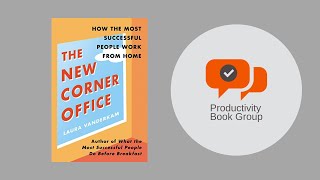
Ray Sidney-Smith and Dr. Frank Buck discuss Laura Vanderkam's The New Corner Office, which argues for managing remote workers by task, not time. They cover five themes: daily rhythms, team building, thinking strategically, and protecting well-being. Concrete tactics include end-of-day email reports, calendar blocking, and tickler-file note cards.
Chapters
Welcome to Productivity Book Group. I'm your host and facilitator, Ray Sidney-Smith. Thanks for listening in on Productivity Book Group's summary review discussion of The New Corner Office: How the Most Successful People Work from Home by Laura Vanderkam. Joining me as usual is our fellow personal productivity book lover and our southern-accented Dr. Frank Buck, the author of Get Organized: Time Management for School Leaders. And he's a regular speaker on time management. Welcome to Productivity Book Group, Frank.
Great. It's great to be with you.
Great to have you with us. And so today we are going to be talking about The New Corner Office, which was published on July 21st, 2020. And so it is very timely and I think useful for a lot of listeners who are dealing with the outcomes of the COVID-19 pandemic. And so what we're going to do today is we're going to cover a little bit about the author. Then a little bit about the book itself from the book matter, the front matter, and then we will get into our discussion on the book itself. So I'm going to lift some pieces from the Amazon author description and the Amazon book description so we all have a little bit of context about who the author is and the book itself. So if you don't know Laura Vanderkam, Laura Vanderkam is the author of several time management and productivity books, including Off the Clock, I Know How She Does It, What the Most Successful People Do Before Breakfast, and probably her most popular book, I think, which is 168 Hours. She's done a TEDx talk, or TED Talk, it says TED Talk here, back in 2016, that is How to Gain Control of Your Free Time, and that's been viewed more than 5 million times. She's been in many publications. She's the co-host of a podcast called Best of Both Worlds with Sarah Hart Unger, and she lives in Philadelphia with her husband and 4 children, and she blogs at lauravanderkam.com. The book itself, The New Corner Office, states on Amazon, quote, Drawing on her 18 years of experience working remotely, plus original interviews with managers, employees, and free agents who have perfected their remote routines, Laura Vanderkam shares strategies for productivity, creativity, and health in the new corner office. End quote. So the book is, is organized in what ends up being 5 chapters. Chapter 1 is Manage by Task, Not Time. Chapter 2, Get the Rhythm Right. Chapter 3, Build Your Team. Chapter 4, Think Big. Chapter 5, Optimize Well-Being. Frank, what were your initial impressions of The New Corner Office?
Well, certainly a very timely book. I mean, she got busy and got this written and got it out while it's, you know, very current event, quote unquote, centered. So my hat is certainly off to her. For that.
It's an—
I found it to be a very easy read, a very friendly read. I think probably a good first read. I know both you and I have read so much about remote work, and both of us have worked remotely, have worked from home for a long time. But for those who are starting out or they're thinking about that, I think it's definitely a good first read.
I agree. I was, uh, I was coming into the book thinking that it was going to have a little bit more structure and methodology, and it, and it didn't. And that didn't actually bother me as much as I thought it would. I thought I was going to be a bit annoyed by the lack of it, but it was actually very practical advice. And I felt like the book provided, as you said, it was an easy read. It was well written, and it had a good flow to it. It had good logic to why she chose one chapter before another, and, and, uh, the sync sequence of those topics, and I felt like the, uh, the interviews she did with people who were working were useful. I would have liked a little bit more rigor there, but of course, you know, like, I don't know how long she had this book in process, right? You know, it seemed like something that was, uh, potentially rushed, uh, because of the pandemic happening and, and the timeliness of it. I, I don't know, uh, but the reality is, is that, uh, the, the number of people that she interviewed, there would have been a little bit of I think a little bit bigger of a discussion had there been more people that were involved in, in it all, and I don't know how many people she interviewed all told, but I just felt like there are certain kind of categories that were not covered, although you made a comment before we started recording about the fact that, you know, she's a mother, a parent, and that really came into it. How did that speak to you?
Well, it adds an entire new dimension to things, you know, for the person who does not have children working from home, you don't have the distractions that you would have at the office. You know, if you're by yourself, you know, and you're not answering the phone and you're not distracting yourself with email, you know, you really are— you're really setting your schedule. But if you're home and there are also children at home, then you've not only got to deal with the distractions just like you deal with them at work, but now you're being distracted by a 3-year-old and that sort of thing, which is well, I want to say worse than the adult. Sometimes it's not, but it's definitely different. So being able to be a parent and carry on a job and do both of those and do them well is a challenge. So I appreciated her point of view on that.
Absolutely. I am a, I'm a pet parent, as you are, I know, Frank.
Yes, am I. Brandon is right here at my feet.
Yeah. And we know the travails the details of working and having a dog, say, barking when the mailman shows up, or those kinds of things, and is not at all comparable to a human life that you also have to manage. And so I fully agree with you. I think it's really helpful to have that perspective, and I think it's something that is frequently not spoken about in a lot of productivity books. And so it was nice to see that addition to it. And we need more female and male parents who are talking about the, the struggles of parenting and being productive with a career.
And one point that she made, uh, just somewhere here in my notes, that good childcare is expensive. So when you're trying to make these decisions, work from home, not work from home, um, being able to bank some of that money, you know, and not have to fork out childcare and getting the child to childcare on the way to work and picking up the child on the way home. That's, that's something, definitely something to think about, even if it means that the job you're doing from home pays less than the job you might have had in corporate America. You're not having to pay for childcare. You're not having to drive from work and the parking fees and the gas and so forth and so well.
Yeah, and that can always be complemented by, say, an au pair or babysitter or those kinds of things, but it's not the full cost of having to always have that child outside the home. Plus, I just, I fully understand and recognize the value of a parent being with the child. You know, there's something very powerful about the bond between parent and child and having that child see their parent. What would be in, you know, hunter-gatherer days, the child would never leave a parent's side, and now in modern life, that child is, is actually away from the parent more often than not. And and other family members. You know, like, one of the big things I always think about is if I, if I do decide to have children, wanting to have those children be closer to their, to their grandparents and to their aunts and uncles. There are a lot— I have a lot of siblings, so there are a lot of us, and I want, I want my children to know their aunts and uncles and their cousins and their grandparents and be able to enjoy that. And, uh, you know, the vast— the nature of, of our The nature of our world being so disparate, you know, we're separated by large distances, is a kind of issue as well. So we all have to take those into account as we're talking about productivity. And I think it's just something that, again, you know, it's just frequently overlooked in discussion. So let's get into the book itself. Chapter 1 talks about talking about managing tasks, not time. What did she mean by that? What did Laura Vanderkam mean by that concept?
Well, one of the big things that I got from it was, you know, when your, when your work is at an office somewhere, there is the structure that's put in place that you're getting in the car at a certain time to get to work by a certain time. There are meetings that happen at a certain time during the day, and it's, it's providing that, that time structure. When you're home You don't have that. So how are you going to plan your day? And so to look at it in terms of what do I want to have accomplished by the end of the day? What do I want to have accomplished by lunchtime? And to plan the day in terms of the things that are going to happen during the day rather than the exact time that things are going to happen.
Yeah. For me, I was, I, I agreed with the concept. I think that it's really actually quite important for us to start thinking about from a management perspective, like business management perspective. We need to start thinking about people from a performance and a results-based perspective as opposed to, um, butt-in-chair time. Uh, you know, that is just a ridiculous notion to begin with. Uh, I remember, you know, back in the '90s, I, uh, pushed my boss to allow me to buy a mobile desktop computer, and it really felt like it because it was a 13-pound, uh, behemoth of a device. But it allowed me to be able to take my work from the law firm that I was working for at the time and go to the beach. I lived in a beach town, and I was able to leave the law firm, go down to the beach, and work on pleadings and whatever else I was writing that particular day and go do my work from anywhere. And it gave a certain level of independence, and quite honestly, I was more productive with the phone not ringing off the hook and all kinds of other things. And while that was still time association, my boss didn't necessarily care about that. He cared about the fact that I was getting the work done. And, uh, you know, I was a salaried employee and obviously billing hours to clients, but he wanted to make sure I was as productive as possible. So he wanted to empower me with whatever I wanted to be productive. And I think so much of— I think so much of our society, um, forgets that fact. And this recent push into remote work, uh, and working from home has really brought to fore, as the, as the author noted, that we are in a place where companies have now learned, whether they like it or not, that their employees can be productive from home, out of sight, not out of mind. And I think that's a really huge piece.
You know, and I think the fear of any boss is, if I let someone work remotely, are they really working? How will I know that they are working and not surfing the web, watching soap operas, watching Netflix, etc., etc. And you can't really measure what the person is doing, uh, it— how many hours they're working. Well, I guess there's certain software that you can, you know, install that sort of thing. But then when it comes to the output, what is the work product? What was actually done? That's very easy to measure. And if that part is acceptable, if the work's getting done, Who cares whether it took 8 hours to do it or 12 hours to do it or 2 hours to do it?
Absolutely. And the only things that I'm concerned about is kind of a little bit— it's more semantics, which is the notion of managing tasks instead of managing performance and outcomes or deliverables.
You know, yeah, because those can be different things.
Yeah, exactly. And she explained it well. So it wasn't that she noted it. It's just the catchiness of the name, managing by task, not time. I get the chapter title, but I do want people to be aware that when she's saying that, she's really meaning managing either projects, tasks, deliverables, and outcomes appropriately, not how long it takes for someone to be at the office for a fixed amount of time, or, you know, as I cheekily always note, button chair time, pun intended. And so, you know, it's always important for us to keep that in mind that we are We are moving into that environment, and that will make some people, um, fearful, right? Because there are certain— there are certain employees who are very comfortable to show up, clock in and clock out, and not really get things done. And, uh, and those people will be— will be, um, shown out. They will be— they will be— a light will be shined on them for being unproductive. But I think that's a good thing, uh, because this will unearth for most organizations that there is a disengaged employee, and why are they disengaged. There are very few people who just want to show up at work and do nothing and then leave. People are usually disengaged for greater, more macro-level reasons, and that allows the company to figure that out. It doesn't mean you need to let that person go. You need to figure out why the organization isn't motivating them to work. That's their job. That's the job of management. So, you know, you need to figure out why they're not working and then, and then do the things that are needed to make them want to to get active, get productive. Okay. Moving right along. I wanted to move into a discussion on Get the Rhythm Right. What does Laura mean by getting the rhythm right? What did you pick up in that chapter, Chapter 2?
Well, again, because your time is unstructured— well, to phrase it a different way, because no one else is structuring your time for you, those ebbs and flows, if there's going to be that in your day, and I think there has to be that in your day, that you're going to have to, to put that in place. When you go into the office, you know, again, there's a time you get out the door for that commute. Now you don't have that. So what kind of routine are you going to put in place at home that sort of gets you geared up for work? You know, we talked so much about— there's been so much written about morning routines. Routines and that sort of thing. So how will you know when you are ready to work? What are some of those morning routines, those morning rituals that are in place? And then bam, booting up the computer, I'm in work mode now.
Absolutely. Vander Kam is speaking my language. This is, this is right up the alley of the things that I've been talking to. I think about this from perhaps a little bit more rigorous a perspective than she does, but I fully agree with her on in the sense that we need to make sure that we are cueing all of our senses into what is going to happen when we sit down to work and what happens before and when we are getting ready to cease work. Work cessation is actually a bigger problem, I think, for most of us who— many of you who are listening, definitely, which is that many of us are workaholics. Many of us are in a work burnout cycle. We overwork and then we burn out and then we rinse repeat. And she talks about rejuvenative activities. She talks about the idea idea of doing work that allows us to be able to both get things done in an appropriate amount of time and showing up to work and then learning how to leave work at work. And that's very difficult when you work and live in the same space, potentially. And so I really— that really spoke to me, that whole notion of finding the right routines in your daily work life.
Yeah, and like so many others, she talks about doing that that heavy work, the work that's going to take concentration, that's going to take time, that's going to take you at your best, to try and do that in the morning. Another thing I like that she said, that those appointments that you have to schedule, the doctor's appointment, the dental appointment, that sort of thing that's going to take you out of the house, to try to avoid midday appointments because it kind of eats up your whole day. You can't really do all that much beforehand. And then by the time you get back from the appointment, well, the day's pretty much gone. Try to have the first appointment of the day. It gets you out the door quickly and you get it over with. You're back home quickly and you got the whole day in front of you.
Absolutely. And I liked her notion about meetings as well. I don't know if that was in Chapter 2 or 3. Was that in Chapter 3 where she talked about meetings and reducing meetings?
Yeah, I know that reducing meetings was discussed. But also the point of having some meetings just so that the team knows who else is on the team, especially when you, when you onboard a new person, you have to have a Zoom meeting where the new person can meet everyone else and put a name with a face and everybody can add that new person to their contacts list and that sort of thing.
Yeah, I think it's really important. I mean, I run a remote company and so I know what that's like and just being able to interact and engage with people is really important in a remote environment. There are just things that you normally would have done in the normal course of an in-person office environment. I've always been a remote CEO in the sense that— not absent, but remote in the sense that my staff was aggregated in one location, but I was always the one who was on the road. And so they didn't see me as much. And so there was a lot of cohesion in the group, and I was the one who had to always kind of extend myself in that same way. And so I know how my staff feels in the sense of they feel always on the outside if they're coming into an environment where they don't know everyone else. So there needs to be socialization, there needs to be socializing, and there needs to be opportunities for us to get together in person throughout the year. That hasn't been possible this year, but, you know, in future years when we are back to hopefully normative travel and normative in-person event times, we want to be able to have those kinds of team cohesion and team collaboration opportunities in person. It's actually one of the reasons why the remote company is— everyone is pretty much geographically based around each other. Even though we don't get together in the same office, they're still pretty much in the same general area. So I'm the furthest one living away from everyone in, in the DC metro area. I'm in Pittsburgh. And so, you know, I travel to them, but we can meet in person. It's not difficult for them. But I think that's really also very helpful is to think about, yes, you could have people all over the country, potentially all over the world, but it actually is really helpful to have a remote team that's actually situated close to each other, even if they're not getting into the same office every day. It's really helpful to be able to get everybody together in person without them having to travel to long distances. It could also be fun, right? You could do company retreats where you go off to Tahiti or to Hawaii or whatever. And I certainly, I want to do that. But, you know, but the, but the goal is, is to get everybody to have these opportunities to interact with one another so that there is good team, you know, team building activities and exercises that can be done.
Yeah. One thing in the chapter, again, you're talking about the idea back in Chapter 1 of managing by task instead of by time. Just at the end of the day, everybody just send the boss just a short, very short email. What did you accomplish today? Yeah. So it keeps the focus on What did I do to really make today count for something? How am I moving forward on goals? Rather than I went to work, I put in my time.
Yeah, absolutely. In Chris Ducker's book about virtual assistants, he talks about this daily email that he requires his virtual assistants to send in order to every day get an update in terms of what they've accomplished today to keep them accountable to things. And it's kind of that same notion there. And I've, I've taken to doing that myself. I actually send myself an email at the end of every day. Where I actually, you know, tell myself what I got, what I got done. Because many times I'll end the day, you know, I'm, I'm in meetings, I'm running around, I do a training, I record a podcast episode, I do a live stream, I'm just all over the place. And then at the end of the day, it's, it's, it's me not knowing whether or not I actually accomplished what I wanted to accomplish. And because I'm, I'm in the doing stage, you know, I'm in, I'm in the weeds of it, and I've planned out my week ahead, but But it's just nice to feel that motivation at the end of the day where I've kind of like put together a calculation of all the things. Mine is automated, but others can do it, you know, in other ways. But I just get an email at the end of the day, and it's really nice to be like, oh yeah, I did all these things. Good on me. I got— I hit my metrics for accomplishment. And you know, it's not something that I'm, I'm the boss, so it's not like I get a pat on the back from my CEO. I really actually think my CEO is a jerk, at least to me. I'm— the CEO is actually really nice to the rest of the staff. But I'm pretty mean on, you know, I'm not mean. I'm just, I'm tough on myself. And so it's nice to have those opportunities to get a little bit of a pat on the back from yourself in whatever way, shape, or form you feel like it's appropriate. And that's really important. She made, she made some notions about— go ahead. And then I'll—
Yeah, I was going to say, you know, that reminds me something that I do, whereas you get an email that's reminding you of what you did during the day. At the end of the day, I get an email from myself if This Then That generates that asked me what I did today to make today count. So it asked me that question. Here's just a little, a link, click the link, takes me to a Google Form that asks that one question. I answer that question that then goes into a Google Sheet. So now I can look back over the last months, years, to see what have I been doing that's really pushed goals forward. Justified my existence on the face of the earth.
Absolutely. And that's one of the things I do with the Marshall Goldsmith questions. If anybody doesn't know Marshall Goldsmith, he's authored many books, but my favorite of his is Triggers. And he talks about his, you know, whatever it is, 13 or 20 questions he asks himself every day. He has someone actually call him. His accountability partner will call him and they will answer all these various questions. And I do something very similar with a Google Form. I go ahead and answer those questions at the end of the day. And it's just a part of my closing out process. It's not an email, but the goal is of course to do what you're talking about, which is just tracking, are you doing the things that create integrity in your life? And that's really important as well. Switching gears a little bit, you know, back to the meetings point, she really talked about the idea of reducing the number of meetings, and for me it actually is probably quite the opposite. And so I wanted to give kind of a different view, which is that I have particular times of my life, you know, calendar blocked out so that I have, you know, time to do focused action. And so I want to, I want to have those times in my calendar to get that work done. On the other side though, I actually want to have meetings with anyone and everyone that, that wants to meet with me. And so it depends on what role you have in an organization, but I am very much about being prepared for meetings. At least that's the standard of excellence that I want to be at. And so having a meeting in the calendar means that I then know, okay, I need 30 minutes prep time and I need 30 minutes or 15 minutes debriefing time after those meetings. And that allows me to actually structure, uh, the, my days better. And I'm never caught off guard. You know, if I'm having a conversation with a client, I have prepared for that client meeting because it's in the calendar.. I don't just get phone calls from clients. You know, I'm not 911. I'm not emergency services. If there's an emergency, you dial 911 and you go get legal, you know, law enforcement, medical, you know, whatever care you need. But otherwise, you know, there are very few circumstances in the world where I need to just pick up the phone and talk to a client. It usually requires for me, and I could be very different from how you operate, But for me, it's I need to prepare for the meeting. I then have the meeting, and then I have usually actions or follow-up from the meeting. And that has allowed me to say to clients, let's just book 10 minutes, 15 minutes in the calendar, but now we have a productive meeting. Instead of you calling me, I answer the phone, you've interrupted my focused action session, and now I answer your question haphazardly, or I say, sorry, I don't know the answer, let me get back to you. And now we've played all of this, all of these games back and forward, to get the answer that would have been if we just like got into my calendar, schedule 15 minutes, then I would have known that was coming and we would have been able to solve the problem in one concentrated period. So the, the, the point is, is that we're all different, we all have different workflows, but for me, uh, calendaring and having those times filled in as actual meetings makes me more productive. And it may not for you, and that means reducing, especially if you have a calendar where you are constantly in meetings, uh, and you know, I'm, I'm I'm, I have a very full calendar every week. You know, part of my job is, is doing business advisory services. So I am in meetings back to back to back with clients. So I understand that, but there's some other level to that that is actually very comforting for me, knowing that I've prepared for each of those meetings because as they get scheduled, then my system automatically creates the right actions for preparation, right? I'm going to get a little remember the milk automation that's going to create a task that says you have this meeting upcoming, you need to prepare for it. Here goes the amount of time needed to get that done. And then I I can go ahead and do that. It's very, very easy for me. And especially when you're working remotely and you don't have, you know, my assistant is not here in my home to follow up with me on these things. So it's really nice to be able to sit and then see those things pop up on the schedule and then just be able to get them done so that you're prepared for those conversations. So just know your work style and experiment. There's nothing better than experimenting and saying, you know what, for one month, I'm just going to have, I'm not going to take any phone calls. Everything's going to be booked in the calendar. And then maybe try a month where you just have a block of time, you know, between 9:00 AM and noon on Mondays. Anybody who has a question, call me at that time and I'll talk to you. See if one or the other works for folks internally inside the organization. I'm not talking about with clients, but, you know, you can have that kind of experience and see whether or not one provides you more productivity than the other. Yeah.
OK. That's one of the things that was mentioned in Chapter 2 that talked about the teams need to work out communication rules. So whether that's, you know, when do you email versus a text message versus a phone call, or just how do we get together. But just working through that rather than just doing it haphazardly.
Absolutely, absolutely. Anything else in the team building chapter, and also about Chapter 4, thinking big?
Gosh, let's see. Building your team. Aim to send a note each workday to someone. Just forming that habit, then, you know, over the course of, you know, however many workdays during the year, you've sent that many notes because most of us send no notes ever, especially if you're working remotely, you're not seeing that person on a daily basis.
So yeah, I've been, I've been doing that for quite a long time. There's a book, 18 Minutes by Peter Bregman, and he has the little end-of-day routine. It's just 5 minutes. And one of the activities he talks about is, who do you need information from? You know, who owes you something? Who do you owe something to? And who do you need to thank? That kind of thing. And, uh, and so I've modified that over time. I'm not getting his questions quite right, but my questions are in that vein. I like to just know, okay, what, what are things that I need to share with my team, uh, with people around me, and just sending those little notes. And I've gone a leg up on that, which is I use a service called Postable, which allows me to type a message into a digital environment, and then it, you know, has different fonts and scripts. I use the handwriting script just because, uh, not that it's still printed, but you know, it's just nice to kind of make it look like it's handwriting. But it will actually print and mail a note card to people, and I use this for birthday cards and for holiday cards and all kinds of things. But I will also use that for thank you notes if I've, you know, had a virtual— now virtual coffee with a friend or a colleague. I will then go ahead and go into Postable, just write a quick note and thanking them for whatever else and blah blah blah, click send, and then it's off and running. And it's a couple bucks and it's just a really great way to do that part. I need to do it more, but it's a really nice feature that you can just do, and it just takes a few minutes and really makes someone's day getting—
Oh, absolutely. Yeah, yeah. And for those that are more pencil and paper, you know, I'm a big fan of the old tickler file. You know, even though I'm very digital, we all still have paper in our lives and need some way to manage it. So in my workshops, when I'm, you know, I always talk about about the tickler file, and a lady at one of them said, well, I've been using the tickler file. Let me share a way that I use mine. And she said, I always want to get better about thanking people for things. So one January, I bought myself 52 blank note cards and matching envelopes, scattered them out through my tickler file so that about once a week, a blank note card would appear, and that was my trigger to stop and write the note because, you know, We think about these things all the time, but we never think about them at the right time. You know, we never think about thanking somebody at a time that where we have a couple of minutes and the tools at hand to do it.
So, which I thought was kind of neat. Fantastic. Yeah. And so to round out the book in chapter 5, she talks about optimizing wellbeing. What were some highlights from the book that you thought were interesting about optimizing wellbeing?
Well, you know, you've just got to make it fun. You know, having a good pen, I think that was one of the things specifically mentioned. Just having that pen that just feels good in your hand and that you're proud to own. I think you've talked about some of this kind of stuff in your life. Having a nice, you know, a nice desk, you know, just having a place where you're comfortable something that makes you proud so that you're looking forward to work each day there at home.
Yep, absolutely. I can't agree more. I think we talked about this a little bit at the top of it, but I think that all of the senses need to be engaged in the context of work. And that also means that you can actually create contexts that are optimizations for well-being. So for example, you know, when I sit down for my GTD-inspired weekly review, you know, I have I have the right drink. That's only for when I'm doing my weekly review. That gives my olfactory senses the trigger that this is weekly review time. You know, I have the same things that show up on my desktop screen. You know, I have automations to bring up those pieces. I want to make sure that I'm in the right location. I've got the right kind of mood, you know, so I'll listen to the right music. All of those senses tell, you know, trigger your brain to know that it's time to do a type of work. And they can also be good for your well-being, which is to help you relax You know, like if I sit down to a stressful— through a stressful meeting, afterward I will want to do something that will help to reduce the overall stress impact on me. So maybe I'll watch a quick video. I've been recently watching Facebook Watch has a remarkably— I don't know why or how I found this, but they have this little comedy channel, and I will just watch a few minutes of a stand-up comic just doing a little bit of comedy, have a little bit of belly laugh. You know, it's just 5 minutes. It's like in the midst of a Pomodoro kind of thing, you know, just a little break. And that little bit of laughter really helps me kind of snap out of, oh wow, that was a tough meeting, or that was just really stressful. Even if it was a good meeting, it was still a lot of stress getting through the meeting. You know, sometimes I'll have a 2-hour meeting, you know, it's a big strategic meeting with a client, that kind of thing. When I'm done with it, I just need to like disconnect for a few minutes before I read associate myself and gear into the next thing. So I'll do my debriefing, and then I'll just take 5 minutes and just watch something, laugh, laugh it off, and then move on. Right? So figure out what the things are that help to rejuvenate you. Right? And she talked about those rejuvenative activities. Really figure out what rejuvenates you and do those things. I think it's one of the biggest missing elements in productivity, which is that it's not just the, the lucery attitude related to games and fun. I know that there is some, there is a value to that in gamification, but it's actually the qualities of expending energy that actually helps you create more energy. It sounds counterintuitive, but by expending that energy on things that you may not see as directly related to work actually help create the boundaries and the space for your brain and body to recover from the work of work's work. And so I really, I think it's something that it's good that she paid attention to it in the book, that she closed out with it as being its own chapter, and that we all need to focus on our well-being, especially in this time. Any time is important, but especially during this time where we're dealing with this global health crisis and we're all kind of in this environment. And I think it's important for us to take heed to our potentially unconscious, the impacts on us from stress that we're just not potentially aware of, right? We're feeling the sense of it. And I know that I'm fairly stressed out attuned to that stuff, so I get a sense, a feeling of the fact that we've lost many lives, and so I feel that more maybe than the average person. But even if you are not that conscious of it or aware of it, you're still aware of it. There's still a lot of struggle and strife, and there's a lot of division right now, at least in the United States, and you can focus on that or you can not focus on that, and I would suggest you not focus on the division and focus on the things that connect us, But that's also a type of self-care, right? That's also a type of good well-being practices. So I think that was just a really good piece there. Any final thoughts? Any other big-ticket items that you wanted to talk about regarding The New Corner Office? And then we'll talk about whether we'd recommend the book.
No, I think we covered it well. I didn't have anything else.
So with that, that, would you recommend the book? And to whom? Who's the person who belongs with their, their eyes between the covers? Okay.
And we talked about this a little bit at the beginning of the chapter, but over the beginning of this session, I think the person who this is their first remote work book, and for the person who is a parent, especially a mother, because Laura, of course, has that role, and I think did a very good job of giving helpful advice on handling it.
Yeah, for me, I think that this is a really nice refresher for someone who has been working from home for a while and maybe has fallen into a rut. You know, they feel maybe a little bit of a rut there. And, and then definitely the category of people that you are— you talked about new, and as well as the parent who is is now, you know, forcibly teacher's assistant plus remote worker plus parent, you know, plus cook in the house, you know, all those kinds of things that have come about.
You know, Ray, one thing that does come to mind, and I just actually had this thought right now because I've read some other things that Laura has written, I've heard her TED Talk, I'm fairly familiar with her work, and she's not a real techie person. Person, you know. So for the person who's working from home and they're not as deeply into tech as you and I are, I think they'll find Laura's refreshing.
I think you're absolutely right. She didn't dwell on the technology. She dwelled on really the human principles and the, and the social principles of being productive in a remote environment. And that was really good for her to be able to do. It also makes the book somewhat timeless, you know, because it didn't really focus too much on— I mean, she mentions obviously the timing of the writing, but she doesn't really lay into a lot of the features that will be, you know, remarkably timeless in the book itself. So appreciate those thoughts. And so with that, we have reached the end of this book discussion about The New Corner Office: How the Most Successful People Work from Home by Laura Vanderkam. And so thank you, Frank, for being here with me.
Always a pleasure.
Thank you. So I have a few comments and announcements before we end this episode for you, so let's get through them. First and foremost, thanks again to Dr. Frank Buck for joining me here on Productivity Book Group. He helps to make these book reviews engaging and fun, and so feel free to check out his work at frankbuck.org. Please note that we host quarterly live discussions of personal productivity books, so just like the one we discussed, you're invited to join us in those live discussion calls if you go to productivitybookgroup.org You can go ahead and visit the upcoming books page for full details. Directions on how to subscribe to Productivity Book Group is on the website. You just click on the subscribe page and you can go ahead and find Productivity Book Group in your favorite podcast app. And then know that you will get the podcast episodes delivered when we put out new episodes, which, you know, there's sometimes distance between the episodes because we're reviewing books or having discussions and that kind of thing. That if any are missing from the podcast feed, you can always go to productivitybookgroup.org and find those episodes on the website itself, because sometimes some podcast directories will only hold X number, but you can always go back into the website and listen to those. Finally, if you didn't know, we have a digital community where we can discuss the books we're all reading. So you don't have to fit necessarily to our schedule per se. You can access it on the web. There's an Android and iOS WhatsApp, and we're happy to have you. So if you go to productivitybookgroup.org and click on community, you'll be taken over to the new digital community to join. You just click on the join button, fill in the information, I'll approve you, you'll get an acceptance email, and you're in. And then you can post books you're reading, give recommendations for future reading selections, and all that other fun stuff. And so with that, thanks everyone for listening here to us for Productivity Book Group. I'm Ray Sidney-Smith, and here's to your productive life. Take care, everybody.
More from Raymond









The Checklist Manifesto by Atul Gawande MD Productivity Book Group Made by Headliner

First Things First by Covey Merrill and Merrill Productivity Book Group Made by Headliner
