The Scientific Problems GTD Solved, Ignored & Spawned with Francis Wade Getting Things Done DC
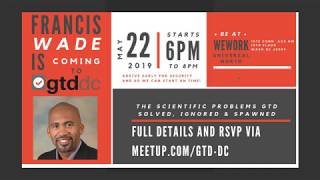
Francis Wade examines Getting Things Done through science, showing how it solved the Zeigarnik effect but lacks empirical research. He argues GTD's original process is outdated for mobile and AI work, proposing instead small, continuous improvements informed by self-evaluation and Kaizen principles.
Chapters
My name is Francis Wade. I'm the president of Framework Consulting and an organization called 2 Time Labs, where we focus on time management, time-based productivity. And we use a lot of research to do the work that we do. And it's a pleasure to be here. I'm here from Kingston, Jamaica, just visiting the DC area, doing another conference. And Ray broke my arm almost to try and get me. Actually, I told him I was coming and said, why don't we do something while I'm here? Came up with this idea. So it's a privilege to be here. Um, in truth, this is a talk that I've been thinking about giving for ages, just haven't had an audience really to listen in. So it's a pleasure to be here. I'm now trying to advance the clicker, but nothing's going on.
Try now.
There we go. Okay, so the scientific problems GTD solved, ignored, and spawned. So I want us to go back in time to that original moment when you were first exposed to GTD, where you picked up a book in maybe a bookstore, or you heard about it from a friend, and over time you began to be inculcated in a different way of thinking. Some of it may sound Sounded different, but much of it started to resonate with you, and you felt this sort of thrill of, oh my God, I've been looking for something like this for a long time. Because most people who pick up GTD have been thinking about becoming more productive for a while but didn't know that anyone had even thought about the problem enough to be able to answer it. So there was that, that feeling of aha, and that feeling of being understood by its author David Allen of being appreciative of being gotten. That yes, he gets me, and he not only gets me, but he's gone a step further. He's come up with a whole bunch of ideas and thoughts, and some of them are maybe things I've even thought of myself, but he's put it together. And not only has he given me a new way to think, but it actually works. So I actually put in place these new behaviors and No, my life is actually better. So there's a thrill of learning, there is a thrill of adding in new knowledge, and there's a thrill of a behavior change— three elements that don't often come together for us as adults. So if you can go back to that moment, my talk is really about returning you to that moment, because once you've read GTD— and maybe some of you, how many have read it? More than once? Everybody.
22 times.
Literally.
I just finished my 22nd time. It's a little scary. But once you've read it and started to implement the ideas, the question is, what's next? How do you return to that original feeling? So it doesn't happen the 22nd time.
—It comes to yourself. I hope not.
But how do you get back to it? And the truth is, the book doesn't give a whole lot of clues about where it either came from or where you should go in the future. There's not a whole lot in it about, here's the body of ideas that I built up over time, here's how I did it, here's the research I did, here's the plan that's hopefully— there's not a whole lot. It's just given as a solution in time. So you're left having to sort of put together the histories and also to look to the future if you want to re-experience that thrill. So how can you do that? What we'll be talking about today, because the book actually did a great job of protecting us from the nitty-gritty. So if you're not in academia, you may not know that there are few academic studies around time-based productivity or personal productivity. The few that exist cover multiple fields. So the ones I have here, which are not even complete, is engineering, psychology, physics, philosophy, learning, and then there's more. And if you were to dig into them, you'd find bits and pieces of things that when put together could look like GTD. What GTD has done, J. Allen has done, is to protect us from the mess, the academic mess that exists below the horizon. Now part of the reason why that mess exists, I'll explain in a minute, but for the moment, let's just take the case that these are multiple disciplines, academics don't work well together across disciplines, they stick to their knitting, and when you ask for complex solutions across multiple disciplines, if you're an academic, if you go into those areas, you do so at your risk. Because you may lose all of the benefits that come from specializing in an area in which your peers recognize your expertise. The minute you start talking new stuff, people start looking at you funny, and I'm questioning their commitment to the field, to be honest, because me, an academic, would have been unlikely to produce GPB. It's also why most people can't quote an academic who specializes in personal productivity. Many of them write one paper and move on to other areas because they feel a backlash. So since the book was written, however, the world has changed. 2001. The— I consider the 2015 edition to be a mild upgrade, changing some of the language, some of the ideas. Adding in some of the science, but the ideas sort of have remained the same. What's changed since then is that you are probably managing more tasks than you did in 2001, probably more than the average person did when the book was written, because the book was written right just as soon as we were going into mobile computing. So most people were using paper at the time.
Might be true today.
But certainly we're more mobile-driven and more cloud-driven. We have artificial intelligence, which is now impinging on our attention, at least we talked about it today, today's meeting, as a technology. And these are likely to combine to change the way we do our work. Now, GTT hasn't really changed. So the question is, what's next? There's got to be a what's next. It has to be— you have to get to the point where you have gotten all you could get from GTD, and we'll explain why, and ask the question, how do I respond to the new pressures that I have? And in particular, what we'll focus on today is how do I respond to more tasks? So there are a bunch of people who have filled in the gaps for us. I can't vouch for any of them, but they This is a small sample, by the way, of all the people who have said, okay, here's what's next. And they've built on the popularity of the book to try to spin off the answer to what's next. And here's what you should do after you read GTD. You can see a lot of them use nice, good expletives to sort of drive the point home. I don't know. Um, but the reason that they are sort of all over the place and they're not coherent, they're not built on research if you read them, is that there is no roadmap that includes the philosophy and the principles of GTD in its entirety. I'm going to present to you a bit of a roadmap today around one area. Now, I'll offer to you a way to think about GTD in the context of all the stuff that went before and all the stuff that's about to come afterwards. And I'm hoping that as you consider what I say, it'll give you some shortcuts, that you won't have to go through all those books that I just mentioned and a whole bunch of blog posts and every podcast that says it's about GTD, that will give you a short way to get to your next improvement or to the next thrill. To the next feeling that, oh, I'm learning something, I'm applying it, and it's making a difference. So that you can continue the loop without having to spend a lot of time, a lot of money, a lot of effort trying to find where the next improvement comes from. Okay, so you wouldn't fail. So today you may be perplexed about what's next, and We're trying to use the Pareto kind of thinking, which is that let's find the smallest change or difference that you can make that would produce the biggest effect. So I'm trying to get to by the end where and how you can find the next improvement or the next thrill of moving yourself to another level. To do that, we're going to need to go where GTD didn't go, pretty much. We'd have to go to the background that was there before, but also to recent research that has come up since then. But let me ask you a question. Why should we care about the science? I really have to ask this question because nowadays there's lots of people who say, "Oh, science isn't important. Who cares?" We just do. But why is it important to go dig up the studies? Well, it's an empirical method that people have used as methodology to test things out. So there's a methodology which is different than anecdotal, right? Right. Because as far as we know, as far as I understand, David Ivey got his approach based on consulting with multiple clients. He hasn't presented any data. I don't think he plans to present any data that is empirical, or— so that's one reason. What's another?
So you can compare your results to whatever the scientific community is, so you can see how you're doing, measure up.
Right, so you can actually form some basis of objective comparison. Yeah, so you could know, because there are parts of GTD that don't work for everyone— not for everyone, for certain people. And they don't know why. And they can't tell why because there's no breadcrumb trail to go back to say, here's where it came from. They say, oh, that doesn't apply to me because I'm different, because— so if you don't know where it comes from, then you can't make fine adjustments. What's another reason why it makes sense? Well, just the follow-up is that knowing why things work, not just what the system is to work, helps you when there's a changing situation, right? So, in the future, if we do have, you know, the changes like you're suggesting, we might be able to adapt better. Exactly, Mendy. So, it puts in your hands your own system. So, there's a subtle shift that I suggest today, away from following a prescriptive set of behaviors, to scripting your own. Away from mimicking a prescription or a set of behaviors listed in the book, or David Allen's behaviors, towards doing your own, deciding on your own. But just like Ray said before, if you don't understand how a car works, you don't have access to getting into the car and doing anything about how it works. But if you understand how your own time management system works, its strengths and weaknesses, which unfortunately means everyone understanding their own differently from the person sitting next to you. If you understand it at that level, then you're really the only one who can make the changes that are required in the future. Now, that kind of understanding is where we're headed, but having academic studies helps. And the other reason is that academic studies are based on hundreds and thousands of subjects. Just the sheer number allows you to test certain ideas and at scale, hopefully also across cultures. As somebody who's a flip from Jamaica, I can tell you I come from a very different culture. Certain things work really, really well here that don't work once you get on a plane and come off on the other side. But having large numbers of people testing the same ideas gives you at least a way of comparing and saying, okay, it works for a large number, it's more likely to work for me. So today we're not going to attempt a full analysis of— I'm not going to do a complete every nook and cranny because that will go beyond the amount of time Ray wants me to talk for. Instead, we're only going to focus on task management and use the ideas from my book Perfect Time-Based Productivity. So our focus with respect to task management is what are the problems GTD solved, didn't address, and then flip or spawn for us to solve pretty much for ourselves. Ready to jump in? Ready. All right, so here's one problem, massive problem that GTD solved, which the academics probably couldn't solve on their own, was that if you look at the— let me ask, are there any engineers? Am I the only one? Today, yes. Okay. But engineers think in terms of measurable output. And when you think of a system, you think of, okay, this is like a mechanism that produces measurable results. So the typical results that a process produces of any kind tend to be the output, how much does it cost, how many errors are produced. Satisfy the recipients of the outputs, or in other words, the customers. Those are measurable outcomes. No problem in measuring those when it comes to factory equipment, for example, which is what I was trained to manage and to learn and understand. What David Allen did was to connect physical action to a psychological result. No, that's— that was a leap. And to do so effectively, that was a huge jump at the time, to say that you are producing something like peace of mind because you are managing your tasks effectively. I mean, that's like saying, okay, well, management and engineering produce a psychological result. So imagine getting 3 people from those disciplines in the same room to try and sort this out. They probably wouldn't. But he made the job, and he's given us all a way to think about being productive that was very different than the ones that came before. Before, it was all about cranking widgets. You know, how do you spend as much time of the day in each day working? Okay, slip in even more time. How can you get more stuff done? And he said, it's nice to get more stuff done, but the real result is mind like water. So of course academics, this is like a big problem, and none of them that I've read— I've read a few hundred papers— they don't even begin to address it. There's only one that actually refers to the work that he's done. I think it's because it's just too hard. They have to become experts in other areas that they're not interested in being experts in, and they've moved on. Even books that focus on Pan-Africanism— I'm sorry, papers that focus on time management. By the way, in academia there's no real conference in time management. There's no journals. And for something that we all do every day, this is kind of an outstanding fact. There's no labs in any universities. There's no departments. The odd paper gets written now and again. You have it? Yes. Yes. Yes. Yes. Yeah, yeah, yeah, within our lifetime.
There was somebody just entering the room for some reason. I thought I turned off the bells.
Keep going. Okay, okay. Um, anybody here heard of the Zaganik effect? Yeah, yeah. Okay, so, uh, Bluma Zaganik was a Russian researcher, and you can read what you said there. And essentially she said that when you start a task and don't finish it, your unconscious mind keeps reminding you that you haven't finished it. So it'll wake you up in the middle of the night and say, hey, did you finish your taxes? So it'll keep sort of nagging you and up until 2011, it wasn't well understood that there is a way to get beyond that. And it was by work done by Ed Masicampo and Roy Bowmeister. Yes, thank you. Bowmeister. Bowmeister. Yes, University of Florida. And what they found was that there's a Gargnic effect, that pinging or that nagging sensation is nullified by making some plans for tasks. Does that sound familiar? How come? It's David Allen. Yeah, it is, isn't it? Because he made the point a decade earlier, without data or proof in an academic sense, but he made the point that, like water, trust insists Put your task in a trusted system, and that frees you from this— he didn't even name the Zygarnek effect either, but it frees you from feeling overwhelmed. So people think that what makes them overwhelmed is that they have too much to do. And Bluma Zygarnek and his later researchers say, no, it's not the volume, it's the fact that they aren't being managed. Well, now this produces some weird effects. Like, for example, I was explaining to someone today that a 10-year-old could have the same nagging effect that an executive has, even though the executive has hundreds more tasks to complete each day. The 10-year-old might have two. I have my math homework and I have my English homework. Why? The same— well, let me ask you. Why could they experience the same lagging effect? Well, they both have the same brains, and it's structured the same way. So yeah, so yeah, and if they're both not managing their tasks, they're gonna get the same result. Same result. Yeah. So this, so this is weird, right? Why would a 10-year-old have the same— a 10-year-old who has no responsibilities in life, for example, have the same symptoms as an executive who has, a multi-billion dollar company to run. Now if someone just looks at it from the outside, they would say, oh, same symptoms, same treatment, right? But it's not the same treatment, as we'll talk about later. Those are two same symptoms, two very different worlds that these folks are in. But it fools people, some academics too, who think that a symptom is a symptom because they don't understand the engineering of task management, which we'll talk about. So, second problem that GTD solved is that of the connection between A Mind Like Water and what we are now calling flow, which preceded GTD, but deep work, the deliberate practice. The idea is that— the idea that you can give yourself over to your task so completely that you get lost in it. And that is your moment of highest creativity, productivity. That is where you produce your best work, where you're able to completely become one with the task and not ever be interrupted and not interrupt yourself either. So David Allen solved that and spoke to that by, by again raising the primacy of having this mind like water, mind that is clear. A mind that is uninterrupted and undistracted by incomplete tasks or tasks that are not being managed well if they are incomplete. And the third, third problem has to do with the history of quote-unquote time management. All right, so the This is a knotty, thorny problem. Um, but there was a very popular book by Alan Lakine called How to Get Control of Your Time and Your Life. So it came out in 1979, I think, but that book wouldn't fly today even though it was a bestseller back then because we, we kind of know that you can't control time. That's— that was an Back to the Future or some other movie that we saw. Control of time is not possible on an individual level. Wish it were, but it's not. However, shortly after he wrote his book, Therese McCann wrote a sort of a seminal work in the time management literature called Test of Process Model, and it came out in about 1990. I should have the year there, 1 or 2. And it was interesting that she used the word process because she didn't actually describe a process, not the way that we understand a process, which is a sequence of activities intended to produce a particular outcome, a real activity. So if you read the paper, you get to the end and you say, where's the process? She didn't describe one. But the term, if you remember back to about 1991, Most of us were.
Some of us weren't.
Maybe some people weren't born yet. Some of us weren't born. But at the time—
It was 7 Habits. Yeah, I think you're right. Yeah, I think I read this book just about that. But the TQM movement was very much in ascendancy, and this book came out. So Michael Hammer wrote The Definitive Book on Reengineering, which was about process change. And the word process started to be talked about in every company, and it was— it became synonymous with layoffs later in the late '90s. By the time she wrote her paper, it was about following a pro— following a process. She used the term, didn't follow the process, but he did. And what happens over time— happened over time since Hammer did his work, and also Deming and Juran, other process gurus was that we have become a process-minded world as a result of the work that they have done. So why is that important? Well, David Allen came out with GTD in 2001, and he took all of the learning around process and applied it to time management for the first time. So this I mean, today we take it for granted, like, yeah, yeah, yeah, we've seen it all. But when it came out in 2001, this was a huge innovation. This was a huge jump in thinking. So he took what had been building for the decade before and then said, this applies to personal productivity. And he laid out the process. I mean, it's easy, like I said, to take it for granted today, but This was a huge innovation. So I was in a similar spot myself, teaching a process in 2001, 2002, not through GTD, but through a different discipline. And essentially it said similar things, that you need to follow a certain set of steps in order to be productive. And somebody had figured out the right steps to follow, and your job was to follow them. And in that particular case, there even was a new terminology you need to use. It redefined certain basic words like now. You had to understand them in order to follow the system. You had to. It was very restrictive. Anyway, so I took the program to— did it here in the States, took it to Jamaica, led it in different places. I was a licensee. My mom took the course. A few months later, I followed up with her when I visited the next time and said, Mom, what did you think of the course? Are you using the stuff I gave you? And she said, no, not really, no. I said, why not? She said, well, it's not for me, not really, it's peaceful, it's not my thing. I don't have kids, right? So that's cool. Closest I could come to having a baby. Asking my mom, doesn't my baby look cute? My mom saying about my baby, my baby's ugly. The thing I believed in and said, no, no, you should— no, no, dad, no— why she was wrong, blah, blah. Like a good mom, she smiled, like, waited until I ran out of steam, and then she didn't even argue back or anything. But anyway, it stuck with me, and I realized that there's a limit to teaching people and wanting them to follow a given process, to prescribe for them this specific of steps they need to take. It works, but so much. And then, so the— and then it's now 2019, and there's a consensus that's emerged since 2001 when the book first came out. So one is that following someone else's process is really hard when it comes to behaviors. We have a tough time doing it. And many people pick up GTD, pick up on the number of new behaviors they'd have to implement, and then walk away as a result. Or any other process for that matter. Why? Well, we all want different things. We come to it with different expectations. We come to it with different methods. Any process someone tells us to do that's personal So the result is that we all cherry-pick. So I've been hanging around GTD communities for, I don't know, however long, and everyone is in the process of refashioning GTD to their own. No, it's not that there's something wrong with GTD. This is a human process. It's the human thing is to humanize. Someone tells you to do A, B, C, D, and you need to go, yeah, but I like F. I like B. I don't want to do A. So it's just normal. So everyone knows that pretty much GTD is cherry-picked by the people who tend to implement it. Maybe there's one person in the world other than David Allen who— but it seems that's unlikely because we're human. When you ask people to make lots of changes at the same time, they choke. So I have a hypothesis that's not proven that when people pick up GTD, the ones who implement it effectively are the ones who are already halfway there before they pick the book up. And the ones who have a really hard time are the ones who weren't, because when they try to implement too many changes all at once, they choke. And the book is more on the idea, on the notion of how you implement Just says go implement. Here is the final solution. And the fact is there's no such thing as a one-size— I think we could agree to that at this point, 2019. There will never be a one-size-fits-all behavioral system that gets to any level of detail. Maybe higher level, perhaps, but that level of human behavior which you can observe someone's behavior and put it on a video camera, no. We're all going to come up with our own. So, given the consensus, what should we do about it? And how is GTD responding to the fact that this is an emerging consensus? So here's where we get to the ignored part. It's a strong word, but it's more like responded. So GTD hasn't said, David Allen hasn't said, okay, I'm responding by changing my approach. He's kept the same process in place with a few tweaks. Few tweaks here and there. So it's not likely that it's going to change much, if at all. Where the change would happen is among the practitioners, the people who have benefited from the book and then now want to go another step, take it to the next level. So I'm going to run through some of the cases where it's been— some things have been ignored. So that process that was outlined starts with stuff. If you ever read the book, you know, but nobody here has read the book. He says stuff. Yeah, okay. He says stuff, and there's a deeper way to look at the stuff that we now have access to. It's just developed in the last couple, in the last 15, 20 years. That there's two kinds of memory. One is retrospective, which is historical memory. The other one is called prospective memory, which is about the future. We're all concerned about prospective memory. And here's a definition that we've introduced at Two-Tam Labs from about the late 2000s. And that is that of a tandem hand. So Time demand is an internal commitment that you make to yourself, a self-promise to complete an action in the future. So if right now you decide to pick up the milk on the way home, that's an example of a time demand. They're all discrete, separate from each other. They're not said necessarily or written, but they're all internal. They all include your agency. And what makes them different from a task is that a task By the dictionary definition, it says it's a piece of work that's been given to someone, a job for someone to do. The difference is that a time demand always comes from the inside of you, never from outside. So we sometimes say we task somebody to do something. A time demand always comes from you, so you have full responsibility for every time demand. Second piece that's you've put together is the idea— and this comes from a whole bunch of research into child psychology. Yeah, so it's the fact that we're taught the concept of time. Well, that word says discovered, but the truth is that we're taught it by someone else around the age of 7 or 8. A little bit later, we create our first time demand around the age of 10. A little bit later, we start to try to preserve the time demand by trying to remember it. And the way we do that is by— I have to remember to do that— because we start to make the connection between preserving time demands and completing our commitments or getting our goals fulfilled. Somewhere in our later teens, these routines turn into habits and practices. Most people graduate from memory and they go to using paper, but of a certain age. Most of us did that because that was how we grew up, and eventually we have a personal system that is built on— built for managing these commitments that we make to ourselves, these time demands. So the reason GTD resonates so deeply is that by the time someone steps into a class, they're already managing time demands. They already have a method, even if it's memory-based. So when, when they read the book or take the course, I and it says capture, clarify, organize, reflect, and engage, there is a level at which they're already doing it. They wouldn't be functioning adults if they weren't able to manage time demands. They wouldn't be able to do their homework, to get through school, to da-da-da-da-da-da-da. So the average person already has some working at some level of everything that's in this process. Now the challenge is that it's all hodgepodge. And they don't know that they're doing it. It's all unconscious. And they have no idea how well they're doing it, and they're experiencing all these symptoms that they don't want. So learning GTD from a practice point of view is really more about matching it to what I'm already doing, more of a pattern match. Let me ask you real quick, when did you start putting together your own system for managing time demands? I ask this in every class, and there are lots of blank looks that I get because I'm Nisha's second. But can you, can you think of one moment when you actually started deliberately? Linda, you're nodding your head. I was a crazy kid. I started when I was 7, and I planned out my entire day. It only lasted for a day because I found it totally boring. But I did it when I was 7. Okay, so here's a remarkable thing.
Were you taught to do that? My mother is very organized, but she never wrote lists other than grocery lists.
But her day was very scheduled. We had— there were 5 kids, and so we got up at 7, we ate breakfast at 7:15. It was a very scheduled day in behavior. Not a list. She just had us functioning that way. So you copied her? I copied her, but I wrote mine down. What did she teach you? Like, did she say, Linda, she's not conscious, like ABC lesson? Well, that's not— that's, that's typical. We teach ourselves. This is the great sort of miracle, is that at some point between 7 and whatever age, we teach ourselves a system. And when we walk into any course as an adult, we already have one in place. So what implication does that have? Well, when it comes to adult learning, there's a diversity in andragogy and what's called andragogy and pedagogy. Pedagogy is the teaching of small kids. Andragogy is the teaching of adults. So the way you teach is very different. Teaching math is not the same as teaching someone how to run. We all know how to— we all know how to run, right? I've learned now. Well, but teaching you how to run very, very fast is more about unlearning old habits and then learning new ones. Teaching math, you can use a pedagogical approach because the child hasn't seen math before. It's brand new. So you can teach that differently than you teach someone who already knows something about the subject. Now GTD doesn't take that into account. Most time management program. Don't take into account that you already have a certain level of proficiency before even walking in. Beyond that, there's huitagachi, and huitagachi is the part I just mentioned about you teaching yourself. The miracle that happens when you're somewhere in your team where you teach yourself a system. Now, what happens in adult life is that eventually your system becomes overwhelmed because it's just not built for the adult world. But the fact that most of us can't remember doing it The fact that we weren't taught, the fact that it just sort of happened, it probably was the key to your success today. You probably wouldn't be doing what you're doing today if you didn't pull that off. But if you were to look at the other kids who were in your class who didn't pull off the same trick, they probably didn't get as far as you did in your profession. And sometimes it's just because you were able to teach yourself how to manage time demands when they He had an advantage. So there is a way in which we teach down to people who already know how to do something, and I certainly did it when I was teaching that program that I led to my mom. I mean, she's had 60-something years of effective living, and here am I. Here's what you should do instead. Without taking into account what she had already accomplished in life. So next one is— has to do with the difference between what a simple to-do list looks like, which you're all familiar with. This is pre-GTD. And then there's a complex to-do list, which is now contextualized. You add a context onto each task. That's the big jump that GTD makes for most people who've never thought of tagging their tasks in this way, or their time demands. And GTD implies that, but doesn't quite say, that there's this progression that I just mentioned a while ago that starts with memory. You start using memory for time demands. You may have gotten to a task list, but GTD offers a complex task list as the solution to the symptoms that you experience in those two levels. Because with tags, you can then list. You can then sublist, sort, prioritize. You can do all these great things. Here's what's in the background, though, from our work, which is that this does not happen by accident. This is a human being who is responding to an increase in tasks, that there is something even magical happening when you make those transitions. You don't even know that you're like, you're genius, and you don't even— how did you figure that? You're 12 years old, how in the world did you know? I can't explain it, and there's no studies that say how, but That's what's really going on in the background. So when someone comes on GTD and realizes it's the answer for them, it's that this system doesn't work for that volume. And it comes from symptoms. Your life becomes more complicated. You get older. Your old techniques begin to fail. You start to see these symptoms. Try to change techniques. And it's all driven by your life becoming too big, too big for the techniques that you have. So if you look back at your own life, you can probably find times when you made this shift on your own. I won't task you too hard with this, but you probably made a shift from memory to using a paper list. To GTD. So you probably could pick up and remember when those times happened. To further complicate things, this is more than just about engineering. So this is— at this point, engineers can get happy because people like me, when it comes to capacity, we get, oh yeah, you just analyze that, then you put in a formula, you add more capacity. But there's a complication here. The complication is that we're not talking about physical objects. The stuff that GTD is about handling is not a remote, it's not a piece of paper, it's not a computer, it's not a widget. It's a psychological object. And Kurt Danziger is an often ignored, great academic philosopher. He said studying broken arms is not the same as studying broken hearts. But if you were to go look at the literature, you'd see that academics— and Olivia, you can catch me afterwards and correct me— but psychological objects shouldn't be studied the way physical objects are. They require different treatment. The statistics that— and I'm a statistician, I'm a person researching by training, so I love that— he said it doesn't apply, can't use it the same way. He said your interpretation, even on economic terms, has changed over the years. And what you think is a— I don't even try to use that example— but is a growing economy today is probably not what they thought of a growing economy 100 years ago. And trying to compare the two with which they do, using statistical methods doesn't work. So in the world of time management, oh my God, it all falls apart. So obviously a time demand is a psychological object. Bridget Klyssen, academic out of the Netherlands, said that time can't be managed in any sense. I took that to write an article, that said, "Can time be managed?" White paper. And discovered that at the bottom of it, according to Einstein and others, time itself is a psychological object. So what the heck are we trying to map? When we say the word time management, most academics who write about time management don't define what time management is. And they certainly don't say what she says, which is that time can't be managed. So we need to understand the difference so that we understand, okay, we're managing for ourselves psychological objects in order to produce certain results in our lives. We're managing these slippery intangibles that really only exist for us, but we try to physicalize them and treat them as if they are tangible so that we can have some sense of movement and control and of being able to shape them and complete them. But it's still tricky. So therefore, DTV is really about managing psychological objects, moving them around, which means that we've got to get an understanding of how they work. So this is getting to where we're going next, because these are some of the building blocks that you sort of need to know where we're headed to next. One of the psychological objects that's been studied in the last 15 years, something called implementation intention. Anybody familiar with what's called what? Implementation intention. I listened to the Audible book. Like, you heard a book by Peter Galwitzer? No, no, there's a chapter on neuroscience and then the new— and he mentions it, right? It's in the new version of TTD, exactly. So Peter Galwitz, an NYU professor, found that tell someone to pick up the milk, or someone who manages the time demand to pick up the milk, is less likely to manage to get it done than someone who describes more details about when and where they're going to do it. So that's interesting. These are just tags, à la, or Some people say they're context, some say they're not. I won't get into that fight. I just call them tags and say all of them are tags. But here's what's interesting. As time demands increase, as the number increases, some tags become more important than others. And the tags that become more important are those that are temporal. So, ad7 ones in red, in other words. At 7 PM and duration 15 minutes becomes more important than the others simply because the volume has gone up and the first thing to give, the first scarce resource, the first thing we stress over is I don't have enough time. So the way to get the time is to apply the tags and use the tags that relate the time. In other words, it's to tag the time demand with the time. Now, we already do this, by the way. We— this tagging happens invisibly in our heads, because if you were to say to yourself, I need to pick up the milk from— after driving home today, this evening, you would apply all of these very— so quickly that you wouldn't even understand it. Even you wouldn't write them down, but they would be there anyway, because you understand the environment in which you need to buy the milk. And you immediately attach these different tags. However, if you're time-pressed, the ones you focus on have to do with the duration and the time you expect to get to the supermarket. Okay, so here's the opportunity that GTD has spawned. When there's an increase in time demands There's a step beyond. The GTD stops here. The step beyond goes here. So, start at the bottom. Memory, we already talked about. Most people go to paper lists before they go to an app on their phones if they're older, like, almost with gray hair. Those of us without gray hair would go skip the paper Go straight to the app that's on their iPhone or their Android device. They start to use that, deal with the increasing time demands. Then they would go to a complex task app which will allow them to do GTD-type actions like OmniFocus. So they give up something like Google Keep, which does not allow you to do that, and they would use OmniFocus or Todoist or one of the others. But here's where people go next: time blocking, which I know you've heard of, right? So time blocking is— we'll talk about it in a minute— the fifth step. And then the sixth step is to do AI-driven time blocking, which is the question that Sig was asking before. So what does all that mean? Well, GTD with respect to time blocking, 2001, the book was kind of clear and people will recite it for you, which I've had the opportunity to have people recite it to me. This is incorrect because David Allen said— however, there was a shift 2015, and it's a real sort of subtle in one place kind of mention David Allen says, probably you should schedule the weekly review, in other words, you should time block it. He doesn't use the word time block, doesn't say, doesn't overturn what he said before about only use your calendar for appointments. Not a frontal attack, but there's an acknowledgement. So in 2018, in the forums, in the GTD forums, which I read and monitor, They put it to him. So the real red-hot GTD type said, what's the deal? Some were saying yes and some were saying no, and it was getting to a fever pitch. And someone said, I wish David Allen would answer this question once and for all, because hello. So he did answer the question. He said GTD is whatever works. So that's all. Flanking. It's not a good thing. Because there's a certain investment in the point of view. A lot of people believe in it very strongly and they'll defend it. But I think he's saying that over this course of 18 years, we have better tools than the paper calendars that he used for most of his career up to 2001. And time blocking The arguments made against it are that effort to make an optimal schedule is too high. The arguments that he's made and others have made. The overhead needed to maintain a schedule when there's a disruption is wicked. I mean, you try to time block and then have to recover from the time blocking, you end up doing a whole lot of recovery and it's painful. And the third, he also mentions, is that whatever you put in your calendar should have a sacred quality. To it. It's like a promise that you're making to yourself, matter of integrity. And if you break that willy-nilly, then that's like a personal failure, a personal break in your integrity. So what's happened with all of this is that the new AI-powered auto-schedulers— and we have a I mentioned the SIGAD, sorry, STAKE, sorry, sorry, sorry, that we put together a comparison of the 6 AI-powered auto-schedules. People who use them on a daily basis like I do, there's no guilt, because it's a different paradigm. It's a suggestion. Someone said menu? It's a menu of suggested items. It's not cast in stone, and it's not meant to be a religious commitment to any other system, nothing like that. They automatically rejuggle your schedule. So it takes away all that overhead that would normally get in the way and make things difficult. So back to where we started, I promised to give you sort of a way to access that thrill. So if you're looking to go past GTD, there is time blocking, and then there are these AI-powered auto-schedulers that allow you to schedule hundreds of items with the click of a button. The way an administrative assistant would do it for you if he or she had access to your calendar and do all the work in the background and present to you as often as you wanted a brand new schedule that has everything optimized. But the best system for you to implement, guess what? It's not a whole bunch of new behavior. It's not a new, a new system in the way that you may think. It's GTD part 2. Matter of fact, one of the things I think that's emerging is that there is no pattern to implement for everyone. There's only the pattern that you're using right now, and then there's one small change, and the change to make next is always the one you're using now plus the one small change. The trick is finding the one small change. How do you find that? Okay, so the way you find that is through what we offer as the ETAPS process, which starts with an evaluation. And here's just an example of one of the evaluations that are in my book, for example. And these won't appear to you to be rocket science by any means, but the person who reads it can evaluate his or her skills and say, okay, here's where I'm at, each of the levels. We use a belt system that says, okay, you're really good at one part, you're not so good at the others. A self-reflection tool. So this has some roots in the way Japanese manage their factories where they look for defects. Yeah, they're very defect-oriented. Right, and very Kaizen-oriented, and they use the defects as clues to tell them where the system is going out of whack. That's different than the approach that was popular before, especially in the Western world, which was that we are 99%, 99.999% effective and we don't need to go find the other 0.000. The idea was we're mostly effective and that's good enough. But you go the other approach and say, where do we have small errors? Because those small errors give us an understanding of how the underlying— how my underlying system works and where the next thrill of improvement could come from. So this is a way of evaluating your skill and just capturing. So this person is a white belt overall because they have one white belt. They could improve in these four areas. When they do an overall evaluation, it could look something like this. And these are all of the skills that are outlined in, in my book. Actually, this is an old chart. We've added 2 more skills to the second edition. A full evaluation looks something like that. This is the hard part, by the way, is the evaluation. The easy part is cherry-picking what to do next, but the thrill is figuring out the defect. It could come from a change in technology, it could come from a new practice someone has introduced, but any of these can come to you and your current system and provoke you to make a small change that could have a big difference. But to implement the change and to figure out noise from signal, nonsense from sense, you've got to be at this level of understanding what you do that is pretty sophisticated. Now you've got to really understand the inner workings. But when you do understand the inner workings, you can produce some magic. You can take, for example, this form and just lay out changes over time. Focusing on one behavior at a time. Or this one, which is more complex. While it looks complex, the suggestion is still what I said before: your current system plus one change. When you understand the system, your own system, then you can say, oh, okay, this change, that's the next 2 months. And then this change, the 2 months after that. And then that change So you are, as Paul said, you're into a system of Kaizen, of continuous improvement based on these small, small mistakes or small errors. So GTD gave you a very, very big bang when you met it or came upon it, or still giving you a big bang. But what's next for most is not another big bang. It's not going to be a DTG or something like that. What's next is continuous improvement, a series of small bangs and thrills. Or I can just have built multiverse and do a mind meld back to the future. But this is where our focus needs to be on, is how do we pick up the defects that tell us where to make these small changes and then make them one at a time or two at a time so that they're not overwhelming. Any kind of commitment to too many changes is going to kill us. So I'm going to invite you to join a community of people who I have formed online, which is all about managing lots and lots of tasks. People who have— almost everyone has been exposed to GTD and used it up to its fullest and are now looking to, how do I manage my own system at the next higher level? And I have a copy of my book here. If you're interested in grabbing and getting into the ideas that we've spoken about. And with that, I'll handle your questions.
Yeah, so if anybody has any questions for Francis— before we do that, we are at time. So we're going to run over probably about 15 minutes. If anyone has to go, I totally understand. OK? But we're going to go over time, just so you know. So questions for Francis?
I think this has been very, very good. And one of the things that you made me think about, and I've brought this up in the past, but you kind of like, so whatever I'm about to say, you kind of like, there's an onion thing, like it's like, oh. So one thing that you didn't cover that I've struggled with and Ray and I have talked about, and as people get into GTD, it's like once you get to the moon, Well, now the moon's not enough. You know, David Allen in one of the seminars says if he came around with a magic wand and could make your whole to-do list disappear, you would have even bigger lists a week or two later. And have you given any thought to that? Because I have a tendency, as Ray will tell you from our numerous discussions, is I just want to do more. And one of the things I've— you've now reminded me of is like, I need to make sure that I schedule some like downtime. Like, you know, one of my favorite, uh, things that anybody can relate to when they want to know what GTD is about is when's the last time you've taken a 2-week vacation? Because in a sense, all the stuff you did just before you took that vacation It's kind of like GTD. You want to go on vacation, you don't want to be thinking about X, Y, and Z. That's how you make that clear space on the calendar. And, and something I need to do more often because what I want to do is have a bigger serve, a bigger forehand, you know, get more work done, get it, you know, and it's like, you can't, you just can't do it all.
To answer your question about how to do more, so you need better evaluation tools. We all do. Yeah. So it's to be able to pinpoint the change that you could focus on next that would give you that breakthrough effect, the 20% change that would give you the 80% result. That's where the science and the expertise comes from, but that's a personal journey because what worked for you won't work for It's not like you could both use the same 20% to produce the same effect. So we're now talking about self-knowledge. And to get that level of self-knowledge, you need better and better self-evaluation tools so that you can find the one. And if you understand how your system works— and this is something that's still sort of— I don't think we do a great job in taking our learners to in terms of that level. To get to that level, you really need to study your system and how it links together, how the time demands move between capturing, emptying, passing, and this thing so forth. You really need to understand interdependency, right? That we are sort of very at the beginning of understanding that. So however, the better you understand it, the more surgical you can be in your changes. So life from now until whenever is about finding these surgical changes, right? And then watching for the result and then looking for the next one. That's, that's the game. It's a perpetual game that we're in. It's the game you're in before you did— you started even picking up— before you picked up GTD. We're just continuing the game.
I guess what I'm saying is surgical changes, but make sure that It's not always about getting more done. Sometimes it's creating that free space that I can hang with Ray and just relax, or whomever I'm talking to or enjoying time with.
Yeah, be present. One more question. Any burning desire questions for Francis? Burning desire? No? Baptism by Jello? Okay, well, with that, um, Baptism by Bye, Ernie.
I have something I'd like to say because this—
I just have this huge insight thanks to you, and so it's not quite a question. Sure, don't worry. So I— what I, what I realized, and it's been niggling in the back of my head, but it just came to the foreground as you were talking, is in my mind the biggest failing of GTD is that David Allen asserts that if you have everything on a list and it's sufficiently granular and the contexts are right and you distinguish tasks from actions from projects, then when you look at the list, you can trust yourself to make the right decision about what to do next. And if that's true for David Allen, he's not quite human. And this is the point you made. Those are psychological objects on that list. And so there are things on the list that I'm anxious about, afraid of, don't know how to do, I'm not sure how long it's going to take. All of those factor into my making irrational choices about what to do next. I go for the low-hanging fruit, the stuff that I can do quickly, and all of those other things that we're familiar with, right? And so to me— and, and I— it's almost like David Allen is willfully naive about how much of a problem that is for people. And I speak as somebody who's been using his system for 20+ years. But to me, the— for me, the big improvement opportunity is always: how can I deal with my own humanity in fulfilling on my commitments?
And I would take it to a whole other level to that, which is that all of your decisions are irrational decisions. At their core. We justify our decisions. All of your decisions are irrational. We are emotional creatures first and then logical creatures next. Our brains developed to be fear-based, you know, tools, and then we got a little bit smarter about it and were able to justify decisions, and then finally our prefrontal cortex was developed. So we are fear-based creatures. So, so in that sense, I don't think that David Allen is naive. He just doesn't have the tools to fix those things. And he's left it to you to figure out. You know, and he will say as much. So I appreciate the comment, and I think your insight is correct for people who are trying to deal with emotional things with an objective, non-emotional perspective. It is difficult. The process is just not there.
So they won't win in the end is what you're saying.
Not trying to play— you know, it's like trying to fix the same problem over and over again with the tools that you used before, which is just, they need to use a different It doesn't always liberate you to get onto that trusted list.
I mean, unless you have a mind like vodka, maybe.
I'm a bourbon man, mind like bourbon. But yes, absolutely.
But one thing I was going to say, when you talk about the simple list and then you added context, I was thinking, yeah, but then so I want to add project and then I want to add priority. And now when I go to an auto-scheduler, I need to add duration, and then I need to kind of add the time block that I put it in, because the auto-schedulers, some of them have a time block. So there's a lot of energy in just creating one item because of all that, because it's now a big matrix, a big table.
And so it's a three-dimensional piece of work. It's not necessarily— yeah, you know what I mean? Like, it's— it is actually more than one dimension if you think like multiple columns in the table, right?
Yeah, exactly.
That's right. Each one is a dimension. But can I suggest that the minute you— the moment you create a timeline, you already add all those dimensions subconsciously. They're already there. So the question is, how many of them can you manage explicitly? How many of them do you need to explicitly manage in your system where it's written? So in my book, I make the distinction between implicit tags and explicit tags. So the list of implicit tags is long, but you don't need to pay attention to all of them. The question is, which implicit tags do you drag to the foreground and then put into your app, for example? Sure. And the answer to that is, for memory, you don't need anything. You just hopefully will remember. For a simple list, there's no tags. For a complex list, you're using context or whatever your preference is. But then when you get to the next level, you don't have a choice. You have to use time, and time is the number one choice. Why? Because time is the scarce resource. Scarcer than project context, urgency, importance. Time is what is the one that you cannot fudge, and that is not— it's psychological.
I can't take a Tai Chi class except for when it's held.
I can't be in two places at once, for example. So that's a clue as to— it's a weird landscape, but that's the nature of it. And it's kind of like surrendering a bit to our psychology. Our psychology just does things this way. Surrendering to it and accepting it, the way Ray is suggesting, and saying, okay, if time is going to be the scarcest thing, then that's the one that I need to pay the most attention to. Have that be the primary method of tagging and have the others be Secondary, nice to have. So there is an order here in, in which handles you choose to manage it.
And so with that, a round of applause for Francis. Thank you, Francis, for being here.
More from Raymond









The Checklist Manifesto by Atul Gawande MD Productivity Book Group Made by Headliner

First Things First by Covey Merrill and Merrill Productivity Book Group Made by Headliner
