Online Community Stories: From an events business to a subscription business
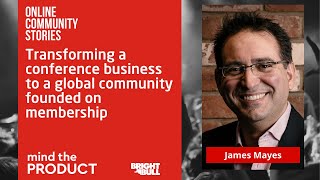
Conversation (YouTube) between Ricardo Molina and James Mays (Mind the Product) describing Mind the Product’s evolution from a 2010 London meetup (Product Tank) into a global conferences business (first conference 2012; by end of 2019 running events in London, San Francisco, Singapore, Hamburg, Manchester) and then—after COVID-19 hit in 2020—rapidly launching a paid membership/subscription product using a fast MVP approach. The transcript covers community scale (meetups in ~208 cities; global reach ~270k–300k), curation principles (editorial-commercial separation), pandemic financial shock and furlough, building a paywall and membership (using WordPress + Paddle), membership features (free Insider tier; paid tier with training, recorded keynotes, AMAs, Slack community), pricing (~$5/month entry; $250/year regular membership), leadership (invitation-only) tier, and early traction (~2,000+ paying customers).
Questions this video answers
2010 (London meetup called Product Tank).
2012 (first London conference).
London, San Francisco, Singapore, Hamburg, and Manchester.
Meetups in ~208 cities with total reach around 270,000–300,000 product managers.
About 20 people on the payroll.
Chapters
Welcome everybody to Bright Bull's Online Community Stories, a series of conversations with leading eventrepreneurs and individuals within B2B media that are driving and launching exciting and really, really interesting online communities. And we with us today, we've got James Mays from Mind, a product who has managed to transform a conference business into a membership offering. And this is a very, very interesting story because James, being a product, a product business, have used their own kind of product, type of approach, project approach to pivot their business. And essentially James and their team and his team with Mitre Product have become like, almost like this kind of organization that all other entrepreneurs are looking for or using as benchmark. They'll appreciate hearing the story. So for me, this is a very exciting opportunity to share that with you and with the community. So, James, welcome.
Thanks Ricardo. Good to be here.
Good. James, do you want to give us a little bit of background and context around Mind the product, who you guys are, what you guys do, and how long have you been in the market, what's your size of your community, etc.
Sure. So we started in London back in 2010, essentially three product managers working at different startups. They realized the engineers had a meetup and the designers had a meet up. There was nothing for the product folks, so they started a little meetup. First one was I think around 30 people in the back room of a London pub. And fundamentally product management at that time was a relatively nascent discipline. And just giving people the opportunity to come together and share those war stories with their peers was kind of the key point. Over the last few years, the first major step in that was when it became a conference in 2012. First London conference was 2012. Since then it's kind of expanded in two ways. Firstly, the conferences, we took those. By the end of 2019, we were running those conferences in London, San Francisco, Singapore, Hamburg and Manchester. And the actual meetups, that grassroots community, is the bit that drove that strength right through. So those meetups are very much run by local organizers, essentially people in a particular city who want to see the world of product management thrive. And they're now active in, I think at the latest count, 208 cities around the world with a total reach somewhere in the region of 300,000 product managers. There are a few of them working on the hardware side of things, but predominantly digital software product managers.
That's amazing. 300,000, the reach that you guys are able to have. Yeah, that's pretty interesting. So, so you started as three product, three product managers in the event. Did you, how did you start? Did you start with, was there any kind of approach to it? Did you start with content first? Did you start. How did it all kind of. And how did this meetup start?
So the first thing was literally my co founder Martin threw up a page on meetup.com product people come together, have a free beer, talk, work. You know, it was kind of a shared therapy session as much as anything else. And it literally that just grew by word of mouth initially and the London one got larger and larger and it was purely driven by those meetups and everything else literally followed that. So the blog side of things eventually came into being when they started saying, we actually want to share some of these war stories with the wider industry. Let's find a place to put those. So the meetup was called Product Tank originally and then when the blog came into being, that was called Mind the Product. Okay. And then yeah, so the conferences business came along probably two or so years after that. And it was kind of a big driver on it was the people in the community saying, whilst we're hearing from each other in London, it would be really great if we could actually hear some stories from the Valley. How is product built in San Francisco, for example? Those companies grow so much faster, do so much more. What can we learn from that? And Martin was looking at it along with Jana and Simon, the other original co founders. And kind of the key realization was we can't, you know, with a free meetup you can't afford to pay for their tickets and accommodation to come to the uk, but if you put enough them on the same day, you can sell tickets to a conference. Okay, let's make that work. First one was 450 or so people, right? Absolute smash hit success. On the feedback, the NPS score was somewhere around 70 mark. So like, okay, let's do that again. And then that kind of gradually scale. 2015, we went to San Francisco for the first time. That was kind of a nervy experience because we were looking at and saying, we're the Brits, we're going to America, to the heart of technology and we're going to tell them how to do product management properly. But by that time, you know, the blog had been running for five or so years. We've built up a great following for the digital content that we were putting out there. So when we put those tickets on sale in the us they sold out faster than we ever could have believed.
Wow.
We put out something like, I think we released 100 early bird tickets at $500 a ticket to test the US market, see how that went. And our kind of feeling was like, if we can sell those 100 early birds in the first month, then that demonstrates there's a reasonable level of market confidence. We can go with that.
Cool, right?
Give ourselves a month. And I'm sitting here, I'm thinking the rest of the team are underestimating. We've got some good demand. I reckon these will go faster than that. And I was thinking maybe, maybe they'll go in a week or so. That would be really cool. They sold out in four seconds.
Wow. Four seconds. Amazing. Wow. I mean, of course, you guys probably had that word of mouth. You had already a reputation. The meetups have picked up. You had an amazing blog, an amazing kind of place of content. Why do you think that there was an element of there was a real, real gap in the market, or do you think it was kind of something that you were doing specifically different? Did you have competitors at the time?
We didn't have much in the way of competitors. I mean, there were a few other things in the world of product, but nothing at the same sort of level that we were aiming at. And I think that was the key. Was the curation driven very much by Martin Ericsson. At that point, the focus was on quite simply, what are the best stories that we can tell. And with so many other technology conferences, then as much as now, the speaker lineups are driven quite often by which sponsors are spending money and how big their checkbook is. And it's like when you get somebody like that on stage, they're going to pitch their products first and foremost. It's like they are there to make a return on that investment. And that's the bit that we took a very different stance on that we basically completely separated the curation and the commercial. So for a lot of those early years, Martin and I operated pretty much arm's length. I looked after anything to do with commercial relationships and sponsoring partners. Martin looked anything, looked after anything to do with what landed on stage or what actually published the site. And having that really clean separation led to essentially an awful lot of trust from our audience that we were absolutely there to do the right thing, to share the best stories. I think the other thing that went a long way is that you tend to find a lot of technology events. They'll either focus on enterprise grade customers like the big existing digital corporations that have been around a long time, or they'll focus more exclusively on the startup world.
Right.
We actually took a different approach and said we want to put both of those things in the same space because when you look at enterprise organizations, one of the biggest problems a lot of them have is they've actually forgotten how to innovate.
Right.
They've got bogged down in process and structure and they can't experiment anymore. Whereas if you look at fast growth startups, they're absolutely fine on the innovation. A lot of their challenges are around how do we scale, how do we support not just 10,000 customers, but 100,000 customers or a million customers? Well, those are the problems that the enterprise is really good at solving. So if we put these two in a room together, they should be able to learn from one another.
Of course. Amazing. Yeah, go ahead.
The other key part of Martin's curation is that he looks at product of saying, you know, product is a mix of what the customer wants, what the technology team is actually capable of doing, where the business thinks it wants to go. Product is at the heart of all of these things. And Martin has a great eye for picking different stories out of different aspects.
Right.
So in a full day conference with 10 talks or whatever, there'll be a couple that are more at the design end of things, there'll be a couple that are more at the technology end of things, there will be a couple that are much more oriented around the business, business side of things and how money is actually made and pricing strategies and things like that. And then on top of that, he layers on the regional aspects. So we want to hear a couple of stories from people building tech in Europe, a couple of people building in the Valley, and maybe somebody building ever in Singapore. And you see the regional differences in how people build software. So getting those stories out and sharing them with new audiences, that's the bit where we really found value. That's I think more than anything else, that's what the audience appreciates, of course.
And I think technology, the technology industry or technology audiences that appreciate, they really value when organizations pay attention to their needs and if they looked after them in terms of content and appreciate that, they're happy to share, they're happy to amplify the message and to spread the love, so to speak, in true kind of community terms. And James, just to be clear, so you always charged for your event, you've always asked for a ticket to be paid for.
Meetups have always been buying for the community. They remain for free. They've always been free. And essentially we look for commercial partners to just host them and provide pizza, basically. Okay. And we've always viewed it as being a continuum. It's like the community end is the product tank meetups, they're free, have a pizza. The level of talk, sometimes they're an absolute smash hit. Sometimes they're people doing their first ever public talks. There's a few nerves along the way and a few mishaps.
Right.
But that's the whole sort of organic end of things. Right. And that, that's great. Speaker pipelining for us is finding those new voices. We've always intended for the conferences to be at the other end of the scale. So yes, it's a paid for ticket, but you know, we don't host them in sort of stripped out warehouses or things like that. We use symphony orchestra venues with fantastic comfy seating, amazing auditoriums. You're not going to get half, you know, lukewarm coffee in a polystyrene cup. We'll have barista carts around the place and you want a flat white, get a flat white, have a good coffee. You know, of course they've always been aimed very much at that end of the market and people appreciate that kind of quality.
Yeah, that's very interesting and I would love to get into the element of the pandemic or actually, let's just get into the pandemic. I want to touch upon the meetups because I think many organizations either understand how they run, but in some cases it's a logistical element, a logistical issue, how to keep control of it, how to keep control of the brand and everything, which I want to touch upon on that. But I want to continue with the journey of like. So you had kind of good. A good round of success, sold out events, putting more confidence out there, audiences growing. 2019. Sorry, 20. Yeah, 2019 or 2019. 2020. Early 2020. Pandemic hit. Tell us about what happened there and how. We all know what happened, but in the sense of within your business and how you guys kind of, as you've highlighted it, review the backlog of priorities and do the shift. Tell that story.
Absolutely. I mean, as you might imagine, the initial impact was nothing short, brutal. We'd spent 2019 investing in the platform, investing in the team, hiring new people, building out this spectacular team. Got to March 2020, we had 20 people on the payroll and all of a sudden revenue just disappears. Everything stops. Not only that, you had eventbrite change the way that they were actually paying out the money that they were holding suddenly stopped doing advanced payouts. So they literally took out the industry at the knees with that. Yeah, that. That was not a popular move across the industry. And then finally, you know, the bank account started going in reverse because we could no longer run events that we'd sold tickets or sponsorships for. And so far as we were concerned, we were going to find a way to survive this. We wanted our reputation to be intact, so we didn't just want to sit there and say, well, sorry, but, you know, beyond our control, we're keeping your money. We wanted anybody that wanted a refund, we wanted to be able to. To offer that. We did that. UK government put in some support pretty quickly with the furlough scheme. So we furloughed pretty much the entire team immediately. It's like, we need to stem the bleeding first. Let's start there. And then myself and a number of others on the management team essentially worked without salaries for a while, while we figured out just exactly what we might be able to do here. And clearly running events wasn't going to be something that we could plan for anytime soon. We didn't know how long it was going to be.
We knew it was going to be a while.
And essentially we'd had an item in the backlog that we considered a number of times, but not really found the time or the urgency to do anything with, which is this idea of saying, we've got fantastic content online, because this one we had, best part, 10 years worth of web and written sort of video and written content on the site. And we'd always noodled around with the idea of this doing some sort of membership program, what might that look like? But just never. It was never a priority, you know, and all of a sudden we've got absolutely no money coming in and we're not running events anywhere. Well, I guess we're going to take a look at that idea on the backlog, then. That could be a. And it was. It was Martin and our now managing director, Emily Tate, who took a huge load on leading that. And fundamentally it was a case of, here's a hypothesis, but we don't know. Classic product management thinking. What's the smallest thing we can do to test this idea? Now, if I ask you, would you pay for a thing? Chances are you're going to be nice to say, yeah, that's a nice idea. You should build that. I would definitely buy it. That's very different to you actually turning up and giving me a check.
Right, right.
We wanted to do something in earnest to test what's the smallest thing we can do to prove that Ricardo will enter his credit card details on this site and give us some money. So the first launch on that was maybe eight, 10 weeks work, something of that sort of order. It was incredibly fast that a single dev here, a guy called Sean, who's been. It was an absolute hero through this. So he cranked out the first version of our paywall and subscription packages, which was partially using our WordPress platform, but then also integrating things like Paddle for powering the payment side of things. That first version launched, it got out there okay. It proved it worked. So that when we can start testing more and more, like, what are the other things that people might find valuable? What are the parts we need to fine tune? And then looking more at the platform and saying, we launched this in a real hurry, there are undoubtedly some bad technology decisions in here. Let's start unpacking those and see which things we need to build better. Okay. One of the things that we're looking at is we're actually getting more and more customers coming to us from a corporate perspective and saying we want all of our product management and all of our design people to have access to that resource. Can we buy 200 seats, please?
Wow.
Absolutely. That's a fantastic position for us to do.
Of course.
Absolutely. It then brings with it the. As an organization, we want to be able to manage which of our staff have access, and we want to be able to see whether or not they're making use of the online training courses and things like that. So we're starting to get a higher level of tooling required and we're looking into what kind of development is needed there now. So it's going to know it's an iterative process. It's far from done, but we've got north of 2000 paying customers on there now.
From a customer. Wow. Congratulations, James. That's a very, very good result. Just a quick question on the element, on the MVP that you've created or that you've developed. So in parallel, of course, you would have quizzed or queried your audience to say, we're thinking about this. So did you get them involved from the word go as well? Did you work groups or with the whole audience? How did that work in conjunction, what you guys were doing, that.
It was a bit of a mix. Some of it was literally putting calls in with people and doing those conversations. We're looking at doing this, would you be interested? And that sort of thing? Some of it. We did some pricing tests to see what people thought might be reasonable. So we had a little bit of guidance coming to us there. Personally, I'm starting to hear more and More feedback now from the larger companies to say this is an absolute bargain. Which tells me that maybe we should think about increasing that pricing a little bit this year. But our initial thing was the pricing matters less than actually proving that the thing works and that people want this. That was the urgent thing. The other thing that we did that we thought was pretty crucial actually we learned a lot from was essentially a stack ranking exercise of listing all of the things that we thought we could include in a membership package and then putting that in public. Please rank these things, tell us which of these things are most important to you, so that we know what to actually work on and we know what to include. We discovered a fair few things in there that came as quite a surprise. I mean one of the things that we. One of my first assumptions was if we charging people for an annual membership, one of the things they'll probably be really keen on is seeing discount access to the conferences when they come back, right?
Not really.
Nobody's really bothered by that at all. Not important.
Wow. Very, very interesting because that's kind of an initial thought. Okay, so we're an event business, we might as well. Yeah, that's, that's a, that's a key part of. That should be key part of the membership. Right. So they've not. Didn't the audience basically validated that?
Not really. Not that much of a problem for them. And you know, fundamentally looking at it in hindsight you can say, well, we do know that north of 80% of our customers just have their company pay for their tickets. So of course they're not that price sensitive. These are typically people who work for multibillion dollar companies. Even the startups are well funded to the tune of a couple of million in VC or whatever, things just weren't that price sensitive. What they did do was they recognized that from the conferences we've run over the last 10 years, we have the best little black book in the industry. So their interests were much more around can you do a monthly AMA session with industry legends so that we could actually get FaceTime with some the people who've defined how and the opportunity to have those conversations. Can you facilitate that? That's what they wanted to see for us. That and things like how can you continue to facilitate networking of some kind in an era where we can't go meet up with people?
Right.
A lot of the time less. So now you're seeing more and more uptake from product managers at a variety of firms. But there's certainly a period where if you were the product manager at your firm, you were probably the only one. It could be a very, very lonely industry. And even now you find that the typical ratio of software engineers to product managers is typically like 10 engineers to one product person. Something like that is not unusual. So you're pretty outgunned. One of the quotes from the early days, that kind of stuck with me. I met somebody at one of our product meetups. I don't think I've seen you here before. This is a London meetup. How did you find it? What do you think of Product Tank? And he said, you know, my CEO is insane. My engineers will hate me. This is therapy. It's been brilliant. So I think, you know, I think that's a fairly common view.
Right.
I don't think he's the only person to hold that perspective. To bring people together and just let them share war stories with their peers was absolutely crucial prior to the pandemic. And then obviously, everybody being stuck at home through the pandemic came even more to the full.
Right. So you started validated with the audience what you might like. Those that. Those of your audience that said, yep, if you do this, I'll pay for it. Then you're like, there you go. What do you think? So uptake was positive from the word go. And so basically they kind of put the money where the mouth is.
It's like any subscription business. You'd like it to grow a little bit faster, but it's definitely going in the right direction. And we can see the sustainability improving. We can see the engagement sites, the engagement stats on the site. People are coming back and using more of it and delving deeper and deeper every time. And we're getting great feedback on what they want to see from us next. So our roadmap for the rest of this year is like, we've got a good list of things to be working on.
Yeah. I think one of the elements also, James, that many people in your place, in other organizations, the question always is pricing. Did you. How did you approach that pricing? Because should we charge, I don't know, a hundred? Should we shot a thousand? What. How did. What was the thought process around it? Because I know many people. I mean, whenever you go to any roundtable with event people that do it, kind of, they're always the question is, what is your membership proposition? How did you go about pricing? Is there anything. Is there any gem that you can share on that front or that you could advise people?
The first thing that we wanted to achieve was we wanted to keep it at A level where it would be individually affordable. You weren't having to go to your company to ask for permission, to ask to expense it.
We know there's a lot of.
We know there's a lot of product folks that operate as freelancers. So it's coming off their own budget. We knew that obviously it was a hard time for companies. People were being laid off and this was a kind of support that people could really use to get them back on their feet. So we're kind of looking at it and thinking ideally we want to hit a point where this is something that if you're not working, you could still justify paying for it out of your own pocket to upskill, to meet fellow peers, that kind of thing. So, like if we can get it to the point where it's a comparable price to a couple of coffees a week, something like that, that feels like the right sort of level to get it out there and get started.
Wow, that's an interesting one. So that's a good uptake. And then the audience started highlighting this is what we value in terms of content. You're adjusting content accordingly to provide that value.
The entry level membership works out about five bucks a month, something like that.
Wow, okay. That's kind of pretty affordable. So. And again, at this point in time, your audience is pretty big anyways. How big was your audience at that time?
It was around about 270,000. In terms of the global community. It's grown a little since then.
Right. And James, a question around there because there's many people highlight. Okay. Many individuals talked about their community as the people that get exposed to the community versus the people that are actually in the house, sitting in the living room more specifically. So do you have, do you know who those 200,000 people are?
We have an interesting mix of data on that topic. As you might imagine, when we first started the meetups back in 2010, that was on meetup.com so we now have something like 208 different meetup.com accounts. With all of those local city members in there, we can't get their email addresses out of meetup. We get no demographic information from that. What we did start doing a couple of years ago is starting to build some of that functionality into the site. And likewise we get more and more data whenever we do the digital conferences over the last year or so. We gather that data at Eventbrite. Which company, what job title, which division do you work in, all of that sort of stuff, which location you're coming from. So we're starting to get richer and richer data. There's certainly a lot more that we'd like to gather in future.
Of course.
Of course.
And so then virtual events. Virtual gatherings is then has then became like the proposition at that point in time as well as the membership. Did you have any free element within your. How does that funnel, if we can call it that way, work for you? Or how does that. I would say, how is that membership proposition works at the time or even right now? How does that look like?
So simply put, we've always viewed it sort of mind the product as being an opportunity for people to engage somewhere along the continuum, wherever they feel most comfortable. That idea of, you know, you can attend, you can attend your local product tank meetup for free or you can attend a conference which will cost you 6, $700. And it's like there's a range of experiences available to you depending on your budget and your commitment, that kind of thing. And we wanted the membership side of things to reflect that too. So if you hit the site at the moment, the line that we take on content, fundamentally if it comes to us for free, we should also make that available to the community for free. So somebody in the community says, I've got a strong opinion on this, I'd like to write you an editorial contribution. Cool, you'll do it. You're taking your time to do that. You can work with our editorial team, we'll put a bit of polish on it. But fundamentally the vast majority of that's come to us for free. And likewise the little. The meetups that have been running through the pandemic have mostly been video streamed instead. So we've got all those videos. Again, that's free content for us. We should make that available for free to the community. So that's what we call our insider membership, which is always free and you get access to that lot. Plus we have a community built on the Slack platform with probably 50,000 or so product people in there. You get access to that as well. Right? That's the free end of the. What we then do is we basically say if it's content that we've had to invest and pay for, you're going to pay to see it.
Okay.
It's a very, very clean line. So that then includes anything where the editorial team have been doing research and deep dive articles. That includes the self paced online training modules that we've been building over the last 12 months. If you missed out on the digital conference and you want to catch the keynotes, cool. That's in the membership portal as well. We pay for the main conferences, we pay our speakers. Even for the digital events, they get paid keynote fees. Amazing. You know, for us, it's. It's kind of twofold. It's firstly, we want them to feel like it's. It's recognition of their efforts. Right. We don't want you to turn up and you didn't really write something. You didn't really rehearse anything. You haven't put that much effort. Effort into it. That's not the deal. We're charging our members to come see this stuff. So we want you to put the effort into it. Therefore, we pay you fees. We want that level of professional diligence.
Yeah, go ahead, go ahead.
It also takes people away from thinking, I'm here working for my company, I need to pitch the product, I need to get a return for them, I need to generate leads. No, we're not paying you because of who you work for. We're paying you because you've got great stories to share. Those are the stories that we want to hear.
I think that's kind of a very, very valuable aspect. And you probably have met a lot of people in the events industry when you said we pay all our speakers by everyone probably will raise their eyebrows. Wow, how do you do it? But I think that we had in our sessions, well, lead Dev as part of the honor committee stories. And they also have a policy of paying the speakers, Payne, whoever writes for the blog, because they recognize that that keeps the organization impartial and they value their time. And I think it's such an interesting story because then I can see that there is a direct correlation with the audience, the community, rewarding you with their attention, presence, money, you know, membership, when you also have.
It's basically reciprocal.
Everyone has kind of mutual respect. And sometimes having mutual respect for your speakers, for whoever contributes, rewarding them financially is a big element. So if anyone then kind of has the content that you've worked on, content that you've prepared, then you obviously will charge for. That's part of the membership of the. Of the tier membership. What else happens there in the membership so I can become a membership for. Has that membership pricing changed at all from, let's say last year to the way it is right now?
No, it was. There was a launch offer on there for a couple of months where it was reduced a little bit further. At the moment it's 250 per year for the regular membership that I think is due a review at some point soon. But really, since Then. But yeah, so you know, you get access to that level of content that we just talked about. Likewise, we've been building out some self serve training modules. So you know, we basically offer two different kinds of training. If you as a company want us to come and train your product team, great. We run facilitated zoom class work classrooms spread over a couple of days and we'll work very closely to coach those people. But likewise, that's not right for everybody. That approach can be a bit expensive for some firms. So we also have self service training modules and they're typically broken up into small video segments. Watch this, understand this and then do this exercise to drive the learning home. So that's included in the membership package as well. We launched an online discussion forum a month or so ago, so that's in there now. You do get the discounts for the conference tickets. And then on a pretty regular basis we run member only. Online events are roughly once a month and they're typically AMA type sessions. Here's an industry leader. This will be somebody on discovery or this is someone road mapping. This one is someone on analytics, things like that. And it's typically one of our folks hosting that, asking the questions for the first 20 minutes to half hour, get the thing rolling and then inviting questions from the community.
Right, that's pretty, that's kind of pretty interesting. So that will be like your tier one membership offering. When people come in, you've highlighted before attending a conference. That's fine, you will put it out, they'll pay extra for that. Is there any, is there any other tier? Tier? Is there a secondary tier?
Yeah, there's another tier in the leadership and the membership program which is the MTP leaders and that one's invitation only. So typically what we're looking for is VPs or chief product Officers. And this sort of came about by the way the industry's matured over the last couple of years. I was catching up with the Chief Product officer in London a couple of years back who used to be a regular at the Product Tank meetup. And I realized I hadn't seen him for a while so I wanted to catch up. Why haven't we seen you around? What's going on? And he said, well, when I used to come to Product Tank, I was a product manager who was responsible for managing backlog of managing the roadmap of doing those presentations. I was the only product manager in my firm. So coming to Product Tank gave me the opportunity to meet other product managers. He's now in the position where he is A product leader and he has eight product managers on his team. He makes sure they come to product tank, he makes sure they get involved in it. But his challenges are now different. So his challenges are things like, how do I identify and support a poorly performing product manager? Right. You can't have that conversation. Product tank with your team around you. You need a separate leadership experience where you can pose that question of other product leaders. So the leadership tier is designed to be a much, much smaller group of people, but they typically have a very different challenge. Typically it's VP CPO type level. But essentially what we're really looking for in terms of qualifying criteria is one of things. You're either managing and developing product managers more junior to yourself. So you have those challenges or you're the one representing the product strategy at board level. If you fulfill one of those two categories, chances are then the leadership program is the one that you want. And it's designed to be a much, much smaller group. So we get much more exclusivity at those member events. There's a slightly different level of content that we publish both in terms of the newsletter and on the site.
And then that of course is by invitation only, but also a paid for. There's a different kind of fee structure to that. Yeah, James, there is. When we go to SaaS type companies, they always have, okay, membership. You pay one year up front or you pay monthly. You can exit what you want. Have you guys have. What are your thoughts on that? Have you got any or any data that proves one way or the other is best or not better? How does that work in your case?
For us, we offer both choices. People can pay either monthly or annually. Really? Obviously we prefer annual. It's always nice to have that money up front, especially when you're trying to survive a pandemic.
More from Ricardo



Implementaciones de CRM - Medipiel: La omnicanalidad y mayor conexión con los departamentos



Implementaciones de CRM - La omnicanalidad y mayor conexión con los departamentos




