0-17 Gyms: How a PT Became a Franchisor 🧐
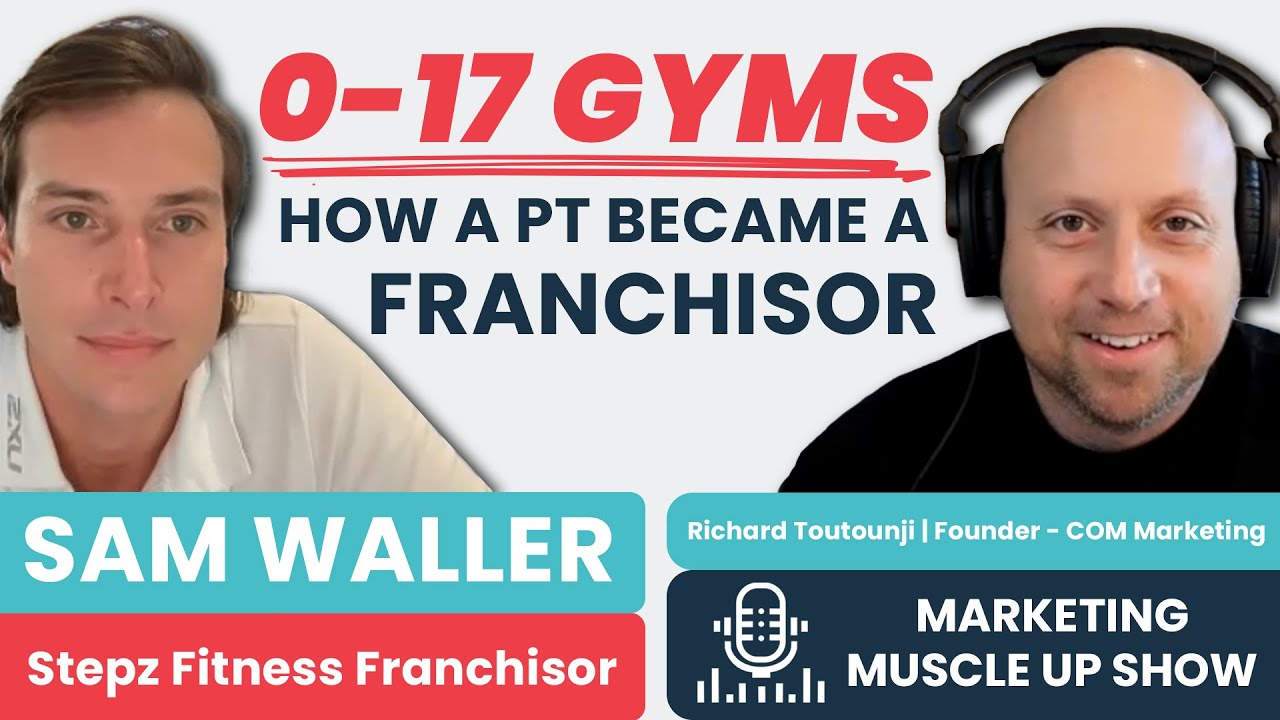
In this episode of the Marketing Muscle Up Podcast, host Richard Toutounji interviews Sam Waller, the founder and franchisor of Steps Fitness, a hybrid 24/7 gym and functional group‑training brand. Sam walks through his 12‑year journey from personal trainer to owning three corporate locations and overseeing 17 franchised gyms across Australia. He emphasizes the importance of a clear mission and personal story, building a loyal client base that can become early investors, and the pivotal moment of buying a master franchise after proving himself as a top‑performing gym. Sam explains why he chose a hybrid model over a pure functional‑training franchise, detailing the higher upfront investment but longer‑term revenue stability. The conversation covers branding overhaul, the need for continual brand evolution, and the financial and operational systems required to scale – from hiring mission‑aligned staff, implementing reporting procedures, and maintaining strong member relationships. Sam shares concrete marketing tactics for pre‑opening (digital ads, 3D walkthroughs, local flyer drops) and membership pricing structures, noting realistic revenue targets ($600‑$700k per gym, $200‑$300k net profit) and the stress of rapid expansion. He stresses ethical growth, preferring steady, well‑run locations over sheer numbers, and outlines future goals: 10‑15 high‑performing gyms per Australian state before looking overseas. Throughout, Sam offers advice for personal trainers considering franchising, highlighting the trade‑offs between independence and systemized growth.
Chapters
Hey, it's Sam Waller here, the franchisor of Stepped Fitness. Listen to my episode on the Marketing Muscle Up Show with Rich.
Welcome back to the Marketing Muscle Up Podcast Show. I'm your host, Richard Toutounji, and in today's episode, we're talking all about scalability. We're talking all about how do you go from one location to a multiple location, then to becoming the franchisor of Steps Fitness, which is a gym, 24-hour gym with a functional training facility into it. I've got on the show today Sam Waller, and he's going to take you through how he did it, and he's going to uncover, uh, the mistakes, the impact, and the successes that he's had to face over the last 12 years, uh, from when STEPS went from 0 to 17. Welcome to the show, Sam Waller.
Thanks, Rich. Thanks for the introduction.
No problem. Um, Sam, it's, it's a challenging time in the fitness industry. And when we say that, not just COVID, I'm talking about floods, I'm talking about, uh, fires. And, you know, one of your locations was, uh, that you have was in floods. And you're sitting here going, well, we're still growing. And I want to talk about that. First of all, let's talk about the mind frame that you need right now in the fitness industry. A lot of people at this point have endured a lot, but you're here going, yes, we're going to push through, and you're selling more locations. So let's just go straight into that. Yeah, great. Quick question, and then I want to get a bit more of your background. What are your thoughts on what you need to succeed as a great business leader today?
Yep. Good question. So the first thing I'd say is you need to be mission-focused. Like you need to have a passion for the industry, passion for helping others, and you need to have a mission. So personally, my mission is to help as many Australians become healthier and fitter through health and fitness. These are the same sort of benefits I got when I broke my back, was overweight through school, and had some bullying. and struggled with being overweight. And then I changed my life through health and fitness. So my driver and my mission is clear. And when things get tough, that's what gets me through. And that's what I find with the good personal trainers or the good gym owners. They've got a really clear mission. And usually that mission is for helping others. So before you jump in from a personal trainer, I think personal training is great to sort of build some— as when you're young or change your lifestyle, it is a great change of lifestyle. But before you take this next step in your career or life, you need to make sure you've got a clear mission and vision. So that's the thing that helps me drive through. Um, and on your other point regarding COVID and the tough times, there's always a silver lining when, when you are mission-focused. So I'd say looking at the numbers of our clubs, our 16, 17 gyms, 95% of them were at a better point post-COVID than they were pre-COVID. And we'll go through what that—
Outstanding. I say numbers and it's good to get straight into that. So talk about your background. I mean, you started off in the business quite young, 20, and we just talked about before, similar age when I started off and you reshaped some things. So talk about the early stages. And also I want to talk to anybody who's a personal trainer right now, possibly maybe earning $35,000 a year. And you've been able to take a traditional, you know, uh, PT industry and continue this to serve more. So talk about how you did that and how others can kind of follow this step, footsteps. Where'd you start off with?
Sure. So personal trainer, starting as a personal trainer, um, the goal, like the key thing here that you want to be doing if you've got a sort of, you want to progress your careers from sort of PT to gym owner, then to multi-owner if you want to do that. It's about building a loyal following and thinking about your members and clients. One of them may be your first investor, like what happened to me when—
Oh, right. First investor, right. Now that changes the game a bit.
Yeah. Well, I think I had a great sort of following, a great sort of loyal client base as a PT, people that I love to spend time with because you are spending a lot of time with them on a day-to-day basis. I didn't initially know that this would happen, but a member from the gym, when I went to every bank, every credit union to try and get a loan to buy the gym, a member from the gym actually invested 50/50 with me and I'll be forever grateful for them. So if they're listening, thank you. I don't say it enough to them because my life's sort of on a path where thinking about those small things, they drive me every day, but giving the thanks and gratitude for that. I don't do it enough. So, um, initially being a PT, it's about building a loyal following, and that'll bring on a good business. PT is all about people, as you know, Rich. It's all about networking people and, and just local community and what you're providing. Um, I wasn't the best technical PT, but I always had a great relationship with my clients. Once you've done that, the next step, if you wanted to take it, is a gym owner. So It's going to be hard to get finance for the gym because it is a big cost, but then you're building a recurring revenue where if you're not there for an hour or if clients go on holidays, you've still got the money coming in and you can live a sort of— you can step up your life and progress financially as well, which was important.
So the early stages, you're saying that you've got to have a good following, meaning a good product as well, be a nice guy, nice person, nice girl,
Yeah.
Um, because if you want to continue, you've got to figure out, well, how— like, for you it was getting funding, and that was that pivotal point where you were able to do that.
Yeah, agreed. Um, and, and I think it's good business too, Rich. Like, um, the basics and fundamentals of, of owning a gym, owning a multi-gym, and running a franchise is people. Um, so I've got a mission to help people, and I've, I want to— I've got a vision that I want to help people in health and fitness. The next part is achieving those results for the people that we serve and also treating people right.
Awesome. And so tell me about now, how long was when you first started to— and you said you've got 17 locations at the moment, and are they all individually owned? How many locations does one person own?
Yeah. So I own 3. We've got a multi-franchisee Who once again started as a PT, had a warehouse, and now he's our top performing franchisee financially, Daniel, in Dapto and Shoal Harbour. And then the rest are individually owned. So I'm a couple of multi-franchise, I own 3 corporates myself, and then the rest are individually franchised.
So as you progress in different locations, different locations, there's a lot of different You know, ladders that you have. But before we get to that question, I want to know, to get— so, you know, you've owned— did you own 3 yourself before you, you know, got the franchise? Like, what was that?
I just— it was one. It was one of the top performing gyms in the group. The franchisor at the time took notice and offered me the master franchise role. And at the time, we were just a 24/7 gym, Steps. was just 24/7 gym. But I had the idea to bring in the functional group fitness. Just probably we were the first to market with a hybrid functional group training and 24/7 gym approach. And that was Thornleigh in 2017. So one gym, one gym was what set it apart for me and just doing it really well, I guess.
And so that's how you got approached then to be asked to take over this?
Correct.
Yep. Okay. And so from there, how did you go and get more locations, more people to invest in, to believe in where you wanted to go? Was it just, again, more clients?
Well, I spent all the money I had on a master franchise agreement, moved to Sydney with nothing to my name. And I just hustled. That was probably the hardest time of my life. No money. I couldn't— sometimes I couldn't afford food because I've, you know, I was basically just hustling and just finding the right people as well. So that was a step that really set things in motion and put— I had to hustle and put things to the ground. And then, you know, and then I started marketing. I started to, you know, learn marketing and build that up, which was crucial now. So I don't have to do all the hustle and bustle that I once had to do to get started. But finding some people that believe in you and believe in what you're doing, even when what you're doing doesn't look all shiny and perfect, I think is crucial. So at the time, Steps still had a bit to do in terms of branding, which I've now updated. It's now a top brand. But it's basically, I believed in what I was doing and I found some people who also believed in me and now, you know, they're with me today.
It's interesting, the early, I mean, the early is really important because anybody can go and get a franchise that has 150 locations, right? But the early, I just love the conversations with the early adopters because it's risk. You don't know if it's going to happen. So it ultimately comes down to one thing. It's the individual that is selling that franchise or that is selling that dream to somebody else. Yeah. Tell me about that. You know, having multiple locations that you are not running, right? You get your franchisees there. Um, if they do well or don't do well, how does that affect you and your mental state and your stress levels and so forth?
Big time, to be honest. Um, it was really hard. It's really— it is still really hard for me when there isn't a performing gym. Um, you know, which will happen, um, which does happen from time to time. I can only do what I can do and And I, that tends to be more than, more than I should be doing. I'll have sleepless nights working all night. You know, back in the day when, when I needed a gym needed help, I take on a lot of that responsibility. But I think what's helped me with that is getting back and getting back in the cold face. We discussed this before and opening gyms up myself that then just recently, probably 2020, when someone pulled out of the franchise with because of COVID and risk and scared. I jumped in, backed into it, and then that gym took off, 500 members in I think 18 months.
So it really comes down to the— does it come down to the individual that is owning the gym? What's the— if you look at all your owners, the franchisees, how do you know who's going to do best performance?
That's the challenge, I guess. You never fully going to know. There's a lot that goes into it, but it's usually the people that have that drive for other— to help other people, that have that drive for fitness and in the industry. Um, and one, one other thing I'd say, Rich, is people who have been a personal trainer for a while, they're usually ones that, um, that can face adversity, that know what it's like not to make money at times.
Yep.
Um, and that I think personal trainers— I think anyone that's been a personal trainer for, for a while is basically an unsung hero because I know how hard it is, um, how the income can fluctuate. Um, so I see them as, as people that I want to help because I know that they'll, once they step into a gym with, especially with a franchise where it's systemized, they've got all the tools that, and they're going to listen as well. I guess that's the other thing.
And they're going to listen too. That's a good one.
Yeah, they, they can listen and take, um, Take feedback, take advice. I guess with comms, when people listen, it's amazing what can happen.
The results when they listen and do the work.
Yeah. But there is an investment. There is a, I guess, dropping your pride a bit. But thankfully, I've always been one to take feedback, take— learn from what other people have done and I'll listen. I know at each step, We talk about a good bio and stuff like that, but I'm, I'm still human. I'm still learning. Um, there's still a way for me to go. So I'll listen, um, to other, to other people who've been successful, other franchisors, competitors, if they'll give me the time.
Yeah, great. Well, let's get into a bit of a conversation on, um, you know, if there's a personal trainer or a studio owner out there and, you know, what, what's the pros and cons of, um, you know, investing in a franchise or just going out and doing it yourself? Who's that perfect person? Because I think if anybody's listening to this and they're wanting to be a franchisor and get multiple locations, or they're listening to this going, hey, I actually, yeah, I just want to be part of a network. What's the pros and cons? Who should do what?
And let me clarify this, Rich, with your life is what you want out of it. I'm not saying what I'm doing, or I'm not saying you should grow and take these next steps. I've got a really good mate of mine who's got one studio and that studio heaves. He's a lot less stressed than I am. And we've, we've basically just gone down a different path. That's Ben from Movement Enhanced in Queensland, Queensland there. So it's up to you which way you want to go, but at each step there is a sort of level up and a change of thinking and a change of what you do. So I loved being a PT and helping people with their— and seeing results. I don't do that anymore as much. I can do it on a scale, but I'm sitting in an office, I'm having meetings, I'm having financial discussions, accounting, all the big business stuff that changes your life a bit. But there obviously is financial incentives and rewards at each step, but you have to sacrifice a bit as well. Okay.
So let's talk about these different revenue steps. And what you have to do, if you can break it down, and maybe we can break it down to having a half-full studio, then a studio, and then getting to that second studio and third studio, that would be a great progression. What are the key differences that you've had to overcome in those stages?
Yep. So PT, we discussed this. It's just about building a good client base and building a loyal following around you in your local area. Don't worry about going too deep, too wide. If your then next step is to buy the gym that you're operating out of, which I think is a great idea because then you know the operations, you know the people, and you've at least got a core group of people that are going to stick by you. And then as a gym owner, it's more about systems and staffing. So before you take the step to a multi-site, you need to have the systems in place. You need to be able to trust staff and employ staff in the business.
Or trust staff and employee stuff. Just dissect that for us a little bit. And I think that's a big problem. People, one, they struggle to get staff, but two, when they have them, it's like, oh, staff did this, staff did that. How do you trust staff? What's the definition?
Firstly, I pick the right people, which you're not always going to be able to do, but I pick people who have this mission, have this dream of helping others, and I basically step back. I've been to one of the gyms, Dubbo, that I opened in 2021. I've been there once, but I found a great staff. I found Bodhi, who's amazing, was a franchisee at Harvey Norman at one stage, and now I pay him really well as well. So because of that, he's got it under control. I don't need to worry about that gym.
Love it. Yeah. Thanks for that.
And then I think you'd only take the step to a multi-owner if you have those systems in place. Sometimes you get that from a franchise, or if you're independent, you've got your own system set up. If you have that in place and you can have staff without you needing to be there, because it's all about that at the multi-level.
And you mentioned that you're in an office mall. Obviously you're not on the gym floor more. Even if you had, you know, 2 locations or 3 locations, you know, yeah, what is the reality here? You know, do you have to be a better, um, communicator or better business operator? What's— who— what do you have to do at that stage?
You have to level up. Like, um, at a multi-gym level, you have to level up and bring in the right people. So then you've got accountants that sort out your accounting, you've got people doing basically a lot for you. So you can just manage the staff, you get the reports. It's all about sort of reporting, trusting your staff, but also knowing what's going on on a day-to-day basis. So it's all about those systems and procedures that you put up as a gym owner at that level. And once again, it all comes down to basically awesome members. You're not there every day, you don't see what's going on. So you've got to really speak to your members. So just recently, I've, I've got a gym in Queensland, um, just recently, and I went there. The first thing I did, um, when I got to Brisbane— I was there for 2 days— spoke to members, spoke to different age groups of the members there, got their feedback. Um, and it was clear. Now I feel a lot better about what I need to do at that gym. Wow.
So straight to members, not teams, just straight to the members, see what they're saying.
Straight to the members. Yeah, 100%, because they're the people that I'm serving. Um, they're basically what, you know, they're, they're basically what pays our bills in the fitness industry. Um, before anyone else, it's all about members for me.
So good. Now, um, I just want to probably, probably ask you this— asked you this question a little bit earlier, but can you just take us through steps, um, how much you're charging for the membership, um, You know, what's the clientele that you'd get in? Just the basics of that for us.
Yeah. So STEPS is, um, STEPS is a sort of hybrid model. So we've got the 24/7 gym side of things, which at the time when we started in 2009, that was all you needed to do. You could open a gym, it could get really successful really fast with just a 24/7 gym model. Um, I realized as a personal trainer, we weren't getting people, we weren't able to impact people's results and health and fitness in a way that we could with functional group training. So I had it all set up to run a function, to start a functional group training franchise. And then I just thought, no, the 24/7 gym and the mix together is crucial. Um, and although it's a higher investment because the 24/7 gym equipment's, you know, a pretty big investment. Yeah. Um, I think now we've got a, we've got a great model with functional group training on one side and a high quality functional group training. Um, and also 24/7 gym. So, The market's now moving this way, but now that's why I'm scaling because now it's about, we've got it all sorted and it's working beautifully. Now it's about scaling up and our members are loving it. So if you look online, we've got some great reviews, which really is important from a marketing perspective as well, your Google reviews. I know you're big on this. are crucial for SEO and ranking. So yeah, it's about sort of that.
Yeah. So good. And it is true because, well, we work with gyms. We always recommend to put a higher-priced package in there, making sure that there's a percentage that will always want a different level of service and you've got the space and the facilities for it. So yeah. Really good.
And I guess, I'm sorry, Rich, I'll just add one thing. I guess Now we've got that in terms of a business perspective. We've got a dual sort of membership option. We've got the premium group functional group training membership, and we've also got the 24/7 membership. So now it's not about like our competitors, it's about as many people as possible under one roof, which I saw as a pretty challenging prospect. Now it's about we don't need to have as many memberships and we'll be a lot more profitable with lower amount of members, which for me, long term and strategically, I saw that as crucial because a huge amount of members— for me, I, I've never achieved it. I've never achieved that 1,000-member in one gym, I'll be honest. Um, I don't— and I don't need to achieve that now and make it better.
Well, you're talking my language. Um, I have a big belief that the fitness industry, we need to, we need to personally earn more money.
Yeah.
And, um, you know, we're not a $9 industry anymore. We really need to up our up our game because we are changing lives. And I think this industry, Sam, overall, everybody needs to get together and up the prices so people understand the value of it. And because it's just overall, essentially it was too cheap. So I'm all in for that.
Yeah. You've given me goosebumps, mate. I think we are changing people's lives. We're changing people's lives and we're impacting them on a level that lawyers, professionals can't do. So let's raise our game together. I think we also need to take some responsibility for what level of education, what level of constant education we're at as well. We can't sit on a Cert III and IV and say, that's all I need to do in terms of education. Yeah. We can talk about this later, but I got a law degree just to make my parents happy. That's what I guess drove me so young and so early is I came from a, you know, I had a great upbringing. I was blessed to get a good education, but every one of my friends and my family was encouraging me to become a lawyer, which would've been great. The money's good, but I just couldn't sit at a desk all day. Yeah. And I wouldn't have been a good lawyer as well. So my driver is also to move so young and so fast has been to create a career in the fitness industry, which is really hard, but also make the money that I could more now than a lawyer. So yeah, I guess—
So good. And it is important to think that way because otherwise you don't have longevity in this industry. You go elsewhere.
Agreed.
So, okay. So you're at how many locations at the moment, Sam?
So we've got 17.
And how long did that take? 0 to 17?
Yeah. Well, I think you can— well, we're 12 years. So 12 years, put simply, 12 years. But I think you could grow pretty fast and have a lot of issues with product, issues with people. And it's not been something that I wanted to do. So when I took over STEPS in 2017, I think we probably dropped some gyms. I consolidated because if they— I want the right people, I want good performing locations, I want to do the right thing by people. And that took some consolidation, slowing down. I didn't grow. I just worked on all the systems, worked on the brand. We updated the brand in 2018 or '19.
Yep.
And that's really assisted things. So it speaks more to what we're about and what we're doing. And then we could add the premium group fitness. And now we're at a point where we can scale, but it takes a long time.
Well, the reason why I asked that question is because there's, you know, the focus that I always put, people see and go, oh, where'd you guys just pop up from? You know, but I always love the real story. And anybody that has any level of success, I always say it's a minimum, minimum 7 years and much more before you even can consider even, uh, doing what you say, oh, I need to be that person or do that. You know, I love the backstory of these things.
I wish— yeah, I wish you told me that when I was starting out as a business franchisor, because, um, it was hard for me. I saw, I saw competitors just— I don't know how some of them do it one a week. Um, it's starting like now that I start to open, I can see it. But for me, I, I want a steady and sustained growth, a long-term growth with the right people and good gyms that For me, I'd be a lot happier with 50 gyms all successful or majority, 99% successful than having a behemoth because each step, there's a lot more stress involved, a lot more, I guess, ethically and responsibility.
I think what you're saying is ethically, you want to make sure that each location is performing and doing well. And I think that's a big thing that sometimes lacks in certain franchises. And I think everything needs to improve everywhere. So I think that's solid strategy there. You touched on brand just before. Let's get into a little bit of marketing here.
Yeah.
I'm a big believer in brand and we work with one of your locations, Thornleigh, Yvette down there, great operator. And I saw the brand switch and you just said, as soon as your brand switched, things changed. Talk about brand and how important it is for to be selling each location to a franchisee and what it means for people to come in.
Yeah. So at the time when I was looking at the investment, I guess the investment is huge in updating a brand, especially with existing locations. It's an investment at all levels as well. But Steps for me wasn't speaking to what it actually was. You know, it was just a— it was— it had a Steps Fitness 24/7 logo. It looked a bit commercial. It didn't speak to we're a non-intimidating gym. It didn't speak to everyone's welcome. It didn't speak to we will help you achieve your goals and we're goal orientated. So sitting down and doing a brand workshop with some of the best in Australia branding-wise, brand strategists, was an eye-opener. And that's also when I I had that reinvigorated sort of drive in me because then I'm now selling a brand that speaks to who I am, speaks to who our franchisees are, and speaks to our vision. And then I guess whether it's a way that customers see that and they relate to it, I think of course they do, but also it's the people that are in the brand are confident and happy and believe in what they're doing. And then it's just a sort of networking scale effect. But it's crucially important to invest in brand and reinvest. Rich, we talked about this recently, how the fitness industry is very fickle. I see it as like a 2-year, 5-year cycle. Just as you think you're onto something, it changes. So—
Yeah.
That's why your brand needs to evolve with it.
And talk about that. Um, you mentioned before, every 2 years you kind of readjust, clean up, spring clean. Talk about how to stay current, you know, with brand and, and what you do. You're saying every 2 years you make some serious adjustments that cost a lot of money, but they have a return. Can you go through that?
Yeah, I think firstly, I think firstly, and why I didn't start down the track of just a small functional group training was I, long-term-wise, thinking, looking long-term, I know that 24/7 gym is always going to be, is always going to be around. There's always a prospect to it. It's affordable. And then combination with functional group training, we've got the best of both worlds. So that instead of being a small, lower investment cost, highly scalable functional group training franchise, Yes. I decided to do the hybrid, which was more money because I saw a longer term, longer yield. Yeah. More lifecycle in it. And I see it to be forever, a forever sort of product. But behind that, there's always new tech, new— like the treadmills these days, Rich, after COVID, I was running outside a lot. I put on a bit of weight with COVID stress and lockdown stress. So I went back to basics and started to do a lot more outdoor runs. Yeah. And then I was like, oh, I don't really need to go into the gym. Um, you know, I'm enjoying my running. But then I went to one of our new gyms with the virtual running.
Yeah.
Um, so I could run in Paris, I could run all over the world. And the tech, the tech enhancements that's happened over the last 2 years, um, that's where from a brand perspective you've got to reinvest, um, with the new tech that members want. Um, otherwise, you know, some of our, you know, you've got to Gyms that are 12 years old haven't reinvested, it's not going to go well. You've got to reinvest, I think.
And this is where you're seeing the return for that reinvestment, people saying, yep, I want that. I want that.
Yeah. As a franchisee, when I was a franchisee, I saw the reinvesting in the refurb clauses or as potentially the franchisor just looking to You know, looking to scale up, make some more money themselves, and I thought it was just a sort of big business type of revenue raising. Now I think the opposite. I think that there is a real yield to it. There is a real ROI, and we've seen that. This the gym that my first gym St. Lucia they've under the franchisee he's just recently got some new equipment, and in you know about eight months they're up. Net 100 members, which, which for a gym that's been around since 2009, um, it's a pretty, pretty big jump.
Yeah, it tells some truth. It does tell some truth. Let's continue the marketing conversation. Let's say you're a, uh, a new, um, location. How do you— what's your secret sauce to get to your first 100 members?
Sure, pre-opening is crucial. Um, a lot of, a lot of new gym owners Um, or independents, I would, I would think don't put— don't allocate enough to pre-opening. Um, which—
Allocate enough cash to pre-open. Yeah.
And I'll be honest here, Rich, yeah, our first gyms that, that I did, I didn't do it because I thought it was too much money. The franchisees just spent so much on, um, equipment and everything else. I almost felt bad for them and I didn't push a huge budget for pre-opening. Now It's absolutely necessary. So having that, I think it's probably $10,000 to $20,000 for a gym like we're doing for the first 2 months, even a couple of months.
$10,000, $20,000. And you'd spend that on what type of marketing? Would it be top of the line? Would it be digital? Where would you put that spend?
Yeah. So it's all, I think at that early stage, it's all about that Facebook digital ad, the seeing virtual videos, like 3D videos of walkthroughs. Because then you don't have a gym that you can take photos of and you can show them around. You've, you've really got to get creative with the 3D videos, the walkthroughs, and, and your marketing and what you're going to bring. So Facebook, I think Facebook brings that more. You have a really nice landing page and then you're just driving as much traffic as possible locally. Stuff like if you're next to a shopping center, you need to be in that shopping center Getting your face out there. You need to be on the ground, getting your face out there locally, partnerships. But yeah, spending money on digital advertising, Facebook and Instagram, that visual sort of look and feel type of advertising is crucial. And
then being right in their face in shopping centers and so forth. Yeah, yeah, yeah.
It's huge. I think shopping centers and high traffic areas, you probably would've done this back back a while ago, Rich, you would've handed out flyers at a local high traffic area.
Yep. Yep.
That still works with all this digital marketing stuff. It is hugely important, but it's important that we don't forget everything that we used to do as a sole marketing thing. So stuff like flyer drops, we still do that.
So good. Yeah. You're talking my language. The game has changed and we do need to know that we've got to be, I always say it's a a 5-funnel approach, at least multiple funnels at all one time. I think the heydays of Facebook only doing will land you in a lot of trouble if you don't approach everything. And it's good that you're saying that you're pushing everything across. And how far out would you market for a new location, like your pre-opening? How far
do you think? So it's a hard one, but I would say the minute There's a risk to start it before you get that council approval or before you even know 100% the gym has to open. So we usually start it the day we get the 24/7. For us, we need a 24/7 requirement that we can operate those hours from council. That's when we've already systemized, we've already got that opening schedule, but that's when we start to put the dollars into Facebook, Google, and digital marketing and Get on the ground.
Yeah. So good. So
good. It's probably when you start your fit out.
Okay. Good idea. Start the fit out, get it done. And you just do a pre-foundation? Do you do a pre-pre-foundation? Do you do a foundation? Like how? Just one? That's the goal?
We've just got to pre-foundation, Rich. We've just got to a foundation membership. And I think the ones that do well as well, the ones that don't necessarily discount it too much. I think our product is really good. We don't really need to discount it over the top, but we want to look after those key members that hold us together. So stuff like welcome packs, backpacks, merchandise, that stuff's all important as well, making them feel really special because goddamn it, they are special. They're the first people through the door.
Yeah. Great. Okay. Just a couple more questions for you. A lot of people talk about this million-dollar mark, get to the million-dollar mark. What is When you're selling a location, a new location, what— I mean, this could be specifically to you or even independent location, but what do you target to be a successful operation? What should we be targeting?
So I'll be honest, I never got to $1 million in revenue in one location. At 3 locations, yes, but not one location. So realistically, I think one location for us, $600,000 to $700,000 in revenue would be amazing. So yeah, realistically speaking, a $200,000 to $300,000 net profit is huge and probably going to be great on the high end. And then $100,000 net passive profit would also be would be more, more sort of achievable. And, and everyone's, you know, everyone can achieve that, I believe. Um, so I think it's about being real realistic about what one gym can make. I don't know what the other guys do, but that's us. We've got a, we've got an operation that, you know, if, if you systemize it, it's very easy business, um, to run. Um, so for, for that million-dollar mark, I'd say for us it looks like 3 gyms operating well.
Great. And I like the realisticness because this is where I believe that people, you know, for us, we have a program called the Half a Million Dollar Club and we want to get businesses, you know, studios to half a million dollars with the easiest, simplest, most profitable model that doesn't require you to, you know, be someone who you're not and to hate The hours and what you do.
And Rich, I think that half a million dollar mark, I think if you've got a good lease, there's a lot that goes into it. If you've got a good lease, your fixed costs are under control, I think half a million bucks should give you a tidy little profit. So the next level would be a bigger size, more rent. So I'd say in that respect, yes, revenue is important, but get your fixed costs down, get your operating costs down, and then you can make good money off $350,000. $500,000 would be awesome.
Yeah. So good. Sam, this has been very interesting. I guess I'm fascinated with a few things. One of those is just sort of being focused, doing what you need to do to get it a stage that you're at now. I can see that it's been a progression of 12 years from zero to that 17 mark. And I think that's a really good thing to say because a lot of people, I think, have wrong expectations of the time that it's taking and putting themselves under pressure to say, I've got to be a 3 or 4 location gym, when sometimes I don't think you have to be.
No, agreed. You can do really well off a Nice one-location gym. There's also, Rich, there's debt and financing that's involved in a 3-location, which brings stress, sleepless nights. So you just got to think about that. A 3-location, yeah, good performing 3-location, that's when you start to get that scale that my competitors are now private equity owned usually. So I'm up against the big dogs. Yeah. So, you know, there's that scale there in more locations. But if you're like me and you're vision-focused, you're mission-focused, and you want to help people, I'm happy to go up against private equity. Our gyms are good against those type of big competitors because we've got that personable nature, the good operations, and As a franchisor, members from STEPS will see me, call me. I'm here available. So there's 20,000+ people that can access me, which for me is important. I'm committed to this industry. I'm committed to helping people and helping our members. So I want to be available as much as I can.
So good. And final question for you. Where's the future for STEPS and where do you think the future is for the fitness industry as well?
Sure. Oh, good question. Future for STEPS is, my goal is sort of 10 to 15 high-performing, great locations in each state of Australia. That's our initial goal. Then we'll look overseas and look at those markets. But If I get, you know, if I get 10, 20 well-performing locations in each state of Australia, I'll be a very happy man. Um, and then, you know, we will look overseas because for me, I guess it's all about giving health and fitness and what we're doing, um, to as many people as possible. Um, and the benefits of health and fitness, I'm, you know, I'm the biggest believer in that. Um, that's why I resonate with what you say about Being able to charge it. As an industry, we need to step up. It's changed my life and I want it to change other people's lives as well. So let's get our word out there.
So good. I think that sums up the second question too, right? Let's get our word out there and raise our prices.
Yeah. Good one, Rich.
So good. Well, thanks for coming on the show, Sam. It's been a pleasure talking to you and really enjoyed our chat. I'm sure I'll have you back and Really look forward to seeing the growth of STEPS and where it's going. And listen, let's have a bit of a plug. I think you guys are doing something really cool there. Where's the best spot if somebody wants to chat to you about possibly opening up a location?
Yeah. So go to stepsfitnessfranchising.com.au, reach out to me there, put an inquiry in on— even on STEPS, if you want to become a member, stepsfitness.com.au. But reach out to me on LinkedIn. I'm available. If you're a personal trainer, want to open a gym, I'm available to help and chat to you and mentor you. Um, it's something that I didn't get as much of when I was a younger guy. Um, but I think what you guys are doing at ComMarketing is also helping a lot. Like, pick good professionals to help you out that know the industry. Someone like yourself, Rich, who've— you've, you started younger than me, I just realized. So reach out to those people who are veterans in the industry. That some won't give you the time if they're, you know, if they don't have it. But people like yourself and myself, you know, we're here to help the industry. We're passionate about it. So I think I thank you for what you're doing, getting my message out, having me on today and getting, you know, raising the profile of the fitness industry, Rich.
Awesome. Thank you. Appreciate you. Thanks so much, Sam. Guys, if you enjoyed this episode, um, give it a, give it a like, give it a subscribe, go check out what Sam's doing there at Stay steps and go walk into a location when you go past one. I'll catch you guys next time on the next episode of the Marketing Muscle Up podcast show. Bye for now, team.









