Continuous learning is a requirement in scaling up in fitness marketing with Hays Daewoud 🙌
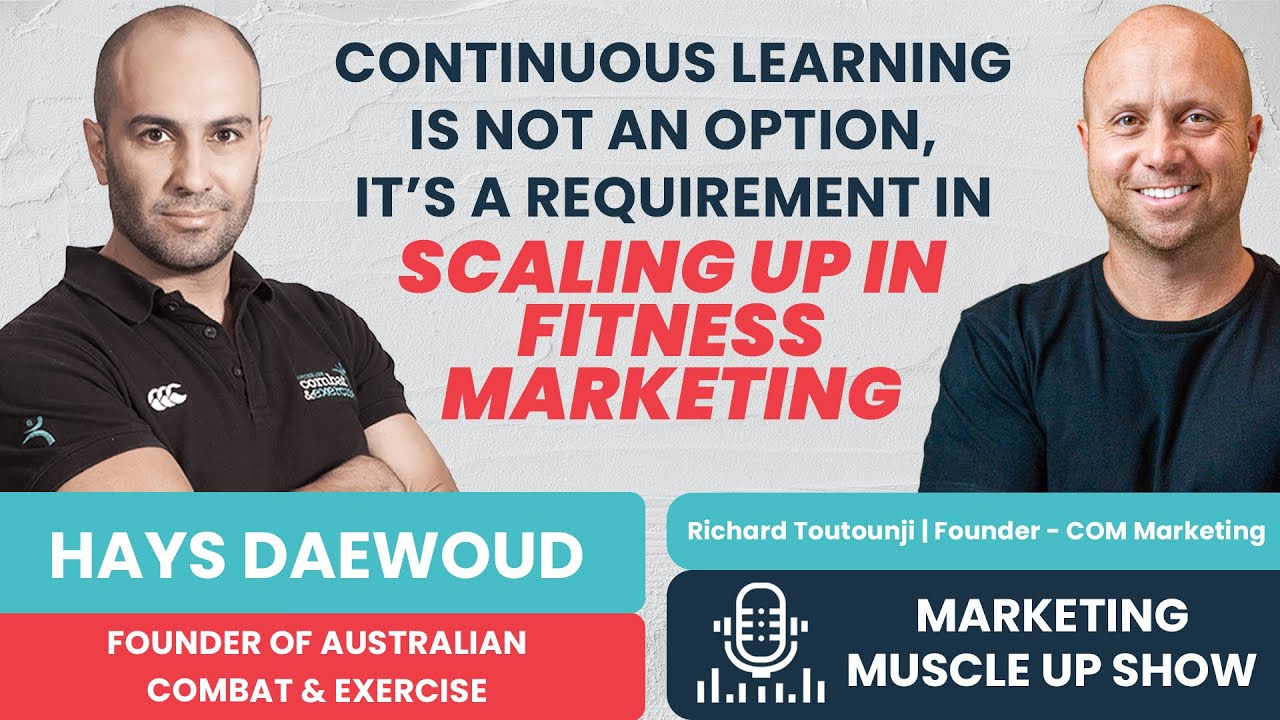
In this episode of the Com Marketing Podcast, host Richard Toutounji interviews Hayes Daewood, a former corporate IT professional turned martial‑arts entrepreneur. Hayes recounts his journey from a redundant IT support role to founding Ace Martial Arts, a world‑class Sydney facility that uses a strict onboarding system, private sessions, and a no‑ego belt policy. He explains how he identified a safety and standards gap in boxing‑fitness instruction, leading to the creation of Australian Combat and Exercise (ACE), a train‑the‑trainer education platform offering multiple accredited courses. Hayes shares early marketing failures—mass‑produced T‑shirts, cold‑calling gyms, and lack of industry research—alongside the lessons learned that refined his approach. He highlights partnership‑driven growth, emphasizing regular communication, human‑centred relationship building, and leveraging his corporate network. The conversation moves to leadership philosophy, where Hayes stresses personal connection with clients, floor engagement, and fostering a supportive team culture. He reflects on post‑COVID market dynamics, noting a surge of inactive individuals ready to re‑engage with fitness and the need for trainers to be well‑educated to address their concerns. Finally, Hayes offers advice for professionals balancing a passion project with a career, urging them to maintain side‑hustles, invest in continuous education, and treat their passion as a sustainable, incremental commitment.
Chapters
We all come from that place of aiming for perfection. We understand that's not sustainable for the fitness industry when you've got so many modalities you've got to work with. But
yeah,
we just challenge them to improve as close as we can. Let's aim a bit higher. And we, we show that in our education, in our progression systems. Let's not just jump to driving the Formula 1 car. Let's first learn how to drive the Ford Laser, get our skill set, and move to the next step. Step by step by step and nail it every time. Ladies and gentlemen, welcome to the Com Marketing Podcast.
All right. And that was my next guest, Hayes Daywood. Now, for those who are in any kind of martial arts, combat exercise, education, sports science, You're gonna love this next guest that I have on today. He comes with 30 years of experience in martial arts and nearly 20 years as a coach, and he's decided to take on a mission and improve the standard of boxing and exercise in the fitness industry. Now partnering with some of the best in the business, he's used exercise science-based research to develop practical courses for personal trainers, SNCs, coaches, physiotherapists, just to name a few. Welcome to the podcast, Hayes.
Thank you, Richard. Thanks for having me, mate. Appreciate it.
Very good. Well, we got on today and I'll— first of all, I just want to, um, shout out about your, um, your, your voiceover, Hayes. I just can't, I, I can't, I can't stop staring or listening to your voice. Take me through why What is it? Where's the radio? Is it a radio head or the radio voice, Hayes? They always say that if you've got a great radio kind of voice, it means you're made for radio. Is that true or not?
Well, I think any bald man is made for radio, Richard.
I don't know about that. I prefer video, Hayes, so speak for yourself.
Look, it was a little— I do things spontaneous and I was driving to work 15 years ago and I heard a guy on the radio do a live voiceover read and I just became obsessed with the ability to sell something using my voice and booked in for a voiceover course. And next minute I'm a voiceover artist. I'm working, I'm doing message on hold and some short ads. I loved it and I miss it and I'll be back in that world soon.
Well, I will be definitely hitting you up once we start to do some radio ads.
You'll be my voiceover. Is ComMarketing advocating radio as a form of A medium for advertising.
Well, with your voice, we definitely will be getting into there. I think the conversions will go up. But I did want to get into, you know, we've kind of known each other well. You know, you go to these events and conferences and you've seen— I've seen you speak at Fylex and present and keep running into you. And I really want to get you on the show to understand, unpack the passion that you have for the fitness industry, one, martial arts, two, education, three, the There's a bit of a combination there that I want to take you through. And I guess for anybody who's listening, there's two sides of your world. Side number one is you actually have a martial arts, a world-class martial arts facility in Sydney where you're in there every day. You've got your trainers, your team, your clients, you've got rings, everything. It looks absolutely outstanding. And then world number two, you have a business with your business partner, Australian Kombat and Exercise, where you present a lot of different courses, both face-to-face and online all around the world. And I guess when I see somebody that's in 2 worlds, there's always a story. There's always—
Yes.
You know, why we're going out and delivering these courses to thousands of, you know, fitness professionals and EPs around the world. So I'm kind of like understanding where did this Where'd this desire for education come from, Hayes?
Well, I stumbled upon it. I worked in the corporate world for 11 years in finance and I studied IT. I left school at a very young age. I started at MLC. Shout out to MLC if they still exist. I was 17 when I started there as an IT support consultant, worked my way up the corporate ladder. And then 11 years into it, I was on leave and I got a phone call and they said that my role had been made redundant. Wow. Yes, on holidays. Very nice, very nice of them to do that. And as I would, I fired up and I was pretty upset and disappointed and my world sort of came crashing down and, you know, got a bit emotional and a bit angry. And when I went back to the corporate world, I had lots of opportunities to take on other roles and make more money, but I felt the need my time was up and I wanted to follow my first passion and teach martial arts full-time. So that's how we kicked off.
And you hadn't been teaching up to this point?
You'd just been— Yeah, actually, I've been teaching part-time since I was, I think, 15, 16. And I was actually running sessions in the squash courts at MLC at lunchtime, teaching boxing and kickboxing.
Bit of corporate health, eh?
Yeah, a bit of corporate health. And on the weekends, I do private training. And for me, it was perfect to have my career and my passion on the side as a side hustle. So when I got retrenched, it was just easier for me to jump into that space.
What is it with side hustles? I'm seeing a lot more side hustles happen now at the back end of COVID here. And There's something with side hustles. We do a side hustle because we want that enjoyment of that hobby, but sometimes side hustles become the front hustle. Was that the case with you? Is that how— it was a side hustle and then all of a sudden, boom.
And to be honest, when I got retrenched, my mind was going berserk. I'm like, okay, do I do voiceover work? So I bought a podcaster and I started doing casual voiceover work for real estate agents. I started working right away. Do I become a barista because I love coffee? And I just kept going to the martial arts. I'm like, that's my thing. I'm known for that. And I set the martial arts business up and I used my corporate contacts to set up my first service under the company called Ace Martial Arts called Corporate Combat, which was teaching corporates kickboxing for fitness. So that was basically my first point was to contact all these people in finance, Hey guys, you're sitting down all day, you're unfit. Why don't I come to you and give you a workout, workout of your life?
Wow. We must have been in the same trajectory. I had a corporate wellness company and we also— I was always trying to find people that could actually do corporate martial arts and things like that. And that was a very popular program that we had when I had my lifestyle's corporate wellness company. People loved it. They loved getting beat up at work, right?
Absolutely. And that was really popular. I had 5, I think 5 groups, 5 companies within the first few weeks of business. So I was making money very quickly. And then I started doing one-on-one private lessons to people in their homes around Sydney CBD, in the eastern suburbs, in the south. I was everywhere, south of Sydney. I was driving everywhere like a madman and getting a lot of speeding fines, unfortunately.
Comes with the job. Yeah. All right. So you're the guy to go to when anybody really wants to learn the skill. Why? I just want to dig into that business just a little bit. And that business, for those who are listening on online, it's acemartialarts.com.au. You can check that out, check the facility out as well. What's the difference here? And I want to get to the education in a second, but What's the difference here with any, you know, compared to any other martial arts? What, guys, makes you unique in this world?
So I got my black belt in a system called Freestyle Martial Arts, which takes the best out of many systems with progression. So it's a mixture of boxing, kickboxing, Muay Thai, Brazilian jiu-jitsu, wrestling, martial arts weaponry, traditional weaponry, self-defense, close quarter combat, It's a mixed system. It took me a long time to get my black belt and I still offer that today. And the difference between, I guess, what we do is firstly, people can't come and join our classes. We've got an onboarding system. So you have to first come in and do mandatory private training sessions.
Right.
So to give you a base and a skill set. So when you come into the class, it's not a daunting environment. I make certain rules. I don't allow the use of black belts in class. So when you grade in our system, you get a belt, but I ban the use of them in class because I don't want ego. So everyone is equal on the mats. We've got a clear syllabus that everyone has access to and a very clear progression system which holds me to account and the student to account. And most importantly, no egos. We have lots of fun and Yeah, it's my passion and it brings a smile to my face at 5 o'clock every evening when I— when everyone starts walking in. And after a day sitting here at my desk, it's, um, it's just perfect.
Yeah, amazing. Um, well, it would take you a few years to get a black belt in all those, um, areas. Um, anybody who's done martial arts and mixed martial arts and in that world, I take my hat off, uh, to everybody because I think there's a huge— there's a huge, um, it's not just the actual training time, there's a huge sacrifice that goes into anything.
Absolutely.
Especially into that world. But take me through then, you know, when you achieve black belts, how does it now, you know, how do you set up, I mean, the other side of the business, which is further education? Because anybody who's going through a set syllabus and structured process like that obviously means that you like structure and you like to do it well. I'm assuming that's your personality coming from IT as well. Now things are starting to make sense to me here.
Right, right.
Systems.
Funny, funny. My last role at MLC, they created a role for me before I left. It was continuous improvement manager. And I looked at how to just make things more efficient. And I've created so many systems in the martial arts system that don't exist. And that carried over to my education to make it easy for people to learn. People do want results faster. We wouldn't want to sacrifice on technique. So the systems, I love it. If I think of something and I can create a system or a pattern for it, I'll do it.
Yeah. Great. System, pattern, and execute out. Let's, I guess, pivot over to the other side of the business, which now you said takes up 80% of your time. So you're in there in the morning and the evenings doing some classes, showing people how it's done, but then in the daytime, You're actually getting more of the education out to personal trainers, EPs, you know, any events that are around, you're there doing your thing, teaching, teaching, running CECs, CPCs, the whole kit caboodle.
PDPs.
Yeah, everybody's got their little alphabet. They're going to do
it.
Tell me about that around the creation of courses? What does it mean for you to get this information out to other, you know, fitness pros?
Yep. So that, that business, Australian Combat and Exercise, came about from me running corporate sessions in the park. I witnessed boxing fitness being run by PTs and group fitness instructors, and I noticed there was a massive, massive gap between what I was teaching and what they were doing. The standard was horrendous. It was unsafe. And from there, I ran another corporate session at Fuji Xerox, and Dr. Luke, our very own Dr. Luke, was managing the health center. And it was there he provided feedback and said, mate, this style of boxing for fitness, we need to teach the fitness industry this. And I mentioned what I saw in the park. So we built a train-the-trainer program called Boxing Skills and Fitness with the Sports Science of Boxing.
Right.
And all we did really is go back to basics and create a progression system and add the science behind it. And that was our first course. And the day it got approved by Fitness Australia, now AusActive, was spectacular. I was very excited. Then I was like, okay, now the fuck do I do? How do I get people to know about it? So I was, I was stuck, but It all came about from the martial arts business. And I remember just phoning gyms, Richard, saying, hi, I'm Hayes. I've got a new boxing course that you need to do. And they were like, yeah, nah, there's people in the industry doing that. Thank you. Bye. So the cold calling thing failed miserably.
Yeah. But was that before or after the radio gig?
It was after. But mate, It was a different world for me.
Yeah.
Calling gyms. So all the interaction in my life were with financial planners and people in the corporate world. And then I'm calling gyms and I, to be honest, other than training at a gym and doing weights, I really had no idea how it worked. So I'd call the receptionist at the gym saying, got a boxing course? Yeah, no thanks. So that course got created for months. I didn't know what to do and I resorted to walking down New South Head Road in Sydney, walking into the gyms with flyers introducing myself. Here's a course, same outcome. Yeah, mate, nah, nah, we're good. Until someone heard, a friend of mine heard that I was doing it and told his gym, mate, there's this guy running a Train the Trainer course, it's the best boxing course. Even though we hadn't run it yet, but I believed it was the best.
Yep.
And I got, um, an introduction with a big fitness franchise, and I did a pilot for them at very cheap rate. And the rest of it, the rest is history. People did that course. We had 12 people, I think, and they loved it. We got video testimonials, and, and then the word of mouth in that franchise grew. And yeah, that's how we kicked off.
Well, I think there's something there. I'm just looking at your website now, Oz Combat ex.com, you can find that. And, you know, the best boxing course I've ever done, but one of the best fitness courses of class I ever attended. And this is Libby Barlett goes on to say the presenter had incredible attention to detail. And that's what I want to talk about because there's courses and there's courses. And, you know, that's why I love the background of where courses and businesses come from. Everything, you sort of say, what sort of business are you going to be running? You just go to the background, you can always tell the type of service and structure that will be in place. And so, the details, tell me about the details of, I mean, of education, I think, as a whole. Why is it so important? Because there's so many different ways. People might say, yep, I just do my boxing class, I'm good to go. But you're doing it at a different level. Tell me about the difference of structurally when you go into an education course like martial arts. Why is that important?
Okay. So training in martial arts and the coaches I had throughout my life, basically the goal was to be as perfect as possible. We must aim for perfection.
It
was drilled through all my masters. If it wasn't, if it was 80%, it wasn't good enough. So that was ingrained in me.
Yes,
you must aim for perfection wherever that is. That's our target. Now, with the fitness industry witnessing the boxing fitness sessions, I knew that we're not, we're not going to get these guys into fight trainers, but if we can just make it from, take it from below average to good at least, right? We're going to have a better standard trainer. We're going to have a better standard industry. We're going to have happier clients. We're going to have less injuries. So that obsession for perfection— and it's not just me. One commonality all our team have, even the lifting team, technical lifting, we all come from a martial arts background. So Shannon Green, he's obsessed with strength and conditioning. I'm obsessed with martial arts. Dr. Luke, He's a researcher, but we all came from martial arts. We all met through martial arts. So we've all got that mindset of let's aim for perfection. So when we present, they see that, they feel that in our courses, in our face-to-face courses. We go in there, we provide so much detail and passion behind it. No matter who the presenter is, we all come from that place of aiming for perfection. We understand that's not sustainable. for the fitness industry when you've got so many modalities you've got to work with. But
yeah,
we just challenge them to improve as close as we can. Let's aim a bit higher. And we, we show that in our education, in our progression systems. Let's not just jump to driving the Formula 1 car. Let's first learn how to drive the Ford Laser, get our skill set, and move to the next step, step by step by step. And And nail it every time.
Yeah. Very good. Very good. All right. I want to go back. You mentioned when you were starting these courses, you had no idea how to market the things.
Yeah.
Disaster. Disaster. Now you've got your courses selling in many, many countries, thousands of people. Tell me about some of your best marketing and some of your worst marketing. Let's start with the worst, please.
Yeah, fucking worst. Yeah, sorry, sorry, I shouldn't swear. So when I started Ace Martial Arts,
yeah,
a friend of mine said, you need to get shirts made up, make a big buzz around the city. I said, okay. So I listened. I bought 200, 200 white t-shirts.
Yes,
it took me years to get rid of those shirts. They cost me $4,000. And I don't even know why I did it. I only had, what, 10 members at the time?
Yeah.
So I realized very quickly just to be careful of the advice I get from people that aren't even in the industry. People are always trying to give advice. So that was my first blowout. And it's funny. And those shirts, every now and then in my garage, you'll see one of them pop out of somewhere.
All right. Yep. They're still there. Yeah,
they're still there. I still haven't got rid of them. So anyone wants any white Ace Martial Arts shirts?
Yep.
Retro. They're retro now. They don't— yeah. So that was one of them. And I, I think cold calling the gyms and not knowing at the time, not knowing enough about the industry and how it worked, I should have done some planning and did a bit of research because I was very angry that day, like getting rejected over the phone. over and over again. And then some of the questions some people asked, I didn't know what they were saying. Does this course do this? I'm like, oh, is this targeting this? Oh, so I didn't do my research. So that's a couple of major errors I made. And I think with marketing, listening to too many people, you know, listening to too many people and just not going with my gut sometimes and There's experts in marketing for a reason. Your mate that runs a kitchen place, probably not the best person to speak to about that.
Very interesting. All right. And I hear you with the, when you print things out and you can't get rid of them, but I also think you can't just throw them out, can you? It's just, you just can't bring yourself to throw them out, can you?
No, not a t-shirt or— beautiful glossy flyer. But look, if you think about it, there was a learning, like creating the t-shirts. I learned what's involved in screen printing for my business, the pricing. I learned that with flyers, I learned about printing, about the copy, the GSM. So even though a lot of these things were failures, I learned going forward about that type of marketing, which was I tried it all and there was a learning from it all. So keep trying, keep trying, and just be careful how much you spend sometimes.
Yeah, great. Okay. So what's the best ways that you marketed your martial arts facility?
The martial arts facility was using my network, my network initially of corporates. And I already had rapport with them. So that was quite easy. And then Initially was just calling people I knew and sending emails and offering some free sessions back in the day.
Yes.
I'm gonna do a group session for free at Sydney Observatory Park for this insurance company. You get 20 people and then they'll sign up. Who wants to sign up for the next 6 weeks? Here's the price. So didn't even give them an option. Next week we're doing this. And yeah, that was then. With the education, for me, I must say partnerships and just meeting people and sharing my passion. And yeah, partnerships has taken us quite far.
Tell me about the partnerships because I think that's an interesting angle, especially if somebody's Facebook ads, they're struggling with that or they're struggling with doing one-to-one marketing. Tell me about how you run a great partnership marketing piece, Hayes.
Look, it's regular dialogue with the business. So if it's a fitness franchise that wants our education, I'll make an effort to always communicate with them. Monthly phone call, sending emails, providing some content. You've got to keep going. If it's a partnership, you've got to keep coming, keep communicating with them. It's not, all right, we're partners and we've forgotten about each other and that's it. It's just nice on paper. So I'm always trying to have dialogue. And, you know, I think it's important. Peter V'Landys said it once and I loved it, um, the head of the NRL Commission, that he will— he said in his podcast he's got a lounge at the RJC where he brings people in and doesn't talk anything about racing or rugby league. They just hang out. And I love that too. So if I can catch up with partners and talk about life and Sport, and just put a bit of a human touch to it is very important for me.
So, so it's, it's the old saying that people will do business with if they like you.
Yes, absolutely. Be a nice guy and be honest and share your passion. No one's ever said to me, shut up, man, you're talking so much about your martial arts or about your courses. All right, your courses are the best. All right. No one's ever said that. They actually get joy about it and they want to support you.
Yeah. Yeah, that's great. I like that principle of just being nice, talking to people. That's really— I mean, with partnerships, that's kind of what it's about. And I think if you're not— you're a person that doesn't enjoy that or struggles with that, I think that's something to really hone into. It's— sometimes there's no— I've asked this question a few times to a few different people, and a lot of the time, yeah, it's really just about being nice and talking to people. And then seeing where that goes, it's almost like you've got to bake before you can ask.
Yeah. I love that. That's great.
All right. So let's move into something else, you know, you're really super passionate about. And that comes down to the, I guess, those principles of helping people out, move up the ranks. And I come back to the education piece, the leadership piece. What are your attributes? I mean, I want to sort of hone this podcast into anybody who is a small business owner that has a martial arts facility, fitness facility. How do you become a good leader to your team? You may have a team, a micro team, maybe another trainer, or you may just be yourself. But how do you be a good leader even to yourself, your team, and then also your students or your clients, depending on what you're calling them?
I said to someone recently that I could have a coffee with every one of my clients and we can enjoy each other's company. So building that strong relationship in the martial arts world, for me, you know, it's a very close— look, everyone throws the whole family environment thing, but,
you
know, Hmm. I know the husbands and the wives of everyone here. I'm always talking to them. Every class, if we have a big class, our big class is, let's say, 18 people at most. I make sure I get around every session and have a chat to every individual. You know, I say hello, and I know it sounds quite small, but I've witnessed in places people aren't saying hello to their clients. They just walk in. Oh yeah, but that client doesn't want to talk. Say hello. How are you? What's happening? Make them smile. Touch them on the shoulder. Awesome work. We can improve that. Do this. Da da da da. Have that interaction. Work the floor. Like, you know, you don't stand there and just call out combos or instructions or exercises. Work the floor. You'll be getting paid to coach. Work the floor and have that engagement with them. And I don't see that a lot. I don't see that a lot. And I make sure when I'm running our courses, we share that with trainers. Work the floor and engage. With my other business, education, I love my team. We all wave each other's flag. Everyone's a fan of each other. It's just brilliant. And when we're all together, we're all in awe of each other. And for me, getting the right people in there are so passionate about the subject matter, it's almost annoying. They can just talk about that all day. is brilliant. It's just so good to watch. And one guy came to dinner once with some of my team. He was— he said, I just love listening to everyone and I love not being the smartest guy in the room. And I said, everyone feels the same way. It's so good. And we have a lot of fun. And look, there are tense times. And look, I think part of leadership, I give a lot of love, but I can also get a bit cross sometimes, but that's just part of the passion. And we can get cross at each other, but we communicate all the time. And that's what makes us strong.
So leadership, um, raising them up, not pulling them down, that's your philosophy?
Absolutely.
Giving them love and being their biggest, um, fan. Cheer squad.
Big cheer squad. Yeah.
I've got 2 more questions for you. Question one, I want to just get your view on things now. Um, it almost seemed like, um, I liked having this, I guess the big question out there, and I know COVID, nobody wants to talk about it still, but I still want to talk about it because I like to know what did you see? What were the successes that you saw through the period? And what do you see that's going to happen and roll out over the next 1 to 2 to 3 years based on what happened over the last 2 years? I just think that there's still a lot of lessons and there's still a lot of unpacking to go. And I'm always curious to figure out, well, from your seat and where you are sitting, What are you seeing both in, if you have a martial arts business or where are you seeing the landscape? Is there any change at this point?
I was surprised to hear the other day, someone called me saying, I haven't done any exercise since the lockdowns and it's time for me to start again.
Now,
so if that's one person, how many of those people are out there?
Wow.
So the effect, this could be for years to come. So we all need to be prepared for that, to have that conversation. And I'm like, great, this is so positive. Let's do this. What are your goals? And he's coming tomorrow, this guy, to train, start his martial arts journey. But, and he's a CEO of a company, so he's got discipline, he works hard, but people still haven't gone back to their routine. So there's a market out there for PTs, martial arts instructors. There's still so many people that still haven't kicked off their routine of fitness and health or wellness since the lockdown. So we're going to find a way to be prepared to have those positive conversations, to, to know the right things to say. Yeah, so that blew my mind the other week. So that was a learning for me. So they're still out there. As far as the evolution of fitness, look, it's always changing. It's been changing for years. I think for trainers, keep educating yourself. Um, speak to people, speak to your friends, ask them questions. If they don't exercise, why? Arm yourself with the knowledge. Do courses. If you've got that knowledge across the board, you're going to have much easier conversations when people come in, knock on your door So that's what I've seen with the COVID situation. It's still out there and sadly businesses are still closing down. You see it in Rockdale, food businesses. I know fitness studios, martial arts. It's so sad. So don't panic. I think there's such exciting times for the fitness industry and the martial arts industry. People are still coming back. And let's just put out a good message out there collectively as a group. Come and train.
Yeah, love it. Come and train. And wow, that you know knowing when you see like hearing that I haven't trained since lockdown. I mean, I think this is really good, and it goes back to the the concept that again, I think you just got to realize that just because we fit, we see people every day, we see the fitness people, we see that percentage. You know, a big part of the world is not yet. in facilities is not yet training with somebody in a structured training program. There's such opportunity that sometimes I do, we do feel we miss. And I'm loving those kind of conversations because honestly, I really believe that this is where we can do a much better job in marketing when we understand who we're marketing to and what their real pain points. And a lot of the time it's not, I want to lose weight in 7 days. It's none of that stuff. It's just taking those first few steps. So
yeah, get back to routine again. Get back to routine. Get back moving.
Yeah. Great reminders. Great reminders. Last question for you. Now, what is the biggest advice? So there's, again, there's people that decide to leave the fitness industry. There are people that have worked their hobby on the side through COVID. I'd like to know, you know, I love to ask this question for anybody who's been in the industry for a while, or they've been through different careers. What's your biggest advice for someone who's choosing to go, should I go with my side hobby, my passion project, or should I just keep plugging away? In your case, it was with the IT technology. That was what you were told, and then you found this passion project. What is somebody— what is your recommendation at this point in the world that we're in? What should people do?
Look, if fitness is your passion, I think similar to what I did, you know, if you can manage your career, let's say you're working in banking and you are a PT or a former PT, keep it in there, keep it going, you know, schedule a few hours, maybe a few times a week, and do some PT. You're making a difference to society, you're getting up and moving again. If you don't have the capacity or the finances to run it full-time, don't let go of it, don't throw it away. And same on the reverse. I've had people work in corporate that want to become PTs but aren't sure. I said, well, do a bit of both. Speak to your managers about maybe part-time, different hours. Make it work because if it's your passion, it'd be sad for you to let it go. If you could dedicate your Saturday morning like I did back in the day, Saturday morning, 8 o'clock start in Sutherland, teaching till midday, favorite day of the week, teach martial arts. And I still worked in corporate. I enjoyed my time in corporate. I was learning a lot. It was my university.
Yep.
Keep your passion there, whether it's for 45 minutes a week or for 10 hours a week. Keep it there. Don't get rid of it and keep educating yourself. That's my advice. You get your qualification in fitness or your degree at university. There's so much knowledge out there. You know, there's so much knowledge and the RTOs and the unis will be the first to say, we can't teach you everything. When you do your Cert IV, you're just walking in, you're putting your toe in the water when it comes to knowledge. And even the worst course, you'll take something positive out of it. I remember going to martial arts seminars growing up. A lot of them were dodgy, but there's always one thing I took out of that session, whether it was great, I'm a great coach, But go and educate yourself. Don't be afraid to invest in money. Don't be— invest in education. There's a lot of free education online. That's my advice.
Excellent. I like the advice of sticking, and sometimes that's a great thing. Like, we don't have to— it's not sometimes black and white in today's world, right? It's gray. And I'm getting used to more of the gray areas. People that are doing a— it could be a side hobby afternoon. The world is very mixed and you've got to figure out where that balance is, and it's going to be different for everybody. So I love the advice. Hayes, before we wrap up, there's 2 kind of places where people can go. I guess I'm keen to come past next time I fly into Sydney and do a workout with you at your facility in Sydney. And you can check that out. On your website there at acemartialarts.com.au. Talk about if you're a PT, business owner, somebody who wants to upgrade their skillset, what's the place they can go to and find a course that you're running next?
Yeah. So our website for Australian Combat and Exercise is aceexercise.com.au or aceexercise.com. So our courses, Go from boxing, kickboxing, technical lifting, technical lifting, strengthening the upper back and assessment, interval training, bodyweight training. We've got about 10 courses on the way. We're very excited on the online space. Yeah, but learn from us, learn from everyone. Thanks though for the plug. I appreciate it.
Thanks, hey, it's good to have you on the board, guys. If you enjoyed this episode, go check those sites out and see how you can find your hobby, find your passion, and educate yourself a little little bit more to be a better leader in the industry wherever you are. Team, if you enjoyed this episode and you want to get more of these, just go to our website, commarketing.com.au, and you can find out more of these. Go to our resource section. And if you do want to educate yourself through marketing to get your business out there, we are running another Fast Fitness Leads Challenge. It's starting next month and we're going to be taking you through the 9 best strategies that you can do to use your database, if that's social media or emails, to generate your next 5 to 7 clients. I'm super excited, and I'm always excited when, when I say, hey, how'd you go? And they go, oh, I just added $100,000 to my bottom line after getting 10 new clients in. So it's super exciting when that happens without spending any money in marketing. Team, I'll catch you next time on the Marketing Muscle Up podcast show. Bye for now.









