Don't Miss Out on 42.7% of Your Clientele with Jen Dugard
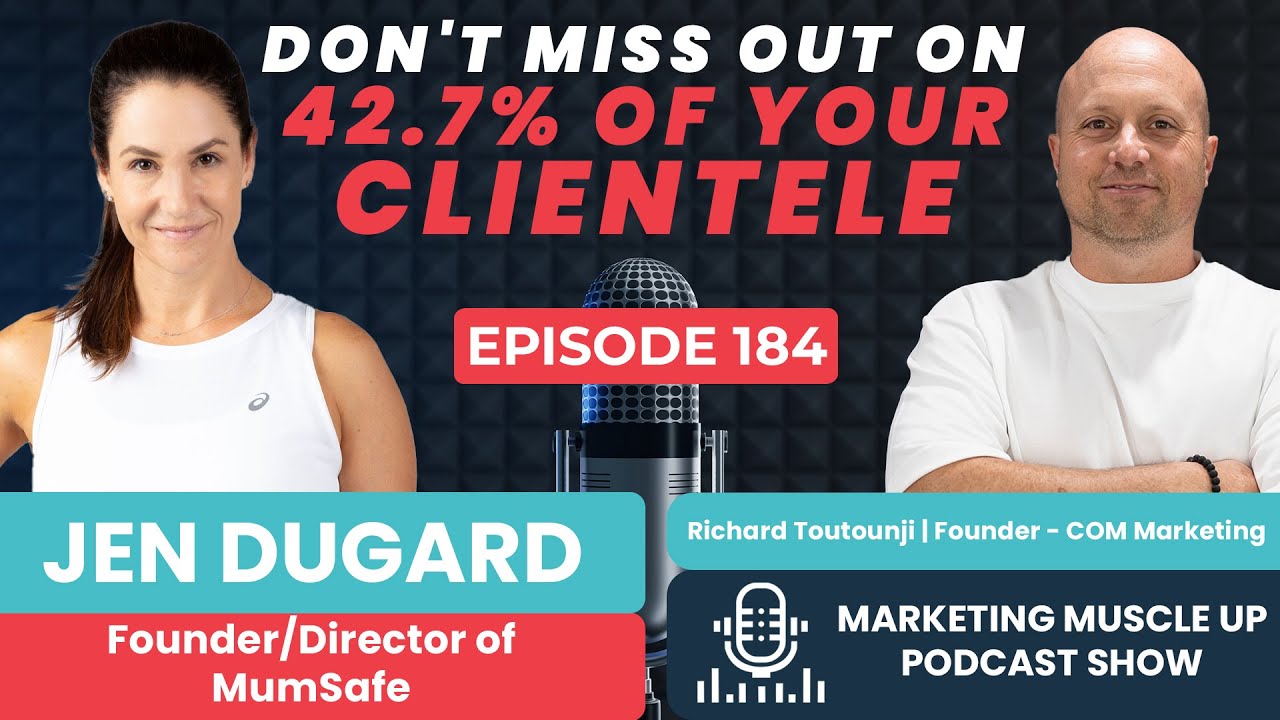
In this episode of the Marketing Muscle Up Podcast, host Richard Deterjan interviews Jen Dugard, creator of the Safe Return to Exercise certification and the Mum Safe program. The conversation opens with a striking market insight: women make up 4.35 million of gym users in Australia, and 77 % of women over 15 will become mothers, meaning roughly 42.7 % of a gym’s potential clientele are mothers. Despite this, many fitness facilities fail to speak to or safely serve this segment. Jen critiques the pervasive “get your pre‑baby body back” narrative, arguing it fuels body‑image pressure and excludes many mothers. She outlines her mission to make post‑natal exercise safe and inclusive through education, certification, and a community‑first mindset. Key components include the Safe Return to Exercise certification, the Mum Safe directory (mumsafe.com.au), and a partnership model with women’s/pelvic‑health physiotherapists. Jen stresses the importance of inclusive marketing – using real‑mum imagery of diverse shapes and sizes, language that emphasizes connection over transformation, and grassroots outreach such as active flyer distribution. She also shares business lessons: tracking income and expenses, setting clear boundaries, and aligning work with personal values (courage and connection). The episode concludes with practical steps for trainers to join the Mum Safe network, access resources on jendugard.com, and connect via Instagram, while reinforcing the broader opportunity to capture the 42.7 % of clientele that are mothers.
Chapters
Look at the actual mums that are in your gym. Take photos with everybody because we often find ourselves gravitating towards the person that, you know, might have the best technique or might do the best thing. But if you got a group of mums from your gym in all different shapes and sizes and got them having fun and feeling good about themselves, you're going to get some really, really great imagery.
Welcome back to the Marketing Muscle Up Podcast Show. I'm your host, Richard Deterjan. In today's episode, we're gonna talk about niche marketing. We're gonna talk about audiences that you may not be able to understand how to talk to that audience, how to market to that audience. And today's— today my guest is the amazing Jen Dugard. Now she's been on our podcast a while back now, but I wanted to get her on again because her stuff is really ramping up and it's really interesting where Jen and the Mum Safe Program is going. Let me just share a little bit about Jen before I get her on here. Now, she's the creator of Fitness Professional Certification Safe Return to Exercise Program and author of the book How to Love Your Body as Much as Your Baby. I just love that title. Now, Jen's been in the game for, I reckon, around the same time that I've been in the game with over 17 years of industry experience. Jen's ultimate passion and ultimate mission is to ensure all moms are looked after safely and effectively within this fitness industry all around the world. Now, Jen serves both moms and fitness professionals, and ensuring all fitness professionals are properly educated and upskilled in working with their pre and postnatal clients. Now, this is really interesting, and she also connects all her trainers On this amazing website, you could you got to check it out. It's momsafe.com.au. momsafe.com.au. She also serves on the board of Oz Active and as an ambassador for Asics the shoes. How good's that? And coaches for Dent Global. Welcome to the show, Jen.
Thanks for having me. I'm excited.
I'm pumped. We hung out on the weekend with a few fitness industry and Oz Active events. And the thing that the reason why I want to get back to you because you've got this authenticity of. Just getting it done, staying in your lane. And I'm really interested because we talk a lot about moms in marketing. I think all the time. I don't know why we use that example all the time because it's almost like this sector of the marketplace that we think obviously they want to get fit again. They want to bounce their body back again. And I know you hate those words. That's why I've shoved them right in your face early on. Tell me about, you know, why you were so passionate about this area.
Yeah. So there's a few things that come to mind, Richard, when you say about the get your body back, because I just fucking hate it. I think that, yeah, there's definitely the body image side and the fact that we should not and cannot assume anything about why a mum is walking into a gym environment. And I do believe that gyms and exercise facilities have, or the fitness industry as a whole has a lot to be responsible for when it comes to the pressure that women feel after they've had babies to get their body back. So if we could eradicate the phrase get your pre-baby body back from all of our goal setting language inside our gyms and fitness facilities, that would be a big step in the right direction. And then of course there's the other side, which is the technical space and the fact that Women have babies, they have a 6-week checkup. The 6-week checkup is not any kind of clearance to say, go into the exercise that you were doing beforehand. It's the end of their medical clearance in a hospital. So it's where the care of the obstetrician or the GP or the midwife ends. Yet we as a fitness industry have somehow adopted this 6-week check of being tick of approval, go and do whatever you want to do. So my mission is to make sure every mum has access to safe and effective exercise. And to do that, we need to make sure all exercise professionals are educated in how to work with mums. And the most important, I think, really to the people that we're talking to on this podcast is it doesn't just mean exercise professionals that specialize in working with mums. It's every single exercise professional. And when we don't do that, not only are we not looking after mums properly, but your gyms and fitness facilities that have lots of mums walking through the door every day are missing out on this huge opportunity to better serve those women, retain them, Yeah. And look after them properly.
Well, I've heard, Jen, that you've thrown some figures out here and I want to understand what these figures are because we can— you are basically saying we can better attract and serve and retain 42.7% of our clientele. And this is a marketing podcast, so we always love to figure out how we can market better. So can you take us through this, I guess, this space and the percentage of people in here and And what they really need. That's really interesting.
Absolutely. So I'll pull some real-life statistics. So in 2020, Statista told us that 4.35 million women used or participated in fitness or gym activities, and that was in comparison to 3.5 million men. So we've already got more women walking through the door or asking to train in our boot camps or whatever it may be than we have men. Now, there's a further statistic from 2016 from the ABS that tells us that 77% of women over the age of 15 in Australia will become mothers. So when you break that down, 77% of 4.34 million is 3.34. So we're edging closer to the men. Like, we're 3.34 million mothers in comparison to 3.5 million men. And then I asked my 15-year-old son to help me with the statistics on that, and it turns out that that means that 42.7% of the population that are walking through the doors of a gym or are the potential clientele of a newly qualified trainer are going to be mothers. Yet we're just not understanding how to talk to them, how to work with them, how to serve them.
I think that's totally true. We just assume that, yep, they'll, as you said, after the 6 weeks check, yep, let's get straight back into it. Yeah. I think when you're taking an exercise class or a Group X class, like who's— you ask the question, who's pregnant? I don't know if they still do that, Jen. I'm not sure. But, and that's, we assume that's good to go, give them a bit of low exercise. But I think there's much more into it. Before we get into the details, which I know you love, by the way, I'm really interested in yourself. I remember, Jen, you used to train at Centennial Park. I think our company did some videos when you went to awards and that kind of stuff. And you've had You've had real life experience and you've stayed in this one niche, in this one lane for so long. Can you tell me the reason? What's that big why for you? You've been a trainer and now you are going global and really educating more trainers so that can live on. Tell me about the why for you in this industry.
Yeah, the why really does every single time I think about what I'm doing or what I'm going to do next, come back to that mission of making sure all women are looked after safely and effectively once they become mothers. And I was actually talking to someone about this at the events we were at a couple of days ago.
Yeah.
And she was like, where did you start? What did you do next? Because she'd had a career that she'd gone into different things and tried different things out. And I've kind of gone, I had a baby in 2008. My background was I knew that when I became a personal trainer that I wanted to specialize in something and I wanted to build a business rather than stay as a personal trainer in a gym or fitness facility. And Body Beyond Baby was group exercise with onsite childcare in Centennial Park, probably at its biggest. We looked after about 100 women and I don't think I had that mission articulated to that degree at that point. But I know that I was definitely thinking if I want to reach more women, I either need to expand in terms of location. So we need to multiply, which we did. We went to Willoughby and we also went to the inner west to Birchgrove.
Yeah.
Neither of those locations were as big, but that was me kind of testing the waters, trying to figure out how I could reach more mums. Then I created Safe Return to Exercise in 2016 because my thought then was, if I teach the trainers, then the trainers can then teach the 100 women each. So you're multiplying that. And then as we step forward and continue to do what we do, the passion really is, how do we consistently level up serving more moms? So every woman, and every woman might mean we have a free program on our website for moms that is called Safe Return to Exercise for New Moms. And that's an offering that sits there for women that are never gonna be able to pay for the services of a trainer. So there's lots of different, yeah, that's the passion. The passion is the mission every single step of the way. And alongside that sits helping small business owners and the ones that I work with are often mums to run awesome businesses because they don't have the, they're not gonna be able to have the potential to reach as many mums that we need to reach in order to fulfill that mission if their businesses are not thriving. So there's a couple of different layers. Yeah.
Love it. Yeah, really like that concept. And Jen, you mentioned obviously you had your first child in 2008, I think you said. Yeah. You've been running this business, being a mom yourself, and I think it's school holidays today, first day of school holidays. First day of school holidays.
Yep.
Thanks.
I should say that to you. We never say that to dads, do we? Like—
No, we don't say it to dads. No, but it is the first day of school holidays here too. So it is an interesting one. It's a lot of balancing, as you know. And tell me, does that make a difference, do you think? Like when you're working really closely with this niche of mums, you're a mum yourself. How does that sort of help your clients or the people that you are speaking to? You also going through this too? Is that a positive or a negative, or how does that So are
we talking to the trainers that I work with or the mums?
Well, I think talking to the trainers because I think they're listening to this show specifically. So that would be— Yeah.
I think when it comes to talking to the mums, it really is understanding their business and the why behind their business because the reality is we don't have all of the time in the day to spend working on our business and we are pulled away from the business at different times. So I lean really heavily on understanding my life values and also helping the trainers that I work with or the business owners that I work with to understand their life values. So for example, my 2 life values are courage and connection. And that to me, they're not just business values, they're the values that sit across all our life areas. And that includes family, it includes relationships, includes health and fitness, includes finance, spirituality, all that kind of thing. And that gives me permission when I, you know, I might feel like I wanna be in my business, but I need to create an environment where if the connection I need to have is with my family right now or my children right now, I can feel okay with not doing what I think I should do inside my business and doing that instead. And I think a lot of women or moms specifically need permission to go, you know what, I'm gonna move a little bit slower in my business in this season of life and It's not all about get shit done, although when you're getting shit done, it's very much about getting shit done, but then stepping away and your hours might be shorter. So you might need to be even more focused in that time that you're spending on the business. So yeah, permission values.
I love that. I mean, in our program, our Com Marketing Ninja program, we have a lot of moms. We have a lot of moms in this. And I think every time there's holidays, we know our attendance is a little bit lower and they say, hey, I'm taking time with my kids. And it's almost like that's the pinnacle. Like if you can have a business and be okay with that. But I think it's that guilt, that what do they call it? The mom guilt. I've got the dad guilt. I've got the personal, everybody's got the guilt, right? But is that something you've also got to help with your mastermind and your clients that you train?
Yeah, I think there's guilt on both sides, right? There's this, the guilt of being away from the kids when you're away from them. And then there's the guilt of I should be doing thing within my business. So you almost can't win either way. But what we do help clients or trainers to do is put very strict boundaries around what they say yes to when they take clients, how they choose to grow their business so that they ideally don't end up in a situation where they're in conflict. So if it's a new trainer coming in, start launching a new business, it's just don't work holidays from the get-go. And it's such a relief. When they do that, as opposed to the trainer that comes in, you know, 5, 6 years down the track and we are helping her to undo a whole heap of things and create boundaries with clients that have not been there yet.
I think it's magic. And this is exactly why I wanted to chat to you today because I think it's a huge issue. And especially when you are doing most of the actual physical training to clients in your business, it's something that you definitely have to look after your body. Let's adjust this conversation for a sec because I know I, we could talk for a long time, but I want to make sure that we're hitting all, and we are hitting some cool, really cool conversations here. I want to just flip straight away to marketing for a second. You said 42.7% of your clientele we can help to attract and serve and retain. I guess my question, you know, considering, you know, your language and marketing, what sort of If we start with the basics, how do we attract those kind of people we want in? You've always got the stock images and things like that, but I mean, we're sort of past those days as we all know. How do you turn your business to attract more of the mums that you would want if you wanted to go into that sector?
Yeah, I think definitely considering the language and the marketing. I mean, you just said images that we use and yes, we may have moved away from stock images, but we still often see in our marketing material, whether it's toned women or women that seem to look the best. And I say the best from what media tells us that women should look like. So shifting the message to market away from that, get your pre-baby body back, making sure that your images and language that you use is inclusive. So do you have mums in the picture and not There's plenty of moms that look great after having babies, and I never want to discriminate and say, well, you can't look like that because every woman is built in a different shape and size. But do you have women of lots of different shapes and sizes represented in the imagery that you're putting out to the world on your website and on your social media? Or does everyone look— I'm on the Gold Coast. Is it all the young moms with their crop tops and booty shorts? And you know what? That might be the the deal in your gym and you're aiming for that. But a lot of women, like, I train on a Thursday, I do a run group, and all the people at the run group are in their 20s. So I'm not their demographic. But if I wasn't completely comfortable in myself, I would not have stuck around because they're literally all in their little shorts and their whatever. And maybe I'm the outlier going in there and they're not even trying to attract me in the first place. But if you want your space to be an inclusive space, you need to have representation of everybody that you want to come and train with you.
And would you advise, like, Having a photo shoot with the perfect client that you want? Is that how you'd go about that or would you source photos?
I'd advise having, like, look at the actual mums that are in your gym and take photos with everybody because we often find ourselves gravitating towards the person that might have the best technique or might do the best thing. But if you got a group of mums from your gym in all different shapes and sizes and got them having fun and feeling good about themselves, you're going to get some really, really great imagery. One of our clients actually, Brooke. She runs a business called Fit Pursuit in— she's in Western Australia, and we have a campaign that we've run called No More Pre-Baby Body. And she created some really amazing imagery of the actual mums that are in her class and make them feel good. Yeah, put them in your photoshoot.
Love it. And, you know, from our perspective, I actually like if you're going for a I guess if you're trying to train guys or train, let's say, females, I find females share your content better. I don't know if that's being a little bit broad here, but I find they're much better on content sharing and happy to be in photos and generally more outgoing than guys. Is that fair to say, Jen?
I think so. I think especially your moms, if they find something that they love and a community that they love being part of, you make them feel special and they want to share even more. So having that community in there and them giving you permission to tag them and even sharing those images, talking about what an amazing gym and inclusive space that they train in, then you're going to get that organic marketing and referrals.
Yeah, we were out at Noosa on the weekend and we've got a group of mums and dads in our new school community there and we were going on a boat cruise and there was about 4 called them the the mums and 4 dads, and they all got their makeup done. And one of the ladies got their makeup done and was super impressed with the place. And she turns up, she turns up and has a business card for every single body else because she had such a great experience just doing her makeup and they were serving her drinks and all that kind of stuff. I was like, wow, they didn't even pay her, but she's like literally like happy to share, you know? And that doesn't really happen, I don't think, with guys that much. It's a huge— it's just a duplication, I think, market when it comes to that, especially with the marketing. Now let's go a little bit more into the technical elements because this is what you specialize in, not just, hey, how to market, but you're really way deeper than that. So let's talk about some of the, like, some other places you get your clients from, like referral networks and allied health. Can you talk about how that connects to
Yeah, absolutely. So I think the first part is making sure that you as a facility or you as a trainer or a gym owner or manager are educated in working with mums.
Yes.
And when you've done that education, we can go into that in a little bit if we want to. But when you've done the education and you know how to properly look after mums, that's going to include partnering with a women's or pelvic health physiotherapist. So for anyone that doesn't know, pelvic floor is an internal muscle. And no matter how good we are as trainers that work with mums are at our jobs, we cannot see or feel her pelvic floor. So I believe trainers should not be giving mums pelvic floor training programs because we just don't know enough about her body. She could be leaking because she has what we call a hypertonic or overactive pelvic floor. We give her more pelvic floor exercises that makes that worse. So what she actually needs is relaxation. So from a referral and a partnership perspective, Every single trainer or gym that works with a woman that's ever had a baby. So we're not only talking those pre and postnatal women, we're talking women from the moment that they fall pregnant to the moment that they're not with us anymore. They are a mum, and we need to consider the different things that their body's been through and where their body's at right now. So we need on our team a women's or pelvic health physio. So we recommend that every single that you go and make a relationship with that physio. It definitely is to begin with, hey, I want to create best practice in working with the mums that come into my gym. Please, can I send my clients to you? Then we want to work out a way to get information back from them because some trainers will send the clients to the physios and then not get any information back. So we can't actually use that information then to create best practice and give them the best exercise guidance. And then over time, when you've been doing that for a while with a physio, that relationship will shift. And for some people, it shifts straight away into, oh my goodness, I didn't realize there was a trainer that I can trust. I've been wanting to send my clients to trainers for a really long time, but I don't trust the local boot camp, and I don't trust any trainer that I don't understand what they're doing. Because the work that they do with their clients that have pelvic floor weakness, have abdominal separation, maybe they have prolapse, they do not want to send those clients out there to I guess get damaged by trainers. So, you know, once you've built that trust with a trainer— well, sorry, with a physio— that backwards and forwards relationship is such a, you know, it's such a good thing for our industries. But also from a business perspective, then getting the referrals from a physio is a great pathway.
Yeah, love it. What about the women that suffer in silence, let's call it? The ones that, um, you know, they're, they're, they're, they're gym hopping or they're PT hopping, they're just not getting Kind of what they need. How do we kind of tap or help out that, um, yeah, those women? Because they're, they're around and they're just not getting in that flow, and they think, oh, I'm just trying to busy, and they're using these other possible things to disguise it. But ultimately sounds like they're not probably getting the experience that you're teaching.
Um, yeah, so I think it's important to remember, I think suffering in silence is a really good phrase. So if you've got a woman that's had a baby and the gym or fitness facility that she walks into doesn't know how to properly onboard her. They're not going to ask her the right questions, and then they're not going to send her to a physio, and then they're going to put her into a class, and anything that she's got going on with her body is not going to be properly looked after because no one's asked her about those things to begin with. Now, that could be a woman that is leaking when she's running. Could be the women that you see, you say that there's some exercise coming up and they run off to go to the toilet, or they're like, I can't really do that exercise. And an uneducated trainer could either go, well, that's because you've had babies, and kind of laugh it off, which is, it's good to normalize conversation around whether it's incontinence or any kind of pelvic floor weakness or anything else, but it's not okay to just brush it off. And eventually those women are not going to feel looked after. They're going to stop coming to training, or they're going to stop coming on certain days to begin with because the exercise intensity is too high and they don't have proper adaptations to exercises that suit them. It's not a safe space for them to talk about what's going on, and they will either just drop off or they will continue to suffer in silence. And the shit thing is, is if you've got someone who has— let's say she's got a mild prolapse postpartum. If she's given the wrong exercise type or guidance, when we exercise, it creates intra-abdominal pressure. If you've got either a weak pelvic floor that can't cope with that exercise, or there's research to say that 60% of women, when they contract their pelvic floor, so they think that they're drawing it up, they actually push it out. So if she either has a weak pelvic floor, can't cope, or she's bearing down on her pelvic floor every time she thinks she's drawing up and you don't know any different, that woman over time could end up with a more severe prolapse. And it might not happen until she's in her 50s, 60s. But we hear stories now, and I'm on some Facebook pages that I'm educated, so it's not scary to me. But it's scary that we've got 65, 75-year-old women who are like, I've done aerobics all my life. I've now got a 3rd degree prolapse and no one ever told me. Or women in there, like, I've got a client, one of our trainers, who she knows all this stuff, and then she still went water skiing with her family, and then she's ended up with a prolapse. So there's just so many instances that if we're not looking after moms properly, they will eventually drop off. And I don't want to think about it in just dollars, but from a marketing perspective, you're losing that client and they're not coming back. And then they're also going to their friends exactly like they do when they experience good things and going, hey, I went there, don't go there. The trainers don't understand how to work with moms. They don't change the exercise. And this is what's happened to me. So they will not refer you either.
Jen, I want to talk about mumsafe.com.au for a second because I'm hearing like I'm getting a little bit scared now and I want to make sure that we can solve solutions for this.
It's not supposed to be scary.
No, it's not supposed to be scary, but I actually—
We want to empower through education.
100%. I actually really believe in this and I think every single person that is training any kind of mum will, number one, probably needs to be on this. So tell me about how do you get on the platform mumsafe.com.au? Because basically it's a directory. For anybody who's gone through the Mum Safe Exercise Program, and then I believe you can get on there. Can you just like— I want to give a plug here. I want to figure out how more people can get onto this. Can you take us through the process, how this works?
Yeah, absolutely. So the first step of the process is to become certified in pre and postnatal exercise. So we run Safe Return to Exercise. You can do that course to begin with, or if you hold another pre and postnatal certificate that is equal to or more than 10 CECs, you can come into Mumsafe with that certificate and then you just complete Safe Return to Exercise within the first 12 months. So there's 2 different pathways there depending. Some people have not done a pre and postnatal certificate before, so we can help them to do that.
Yeah.
Then there's certain criteria that all of our Mumsafe trainers meet. And the reason that we have this is because you can do a pre and postnatal course and then not implement anything. And we want the trainers that the mums are coming into contact with to be operating from best practice. So they have to prove a partnership with a women's or pelvic health physio, which we help a lot of our trainers to facilitate that once they're on the inside. They have to hold the correct insurance, and that might sound silly, but a lot of trainers are not unfortunately holding the correct insurance for the services that they're delivering. They have to be registered. Now, I'm obviously an advocate of OzActive, but we don't specify that you have to be with OzActive, and we've got some EPs that might be with Essa.
Sure.
And then finally, you have to be committed to your ongoing education and working with women and mums, and we make that super easy because We provide that to you and every year of your membership, you actually get— we do a masterclass every month and at the end of 12 months, you get 10 CECs. So yes, we're asking you to be registered, but we're providing the ongoing education and CECs so you don't have to go spend any more money doing more education.
Yeah, this is great. And I think this is a no-brainer, especially as I'm a big believer and I was active in certifications and making sure that you're different to everybody else. And so I think every person that's listening here that is training with mums, you should go to momsafe.com.au and get yourself sorted and get yourself on it. And apart from that, people can actually find you and click on your little profile, your video, your photos, and they go, hey, I, you know, I'm, I want to find a Mum Safe trainer. So it's a no-brainer either way. So go check that out. Um, yeah, go check that out and sign up. That's, that's definitely—
If they want to sign up, there is a link on there, but they can go to jendugard.com and join the waitlist. We'll open one more time for new trainers in November.
Great. Sort that out, team. Now, I kind of started the whole concept of get your pre-baby body back. I want to come— I want to get back to this, right?
Okay.
Tell me about— okay, so we're doing the old marketing, the spring into summer, get the body, pre-baby summer body back. Let's talk about what else we can use around this. What are the right words we need to use to attract the audience? Can you just give us maybe some words or some different ways we can do that?
I think the first thing to think about is when you're marketing with that language, what are you marketing to? So it might work for some women and they'll come to you because that's what they want, but we're actually playing on a woman, a mother's self-worth. So the reason why a lot of women want to get their body back is because because they believe that if they were smaller or more toned or whatever it is, then they would somehow be worth more. So I think that it's really important that we think about how we're attracting people into our business. Are we bringing them in from a lack of self-worth and shame perspective, or are we attracting them to a tribe that can connect them? So using words like connecting with other women, showing, you know, we talked about photos before, but if we're showing them a group with lots of other women. So many moms are suffering because they don't have a tribe around them, showing them groups of happy women and talking about health. And I know that in the fitness industry for so long, it's like people want body transformations and all this kind of stuff. But really, I do think we're shifting a lot towards women want—
I'm not sure I understand.
Siri does not understand what I'm talking about. Women want connection. They want to be good representation for their children. So helping them to understand that they could be great role models from a health perspective, not from a body weight perspective.
Great. Love it. This is really interesting, and I think anybody who has been in this space and struggling to to really connect. I think this is a really good conversation. Um, I want to ask you a couple marketing questions if I can, Jen. If you were down to your last $100 and you're— you going back to when you were a trainer, maybe you've got the experience you have now, you're down to your last $100, what, what would you do to, to get more people through the door? Especially if you're training women, because we're having this— I mean, mums, because we're having this mums conversation.
Yeah, I'd go buy flyers. I'd go get some flyers done. I'd spend $100 on flyers and I'd get out there in person hanging like where moms hang out and create conversations. So it's not about passively handing out flyers because I don't believe in letterbox drops. So like 100 flyers wouldn't get you very far in a letterbox drop. But if you really think about, let's say it costs you a dollar a flyer and you've got 100 flyers in your hand, that's 100 conversations that you have the potential to create if you are brave enough to approach somebody, start a conversation, Find out all about them, find out what they're struggling with, find out how you can help them and invite them to work with you. So, you know, I think a lot of people go, flyers don't work. We know that flyers work, but they work when you're actively flyering rather than when you're passively flyering. Passive flyers can work if you leave them in a coffee shop and people pick them up, which is great. And it's the whole layering effect of them seeing you in your community. But yeah, we often challenge our trainers when they're When they're in, like, I'm going to say recruitment or asking, we call it asking period for new sessions. It's like take 10 flyers in your bag every day and just have 10 conversations when you're going about what you would normally do. Yeah,
I love it. It's that passive and active. It's great because, I mean, I remember back in the day I'd do flyers, but when I would do the flyers, I'd get clients. When somebody else would do the flyers, there'd be no clients. You know what I mean? It's like that, hey, have uniform on and talk to people and get out there. Yeah, it doesn't require that much. All right, one more question for you. I'd love to know, you know, you've been in business, what year did you go in business, Jen? I want to get my stats right. I said 17. Is that a true—
Yeah, I guess so. So I was a PT for 2 years before that, but 2008, I guess Body Beyond Baby was born.
So yeah, let's call it 17 or maybe more, but it's a long time, I think, in business and congratulations too. What's been your biggest lesson in business and maybe one of the biggest mistakes? Because sometimes we can learn off the mistakes. Is there anything that, that, uh, that you can, um, anything highlights to you?
Yeah, so I can definitely do the mistake one, and the mistake is not knowing my numbers.
Okay.
So I think, I do think we talked about this in the last podcast too, but if you as a trainer don't understand the money that's coming into your business and the money that's going out of your business, at some point it's going to catch up. So for me, it caught up 2 years in a row, which was ridiculous because I had to learn the lesson twice. But I was bringing the, you know, Body Beyond Baby was turning over probably a couple hundred thousand dollars a year. Um, that was at the time where I'd taken some business coaching and the, you know, the key message was work less in your business, work more on your business. So I brought in contractors and did all the things to make it look like, and I was getting all of these positive, you know, feedback on, oh my goodness, your business is growing, it's going all of these different places. But I was watching the dollars coming in and not watching them going out. And at the end of that financial year, I had $16,000 in my personal tax return. So, and then I did that for the next year after that. I was like, oh yeah, that's bad. I shouldn't do that again. Didn't put the systems and things like that in place and did it for year number 2 as well. So get a really basic spreadsheet. Like I've got spreadsheets if people want to spread, Richard, I'm sure you've got spreadsheets, but I've got a very basic spreadsheet if someone would like, which is their actuals, which is their projections and all of their, you know, in-between stuff, both for your personal finances and for your business finances.
That is absolutely great. I always sometimes go in and out of that. Actually, just a couple weeks ago, I downloaded a brand new spreadsheet and you can even get them online super cheap templates and find the thing that works for you. But yeah, I think basic is good. Simplicity is good. Well, Jen, this has been great. Always amazing Amazing to talk to you. And I want to also congratulate you for, as I said at the start of this, staying in your lane and just staying super focused and positive and driving that message down. I think I don't see that a lot anymore. A lot of people switch and that's fine. They go from here to here to here, but I love the transition of continuing that mission, that vision, which is really, that really appeals to To your specialty, your expertise. So thank you for driving the industry through your expertise.
Thank you for creating a space where I can share the conversation.
No, we love it. We definitely want to get you back. Now, Jen, I want to harp on about Mumsafe again. Is this the place to connect with you and get it, or where else should we go to have that conversation with you?
Yeah, so if they're a mum, they go to mumsafe.com.au. And if there are trainers that want to check it out, obviously do that. If you're a trainer that wants to learn more either about Safe Return to Exercise certification or becoming a Mumsafe trainer, It's jendugard.com, and there's 3 ways that you can connect with me on there. And if you get stuck in all of that, just find me on Instagram @jendugard and ask me the questions.
Love it. jendugard.com if you want to go one of those courses, which I highly recommend you do, or mumsafe.com.au. And Jen, you're joining us— if you listen to this now, you would be joining us in our next COM Summit at the end of the year. So we're pretty Excited for that one too.
I'm excited. And the fact that I get to go a little bit further north up to the Sunny Coast is exciting too.
Yeah. And we've both moved from Sydney, haven't we? And decided to get some sun up here.
So
you're kind of a neighbor, so it's going to be good to have you up there.
Yeah. No, I'm super excited to hang out with you and your team.
Well, team, thank you so much for listening to this episode. Now, if you have enjoyed this episode and you need to get this message to somebody else that might be a trainer that haven't heard about this before, The best way to do is share this episode. You can literally copy and I always like whenever I share something, Jen, I always literally go and share it to 2 or 3 of the people that I think need it. I literally copy it, right? I don't do the shares. I literally copy it. I just text them, hey, listen to this. I do it between a couple friends all the time. I love it. Just text them, boom, listen to this. Because you sort of know it's like, hey, that's priority. Listen to that. You know what I mean? So guys, if this has inspired you, go and share this content out there and we'll see you next time on the Marketing Muscle Up podcast show. Bye for now, team.









