From Personal Trainer to Franchisor of Stepz Fitness: Sam Waller's Journey and Strategies for Growth
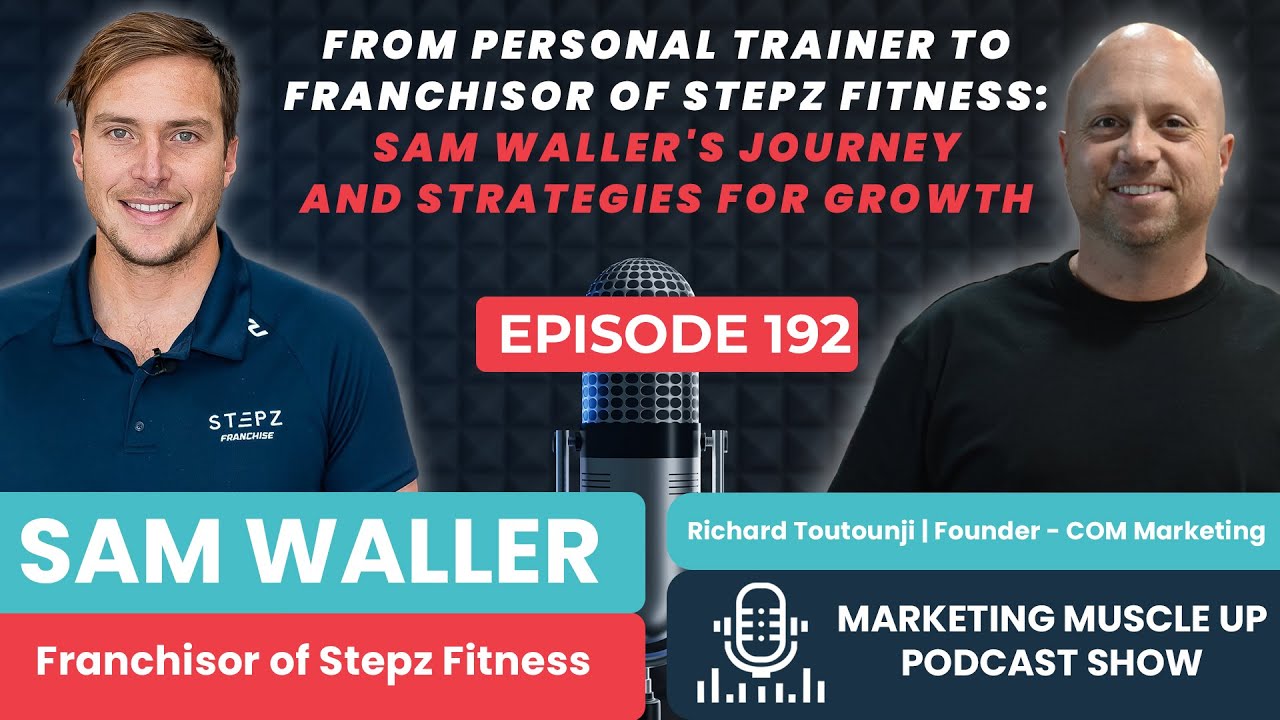
In this episode of the Marketing Muscle Up Show, host Richard Eternity interviews Sam Waller, the founder and franchisor of Steps Fitness (stylised with a Z). Sam recounts his personal journey from an overweight, bullied teenager who dropped out of a business management degree to becoming a personal trainer, buying his first gym at 20, and eventually acquiring the master franchise for Steps in 2017. He explains how he transformed the original 24/7 gym model into a hybrid offering that combines round‑the‑clock access with unlimited group‑fitness classes, allowing a single member to generate double the revenue of a traditional 24/7 membership. Sam shares operational metrics – a “magic” break‑even point of roughly 300 members (including 100 group‑fitness participants) and a recent milestone of 950 members in a single location, generating about $25,000 per month. He discusses his aggressive regional expansion strategy, preferring regional markets over high‑cost city CBD locations, and highlights recent openings such as Musclebrook, Lake Macquarie, Singleton, and Rouse Hill. The conversation also covers his marketing approach (heavy expo presence, high ad spend, avoidance of influencer tactics), his philosophy of reinvesting profits back into the business, and his belief in hiring committed staff over highly educated but transient talent. Sam reflects on emerging technologies, noting AI’s role in program design and the potential of VR/Apple Vision Pro, while asserting that his long‑term, 50‑year vision makes such tech a peripheral concern. Throughout, he emphasizes a core mantra – “what you believe, you achieve” – and shares a personal anecdote of surviving on his last $100 by investing it back into the business. The episode concludes with practical advice for prospective franchisees and a call to action to contact Sam for opportunities.
Chapters
What is the reason that I'm here today is a sticker on the back of our bathroom door as kids. It says, what you believe, you achieve. Believe in what you're doing by creating, by thinking about and getting to a point where you've thought about a business plan or you thought about a career path that gives you goosebumps, that gives you joy to think about, that gives you passion.
Welcome back to the Marketing Muscle Up Show with Richard Eternity. Today we're talking to an individual who who basically grows and sells gyms and has a franchise model called Steps Fitness. If you've seen it around, it is around now. Sam, you know a little bit background. He was on actually our show about a year ago. And it rated really well. So I invited him back and, you know, quick backstory on Sam before I get him on. Had his first gym at 20 years old and about a 183 square meter site. He grew that business to $670,000 in 2 years, had 5 personal trainers working for him. And now what he does, he basically sets up an entire process. If you're a PT or a studio owner or gym and you want to take one of these franchisees, He's now the franchisor of Steps Fitness. That's Steps with a Z, by the way. Now, what Sam does is he has a big belief in what he actually do. It is a gym, and inside the gym it has a studio. And what he does is drive his owners to grow their business. And I thought I want to bring him back on the show because a lot of— a lot has happened since we spoke last, and I want to just pick his brain to go, you know, where are the key drivers to fill your gym up, to fill your studio up? What is he doing to do that and sort of see what's he been up to in the latest purchases and locations that he has grabbed? Welcome to the show, Sam. How are you?
Good, Rich. Thanks for having me again, mate. It's been, it's been a busy 12 months since I last saw you. Um, I think I made a commitment that year to be everywhere, do everything, say yes to everything. And that work that actually did was really good for me. I did a lot of expos, did a lot of things and it did pay dividends and it cost, did also cost a lot of money, as you know, like to get your, get the brand out there, get your name out there. There's a big spend on it, which we can talk about later, but it has been the right decision. So I'm pleased to say like it's been the right decision. We've had our biggest year of openings last year into, and we've opened I think probably about 5 gyms in that calendar year. So it was very, very good.
Congratulations on the growth. Love growing. Well, let's talk about that and let's talk about how are you growing at the moment? How are these— and for those who haven't listened to the show, Sam, can you sort of take us through a little bit about your story and talk to us about the STEPS model for those who are unaware of it? What does it look like? What's the memberships you need to make some money and all those kind of things?
Sure. So Steps started as a 24/7 gym. So we were in 2009, we started at the same time as all the other 24/7 gyms. And that wasn't under me. So it was under the franchisor at the time. So it was just a 24/7 gym and we were, you know, expanding at the same time. I came across Steps when I dropped out of university around the same time, around 2008 or '09. What'd you drop out of
doing? Sam?
I was doing a business management course and, um, and you'd think it's the right thing to do if I wanted to run. I've always wanted to run my own businesses. I, um, my grandfather gave me a good model of what it could do, like the life you can live in business. Um, I didn't know how I would do it in the fitness industry, but I also didn't know where to start. So, um, I thought university might be the good thing. There's also a lot of pressure from my parents to go to uni. I had a blessed education. I went to a private school And generally what happens there is you go to university. I dropped out of business management. I did end up completing a law degree down the track while I was running that first gym. But yeah, I did drop out and I actually stumbled across STEPS and it was the lowest point of my life. You know, I, I, my life's plan at day one sort of wasn't working out. So I lasted 2 weeks at uni and then I stumbled across Steps. And Steps at the time was just a 24/7 gym. Nothing too unique about it. One thing I did really love about it was the non-intimidation. So my pride was shot. This was a small gym that was not intimidating and everyone was welcome. And I really love that about Steps. And I've maintained that through my ownership. I've maintained that throughout the years.
So you were a client, you were a client in Steps originally, Sam?
Yeah, I was. I went straight. I did my fitness course. So I think it was, I think I had a membership, but I was also, I also started there as a personal trainer in 2009. So that was my starting and it was working for myself as a personal trainer within Steps. That gym was the one that you were talking about in the bio that I ended up buying. I think it was a couple of years later.
Yep. Excellent. Um, and so what, you, you were going to the gym to, to, to put some muscle on, Sam, or what, what was going on?
Yeah, well, I, I like— another thing was in school I was overweight. I got bullied a fair bit. Um, well, I, I say I did. My mates have listened to a couple of these and been like, oh, you weren't that bad. But I don't know if it's a sob story, but I do, I do remember not having confidence in myself. So I think I— my pride was shot in school. You know, my confidence was low because I was, you know, a bit overweight. I just internally, it could have been worse. So I lost that weight. That ended up giving me the confidence, more confidence to sort of do things in my life. And without doing that, doing the health and fitness thing, you know, getting in control of my own life and health, I wouldn't also be here today because, you know, health and fitness is a great blessing. And when you can get control of it yourself, Everything will start to fall into place in your life, even if you don't want to be a fitness professional.
Mm-hmm.
So yeah, and since then, STEPS is sort of, I bought that first gym. I ended up, made changes. So we, I bought the master franchise, moved to New South Wales, made changes to the model, added the hybrid. It was a unique model, added the hybrid function, functional group fitness into the 24/7 gym model. I wasn't gonna open a gym. There was just another 24/7 at the time. There was too much competition. It wasn't gonna be a battle I would win, I didn't think. And I wanted to give people more results. So I changed the model when I, when I moved to New South Wales and took on the master franchise, opened a couple of gyms there. And then the franchisor at the time saw that I was moving well. There was also, you know, they They were having trouble running the franchise because they weren't from a fitness background. Competition, I think, was hard. And they didn't have the answers to franchisees. So there was an opportunity for me to take over the whole group in 2017. And that's what I did. Amazing.
So from a chubby kid to owning, what, 20+ gyms? That would definitely help confidence, I'm assuming.
Yeah, well, it wasn't— it was the initial thing of just the weight loss, my confidence. As you get older, Rich, I'm not sure if it's you too, but it does take life. Life will always find a way, or people, I don't know, but there will be losses that, you know, your pride and confidence will take hits at times. And it actually gets harder as you get older. At that, buying my first gym, I thought I could do absolutely anything. And I thought— I didn't even think whether it'd be successful or not. 100%. successful. So I didn't look into any numbers. I didn't look into anything. I just knew because I'm running it, it'd be successful. So now I can't make decisions. The decisions I make now have to be on a lot of different things. It can't just be because I'm not going to fail.
So yeah. I love that. I got my first gym at 17 and it was the same thing. I was like, yeah, of course we'll succeed. You know, there's, there's no, there's no limitations. There's nothing you can do. But as you progress through, there's different, uh, different things to consider. So Sam, um, The model, the steps model, how many members, you know, should, should a steps model have in a perfect situation?
Yeah. Well, the good thing is because we, and this was important as well, it's not like a traditional 24/7 gym where it's all about your membership numbers. With the group fitness, that equates for one member. So they pay double, they pay $29.95 a week, still a really good price. Unlimited group fitness. So that's effectively a double membership on a 24/7 membership, which is $14,000. I think we just raised it 1st of March. So $15,095 for 12 months. So it's almost double what the 24/7 is. So we need less members to be successful. The magic number always changes. It's a question I get early in the franchise discussions. Like people ask me, how many members do I need to break even? On average, you know, on average over the last couple of gyms, it's been about 2— sorry, 300 would be the magic number for us. 100 of them would be group fitness or sometimes less, 50 to 100. So 300 is the magic number, which I believe now is very achievable. On the upper end, we've just hit a milestone of 950 members at one of our gyms in 12 months. Which is amazing. And I, 12 years on, I'm hitting more milestones than ever. And I think that's because I've really found the magic, you know, the model is really working well and what we've done, all the backend work is all coming to fruition. So I didn't make money, I didn't make anything. I just paid, you know, I was just able to eat. And the last, up until the last sort of 2 years is when I made some really Good money, you know, money to live a comfortable life. But before that, I wouldn't say I was comfortable at all. So that's 12 to 14, I think it's 13 or 14 years in.
13 and 14 years in. So I just want to stop on this one here. So basically you're saying, you know, you're eating baked beans and, you know, little baked beans and tuna cans of tuna, possibly the cheap ones up until, you know, the year 12, the year 13. And this is really interesting, Sam, because I think a lot of people Misconfuse, and I appreciate your honesty too, Sam, misconfuse success or misconfuse, oh, someone did it in 2 years. And but it's not, it's not always, it's, I mean, even if it's, it's 2 years here, there's always that, you know, below the ice, that image that you always see, that, that work you've had to put in there, grind, grind, grind, grind, and then you start to see some dollars, you know, after a decade kind of thing.
Absolutely. I would say, yeah, I'd say like what I'd say it could have been different I could have been, obviously I could be a better smart, like better at saving and stuff. I, but it was a bit of my fault. But I think getting comfortable is a word that I'm not a big fan of. A lot of it, some of it was my own doing. So if I made a lot of money from selling my first gym, like a really good amount of money at a young age where I could have done a lot of different things, I could have put it in the share market and been good. Yeah. But no, I've reinvested, I've reinvested everything consistently into back into the business. And I think that's paying dividends now. But yeah, I would, I would have got some, some years I didn't, you know, some years that I didn't make money as well. So it's been, it's been, yeah, a big, a big long, I just want to reiterate, like it is 13 years in this, in with Steps Fitness. If you're passionate about a company, if you're working for someone and you, you're really passionate about that company, stick with it. There will be rewards. Like, you know, I just, I just see too many people chopping and changing. And now when I'm looking at resumes in the industry, if I look at someone that's changed jobs every 6 months, I just won't even give them a shout, no matter how high the jobs were, no matter what they look like. I just won't give it a go. The same thing is I would prefer to build up a staff member who's committed as opposed to a staff member who is very highly educated or very switched on and very good at things who might leave as well. So yeah.
Yeah, great insights there. Really good insights. Sam, let's progress on, you know, I sort of wanted today really focus on just some, you know, key points that have changed in the last few months that people should be looking out for and what you've seen happen in the last, you know, 12 months for positioning and growth? What are some key areas that you are seeing people should be listening to or paying attention to now that you've seen has helped your growth over the last 12 months?
Sure. I think the market at the moment has changed a lot. I think There's always gonna be new operators. I see it all the time. New operators, usually the one that usually they've got a lot of marketing dollars. They could have been successful running another franchise or something. They've got a lot of marketing dollars or their brand looks really nice. But don't get confused. Like, I think there's some of them will do well, some of them won't. I think I'd hate to sort of talk badly about the company or the brand because I did train there. I did train there a lot and I still love it. F45. But look at, I, you know, I'm not a market maker, but I saw this coming because hence why I started Steps Interactive. I started just a group fitness model to compete with F45 back in 2017. I decided not to do it and to combine the models for long term. This was like a 50-year horizon. So for my kids. My kids' kids to still have Steps Fitness around. That was my, that was how I looked at things and how I still look at things. So there's a lot of different entrants. There's always the technology, Apple, Microsoft bringing out technology. 2 things in that space has been AI. AI is gonna be huge in fitness. It allows trainers to write programs in 2 seconds, make sure your customers don't know it's AI. Make sure you just use it as a tool to support what you're doing and to support your mind. That's still crucial because everyone can just get AI programs. Not best practice. Yeah. And then the VR headset that just dropped, $6,000. This is iteration 1, but I think those 2 things are really gonna mix up the fitness industry, all industries, but Fitness in particular, because the thing in the past about what Apple and stuff can do has been they can't give what a trainer can give. They can't, they don't have the knowledge or they don't have the personality or the closeness to give that. These things make it, these things change the game because AI can adapt, will adapt to the personality. AI will probably know the personality more. And then this vision goggles will make the whole experience of training at home a lot closer. That being said, do I think it'll affect my business? No. I've had a 50-year horizon. I will either implement it, which I probably— I don't see that happening, or I just make sure that what we do is so sticky, so unique that we don't need, we don't need to worry about adding that stuff in. I'll always add certain things. I'll always try certain things. See what works. But I don't think it'll affect me long term. Like, I know it won't affect me long term. But am I using AI? Yes, of course. Am I—
Have you, have you bought the Apple Vision Pro goggles yet, Sam?
I just started looking into it. Gotta chat to my— it's something I'm looking at, but I would probably go for a version 2. I just think it might be a bit clunky, this version. Yeah. I also, I'm about to have a kid, Rich, and I think, oh, I don't want, I'm scared of what world he's gonna come into. Like, I don't wanna sit at home and look at TV or work in that virtual environment. Like on my phone, I've got all notifications turned off. I don't, you know, technology is so great these days that you could be fully immersed in, I could spend a full day on playing with Facebook or putting up Facebook posts or doing this or thinking that it'll improve my business. But it really won't, like you're just wasting time. The old school stuff, you know, if you're just playing with Facebook the whole time, unless you're gonna be an influencer, there's no real point of doing all that stuff. You need to run ads, of course, ads are why we're here, but organic social media posting, I always sort of knew that I wasn't gonna be an influencer and I, we talked about this earlier. I didn't really want to be an influencer. They're great for bringing people and eyes to your business. But my personal approach on life is I don't wanna be that. I don't mind. I don't wanna have my face out there that much. That being said, I still have to have a certain level of public personality. Yeah.
Well, this is really good. We are talking about the Apple Vision Pro, and I think, you know, these— it's interesting what you say. Like, you know, this is, it's not laughable now. We are gonna be seeing people that are gonna be buying these things, sitting there and watching them. It's like, you know, Apple Watches, who'll get that? I still don't have, you know, I still don't have an Apple Watch, Sam, or no.
Good on you, mate.
I don't say that publicly, but you've said it now. I have no Apple Watch, no Garmin Watch, zero. I have nothing. I have nothing.
That's an interesting thing. I thought, I thought, yeah. Do you have notifications on your phone?
I have nothing on my phone. Nothing. No notifications, nothing on my phone.
Well done. There might be something to it then, I think, guys. Like, but in that same token, we could also sound like 2 older blokes.
2 oldies. Yeah, exactly right. Let's change. We'll get someone else for the AI next podcast. But in all seriousness, let's talk about what you said. You know, we, you're, I mean, we are talking to fitness professionals and I think a lot of them would also be worried around, you know, the VR goggles and things like this. And I've been looking at, I mean, researching and doing a lot of things in this space the last few years, but we are now in this process. But I think what you're saying is that we're also in a people's business.
Mm-hmm.
And I also think what you're saying is like, yeah, if you don't know how to communicate Um, will there be a problem? And, and we're all going to work with people who want that human interaction. And I think that's what you're sort of saying is triple down on what's working now. Don't get lost in the weeds of the Apple Vision Pro. Like, just understand that this is a tool, but we know we need to, um, we need to still, I think, just love the craft that we're in and, and not— and, and, and you said something before, you said belief in yourself. You said, I asked you before offline, I said, what was the one thing that you got to share? And you sort of said something about belief in yourself through all this process. Otherwise you wouldn't be here 13 years later, 20+ locations. Talk about that for anybody who is seeing the distractions at the moment. They're not seeing the money in their bank account at the moment and they're going, why?
Sure. No, great. I, so yeah, what, what changed my life? What, what is the reason that I'm here today is a sticker on the back of our bathroom door as kids. You know, I, it's, I'm really gonna go to the one thing, but I think out of everything else, this was, there's a range of different things that, that led to where I am today, decisions, whatever. There's also a range of different people that helped me get here today. You know, my grandparents gave me that blueprint of what life can be. My parents gave me the tools, confidence, and support to have that life. But if I really condense it down, it was a sticker on the back of the door that mum put up that says, what you believe, you achieve. Because I wouldn't have— a lot of people, I wouldn't have got into the fitness industry. I wouldn't have dropped out of university. I wouldn't have thought a young to be a franchisor, to run Steps Fitness franchise at, I think I was 23. I would have been the youngest franchisor in Australia. Not anymore. I've obviously been, been here for a bit now, but it all came down to a belief in myself and a belief in what I was doing as well. So firstly, believe in what you're doing by, by creating, by thinking about and getting to a point where You've thought about a business plan or you thought about a career path that gives you goosebumps, that gives you joy to think about, that gives you passion. Once you've found that, you've gotta just believe in yourself through all out, like against all odds. Because the odds, the odds were high. The odds were against me to be successful in my first gym at such a young age without business experience. The odds were against me. To be able to create a career out of this when at the time, I'm not sure if it's changed now, the average wage of a personal trainer was about $35,000 a year. My experience is with belief in yourself, like you can make hundreds of thousands of dollars. Well, I'd say $100,000 as a personal trainer pretty by, because it is trading time for money. So hence why I've changed from that level. But A belief in yourself and that belief is gonna change. Like you're, you have another question here, Rich, is what would you do if you were down to your last $100? And before, without getting into that question is I have been down to my last $100. And it wasn't, it was when I was a master franchisor. So I had the title, I spent all my money on getting the master franchisor. And as things happened, it didn't kick off as fast enough. The models and projections didn't work. Yep. So I had to hustle. So I have been down to my last $100. The only thing that got me out of that was a belief in myself, a belief that I would be able to change this around. And then, and then too many people these days, I think, have that belief and then don't back it up with long days. Don't back it up with sleeping in their business, their gym when things are hard. Don't back it up with You know, work, hustle, grind. So yeah, they're 2 cliché things, but I do think they're very important. I think they're, I wouldn't be here without them. So yeah.
Yeah. Great belief in yourself, belief in your vision because nobody else will believe if you don't believe. Yeah, that's good. Good move, Sam. Well done on the You know, the, the, the new locations where the locations were, the new ones anyway, where the new 5 ones.
Yeah. Good. So they're regional. So we've got a regional, we're sticking to what's worked really well. We've opened, I opened Musclebrook, one of our gyms. Don't want to give too much away with the location, but I just did.
Yep. Yep.
Hot topic. But that, that was one of the ones that got up to like, you know, almost 1,000 members. In 12 months and netting some, yeah, I can tell you, but I'm not showing off. It doesn't happen all the time, but netting probably $25,000 a month, you know, under management. So it was, that's a success story and we're just gonna follow on from that with a regional focus. So we're not even, if someone gives me a city side, if someone tells me to go into the city, I'm not interested. I know what works in our business.
You know what, I just love it because, you know, we still have this massive population problem in regards to obesity, overweight. And I tell you what, the regions is where we're having a lot of success too with our clients when they've got regional areas. I mean, they can just do better what they're good at instead of just, just doing everything to just to stay afloat. There's just so much competition in such a very tiny, tiny, tiny area. So I
agree. I think a lot of, I think a lot of business, and I've been tempted, Rich, like I think a lot of, I've I had a realization when I wanted to push into the city. Is it an ego thing? Like when I'm doing so well, why would I go and go into the city? Why would I? Because I want, you know, there's a couple of things. It could be because I want the people to see the brand. I wanna be prominent. I want myself to, you know, there's a lot of pride things in that, but it's just not, Not gonna happen anytime soon. And our strategy's very regional. So yeah, we've opened Lake Macquarie, Singleton, one in Rouse Hill, which is, I would say, metro, but still not CBD location. Rent was up a bit there. So
yeah.
Yeah. Rent just goes up, your costs go up the higher you go in. And at this stage, we've got a regional Approach. And it's not just throwing them in any region because you will have to travel more. You will have to— finding employees is hard. So I do have to get there. So they're concentrated in a region of like a New South Wales region, you know, Queensland region. It's very concentrated and we build out from each area.
Love it. Some really great Success leaves clues right there. I love it. It's been a blast, Sam. And did you answer that question with the $100? What was the last $100 you spent your business on?
I did have to think about it, but yeah, it was not too long ago. Like it was 2 years before I bought the whole Steps Fitness franchise. So in probably that—
But what would you do with it? What would you do with it? Buy a franchise? Is that what you're saying?
No, I wouldn't buy a franchise. No, I would, you can't, you can't get, you can't do much with $100. So, um, you know, my wife was buying, my now wife, um, was buying me groceries at the time. Um, I didn't have any money to eat, so I spent the money on my, my, the business and myself, um, backed it up with action. So, love it.
So, so you kept it, you kept the, uh, a bit of food in your belly and work harder on the business. Yeah.
Yeah, I think the great thing about being in this industry is that we know, we know worst case or not worst case for a lot of people. This is my happiest time of life or happiest career time was when I was a personal trainer. We know we can always fall back to that. You know, we know that it's such a great rewarding career. So I've gone through life knowing that if all else fails, I don't think it's at a point now where that I need to worry about that, but I can always go back and train people one-on-one, train people in the park, which I'm ready to do even now as a franchisor where I'm not meant to be. I've been at one of my gyms running some group classes at the start of this year. So I need to still, you know, still when things happen, I still need to step in and go back to the basics, which which is very rewarding. And I don't, I don't want to negate anyone from wanting to be a personal trainer for their career. It's a great decision. You don't need to run multiple businesses, you know, trading, being a really good personal trainer can be a really rewarding career in life. So, you know, to all those who have been there and stuck with it, congratulations.
Nice work. Some good tips. Thanks for your time, Sam. That was outstanding. I always get a lot from speaking with you. You're direct. You're honest and you give us what's happening in the marketplace at the moment. Team, if, listen, if you're actually wanting to join the Steps brand, reach out to Sam and he can, you know, show you through the process and show you the best location to grab if you're interested down that way. Definitely check out Steps and yeah, contact Sam. If you— no dramas. Great to have you here, Sam, as always. Uh, team, if you've enjoyed this episode and you think this is going to be really interesting to somebody else that you know, share the episode and, um, say this has really inspired me to be better or to stick around, uh, after the decade and know that it's, you know, just believe in yourself. So that's this episode for today. If you want to hear more of these, go to website commarketing.com.au. Thanks, team.
Cheers.









