How Sumo Salad Has Adapted in a Changing Industry with Luke Baylis | Industry Change Episode 21
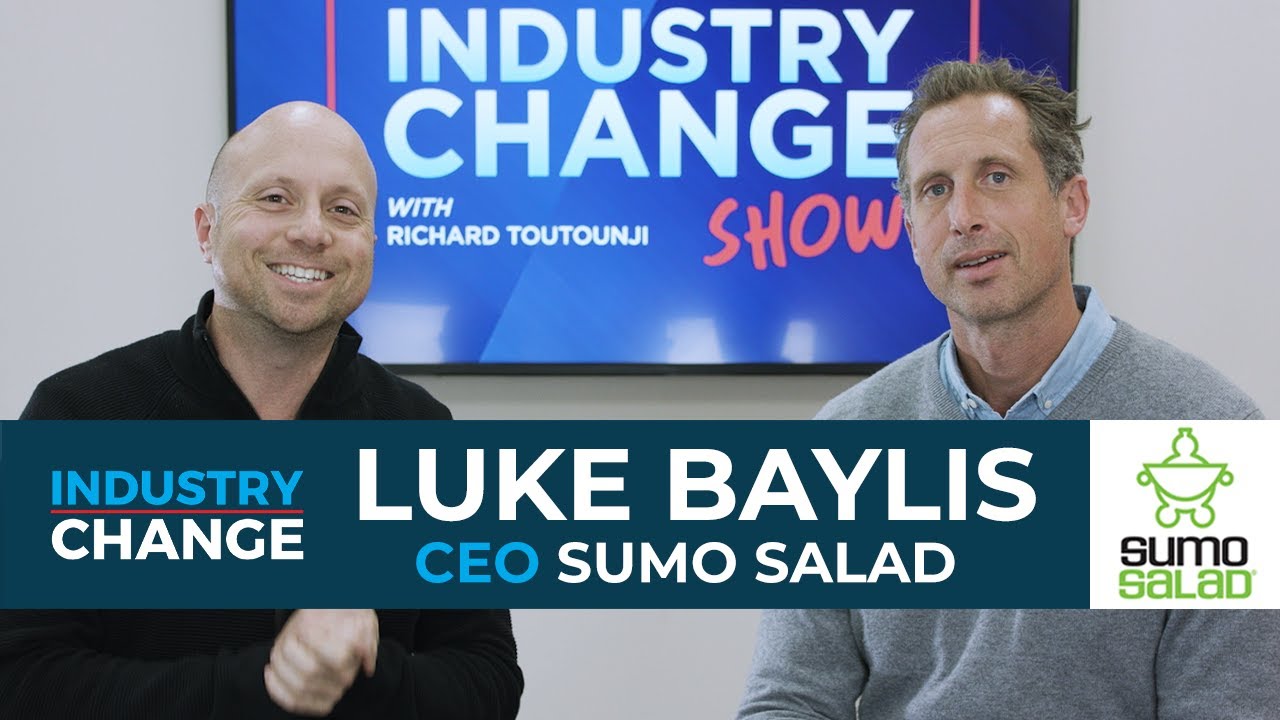
In this Industry Change episode, host Richard Toutounji interviews Luke Baylis, co‑founder and CEO of Sumo Salad, to trace the brand’s evolution from a single salad bar born out of a personal health crisis to Australia’s largest salad chain and now a broader wellness platform called Sumo Well. Baylis recounts his early years in IT, the weight gain that motivated a lifestyle overhaul, and the 2003 launch of Sumo Salad aimed at filling a gap in affordable, healthy fast‑food options. The conversation covers rapid growth to over 100 locations and $90 million in turnover, the later erosion of the food‑court model, and the strategic decision four years ago to pivot away from a pure salad retailer toward a holistic nutrition business. Key innovations include the Sumo Smart Plate – a modular, customizable meal system – and the acquisition of the ketogenic brand Thrive, whose randomized controlled trial showed significant weight loss and health improvements. Baylis explains how Sumo Well now partners with personal trainers, gyms, and digital ordering platforms to deliver outcome‑based meals, offering trainers a revenue stream. He shares personal resilience practices (early wake‑up, meditation, ice‑bath) and three entrepreneurial lessons: deep customer insight, bold willingness to cannibalise core business, and purpose‑driven perseverance. The interview ends with a call‑to‑action for trainers to contact Sumo via email.
Chapters
Welcome back to Industry Change. It's Richard Turtungi, and today I've got a very special guest. I'm talking all about food, nutrition, franchising, and what it means for the wellness, fitness, personal training industry. I've got Luke Bayles, co-founder and CEO of Sumo Salad. Welcome to the show.
Thanks, Richard. Pleasure to be here.
Good to have you here because, um, um, there's a very interesting stat I want to share straight away. Um, and I'm not really going to give you a full intro here because 92% of you have brand awareness in the market of Sumo Salad.
That's right.
And so if you haven't, if you don't know Sumo Salad, you may be living under a rock right now. Who knows? But Sumo Salad was a fundamental, the largest, correct me if I'm wrong, the largest food salad chain in the world.
It was.
It was, and we'll get to that story in a second. And it's a really interesting story just to start because we are, you know, we talk a lot to health and fitness professionals and fundamentally the 2 worlds have been different. We've had fitness and we've had food. And at the moment, what I want to talk about today is you're kind of bringing them together.
That's right.
And you're merging 2 worlds and Hoping to have a good collision here.
Absolutely.
So take me through, take me through the early points because I mean, you've been Entrepreneur of the Year, I hear GQ Magazine Man of the Year. There's a whole accolades of what you've done and I'm really curious, how did you start off to be that, you know, 2003 you had your first Sumo Salad, how did you actually start? I love the entry point of how you got into your entrepreneurial career.
It's not too much of a glamorous story, to be honest with you. Me and my best friend were living over in Chicago and New York in an IT company, which was a global building exchange carrier. So we were basically wiring optical fiber as the internet was starting to become high speed. And whilst we were over there, we were young, we used to, we were going out, we were eating the wrong foods, drinking. Yeah. Entertaining all the time. And through having a very poor lifestyle, I ended up putting on 50 kilograms.
IT world, 50 kilograms.
50 kilograms. And in America, when you sit down and you order a salad, it comes, it's like almost the size of a table with blue cheese and fried chicken and everything. And so what happened was just making poor food choices and not looking after my portion control and not having that, exercise, you know, over a period of 4 years I put on 50 kilos and it was awful. And so in coming back to Australia, you know, I was always used to being fit and healthy living in Australia with that sort of, with the beach lifestyle, you know. So when I came back everyone just couldn't even recognize me. 50
kilograms?
That's right. So I look like I got a bike pump and pumped myself up and became the actual sumo man.
Is that the name where it came
from? No, unfortunately, but it could have been. But I guess, you know, with every major, you know, issue like that then comes an opportunity. And I guess in coming back to Australia and trying to sort of get back to a normal regime, you know, I started to eat healthy. I started to eat a lot of salad. I started to, you know, I started to cycle and jog and go to the gym and really sort of take it upon myself to change my lifestyle. And what I found is that it was very, very difficult to make good nutritional choices everywhere I went.
What year was this about?
This was in about sort of 2000 and— 2001 to 2002.
Okay.
So the more we tried to change, and eating is such a critical part of any sort of wellness journey, It's 80%, you know, if you're not eating right, no matter, you can't out-exercise it. So in trying to make better nutritional choices, we found there was just a huge lack of availability. And, you know, and also the price point was like to buy a salad in a cafe, you'd have to pay $25, $30.
Yep.
And just, there just wasn't that culture in Australia at that point in time. So we said, well, screw it, let's create it ourselves. And off we went in 2003 and developed Sumo Salad. And Sumo was all about trying to make salad into a big, filling, satisfying meal and taking what was considered a wispy little bit of cucumber and carrot into a beautiful meal where you've got a great mixture of healthy ingredients and flavours and really leveraging that Asian profile.
And I think what you're saying, if we can go back a little bit, 2003, 2002, 2001, that wasn't really around at all.
No, it wasn't.
Now it's on every street corner, but it wasn't around.
When we went to our investors and said, and 2 big fat guys saying, we wanna do a salad concept, we just got absolutely laughed at. And in hindsight, some of the best ideas that you can come up with are the ones that people laugh at because people aren't thinking that way. So it was actually, when we look back retrospectively, we're actually quite proud that we got laughed at and we stuck with our guns. We knew there was a demand for it. And we just battled through and we just, we were convicted, you know, to trying to change the way Australia eats and create a better option. And we just put our heads down and did it.
And you did that, you know, I mean, a decade and you're still doing it today. And what was the, you know, what was the stores that you made 92% brand awareness? I've got a few questions for you. One, how did you actually manage to do that? And 2, what was the growth that you had at that time? Was that part of the clues there? How'd that happen?
Yeah, so I mean, we grew to over 100 locations and we've been going for 16 years now. And it's funny 'cause a lot of kids that were sort of, I don't know, sort of 10 years old at that time, now it's become a staple. They've grown up with it. So we've sort of almost like gone through a full generation. Yeah, wow. And people just know it's in airports, it's in the city, like it's just through, and because it's got such a unique and memorable brand name, people just, people recognise it and a huge amount of the population have tried it and had a positive experience. And when you think of fresh and healthy, Sumo is one of the first brands that springs to mind.
And there's a few clues there. I mean, if anybody's listening here and they want to create a national brand, there's a lot of people that want to create a national gym chain, a franchise chain. Is that— what I'm hearing is that you're at airports, you're at shopping centers. Is that— was that your kind of like secret sauce to do that?
Yeah, we didn't have a huge amount of money for marketing. We self-funded the business, you know, which was a huge challenge in itself. And every dollar that we had, we were trying to expand with it. So it really was around making sure that we got good locations, and a lot of the, the brand equity came through Just training in local communities and getting, you know, that sort of following.
Wow. And so that grew, but at the same time as that grew, competition grew. I'm assuming more salad bars came up.
Yeah.
Tell me about that journey, because anybody who's listening here, we hear a lot, Luke, about competition. Some gym opens up around the corner, a personal trainer opens up, everybody's in competition.
Yeah.
And tell me about your competition, what you had to go through in You know, you say it's not glamorous being a business owner entrepreneur. What was that non-glamorous part in the main chunk of Sumo Salad?
Well, I think when anyone sees your success, they go, oh, I can do it better. And what that includes—
I love it. I can, you can do it better, hey?
Yeah, that's the sort of the natural entrepreneurial—
It's the ego out of you.
Yeah. And so there we were, we'd achieved amazing success. We'd built a business doing $90 million in turnover. And we didn't have a competitor. So—
About $90 million in turnover, no competitors.
No real competitors. There were people starting to, 'cause people didn't really, the wellness trend hadn't really emerged yet. We were still carving our way. But I guess as we bred more and more success, yeah, more competition came in. You know, for the first probably 10 years, we were able to withstand any sort of competitive threat. But the big thing that really affected us was when we were in food courts and the whole shopping center environment changed where food courts used to be the only place you could go and eat in a shopping center.
Sure, yeah.
And now there's cafe precincts, there's casual dining precincts, some even have fine dining precincts. So our competitive set, changed by 300, 400%.
Wow.
There was direct competitors. And also the actual trade environment where we had most of our infrastructure set up became less relevant to our consumer. Our aspirational healthy consumer wanted to go to these new, shiny, better looking places within the shopping centre and they divorced going to the food court. And so there we were, not in the right, we're in shopping centres, but we weren't in the right parts of the shopping centres. And so we had to do a lot of work to really repivot our business and think, what's our endgame here? Are we actually trying to just be a salad retailer or is our whole business around trying to, you know, trying to change the way Australia eats for the better? So we had to take a whole step back and reassess what our purpose was to then go forward and completely repivot our whole model.
And when was that year? I mean, you had that 9, 10 years competition-free, $90 million. Was it just like things, I mean, yes, pushing hard, 100 stores, but when did you realise that, hey, we are not in the position we were before and if we keep going down this way, we might not finish up the way that we want to finish up? When was that realisation?
I reckon it was about 4 years ago where I said, shit, if I don't make a change now, we're not going to have a business in 10 years' time. And I could just see this little erosion at the fringes. And it was just, and the momentum was building and building and building. And we could see there was, even at early stages, a noticeable shift in the consumer's purchasing patterns. And so you can't put your head in the sand when you see that.
And that was numbers and data you got from all your stores?
Numbers and data, looking at what was happening, looking at the, not just the competitive set, but also people, going to buy online, you know, having more healthy options available through the supermarkets. Like everything just sort of, you know, it compounds. And so when you're sitting there with a business that you know is gonna get slowly eroded over time, unless you have the courage to be able to say, we've gotta make a big change now. And even though that change might not, a lot of people say, no, just stick with your core and, you know, just grind away.
Yeah, you were in shopping centers and airports, yeah. Why change?
And we just went, that's not, that's not the right thing to do. We know over time this is going to become more and more challenging, and if we don't pivot now, we're not going to have a business. And so we took the, we took the move to completely shift our whole strategy.
And before we get to that, I want— I've picked up a few things here, one being that you had a lot of passion. You had a good story from the start, like you had 50 kilograms and you lost it. You created this out of passion, you and your business partner. And that you made a fundamental decision, you know, 4 years ago to make some adjustments. And, you know, we ran into each other, um, maybe a year ago or something at an event, uh, by a person being in our Ninja Program, Lawrence. And, um, he's been really deep in wellness and the corporate wellness and that kind of surroundings and fitness. And it's interesting because you're listening to the market in a very different way and you're, you're hearing different industries pop up. Yeah. I mean, is that, how do you, How do you predict the future being here? And now, you know, we'll talk about in a second, but you're kind of merging into fitness and personal trainers world. How did you smell that there was something on the horizon? How do you know how to get to there?
Well, I guess the short answer is you don't. But what you do is you do a series of tests and you, you know, you broaden your network. You think holistically around what the customer journey is. And you speak to people and you, you know, you do, you make mistakes along the way, but you've got to get out there and start to test some of those theories and shoot a few little, you know, test shots before you sort of launch the cannon at it in a particular direction.
Hmm.
So what we did was just go, this isn't right, we know it's not right. You know, we see that the wellness consumer is engaging in fitness, personal training, better eating, all these different, all these different activities. And from there we thought, we can't just be a salad bar that people come to when they're in a shopping centre. If we're going to provide a real solution, we've got to start to collaborate with like-minded people and like-minded brands and really provide, surround the customer with better solutions. And we can be that nutritional partner of choice. And so it was through coming to that realisation that we started to sort of broaden our sphere of thought. And broaden our network and really start to collaborate with the likes of personal trainers and people that really cared about people's health and wellbeing.
Wow. I love this story because through passion, through a solid why, you're now at, I don't know if it's, this is 2.0 or 3.0 version of Sumo Salad, but at the end of the day now, you continued with the reason why, but now you've just changed the actual perspective and who you're talking to. And I think that, You know, for anybody listening here, fundamentally at that point of, hey, I've got to change, if I can ask you, what was the one thing that made you change? Because why are you going to change something when you're on a high? Was it because of passion? Because it was the why? Because it was like you had to do it? Like, why would you go and do that massive transformation? Because a lot of people in that zone, they stay in that space and they don't ever adjust and they adjust too late.
Yeah, well, I forgot what it was. There was a moment in time, but it's almost like if you ask a series of questions like, why do you do it? And then you keep answering, but why, but why, but why? You get quite advanced in terms of trying to discover your purpose. So we thought of ourselves as a salad retailer. Why were we a salad retailer? Because we wanted to try to put put healthy foods into shopping malls where people didn't have access to that. Why did we want to do that? Because we wanted to change the way people ate. And so by taking a couple of steps back, we actually tried, we were able to refine our purpose to the point where we could say, we don't have to focus just in this little niche, in this little pocket. We can play a much bigger game. Wow. And by, the purpose was just, a lot more powerful because we're now changing the way people eat and the way people consume nutritional foods and providing a much better solution for the customer, as opposed to being in a volatile trade environment that only targets a very small subset of the market. So it was through coming to that realisation and really testing that purpose and probably reframing that purpose that really enabled us to advance our strategy and pivot our business.
Great, well, that's what I wanna talk about now. And this is the exciting part of your, the next version of Sumo, I see it, and it's basically Sumo Well. Sumo Well, right?
Yeah, so Sumo, we've—
Sumo Well, sorry, so I'll say that again. Sorry, so Sumo Well Meals, and this is the next version of Sumo?
It is. So Sumo decided to become a house of wellness brands, and so we've launched, and our objective is to be able to supply 50 million meals per annum to Australians. And by doing that, we feel we can have a much bigger impact than even the government to a large extent around the wellbeing of Australia. Yeah. And that, by having a business that can scale up and provide that level of a solution to the way people consume food, it's a hugely motivating purpose. And so when we looked at our market, we said, we don't want to just be Sumo Salad. So we dropped the word salad and we became more sort of holistic wellness. Yeah. So we wanted to do meals and salads and smoothies and different things like that. And not just be restricted by the word salad. So we leveraged that equity in Sumo and then, you know, so we could play in different categories. Then we also said, well, Sumo stands for a lot of, You know, everyday wellness. And a lot of that is about taking, empowering the customer to make the right decision for themselves. It's not a prescriptive diet. It's just about giving them a really good nutritional solution where we put a lot of micronutrients in our food and they can determine how much carbs or fats or whatever they want to do. But they've got the ability to customise their own meal.
And when we say they, we're talking about personal trainers, right?
Well, the trainers or the consumers or whomever it is who wants to sort of advocate that offering, so.
And I had the pleasure to be in the office maybe a year ago now, and I love the concepts of the meals and they attach. You can have different proteins, different carbs, and they reattach. And there's a lot of different options now.
That's right. And this is where we've developed almost like a new eating system, which is called the Sumo Smart Plate, where it takes the, you can combine lean proteins, high micronutrient vegetable mixes and complex carbs. We've taken all the sugars and bad fats and all the refined carbohydrates out of the meals so that you can have, you can create your own. So if you're vegan, if you want to put on muscle mass, if you want to strip fat, you can construct your own meal to achieve your own personal outcome. And it really, with the right framework, gives people the ability to provide a very, very good eating solution. 'Cause not everyone has the same biological needs. Like Lawrence, who you referenced before, he's a vegan. So by pushing a high protein meat diet, or some people have different religious beliefs. So you've gotta give people the ability to make their own decision on what's right for them. And
it's amazing 'cause you were dealing with trainers. Some trainers, they like the carbs, some like the keto diet. So you've really gotta make sure that you're pleasing everybody you're trying to get to.
And at the end of the day, it's not just the trainers, but it's also about them understanding their customers and being able to have a partner like Sumo to be able to say, well, we can help do that thinking for you. We can give you the solution to help you with your customer get the maximum out of their workout and out of their sort of nutritional needs. And as we know, like when a customer, when people are training, they're eating well, the outcomes are exponential. Mm-hmm. So you've got to combine this healthy eating with that movement. And that's where we, you know, we're so excited by the partnerships with personal trainers. We want to really get out there and support the personal trainers to be able to use this as a tool to get better results for their customers.
Well, now correct me if I'm wrong, you know, the plans, I don't know, you know, where that's at, but I know you launched in Fitness First a couple of days ago, is that correct?
Yeah, yeah, we've got a trial going. We've created a new sort of digital ordering system. So we've created like a, you come in and you say, okay, I wanna put on muscle mass or I wanna shred fat or I wanna optimize my nutrition. And so we create these outcome-based diets where at the push of a button spits out exactly what you— Yeah. the outcome you want to achieve. 'Cause a lot of people don't know the science behind it. So we've got nutritionists and dietitians who create these sort of scientific eating programs that just enable a very easy way for people to engage with it and get those outcomes. And it's interesting 'cause what we did, we've recently acquired a brand called Thrive, which is a beautiful brand. And it's all about ketogenic, ultra-low carb eating. And again, no sugars, no— Gluten-free. Low saturated fat. And we did a study, a randomised controlled trial with the Thrive brand, and the results were phenomenal. Of 200 people that did the RCT, everyone, the average weight loss was 4.5 kilos. I think the highest person in the sample group lost 18 kilos over a sort of a 12-week period. They had—
Was that with exercise or balanced diet or just the food?
It was the food and a sort of a moderate exercise program. And so what we saw was they had improvements in their blood health, their C-reactive protein, triglycerides. They even had improvements in their cholesterol saturated. Surprisingly, they had huge improvements in their VO2 max. So people were actually fitter by consuming healthy foods.
And so now this connects to everybody in the fitness industry. And this is the industry that we spend a lot of time in. to get better results without having to reinvent the wheel.
Absolutely.
A push of the button.
Yeah.
Or a vending machine with the food, whatever, whichever option is available to them, ordering. They can make money as well on it, send to their clients. There's so many options now.
Well, that's what we want to do is make it really easy for personal trainers to provide a holistic solution and not just provide a great solution, but also the ability to make money from it. So when you're advocating the food, you can actually take, for every meal that you sell, you can make money. And the more people that are eating that healthy food, the more of a sort of almost like a little business this can become.
Yeah.
Because we come from a business and franchising background, we understand the needs around marketing, attracting customers, providing customers with satisfaction around their outcomes. So this is a really easy thing. It's a really easy toolkit that we can provide the personal trainers to enable them to increase their income and give their customers better results.
Yeah, and that's what we're all about at KOM, is about marketing to achieve better results. But the one thing I always say is that you can market as much as you want, but if you don't provide results, the marketing won't work.
It doesn't work, that's right. It can't be superficial. The one thing in wellness is there's so much marketing guff, and you've got to be able to provide a credible and authentic solution. And this is, you know, this is why it's important that, you know, that you do combine that diet and movement and do it in a way that is scientifically proven. And I think we're one of the only brands, or the only brand that I'm aware of, that's actually gone and spent half a million dollars on scientifically validating our whole eating program.
I love it because what you've done basically, and I'm hearing the stories that you were first to market with largest retail chain salad bars.
That's right, yeah.
People caught up. Now you're going and saying, okay, well, how can we get, again, the end goal is Australians more healthier and active. And now you've gone and marketed and partnered with, you know, obviously the whole salad come to your house kind of stuff, the packaging boxes, that trend. You've taken all those pieces and then you said, okay, right, let's get to the actual market that really wanting to move their health forward.
That's right. I mean, the fitness consumer and the personal trainer, they're time poor. They don't want to have to think about all these, They don't want to have to do an ingredient shop of hundreds of ingredients to get the right nutritional values. So it's really about making it easy at the push of a button. And then all of a sudden the meals come through direct in a refrigerated box to your home. It's just so simple. And that's what we've had to really think hard about. How can we make this as frictionless as possible so that, you know, and make sure that we can, you know, get those results? 'Cause that's what's going to determine the success of our new business.
It's great. I love the conversation because it goes from entrepreneurship to business to health and fitness to nutrition and really, you know, results and moving people forward in a healthy, happy way. That's right. So it's an amazing conversation. I want to maybe gear it now to, you know, entrepreneurship for a second because this is where you've come from. So for those who are in this position of like growth and they do want to grow a business, they want to start a franchise, they want to scale up, because a lot of people, you know, they're in the business and they want to expand, they want to do more of it. What are your, maybe if I can give you 3 tips, more of a business entrepreneurship show right now, what are the things they have to do to continue through the hard, painful times? Because I know in your career, you know, our conversation, there has been some really tough times in your business and the journey. How do you get through the tough times in business?
Look, it's— I reckon the tough times are what carve you to become more resilient and a better person. And you have to dig deep and find that inner strength to be able to keep fighting and keep innovating and keep creating those solutions that enable you to advance. And if you can't do that, then you die. And that's the reality in business. And 96% of businesses Do die. And that's a really terrible statistic, but it's, you know—
What do you do personally? 'Cause I mean, you had some great morning rituals that last time we caught up for breakfast that you showed me about. Is it, what is it for you? Is it the morning rituals? Is it hanging around proximity? Is it like studying and researching? How do you get through on a daily basis?
Yeah, so I do, I've got a very sort of regular morning routine. I wake up between 4:30 and 5 o'clock. I do meditation for half an hour. I then jog to the gym. I do my workout. I then do a steam room, ice bath. And then, and while I'm doing that, I'll listen to my audiobooks and podcasts. Yep. And I've just got this routine that in the morning just makes me feel like I'm a superhuman and I can tackle anything that's thrown out at me. And I combine that with a healthy eating routine and physically, mentally, I'm switched on, I'm aware, and I'm going to play at my best. Amazing. And that's really important. But to your question before, the things that make you, that help you overcome these challenges in business, you've got to be able to understand your customer and be able to provide them with a proper solution. What we found is that By asking our customers more information, what are you seeking? How can we do it better? Be humble with it. And, but by asking those questions and getting more insight and more data, you can make some really good business decisions that aren't risky and don't cost you a lot of money. So it's really important that you can do that. Then be bold to make change. Don't just try to protect your little patch. Be open to doing something completely different that may even disrupt your core business a little bit. It might even cannibalize that a little bit. But don't worry about it. You've got to keep evolving because if you're not evolving, you're going to die. And we've seen it with the best brands in the world, like whether it's in the computer industry, phones, health, whatever it is. If you're not evolving and constantly willing to make change and keep moving the customer experience forward, then you're going to die. And then I think another huge thing is just it's about that passion and that purpose. In a small business, you go through some bloody tough times and you need to be able to get up and know that it's not how hard you hit the ground, it's how quick you get back up. And you've got to have that resilience to be able to get back up. And I think being connected to what you're doing, knowing that you're doing well for Australians is a big motivating factor. Yeah. So leverage that, rely on that to motivate you to keep going and keep fighting the fight. And I think when you combine those 3 things, there are only 3 examples, but they're really important examples that have helped me tremendously, you know, combined with my sort of personal routine. And it's, you know, it's been transformational.
Well, I love the personal training. You're into the cold showers and ice baths and the Hof. And this is great. I could literally speak to you all day about this topic, but thank you for your time.
It's a pleasure, Rich.
Last thing is like, if there's a trainer out there or a gym, how do they kind of get aboard? 'Cause I know this is all rolling out. How do they kind of say, hey, I'm keen, what do I do? Where do we direct them? What happens?
Look, just email me, luke@sumoseller.com, and I'll pass you to one of our team members and would love to have a chat if there's something that's of interest to you or you've got any questions. Yeah, I'd love to connect and see if we can help out.
I love it. luke@sumoseller.com. I love also too that if you just realize that you're open and you're open for opportunities. Absolutely. And that's the greatest thing, I think.
Look, to change, to change, to provide Australia such a huge solution, you've got to be open to change. You've got to be open to working with people and collaborating and connect with like-minded individuals. And that's hopefully what we can achieve over the next coming years.
Amazing. I look forward to seeing the continuation of Sumo Wellness and the growth in many different sectors and pockets and wherever that's going to land.
Thank you.
Thanks so much.
Cheers, Rich.
Yeah, thanks a lot. I'll see you next time on Industry Change. Now remember, if you want to listen to this on podcast, go to your favorite podcast platform and check it out there. For more Industry Change, you can simply go to our blog or that podcast channel and watch the past episodes. Thanks so much. I'll see you next time.









