How To Get Rich In The Fitness Industry With Jackson Millan 💸
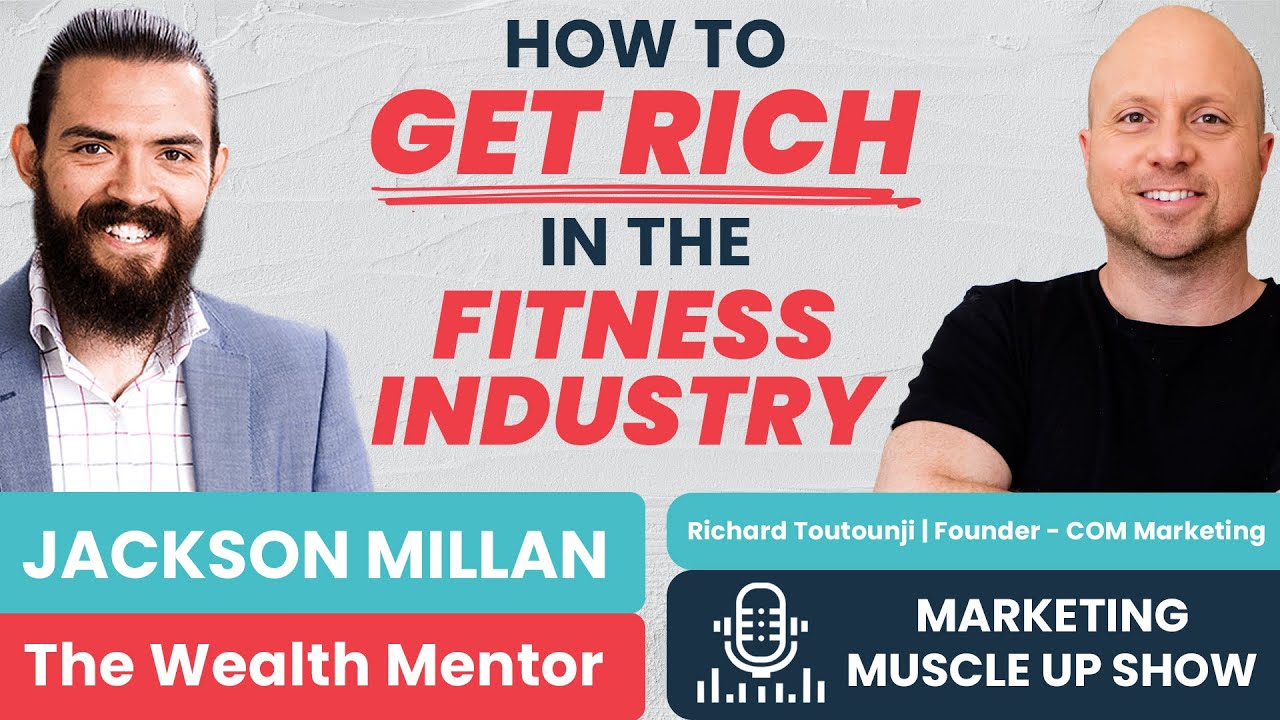
In this episode of the Marketing Muscle Up Podcast, host Richard Toutounji interviews wealth mentor Jackson Millan about creating and scaling wealth for health‑ and fitness‑industry entrepreneurs. Millan shares his personal journey from a family of cash‑strapped tradespeople to a multi‑million‑dollar business owner and wealth coach. He introduces a five‑stage "wealth pyramid" (battle, comfort, surplus, freedom, abundance) and explains why most fitness professionals are stuck in the lower tiers. The conversation moves into mindset (loss‑aversion bias, moving from pain‑driven to pleasure‑driven business decisions) and practical tools: a personal profit‑and‑loss statement, separating business and personal cash flows, and setting clear income, profit and revenue targets linked to client numbers. Millan outlines three predictable wealth‑building vehicles – scaling the business, property investment, and diversified index‑fund shares – and recommends a simple allocation (business reinvestment, property, then a global index fund) while limiting speculative assets to 5 % of net worth. He contrasts the role of a traditional financial advisor (done‑for‑you) with a wealth coach (teach‑you‑to‑manage), emphasizing financial literacy for business owners. Finally, he gives a concrete implementation timeline: three months to set up financial foundations and a typical ten‑year horizon to achieve financial freedom, supported by a 40‑point financial health scorecard available at wealthhealthcheck.com.au. The episode also includes light‑hearted anecdotes about Millan’s snake‑relocation hobby, used as a marketing hook.
Chapters
What next? Do I put my money in crypto? Do I go buy another house? Do I put an extension on the— should I just put the money under my bed? Hey, welcome back to the Marketing Muscle Up Podcast Show. In this episode, I'm really excited because we're talking all about money. We're talking all about profit. We're talking all about wealth creation. Now, don't turn the podcast off. Because if this conversation scares you, you need to listen to it really, really carefully. Now, I've known this gentleman for a few years now, and he really is the number one game player in this space. It's Jackson Millan, also known as the Wealth Mentor. Now, he's an award-winning entrepreneur and wealth coach. He's been there, done that, which I like most importantly. He's also the author of international bestselling Enjoy the Journey. Isn't that interesting? Enjoying the Journey: Create Wealth and Living the Life You Desire. It's been featured on the bestselling list in 8 countries across 15 categories. That's huge. Now, over the last 15 years, Jackson's spent dominating the wealth and business strategy space, not just a business coach in that space, but also helping to generate over $1.5 billion in combined— that's $1.5 with a B— in combined wealth. And he's personally scaled multiple 7-figure businesses and helped his clients do many of the same things. I first met Jackson a few years ago. I think an event or actually through a good friend of mine. And yeah, we've been having a few conversations like this. And so I'm really interested to get into it. Jackson, welcome to the podcast.
Mate, thanks for having me. I'm really looking forward to chatting about money and wealth and all things financial.
Yeah, totally. Now, I've got some preset questions here, but your knowledge goes more than a few questions, Nolly. Jackson, you've really, you're in the forefront of changes. And at the moment, Jackson, there's a lot of changes happening in the space. And specifically, I do want to talk to, I want to talk specifically about kind of smaller operators. We work a lot in, as you know, in the health, wellness, lifestyle kind of space where people are impacting and making an impact to people and they want to create change in their lives. But the one thing that I think Most people, myself included, Jackson, we always leave ourselves to the end because when someone says, you know, I have strategy calls with our clients, one thing I say is, well, you know, what financial goal do you want to hit? What's your revenue target? And it's like the eyes are just blank because they're focusing on members, not focusing on even revenue. But I really want to focus on profit too. So Jackson, I guess my first question, I want to go back a little bit because you've got a personal story around this. And this is the reason what I I always love to go, why are you a wealth coach, Jackson? I mean, it sounds cool, but what's the journey? What got you to this point?
Yeah, it's a really good question, mate. So this all started with my parents. So my parents were business owners. My mum was a hairdresser. She was an award-winning hairdresser, phenomenal at what she did, some of the best in the country. And my old man was just really great with his hands. He was a tradie. He had lots of different trade businesses and he had the potential to be a great entrepreneur. He was really good at starting things, but wasn't very good with following through. And the grass was always greener on the other side.
Oh, yes. We can all feature that. Yep.
Exactly. But the big thing for them is that they were like Oliver Twist, right? It was always hands out. And it was just like they would work incredibly hard and they would ask for more. And it was as if they were begging to be paid what they needed to just survive. And survival was really what we did. We never really went without anything, but there was never any excess. There was just enough. And I come to realize that hard work didn't mean financial freedom. And I realized that my parents didn't understand the language of money. They were working for money as opposed to money working for them. So I decided that I was going to go down a path to kind of break the catalyst. And I started training to become a financial advisor.
Right.
And I very quickly realized that the financial advice industry really only wanted to help 2 types of people. They wanted to help people who were already wealthy and make them wealthier.
Yes.
Or they wanted to sell commission-based products to people like my parents who quite frankly didn't need them.
Yeah.
And it really was disheartening for me. And I was ready to hang up my hat, but then I asked myself, okay, if you're going to do this the way that you wanted to do it, what would it look like? So I binned the term financial advisor and I started calling myself a wealth coach. And I started building a syllabus, a framework, a system that allowed me to educate my clients to make money work for them. And here is the fundamental issue, Richard, because most people, fitness professionals specifically, are immensely passionate about what they do.
Totally.
And I'm sure you agree that the vast majority of fitness and health professionals believe that health is a God-given right. It's a human right. Everyone should be entitled to be healthy.
Yeah,
that comes with a lot of guilt because I'm sure if they could, they'd probably do it for free.
I know they do it for free.
And they do it close to free because they don't ask for what they really deserve. But the problem is here that we've got this vicious cycle, this double-edged sword. And this leads us to paying ourselves last, burying our head in the sand with the numbers, becoming a financial ignorer, just expecting that hard work and more reps is going to result in better results. And it just doesn't. And there's 2 things that you need to master in your business, your fitness business specifically. You need to master your marketing and you need to master your money.
Hmm.
And if you can nail those 2 things, you are unstoppable. You can work through recessions, you can work through events like the GFC, you can work through COVID, you can work through anything. Those are just the tools that you need to be able to thrive in a modern-day business today, particularly in a marketplace that's so crowded like the fitness space.
Yeah, very interesting. And I think it's very true. We do want to help people and it's really important to do that. You mentioned marketing and money and obviously that works well for us because we're in the marketing and in the money game. And yeah, we also believe that if you can't get leads in well, and as our friend Steve Jensen says, sales solves all problems, but you need leads to get to that point. Let's just kind of go like a micro point here. If a business is struggling at the moment, Jackson, when I say struggling, you mentioned that your parents, that you didn't go without, but it was week to week pretty much, right?
Yes.
You got by. And I think, is it safe to say, Jackson, that most people, I mean, you obviously are in this game, you're having those conversations. I'm not in that degree. Where are most people with their finances, Jackson?
Yeah. It's a really interesting point, mate. So we define people at a potential of 5 stages of what we call the wealth pyramid. At the bottom of the wealth pyramid is what we call financial battle. These are people who are burning cash. They're drowning financially. They're essentially going to sink the ship, right?
Yep.
We've then got comfort. This is where people are treading water. They make just enough that they can pay the bills. They can keep going, but they're not moving forward.
Yep.
then got financial growth where we've got surplus, we've got profit, and we're making money work for us. We're advancing, we're magnifying our position, we're progressing. Then we've got this highly coveted financial freedom, which is basically achieved by 2 things. You own your home and it's paid off, and you have enough passive income that you can choose what you do with your time. And then we've got stage 5, which is financial abundance. This is where we're at a stage where we can focus on legacy impact. And generational wealth. Now, for the vast majority of people that I see right now, they're on this tipping point of battle and comfort.
Battle and comfort.
It's this vicious cycle that they get their head above water and they might get one step forwards. And then for some reason, they get hit for a 6 and they end up taking 2 steps backwards. And they just can't seem to break through this invisible ceiling to go from surviving to thriving.
Wow. That's so good. Battle, comfort, surplus, Freedom, abundance. Wow. Very, very interesting. And it makes so much sense when you put it that way. And so let's say for somebody who, I think it was the, there's 3 levels. I think it was the comfort. So let's say you're a personal trainer or a fitness professional or a studio owner and you're in the comfort stage. You've maybe had a battle stage a year ago and you're smelling something's changing and you don't want to go back to there. What could a person right now do to maybe change their mindset or to change their finances? Or do I have to, you know, open up a bank account or something? What could I do straight away that could help me to do this?
Yes. It's actually all mindset related, mate. You hit the nail on the head because here's the thing. We run 2 different operating systems typically. We either move away from pain or we move towards pleasure. And fitness professionals are phenomenal at moving away from pain. Right? It's like, it's even part of the actual fitness itself. Like you're doing squats, you need to feel the burn. You've got to squeeze out that last rep. If you're not feeling the pain, it's not working. You're not building the muscle. Right? But that's not how we grow a successful business and that's not how we amass wealth. It shouldn't be painful. So what we actually need to do is we need to shift away from pain, which is what gets us out of battle and into comfort, But the reason why we're hitting that invisible ceiling is because if we're in this comfort zone, this cushy part, then there's no emphasis for us to get out of our comfort zone anymore.
Yeah, totally true.
We have this principle that's called a cognitive bias for loss aversion. There's actually been a Nobel Prize that was issued in 2016 on this very thing because what they were able to prove is that the emotion of a loss is twice as significant as the potential of a gain.
Wow. Yep.
Now what that means to get you out of comfort and into growth is that you need to put twice as much effort into your future planning to get you from comfort to growth and beyond than you did to get out of battle.
Amazing. Twice the amount of effort.
Twice the amount of effort.
But those squats, just do the last squeeze, the last set out, it's probably a bit easier, it sounds like.
100%, it is. So we've got a framework for this, Richard.
Okay.
The first thing we need to do is we actually need to focus on the individual themselves because the biggest mistake I see fitness professionals make is they treat their business as if it's the destination. It's a vehicle. It is a wealth creation vehicle. It is like a share portfolio. It's like a property. In actual fact, it's better because there are very few businesses that can be a cash creation machine like a fitness business. It's phenomenal at generating cash if you nail the numbers. What we need to work out is what are the numbers we're trying to achieve? So we actually need to map out your personal plan. So we've got to ask ourselves, well, what do we need to be able to live a great lifestyle? So how we work this out is, okay, let's do what we call a personal profit and loss. I hate the dirty B word, budget.
Yep.
Personal profit and loss. Let's work out what your ideal lifestyle costs you to pay your rent or to pay your mortgage. To eat nice food, to go out on the weekend, to have nice experiences. Let's assume that it's $100 grand a year.
Sure.
Beautiful. Firstly, what does the business need to do to consistently produce $100 grand a year for you?
There we go.
Income target into profit target, profit target into revenue target, revenue target into members, members into leads. We can now link all of the activity So that outcome, how much more invested are we?
Totally. We want those marketing, we want the sales to work. We want the conversion to work because we're working in our favor now.
Exactly. Next stage is, okay, the $100 grand, say, gives us the beautiful lifestyle, allows us to do the things we want to do. How much extra would I need above and beyond that to now start planning and building wealth, to work towards buying my home, getting the next investment property, building passive income streams, paying off debts. Let's say it's $120,000.
Yep.
Okay. Do the same exercise. So in the words of our good friend Steve Jensen, we need our bare-ass minimum. That's the $100,000. And the $120,000 becomes the stretch. And that's in the cushy zone where we find ourselves at that stage 3 of growth where financial freedom and the path towards it becomes presupposed as long as we can hit those numbers.
Wow. Very, very interesting. And it makes sense when you look at it that way because it's almost like you want to win, you want to make sales, you want to do better marketing because there's a point for it. Sometimes do you think we lose our way? Like we just run a business and we think that's the thing and we hope— and you know something that, Jackson, I've got to ask you that this is something that irritates me only because I used to do it where I ask a business owner, you know, what are you making each week? And I do the activity and they say, oh, you know, I don't pull myself a wage out. And then I go, okay, well, hang on, hang on, hang on, back up, back up. You got to eat some food, right? What do you spend to eat? I don't have a wage. I don't draw a wage. But then we go through and we look at what they actually physically pulled out of the bank account. It might have been they put their business card down or they might only have 2 accounts. They pulled out cash and it equates to a few hundred bucks. Let's say $400, $500, $800. And they actually don't realize they're getting paid that. Talk about that. Is that a common thing that you see for small business owners, Jackson?
So common. The amount of time I've seen people go to the charcoal chicken shop or sushi train or whatever and run their business card is just appalling. Stop treating your business like it's an ATM.
It's
not. And look, I used to do this myself as well, right? And the penny dropped for me is that I had an ex-business partner that I'm happily out of business with, met many years ago. We had a successful business, but we went to an event at the casino and I saw him use the business card to go take cash out to go and gamble on the tables. And I go, yeah, I don't want to be in business with this guy. I actually had a mentor very early in my career who said to me, never be in business with a gambler, a cheater, or a drunk. And I go, okay, I'm going to take that really personally. This is a warning sign and I'm not going to do that. But the whole aim here is that you need to run your business like you're a professional.
Okay.
Yeah. And we need to make sure that we put on the lens. Ask yourself this: if I was the CEO of Plus Fitness, of a publicly listed company, would I be allowed to do this? How would I do things differently? And how things would have been done is you'd have a salary, and typically that'd be enough for you to be able to maintain your lifestyle, have comfort, not have anxiety about your day-to-day, week-to-week You'd have a bonus that is linked to the performance of the organization. So if you put in X amount of effort that gets Y result, you get Z. And thirdly, you would get a profit share for the shares that you own in the business as an investor.
Makes sense.
And you can go to the charcoal chicken and get the sushi train as much as you like, but there's a line of separation. So we've got clarity. Between what is business and what is personal.
And then I guess the same thing happens. Like you've got to manage your budget over there in your family household for the $100,000 or whatever you're taking. And you might only be able to eat 4 charcoal chickens instead of 3 that week. So you're just going to manage that, I'd
say. And that's the come to Jesus moment that we sometimes need, mate, because this is the problem.
The come to Jesus moment. Yeah. That's very interesting. Tell me about that.
The problem is that when you treat your business like an ATM and you're taking these ad hoc drawings, we've proven it that on average you spend 15% to 20% more than if you set up the right structure. So just the pure mechanism of separating, creating a structure of the actual transfer of money, and also the way that we structure finances both in your business and in your personal cash flow, we typically improve your surplus by 20%.
Wow. Outstanding. I can definitely believe that. when I started off business, I started at 17, Jackson. I probably had the same account that I was pulling out. I had no idea. And you start to realize and you go, hey, this can't be right. This can't be normal. And then you go, I just want to go get a job where I get paid every single week. But like, you can get paid every week, can't you? You can do it. And I think that's really a huge achievement for like, I think that's one of the, you know, when you're talking about those levels, the 5 levels, I think just being able to pay yourself a salary every single week where you're not late and you pay your super and you put your tax in there and that kind of stuff. I mean, how good does it feel as a business owner to do that?
It feels so good. And look, once again, I want to use a fitness analogy here because this relates to your clients, right? You've got clients who come to the gym and you're trying to get them to achieve their goals and they do what you tell them in the gym, but they eat shit, they drink too much, they party, they're not sleeping, they're not drinking water. They're not respecting themselves. How frustrating is it when you've set out this plan and you've tried to hold them to a certain standard and they disrespect themselves and the outcomes they're trying to achieve? Like there's this negative correlation between the outcome they want and the activity that they're doing to get there. It doesn't make sense.
Hmm.
And it's the exact same thing where you expect yourself to turn up with energy and vitality and clarity in your business to drive the results forwards, but you're not treating yourself with respect.
Makes certain sense. And it all comes back to those personal daily, whatever you do to ensure that everything's working in a bit of a flow, not a force. Correct. Listen, let's break up the podcast a little bit because I heard a rumor, Jackson, that I've got here You know, what's one thing most people don't know about you? And it says IG, a huge Star Wars fan. Now, I don't know if that's a missed typo. Is that correct? Are you a Star Wars fan?
I'm not a huge Star Wars fan, but I do like Star Wars. I've— my girlfriend is probably a bigger Star Wars fan than I am. She's a big geek. But in saying that, my nickname as a kid was Yoda. So That's where that comes from.
And there's another interesting fact before we get to more questions. Now, you've moved up north and—
Yes.
Whenever I'm on your Facebook profile, Jackson, in between my household with Joey, we have a little snake problem here as well where we are, not as big as yours, but it's Jackson the snake man over there. That's what we call you. Tell me about you ripping snakes off your chicken pens. I mean, how do you do that and how'd you learn that, Jackson? Because you can Learn things pretty fast. I'd love to digest just a little bit on this snake conversation.
Yes, mate. So we spent about 9 months traveling around Australia in a 4-wheel drive in search for our dream home, and we found it in Far North Queensland. So we bought a 70-acre property that backs onto about 5,000 acres of World Heritage rainforest, and we've turned it into an animal sanctuary. So we've got about 62 animals so far, plus the wild ones that run around. But because we are in the middle of the rainforest, There are some big pythons. And I think so far we've relocated 35 or 40.
35. Wow.
Yeah, I think the biggest one was about 6 metres.
And you've relocated those yourself, Jackson, is that right?
Well, the problem is where we are, there's no way we're getting a snake catcher out here. So, I just— I had snakes as a kid, so I'm not afraid of snakes at all. And I just realised that we needed to get the job done, so I had my I've got my phone in one hand filming. I've got my other hand with a little hook trying to get the snake. I try and capture all of it for the entertainment of my social media friends. And it's been very entertaining so far.
It has. Well, talk about marketing. Anything snake-related is definitely going to get attention in any newsfeed that you have. That's for sure.
It's very polarizing, I tell you. I've got some people who have unfriended me because of their fear of snakes. I've had others who've conquered their fear. So it's polarizing, definitely. You're my hero in that game.
Joey's got a 10-visit pass to the Snake Catcher here. I think we're up to visit 6. So I'll try to definitely jump onto your experience in that. But Jackson, getting back to the game of growing your fitness business. Okay. Let's say, okay, we're on board and we are paying ourselves. We are paying ourselves and we've got a house and we're kind of getting the repayments done and the business is kind of okay. But A lot of people struggle, Jackson, then with, what do I do? Do I keep just working really hard? Do I put my money, the little money that I might have or the little profit that I might have? And not to be negative here, if you have a lot of profit, and I'm just trying to, I guess, pin it to a traditional business owner who's done okay. They've got by. They're okay. They're paying themselves. Their kids are okay. Everything's good. But it's like, where to then? What next? Do I put my money in crypto? Do I go buy another house? Do I put an extension on the— should I just put the money under my bed? What's the advice, if you can give advice around that kind of people, maybe in the surplus, the freedom area kind of zone?
Sure. Yeah. So look, ultimately this depends on the type of business that you want to grow. And the aim of the game should be that you should be building wealth independent of your business. And because we can amass a huge amount of wealth in our business, but it's risky, right? And we've seen the number of fitness businesses who have been impacted through COVID, what's happened to their valuations. It hasn't been nice. I definitely believe it will bounce back. However, it's going to take time. So for this reason, we want to take our business profits and we want to turn it into personal wealth.
The
aim of the game is there are only 3 predictable ways to build wealth in this world.
Okay.
There is business, So building value into your business, buying other businesses.
Yep.
There is property being your home and building an investment property portfolio.
Yep.
And there is shares. And we don't want to be stock pickers, guys. Don't pretend to be an investment guru and you're like, oh yeah, I like BHP or I like CBA or I like Tesla or whatever. Accumulate the share market using index funds that allow us to bet on entire markets, not individual companies.
Got it.
Okay. So my strategy is exactly the same. My business at the moment is worth $6.2 million. I have a property portfolio that produces cash flow for me, and I'm in the process of accumulating 2 investment properties a year. And all of the remainder of my surplus goes into a single Vanguard index fund that's diversified across the whole world. It's simple. So The aim of the game here is that it's just about the system of allocating money into wealth. The problem for most entrepreneurs is that it's boring and it should be.
It should be boring. Okay. Tick.
The issue is that for most people, they try and get their kicks from their investing and that's not where you should get your kicks from.
So you don't think I should download the CoinSpot app, Jackson?
Look, I dabble in a little bit of crypto, but it's money that I can afford to lose. And I've said it that I invest in speculative investments, startups, crypto, or anything of the like to a maximum of 5% of my net wealth. And not all of that is allocated. I think at the moment, I probably only have about $70,000 allocated to speculative investments and it's play money.
Yep.
So unless you've got a sizable portfolio of wealth, don't go and speculate. Sure, there's been lots of millionaires and billionaires created, but there's been more people who have lost money as a result of that and money they couldn't afford to lose than those who have skyrocketed to financial freedom speculating on these untested asset classes.
Yeah. I love it. Speculating. Okay. So very interesting. So basically you are saying keep it simple with those allocations you have. And maybe we're going a little bit deep here, but when do you— let's say you got the one property, And you may want to get another. And this is something I literally just came across today, right? Someone's just got a house that I know, just bought into a house. Their fitness business is doing okay, but not amazing. Okay. They, and they've got a little bit of money that came in. We're talking about, I think maybe $50 grand or something like that in profit. And so they're saying, well, I want to go buy some new equipment. For my gym. I want to redeck it out. Do you think that's the best way to go about now? Would you— that $50,000 can go somewhere else, Jackson. What would you—
I agree.
That specific answer, I'd love to know your thoughts on that.
Yeah. My thought process on this is that if we— there's so many business owners who use this guise, this throwaway line, I'm going to reinvest back into my business.
Yes. Reinvest.
It is a— 9 times out of 10, it is a poor excuse for money mismanagement. Because they— and a reinvestment requires you to say, okay, I'm going to go buy $50,000 of equipment. I know that it's going to take me 12 months for that equipment to be paid off for me to reach my breakeven point. And for every month thereafter, it's going to be providing me with a 10% yield, right? Because it's only when we can crunch those kinds of numbers that we can go and compare it to buying an investment property or investing it into the share market. Because what we're trying to do is understand the true opportunity cost of all of these investments side by side. Because back on my previous point, if we've got 3 things we invest in, our business, property, and shares, what dictates me investing in one or the other? So for example, I buy businesses every single year. I'm currently buying 3 at the moment. And the calculations I've done on those businesses is each of those businesses provides me a 33% return on capital every year. And I've used equity in my existing business to be able to acquire those. So zero cash down. So in actual fact, it's an infinite cash-on-cash return. So it's a 30% return on equity, but infinite cash-on-cash return. So of course I do as much of that as I can, but I also recognize that business is risky. So I go and look to buy a residential property. Let's say I put a 10% deposit down. Let's say that property goes up by 10%. That is now 100% return on my cash on cash.
Wow.
So because I understand those numbers, I have the ability to make objective forward-facing decisions. The problem here, Richard, is that most people are doing this based on gut feel.
Gut feel or things that maybe their parents have done or not done or advice they've got from somewhere.
Correct. And the best thing that you can do is stop letting other people fish for you And learn how to bait the hook and fish for yourself. And it's not that hard, guys.
And tell me then, wealth— you're a wealth coach, you're known as the Wealth Mentor. Whenever people are going, okay, go speak to your financial advisor, it sounds really big, Jackson, like I've got to have a portfolio of $100 million to speak to this financial advisor. Can you just kind of tell us a little bit about what is a wealth coach what is a financial advisor? And I guess the next question is like, well, how do I start, Jackson? How do I get moving? How long is this going to take? Where's the first point of call?
Yeah. So look, I sound like I shitbag financial advisors, but I don't mean to. They just serve a different purpose than what many people need. So the point of distinguishing is that a financial advisor typically is going to offer you a done-for-you solution. They're going to say, hey, come to me. Tell me what your goals are. Tell me what you're trying to achieve. Tell me about your current financial situation. And I'm going to advise you what to do. And I'm typically going to manage your money on your behalf so you can outsource that responsibility to me.
Yep.
That's okay. However, you are now responsible, like that person is now responsible and your results are directly related to what that person does and you're reliant on them. And as long as you understand that and you're okay with that, then that's fine.
It's like for our clients going to a, like a marketing agency to go and get them leads, or they can probably learn it themselves.
Exactly.
Okay. Financial level.
So whereas a wealth coach will teach you the strategies, they do it with you. They'll take you through the same process of defining your goals, understanding your current position, but they will teach you the various strategies and tactics of how they work, when to use them, how to evaluate them, and most importantly, teach you the decision-making frameworks to make better choices for yourself. Because it is my opinion that no one will ever love your money like you do. So it is a duty of yours to learn how to manage it better for yourself, even at a foundational level. And what that then allows you to do is to bring experts in as you need to, to outsource certain responsibilities, but at least you could hold them to a higher standard because you know what standard to hold them to, as opposed to taking a blind leap of faith.
Yeah. I love it. So it sounds like the wealth coach is needed for the majority of people to get—
Particularly a business owner, Richard, because the problem that I've found in my experience with many financial advisors is that they only deal with personal. They draw the line at what the business has already produced.
Got it.
But most of our clients, they've got unlocked wealth in their business. We've had so many fitness businesses that have come to us who've been spinning the tires, have been stuck in that comfort phase, which has limited them to buy their dream home, to build investment portfolios, to create passive income. And it's only been through helping them unlock that hidden wealth in their business that has allowed them to go on and build that personal wealth, where a financial advisor typically is not going to be able to provide that level of service or advice or mentorship.
Yeah. Love it. Really, really interesting. And I love the personal story where this came from as well. I think it hits home hard because it's really important that people know, okay, yeah, this is something that I've been through or Jackson's been through and it's firsthand, you know, really, really interesting. Been fascinating, really has. Now, Jackson, before we wrap up, I guess my final question is, you know, what, how long is it going to take? Let's say we're raising our hands now, we're saying, listen, this sounds like good sense, you know, and I'm sitting here going, why didn't I think of that? You know what I mean? And how long do you think it takes for somebody to get, and depending where they are, but how long does it take for somebody to get, I guess, better systems with their money, feeling confident with their money? They may not have reached that financial freedom stage yet, but how long does it generally take for somebody to get on the right path in your experience?
It's 3 months. It really is. It's 3 months of implementing the right financial foundations, of renovating and getting all of the financial skeletons out of the closet, fixing things up, optimizing how money flows both personally and in your business, and setting up the right systems so we can automate things, we can streamline things, we can free up bandwidth and get you focusing on the future. And in our experience, our clients are on track to create financial freedom in 10 years or less on average.
10 years or less. Excellent.
And look, it is a marathon. And for some people, that's going to sound like, oh gosh, 10 years is a long time. But I think most people overestimate what they can do in a year and underestimate what they can do in 10. And there's so much we can achieve along that way. It's not just no financial freedom to financial freedom at 10 years. There's a transitional framework. But the big part here is at least having a plan to follow, a roadmap that's going to help you guide and make your decisions confidently. And as my book is titled, enjoy the journey along the way, because this is not about eating cornflakes for dinner and shrinking yourself wealthy. My motto is live for today and plan for tomorrow. We should be able to live an amazing, full, rich life of experiences now and create financial freedom at the same time.
Love it. Jackson, it's been so, so interesting. I look forward to getting you back and continue hearing about the snake stories and the financial freedom of what people can do with their business. Because it is, you know, it's great because, you know, it makes more sense. People can market, people can sell, people retain their clients for a reason, for a purpose, not just the daily grind. Yeah. So it's Super interesting, Jackson. Listen, how do we get a copy of your book? How can we start some kind of learning process? You know, we'd love to know a bit more. How do we get a copy of the book, or where can we get?
Yeah, got a whole heap of goodies for you guys. So if you go to wealthhealthcheck.com.au, that is wealthhealthcheck.com.au, you're going to get a copy of all my best-selling books, some scorecards, calculators, cheat sheets, and you're going to get our 40-point financial performance scorecard, which is the top 40 things that get in the way of most business owners creating. Creating financial freedom. The scary thing is the average score is about 18 out of 40, which means most business owners are below average financially. But the good thing is that most people can add at least 5 to their score in 30 days or less once they do the scorecard. So go to wealthhealthcheck.com.au and complete that, get all of the goodies, and start implementing and taking action. And of course, if you want to reach out and have a chat, all the details will be on there as well.
Well, the good thing about fitness professionals, they're very competitive. So I'm sure they can try to smash that 40. to get to the highest they possibly can. Jackson, it's been great. And if you are listening to this, team, Jackson's going to be at our COMM immersive for our Ninja and COMM community clients. I look forward to hearing you there if you are listening to this podcast in real time. Jackson, thank you so much. Looking forward to hearing a bit more about, you know, unpacking this in more detail later at the immersive. And thanks for your time today.
My pleasure, mate. Chat soon.
Cheers, mate. Guys, if you've enjoyed this episode of the Marketing Muscle Up Podcast Show, be sure to subscribe and tune in for more episodes. There's 100+ episodes sitting there for you to wait to help you to grow your health and wellness business. And I certainly got a lot of that this episode— profit, revenue, and, you know, making business to work for you. Thanks, team. I'll catch you next time in the Marketing Muscle Up Podcast Show.









