How to Grow a Boxing Studio To Over 90 Locations with UBX CEO Michael Jordan 👊
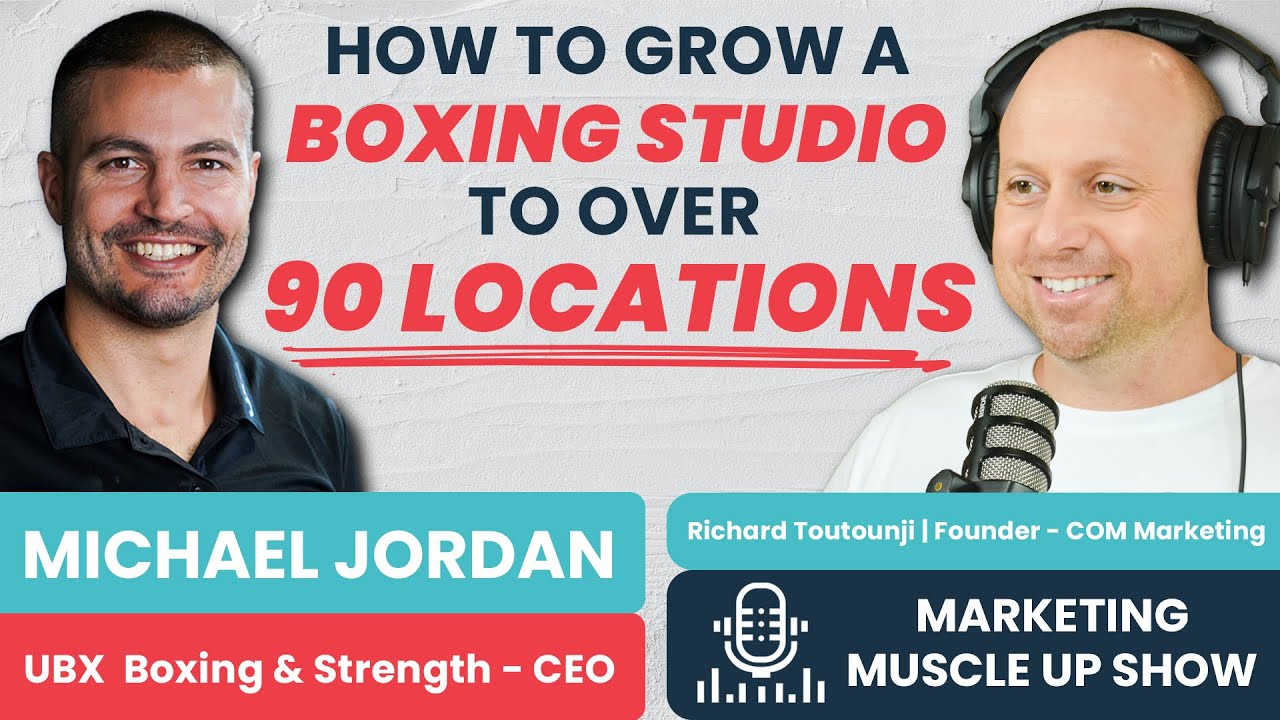
In this Marketing Muscle Up podcast episode, host Richard Toutounji interviews Michael Jordan, CEO of U‑Box Boxing and Strength, about how the company grew from a single boutique gym to over 90 locations across Australia, New Zealand, Singapore, the UK and plans for the US. Jordan recounts his early career in marketing and wearable tech (Myzone), the insight that led him to see a market gap between hardcore boxing gyms and low‑skill pad‑work classes, and how that informed U‑Box’s core value proposition – convenient, skill‑based boxing combined with strength training. He explains the 2019 rebrand from 12Round to U‑Box, the creation of a comprehensive brand‑guideline playbook, and the importance of a clear, unified brand voice. The conversation dives deep into the franchise model versus independent ownership, introducing the “5 Cs” (Capital, Capacity, Competencies, Character, Camaraderie) used to assess prospective franchisees. Jordan outlines a step‑by‑step marketing launch framework (Hype phase, Foundation 1, Foundation 2, VIP week), typical pre‑sale budgets ($10‑15k) and the breakeven target of 110 members. He also discusses operational challenges in scaling internationally, the need for annual game plans, performance managers, and the impact of COVID‑19 on expansion. Finally, he shares upcoming innovations, technology roll‑outs, and the next growth focus on the United States.
Chapters
It was a great opportunity to really reassess, you know, our brand. And so we did a big update of the brand guidelines. And for anyone that doesn't have a brand guideline playbook, I'd say that is the— stop what you're doing and go back to that.
Hey, welcome back to the Marketing Muscle Up podcast show. I'm Richard Toutounji, and today we're in for a special treat. Uh, I want to know all about the game of boxing and strength, and I've got none other than Michael Jordan, uh, joining me. He's the CEO of UBOX Boxing and Strength, Australian-founded and fastest-growing boxing franchise globally with 90, uh, studios and growing throughout Australia, New Zealand, Singapore, and UK. Michael, uh, welcome to the podcast.
Thanks, Richard. Great to be on, mate. Looking forward to this chat.
Yeah, awesome. Um, we caught up a couple weeks ago at the fitness show, and, um, there's a lot of things that have changed in, in this world, in your space. I know you've come from the— I know you've come from a marketing background, um, many years ago. You had 15 years experience in this space. Um, you've had your own gyms, multi-sites. Uh, you've been in the wearable technology former MyZone MD for Asia Pacific. So you've had a lot of experience in this, and now you're sitting as a CEO of the largest growing franchise here. Tell me about how you got involved in this and why the decision to move into this, Michael.
Yeah. So without going into the full history of how I got into the industry, which was back in my mid-20s after starting in marketing, I Started working for a company called CFM over in the UK. That company then went on to found Myzone, and I came back to Australia to help run the operation for CFM and Myzone here. That was a great experience in its own regard because Myzone was definitely an innovative new product that had a bit of the, what do we need this for, factor. Yeah. Before it actually became a main stay in the market. And I remember those early days of, first of all, convincing— trying to convince clubs that heart rate technology and the feedback on workout is something that improves the experience and improves the retention and attendance of members, given that predominantly at that point it was all about heart rate training for athletes. And so there were some really sort of interesting insights there, and particularly into the psychology of motivation and I found that really interesting in working in that space to really look at what drove member behavior and taking them from being extrinsically motivated, i.e., you know, I've got to join the gym to lose weight or for the upcoming wedding or because the doctor said, to intrinsically motivated because I enjoy it or I want to master something or improve on something. And So that really sort of changed the way I looked at how fitness providers should position their products. It shouldn't just be about sales, it should be about how to get members intrinsically motivated to stay along and love doing what they do. So in that process, I've got to see a hell of a lot of gyms. We work with big box clubs, 24/7s, and the up-and-coming models of the boutiques, which, you know, um, 8, 10, 8 years ago was just hitting the scene with CrossFit and some other group training providers. So, you know, in that, that early period, it was really interesting to see the different dynamics of, of members and the level of engagement, um, between a, say, a big box 24/7 member and a boutique member. So And what we know that CrossFit did really well to really kick off the boutique phase was, uh, 2 things. They were great at building relationships, that community, or as it was known back then, cult.
Yep.
People lived and breathed CrossFit, and that was a sort of new, sort of, uh, new type of member in the industry, and they were paying a premium because of it. And also results, you know. And while there were some downsides of the type of CrossFit training in that coach-led program set environment, members were getting fantastic results. And so I was really interested in the boutique space and came across, um, Tim West, who had started up a model, 12 Round Fitness, in Toowong, back in the test club in 2014. And we got Moisés in that club and we had a few good catch-ups and, you know, I saw huge potential in the model. And based on 2 things, and it's always looking at where there's a gap in the market, um, and the 2 things that U-Box now, formerly 12 Grand, and we'll talk about the rebrand a bit later, but the thing that I saw with the U-Box model that was missing was, first of all, boxing has been hugely popular in the fitness industry, but there's been 2 ends of the spectrum, as being box— hardcore boxing at one end of the scale, and then sort of boxer-sized member-on-member pad work at the other end. Yeah. So I saw there was a huge opportunity to scale up that sweet spot in the middle with, you know, genuine boxing skills and drills coupled with strength training. And also the fact that unlike regular group training, there was flexibility of being able to start at any time, which You know, at that time the convenience economy was in its early stages, but as we know, over the last 5, 6 years has become very prominent in, in every industry, you know, to provide products and services on demand. So that was a long-winded version, even though I was meant to do it short, but it was, yeah, through my dealings with Myzone that I saw that 12-brand and now U-Box Had a massive opportunity to scale. And so that's when I partnered up with Tim and Jonah and started the journey.
So Michael, how do you know, I guess I'm asking for this, anybody who's got that next opportunity they see in front of their face right now, the next thing, how do you know that U-Box was going to be the next thing? Is it something that you just go and work for? Is it a hunch that you have over the experience? How do you choose? What's that next thing that you think is going to be the biggest thing?
Yeah. I mean, if you read any startup book, it often talks about finding a problem in the marketplace that's not currently being solved or not being solved well. If you were joining an existing marketplace and doing something that is already out there in the marketplace, more challenging to scale up and grow because you're in what they call the red ocean of other providers. And then you've really got to be on your game to scale up and grow, given so many others are trying to solve the same problem. The second part to that, so when you're defining your value proposition, if you can't clearly explain it to you know, your friends or family in 30 seconds without them getting it, then it's probably not that unique or easy to grasp concept to bring to market. So if you're still bringing it into conversation as to why your— the new product you bring to the market is going to be different and better than what's already out there,
Yep.
That's also a good sign.
Love it. Problem in the marketplace. That is a good one. And then that goes into marketing, Michael. I mean, marketing is all about trying to go out there and find the right client to come to you. But is it essentially— and it's a little diverse question here, but is it essentially bringing that attention to your marketplace that, hey, This is the problem that we've found and this is the solution. Is that how you go out there and get more locations and more franchisees in your network?
Yeah. Both from a B2B and B2C perspective, I think with our particular model, so using our U-Box as an example, talking through our 2 value props, which is the boxing inconvenience Um, you know, we're able to sort of clearly identify that, that gap between the intimidating hardcore boxing gym environment, which a lot of people are familiar with, you know, the perceived or real threat that you're gonna have to get in the ring and someone's gonna punch you back, takes a big chunk of the market out.
Yeah.
Um, and then at the other end, if anyone's done a Boxercise class and done member-on-member pad work, they would have known the highly erratic, sometimes dangerous experience of being partnered up with someone at a different level to you. Totally. Skill base. So straight away people nod their head and go, yep, I get that. And so when we say, you know, we've got 6 to 12 rounds of a boxing component, you know, with proper boxing coaches that develop your skills as well as the conditioning, um, that they get it. They go, aha, I see there is that gap in the market because You know, if they're familiar with the industry, that they experience the two ends of the scale. And then, you know, the other side of convenience is just talking about real-life examples, you know. And if anyone's done group training, the biggest frustration with that is booking classes, running a little bit late to class, and having that awkward, you know, do I go or do I run when I'm 10, 15 minutes late? Yeah. But we see the impact and power of group training, the community, the coaching interaction, all that stuff. So the ability to be 15 minutes late from your business meeting and still be able to get the workout in that you really wanted to do, everyone both from a sort of business model or consumer model understands there's value in that. So You've got to give those real-life examples to put into context what your value prop is. And if it's not that remarkable, then not many people are going to remark about it when you launch it into the market.
Yeah. Yeah. Great insights there. I just want to go back a second. You talked, just for those who are going, hey, I haven't seen UBOXX around, where'd these guys come from? You did a recent rebrand, 12Round to U-Box. Can you just quickly talk about why? And then for those who are considering a rebrand, what are the pros and cons to that, Michael?
Yeah, of course. Yeah. So we started franchising in 2016 and we did that as 12Round in Australia. We had some quick growth in the few years up to 2019 when we started our international launch. Yeah. In that process, we couldn't get the trademark for 12 Grand internationally, so we were put in the position of, right, we've got to create the brand again. Now, as painful as that was at the time, it gave us an opportunity to— if we would do it again, what would we do better? And so we looked at the model, the positioning, the future of the brand, the modernization of the fit-out, And we felt that U-Box better represented, you know, who we were as a product. It said boxing and strength on the label. It gave us a more medium, a premium feel. The black and white are better colors to last the test of time, that they don't date like some colors, which we had green in our logo. So there were a lot of upsides to it. And so we launched the International Club under U-Box. and grew New Zealand, Singapore. Then, uh, end of last year, we, we partnered up with a group in the UK to roll out, um, 250 clubs over the next 10 years under UBOXX. So long story short, we realized that we're gonna have to grow 2 big brands or unify the brands and bring them together under one. So nobody wants to grow
2 big brands. That's, that's, uh, double the amount of work, I think,
particularly when they're the same thing. It's very confusing for the public when you're talking about 2 brands that are the same thing. So, you know, we— it was a great opportunity to really reassess, you know, our brand. And so we did a big update of the brand guidelines. And for anyone that doesn't have a brand guideline playbook, I'd say that is the— stop what you're doing and go back to that and put together a brand playbook. Guideline because it really helps you crack on with executing your brand through all the various touch points your brand interacts with the public, whether it's the way you communicate, your digital marketing, your in-club experience, your merchandise, your signage, and everything in between. You know, if you've got that really crystal clear, you know, what's your purpose, how do we represent ourselves, what's our brand voice, then it's very easy to make decisions on the go with the brand once you're live, you know, in the marketing, you know, play month to month. So we did that. We really sort of took a look at how we could reposition ourselves, really articulated our value prop, which is now world-class boxing workouts ready when you are. We've got a new tagline, Rethink Impossible, and that then was then put together and packaged and presented to the network and provided an opportunity not only to unify the brands, and we've got a mission to be the world's largest boxing community under the one brand, but also an opportunity to relaunch the 12-round clubs into the market and target those prospects that hadn't yet engaged. with 12 grand before under the new U-Box brand.
Yeah. What a great initiative, especially when you can go into the marketplace with a brand new brand. I think that's a huge part of marketing, a great opportunity there. Michael, we work a lot with independent operators. There's a lot that listen here. And then you have generally those who want to purchase a up-and-coming franchise or a new franchise or existing franchise. Take us through, you know, in your views, because you've seen both sides of the spectrum, um, what, what are the pros and cons? I mean, who should go for a franchise? Who should say, listen, I want to— I need to go down and purchase a location? And who should go and get their own location? You know, because you've seen it from both sides. I mean, is everybody suited to get a franchise or some suited for independence? What are your thoughts on this?
Yeah, really great question. And the answer is there's definitely the 2 categories, people that are better to set up their own business versus those that, you know, are best suited for franchising. I think with franchising, the thing that incoming franchisees need to sort of digest is that the playbook is set. So you've got your playbook, and your idea is to excel and be the best you can within that playbook. So, you know, bringing your personality and sort of experience within that playbook. So it's sort of like, you know, everyone that plays rugby needs to play by the rugby rules, but each team can have their flair within that game, right? Yeah. So it's not that, you know, unique personalities can't provide that flair within a franchise model.
Yeah.
But where they sort of switch to going, they're better suited to independence, is if, you know, that they really enjoy the creative process of coming up with the model, the systems, the marketing, the sort of, they want to develop a product from scratch that they dictate the direction and strategy for the product. So if you've got an amazing idea that you want to bring to market and you don't see an existing franchise model do it, and you don't believe you feel you can be confined to a franchise playbook, then going down the independent route is the way to go. You still need to assess all the things we talked about at the start. Do you have a unique value prop for the market? And obviously, do you have the resources and time to build the systems that you don't get with an independent club? But that's probably how I'd categorize the two, whereas coming into a franchise, all the strategies, support systems, technologies in place ready to go so you can get straight into the operating of the business and growing from there.
Yeah. Love those 2 different examples there. You're now expanding overseas. You're in Australia, you're in New Zealand, Singapore, I believe. As someone who's the CEO leading these locations, what's the biggest barrier you have in the growth of in the growth of locations, but also making sure that each location is independently growing, happy, getting the leads, doing the marketing right? What are the challenges when you're trying to grow a brand and also looking after each location as well?
Yeah, well, as we all know, the last couple of years have been extremely challenging for the whole industry. And so it's, you know, while this year has been slightly different in that we've been able to put, you know, annual calendar and game plans together, which is crazy to think for 2 years we just really couldn't do that.
Yeah.
You know, I think that's where it starts, is having a really clear sort of game plan for, you know, your marketing and engagement activities for the local clubs to execute, so that there's always, you know, a strong initiative to execute to either, you know, generate leads and sales for the club or, you know, provide initiatives for members to drive attendance and retention in club. And, you know, so working through a clear annual game plan throughout the year is a really important place to start, and then having the performance managers across the regions working with clubs to identify the strengths, weaknesses, and what each individual business needs to develop to, you know, take them to that next level. And so that's, that's an ongoing thing, and that's, you know, a really important factor is sort of having a really clear game plan and strategy for growth and retention, and then making it easy for them to execute that, and then having a team to support them along the way. So that's from a local level perspective. Then from a brand, sort of an international growth perspective, I'd say 2-fold. One, COVID really put the brakes on a few international expansion opportunities. We had a guy go over to the UK to launch our first club there. Yeah. And came back. And just regaining that confidence in the market from outside investors that the future is bright for the industry. There's lots of lead indicators with the increased importance that people now put on their health and mental and physical fitness. And so while there's been a recovery period, it's bright times ahead and getting on the forefront of some opportunities for growth in the industries where a lot of investors are looking. And to be part of that, you just need to, again, clearly identify whatever market you're entering, that there's a gap in the market that your model can gain traction in. And so that's the big thing when we look at a partnership with Empower Brands and international expansion is they identified the same thing we did, that there was a gap for boxing and convenience in their marketplace.
Yeah, amazing. Um, and I love this. I like the piece, you know, really getting clear on your brand guidelines. A lot of people, I think, would bypass that. And, uh, the reason why I find it really interesting is because we, you know, when you, when you are growing multiple locations at one time, and let's say an independent is just growing that one, it makes a big difference because your message has been putting out there multiple times, every time. So there's something, there's a big truth in that I'd love to, you know, just bring to everybody's attention in regards to that. Michael, couple more questions for you. I mean, really interested in For those who are, I mean, for those who are having the one location and they're in the one location, when, you know, when you say, okay, let's launch a new location and someone's got a brand new location, what would a brand new location need to get off the ground? Let's say they've got zero clients there, then they want to get to 100 clients.
Mm-hmm.
I guess, what's the timeframe? What does it look like in regards to marketing spend? And what should we expect in those, let's say that first 100, if you want to put it that way?
Good question. I mean, breakeven for U-Box model is 110 members. So target is to achieve that within the presale. There's a few really important factors and This is industry-wide. First of all, getting a great location with good commercial terms with the lease, particularly with the incentive, a rent-free period, you know, is always beneficial, minimum 3 months, often more than that. Get our contributions as well. You know, if you can get those incentives, that really extends your runway for your targets you need to hit as you launch your club. So obviously reduces your expenses early on. And so that's the most critical thing, first of all. And then making sure you've got the capacity to then execute the presale. In our case, we work over 4 phases, a hype phase, the foundation 1 and the foundation 2, and then the launch. So each one has a hype phase, is registering as many leads as possible. U-Box is coming to this suburb, register your interest now, build up your lead database, and then have your countdown to your first release. So we call them urgency cycles. Yeah. People feel very Reactive to FOMO, fear of missing out. And, and so doing that with the best offer before you don't have a lot to show with your fit-out, that gets you early, early adopters that just love a great deal. Then as you sort of approach it, your sort of fit-out's underway, we can scale up to your Foundation 2 for those that want to come meet you down at the club. And while they can't do a workout, they can—
Yeah.
touch, feel, meet you, all that stuff. That's your second urgency cycle, um, you know, and, and do that right up until the opening where we do what we call a VIP week, which is the final opportunity to, um, experience the workout. Yeah. But also get the foundation right, um, before you, you do your launch special. So Those cycles are really important and sort of planning them out strategically with, you know, your mix of digital and local area marketing. At the start, it's predominantly digital, and then from about 6 to 8 weeks out, you really hit the ground to, you know, get your brand exposed as many times as possible in person through signage. through corporates, community groups, all that stuff. But budget-wise, it just depends, you know, that you can be efficient with it, but, you know, $10K to $15K, it just depends on what type of business model you've got. Yeah. But spending that over that period for signage, digital, and outreach is a fairly Reasonable budget to execute that.
Love it. Great insights there. The hype phase, the 2 foundations, and the opening in the VIP week. Huge value there, about $15K in spend. And it's good to know, Michael, because at the end of the day, we were talking about before, marketing has changed and a dollar can go a lot of different ways used correctly, used right. Knowing what you're doing, and that's why I love this concept. You know, ensuring that you can lead. Here's the here's the kit. Here's what you need to do. Go and execute. You can be a big a big a good business operator that way. There's a couple final questions. I want to know, in your experience, what makes a really good operator, and what and and what makes a really poor operator? I know I'm going off script here a little bit, but I just think that in today's marketplace, business is not what it was 10 years ago. And it does require somebody to, I think, know what they're doing in business today. It doesn't matter what plan you have, but at the end of the day, you want to know what you're doing. So what are top 2, maybe 2 or 3 characteristics of a of a great operator versus someone who's on the lower end?
Yeah. Well, we have, when we're interviewing franchise applicants, what we call the 5 Cs, which we assess the appropriateness of an applicant on. So those 5 Cs are, first of all, capital. You need the necessary amount of capital, not just to launch the club, but to have in reserve. Every small business needs capital to get started and get going. Then we talk about capacity. Capacity is really important. I'd say this is one of the biggest ones entering a fitness business, a small business is we have 2 categories, either owner-operator or active investor. Owner-operator is someone that takes on the manager's role, works in the day-to-day. The active investor has other jobs, businesses they run, and the U-Box is an investment. But the capacity to still be able to support your team, we say for your first club, train at your own club, host the weekly meetings, be an expert on your business so that you've got the finger on the pulse when you sort of coach the staff and work with the members because with these models, members are paying a premium. Yeah. So if suddenly complacency sets in or the club experience drops or the club gets dirty, if you're not across it as an active investor, the experience can lead to a downturn in results fairly quickly. So that we
need
to make sure, you need to make sure you've got the capacity if you're not owner-operator to support the business, um, you know, to drive the experience that needs to be there. Then we talk about competencies. So to your point earlier, you know, uh, the competency could be— as a previous fitness operator, it could be they're highly skilled in the technical side, they're great coaches, but it's identifying, right, what relevant competency that they bring to the business and what are the areas they need to be quickly, fast upskilled on. And you'll know this yourself, until you get upskilled on, let's say, marketing, you may need to outsource that initially because you can't sort of be great at one thing and poor at another in this industry. You've got to sort of be on your game with everything. So looking at that competency, the speed to be able to learn things quickly and then apply it in a sort of systemized fashion, month to month, week to week, quarter to quarter. Then we look at character and character comes twofold. And I think we all know this having gone through the last couple of years, running a small business is hard. It's really hard. And there's just so many twists and turns that, you know, that ability to sort of roll up your sleeves when the going gets tough and sort of persevere through the tougher times to get to the good times is really important. So, you know, always sort of reflecting for yourself, or if we're looking at applicants, sort of their previous experience in and going through different challenges and adversity and coming through that. Because there's undoubtedly challenges when you open and launch and operate a small business. So, if you don't react well under pressure and stress, there's certain examples where you may be better off staying in an employed role.
Yeah.
Versus growing a small business, because the buck always stops with you as a small business operator in that, really comes into play, but also the fact that, you know, getting along with, with, um, the prospective, um, operator. And then the final one, just we talk about camaraderie, you know, um, being a, being a team player and being able to collaborate and work together with, you know, your peers and one another to try to level up your performance as a, as an individual group. And, you know, like we saw at the industry events last week, that's great from an industry level as well. If we all work together and sort of see how we can improve,
then
yeah, we all rise together.
Outstanding. Very good answers there, Michael. I love the style that the 5 Cs— excellent insights on that. Michael, thanks so much. Really appreciate your insights, giving us some real golden golden items that we can tick off to make sure, are we doing this if we're a franchisee or an independent operator? Finally, where to from now, Michael? You mentioned you've got 250 locations launching. What is the future of U-Box at the moment?
Yeah. So that's obviously a long-term project in the UK. We're just really focused on continuing to evolve the U-Box model. We've got some exciting new innovation and technology coming into the mix over the next 6 months that will be really exciting to launch across the network. Continuing to analyze, optimize how we can improve performance across the group and then continue to grow internationally as well with USA, the next sort of focus for growth over the next 12 to 18 months. So yeah, very busy times and yeah, just really excited about keeping the momentum and progress across the board.
Amazing. Well, thanks so much, Michael. Guys, if you haven't yet experienced the U-Box, it's uboxtraining.com. And if you're interested in getting a location, Hit Michael up or go to the website and you can check more about that. Thanks so much, Michael.
Thanks, Richard. Really appreciate being on the, um, on the podcast, mate, and congrats on all the great work you're doing as well.
Cheers. Thanks so much, guys. If you've loved this episode, uh, be sure to share it out with a friend, um, and really reply back and say what did you love about this episode. Otherwise, go and check, uh, Michael and the work he's doing and the expansion they're making at uboxtraining.com. Thanks so much, guys.









