Pilates Perspectives:Insights from Robyn Rix on History, Method, and Growth
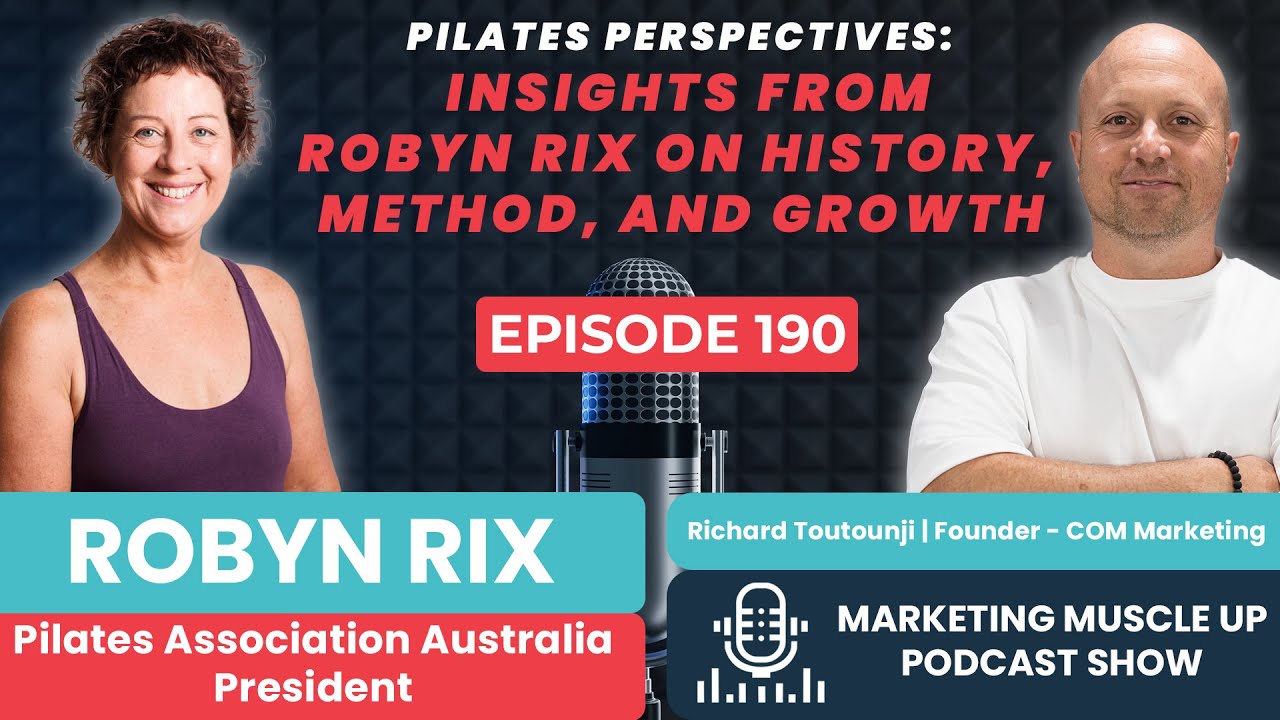
In this episode of the Marketing Muscle Up podcast, host Richard Toutounji interviews Robyn Rix, founder of Pilates Works and President of the Pilates Association of Australia (PAA). Robyn explains how she balances running a boutique studio with leading a national industry body through disciplined systems and compartmentalisation. She draws a clear line between "real" Pilates and the many commercialised versions proliferating in gyms, offering a checklist that distinguishes authentic practice and describing the two main streams – classical (faithful to Joseph Pilates) and contemporary (modern research‑informed). Robyn shares her personal journey from actuarial work and architecture to Pilates after a misdiagnosed cancer scare, highlighting a client whose migraines vanished after treatment. She details the practical steps she took to launch Pilates Works: selecting a location with no nearby studios, hiring diverse staff with complementary personalities, and using low‑tech marketing such as a local letterbox drop and an open‑front storefront to demystify Pilates. Her marketing philosophy centres on deep market understanding, visual accessibility, and branding over social media. She recounts a costly COVID‑era lease mistake, applying her "30‑second rule" and a "trial‑and‑success" mindset to recover. Robyn outlines the PAA’s advocacy work – representing members, lobbying for health‑fund rebates, and pushing for proper training standards, especially among physiotherapists. Finally, she advises studio owners to seek expert help when needed, illustrating this with a hypothetical $100 marketing budget spent on consulting, and provides the PAA website and contact details for listeners.
Chapters
There's a thing called the 30-second rule, which is when you make a mistake, focus on it for 30 seconds, work out what you did wrong and what you could do differently, and then move on.
Welcome back to the Marketing Muscle Up podcast show. I'm your host, Richard Toutounji, and today I've got a really special guest, someone who I've done some work with in the Pilates industry. So if you have a Pilates studio or you're thinking about getting into it, this episode's gonna be a real eye-opener for you and going behind the scenes of somebody that's leading this industry and teaching other people how to become better in this niche. Robin Ricks, welcome to the call. Robin is the founder and owner of Pilates Works on the Lower North Shore of Sydney. So if you're in the Sydney area, Look out for that studio. I met Robin in the PAA, also called Pilates Association of Australia. So many different roles in that, but currently she's the president of that. And I got to know her, her amazing business, what she does, and that she really cares for this industry, saying that a second generation trained by second generation Pilates instructor. Right? And this is really interesting because this is when you're following the Joseph Pilates story, you've got the second generation. I'm going to ask Robin a little bit more about that, but this is where it becomes interesting. A lot of people change careers because something happened, and hopefully I can get some behind the scenes out of Robin. Robin became a Pilates instructor after completing her architectural career, Bachelor in Arts, and then she decided to change careers because something dramatically happened in her life. So welcome to the show, Robin. Good to have you here.
Thanks, Richard. Thanks for having me.
No, it's a pleasure. Now, Robin, we've known each other for a couple of years. We first came in contact, you being the president of an association called Pilates Association Australia, also known as PAA. But you've also got your own business as well called Pilates Works. So my first question to you straight off the bat is How do you manage running a small business and also being the president of a Pilates PAA as well, where you're looking after a whole bunch of different, uh, a whole bunch of small business owners like yourself? How do you do both?
I'm a very organized person, Richard, and I have quite a lot of systems in place that allow me to do that. So I try to stay incredibly focused on one thing at a time. So I have a list in the morning. The first thing I do is I work on my own business. And then the second thing I do is I work on the business with the Pilates Association. And I also, for my sins, I'm also on a strata committee.
Oh, strata committee. Okay. Yeah.
So as they say, if you want to get something done, give it to a busy person. So I just try to compartmentalize everything.
Very good karma. I can't even say the word. Um, and it's interesting because we're all doing so many different things, right, um, in our lives. But, but let's just quickly talk about, um, the— I'd love to know, go a bit deeper in Joseph Pilates. I mean, when I first came across Pilates, I was working on a cruise ship, oh, a long time ago, and, um, we had to go to the UK to get taught, um, by, uh, Joseph Pilates. It probably would have been a second generation And taught us the Pilates, Joseph Pilates method. Now today in the marketplace, Robyn, as you know, there is Pilates studios coming out of everywhere. They used to be, you know, very unique to find, but now you, you find them on every street corner. Every cafe has the things coming out, gyms, health clubs, they're everywhere. Robyn, tell me about, you know, let's go back a little bit and talk about Joseph Pilates and talk about the different streams of Pilates just so everybody understands. Um, that, that world if they don't already?
Yeah. So Richard, I just wrote an article actually about exactly that topic. So it is a flavor of the month. It's a shiny bright thing. It probably has been, I'd say, for about 5 years now. Massive increase in the number of studios operating. To me, a lot of them are not Pilates. And so I've just written an article talking about that and saying, how do you tell whether it's Pilates or not? And I went to— I'll often go and do a bit of shadow shopping myself with new studios. So I went to a big chain. I won't mention its name. What they were doing was not Pilates. When they called, they called. I went to one session and it was one of those deals, you know, you get so many sessions in a week. And they called me and said, you know, are you coming back? And I went, no, because you're not teaching Pilates. They're going, what do you mean? And so I had to actually explain to them why what they were doing was not Pilates, because it's meant to be mindful exercise where you're concentrating on what you're doing. You do limited number of repetitions. You do them very mindfully. Whereas in a lot of these new gyms that are teaching Pilates, it's like, how many can you do in 2 minutes? And it's not Pilates. So part of my challenge as the president of the Pilates Association is trying to figure out how to get that message across to people because it's an amazing method. And sometimes I get accused of going, oh, you just want, you know, want to keep it elitist. I do not want to do that. I want as many people as possible to benefit from the method. I think it's an amazing method. It applies to everybody. So if you're 90 years old, I've taken a 4-year-old doing Pilates, you know, so it can benefit everybody, but it has to be done at least 90% right.
Got it. So Robin, let me be the devil's advocate here. Um, you're saying it's not Pilates, and then someone says, oh, but it is Pilates, we're doing these things that they've taken from— we've sort of taken it from this And we've kind of changed it around. Um, when, when you say it's not Pilates, when does it become where, you know, we, we find something and improve? Are we improving or we're actually reversing it? Is it— or is it like we should just call it something else like circus or something? You know what I mean?
Um, so I think the problem is people use the Pilates equipment and then they invent their own exercises. So I'm happy for them to do exercises on a reformer
Yep.
So if you want to do aerobics on a reformer, fine, no problem, but it isn't Pilates. So I, I do have a checklist, Richard. I can give it to you.
So grapevine is not Pilates, is that what you're saying? So the, the
grapevine
is
definitely not Pilates.
All right, so there is a list of definitely not, and, uh, I did say it's kind of—
it's more the, um, so if everyone's doing exactly the same thing And there's no— so normally we tailor it to the individual. So if you need a particular thing, so if everyone's doing exactly the same thing at the same time to really loud music, um, they're throwing in additional weights and things like the equipment on its own is enough. If you're not concentrating on the movement, you're trying to do as many as you can in 30 seconds. That's not Pilates though. Okay. I'll give you the list.
I'm looking forward to it. We'll publish a list. Look in the show notes. All right, so I think we all understand what you're talking about, Robin. I think even the, the, you know, the people that experience this kind of version of Pilates, I think it's a really good education too to, to talk about where— and let's just go have that conversation a little bit. Talk about Pilates, the benefits of it, doing it the pure way, and the Joseph Pilates method, just so we all understand it just quickly. And then someone else can compare to say, well, You're right, Robert, it's actually different. We're not doing Pilates. Uh, give us some quick overviews of Joseph Pilates' method.
Okay, so in fact, we don't teach— so there are 2 streams of Pilates. One is called classical and one is called contemporary. The classical one teaches it exactly as Joseph Pilates taught it. So those people would probably argue that what they're doing is Pilates, and possibly the contemporary people are not doing Pilates either. Um, but my belief is that the contemporary Pilates takes the principles that Joseph Pilates had and we're applying modern research to that. So there are some things that we have learned since Joseph Pilates, like he was around in the '30s. We've learned a lot about the human body. So I think that that's, you know, it does need to evolve, but the basic core beliefs of how the system works has to be maintained. And I would also say that like Pilates goes from, actually did just a little table that people, Pilates goes from helping people who are elite athletes through to people who have chronic, complex, long-term issues. So I've had clients with Parkinson's, strokes, multiple sclerosis, and Pilates can cater to all of those things. So if you just want to do fitness, you can, but there is still some rules that you need to abide by when you do that.
Yeah, love it. Okay, good to know. Good to know. So Robyn, let's talk about your journey into the Pilates space. Just, I mentioned that you changed careers. Can you just talk about, you know, 'cause I think this happens a lot in the health and fitness and wellness. People get to an age or they get to a point or something happens and they dramatically change. And that's something that happened to you. Can you just sort of give us your story of why you are really passionate about this career?
Yeah, sure. So originally I was an actuary. Very mathematical, worked in the corporate world. Then at 40, I went back to uni to do an architecture degree. It was something that I'd always wanted to do from when I was a kid. I went back. In my last semester of my degree, I was diagnosed supposedly with secondary cancer, secondary metastasized cancer to my liver. I was told that I had probably less than a year to live. Now, I didn't believe them. I had a bit of pain in my side, but apart from that, I was well. I hadn't lost any weight. I really did not believe the diagnosis. For 6 weeks, I made my doctor do different tests. Everything came back inconclusive. Eventually, I saw a liver specialist, and he said, you should never have been told that this was a secondary cancer. It has none of the characteristics of a cancer. Having done 3 years of architecture, I really needed to go back and do another 2 years to finish my master's. I had 2 small children, so they were 4 and 6 at the time, a husband who probably wouldn't have coped if I wasn't there to help with the children. So it was really a very traumatic 6 weeks of my life. So I thought, what do I want to do? And I'd been doing Pilates just at the gym, fitness Pilates, probably for about 6 years. I figured there was more to it than what I'd learned at the gym, and I decided to go on to the course halfway through the following year. Um, when I started, I just loved it. I loved everything about it and just the difference it made to people. So one of my first clients was a prison guard who'd been having migraines 3 times a week for 25 years.
Right.
After a week, his migraines started to diminish. After 6 weeks, his migraines had completely disappeared. Um, and I just thought, I can't not do this, you know. I have to continue to do this work.
Wow. Um, quite life-changing. And, um, so you tried on yourself, you tried on other people, and you sort of just fell in love with it. Is that, is that, is that what makes a great fitness professional, wellness professional, Pilates professional?
I think so. Yeah. I mean, I love, I love my job. I love my staff. I love my business. I love my clients. And often when I send out their kind of welcome email when they join, I go, welcome to the family, because that's how I feel. And I have clients, I mean, I have one client who's tried Pilates pretty much everywhere around the world. Whenever she travels, she tries all the different Pilates studios and she always comes back and she says, this is the only place I feel at home.
Ah, very good. I think that's what we all want to do in this wellness industry is we want to get people to be a community and to feel at home. I want to veer our questions a little bit now for somebody who is a small business owner, you know, and then we'll touch on— I'm going to go in between. I'll touch on the association too. But as a small business owner, you have a great business called, mentioned before, Pilates Works. I actually used to have my very first studio right near your location. And, um, what you do is, um, you know, you teach, you know, you run that business as a small business owner. So take me through, um, I guess what's been different in running your own business, um, versus when you're working somebody else, you know, because there is a lot of people that transition careers and they sometimes they don't get that reality. But what, what's sort of the, the key differences? In what you're seeing running your business?
So the first thing I did was I actually worked for somebody else because I had only worked in the corporate world and I really didn't know enough about running a business. So I worked in someone else's business for a few years and I was constantly noting things and thinking I wouldn't do things that way, or I really like the way the person does that. So it gave me a pretty good understanding of what It's required in the business. Yes. Um, and then I did a lot of research about where to locate my studio. So at the time, Pilates, so 2010, there weren't that many Pilates studios around. Um, so I found a location where there were no other Pilates studios. There were some physios nearby and, and located it there. Um, and then I think staffing's the next kind of critical thing is finding people who share your passion.
I think that's the hardest thing, right? How do you find people who share your passion a lot of the time?
Yeah, one of the funny things that happened is I actually went, so I had 2 staff at the time, we went down to Melbourne to a conference and there was a psychologist at the conference and she actually got me and my 2 staff members to come up and she said to me, one of the unusual things in my business was that my 2 staff were very different from me. And she said, I see so often people just recruit people who are identical to them. So I think having people who are quite different. So she said, if you've ever done any of the kind of Myers-Briggs stuff, that—
Yes, I have.
If you actually, if we, if you combine the 3 of us, we kind of covered every aspect of it. And like, I think that's a really, like, it hadn't really occurred to me that that was true, but it also means that it's good for my clients because You know, some people don't like my style, but they may like the style of one of my other instructors. So there are people who only go to one instructor. Some people are happy to go to all 3 of us because we teach differently.
Yeah. What a great tip there. I love that. You know, yeah. Don't be scared to hire people outside your, outside what you, what you are, because then you can obviously retain and get a different type of clientele. Yeah. That's a great tip.
I would also just say on that one too, I'm a big, um, de Bono fan as well. So if anyone's ever read Six Thinking Hats and he talks about the people like, so black hats are the ones that always interest me. So they're the people who are quite negative and are always telling you that something can't be done.
Yeah.
And people in a team who are really optimistic and go-get-'em kind of people don't really like the black hats, but I love them because I'm one of those optimistic people who anything is possible and I need someone around me to go, hey, wait a second, have you thought about this? So I don't think I've ever been It doesn't happen in my business because I don't really need it. But
in
Pilates Association, in the corporate world, when I've worked, I've always really welcomed those black hat people. And I tell them, you know, their contribution is incredible because without them, you know, I'm going to make some massive mistakes. And often I'll ignore them. Like I'll listen, I won't say I ignore them. I listen to what they say and then I might take some action to make sure that what they think might happen won't happen. But it gives me knowledge and I think knowledge is always a good thing.
I love it. And that's why you do a great job in the president of that because if I was on, it'd just be like, no, I disagree with you. So it's, you gotta have that right person to be able to manage all those personalities. I love that. Let's just touch on, because we're a marketing podcast, I wanna get straight into some marketing strategies that you do in your business. So if you're a Pilates owner and, you know, Robyn's share was already I love the concept of hiring different people. I think it's awesome. So Robin, tell me about marketing and how you market in, you know, today's landscape when you've got a lot of Pilates businesses brand new and they're, they're sort of like possibly not teaching the real Pilates or they think they are. And then you've got your business where you're teaching the Joseph Pilates Method. How do you market now? And I think this question is a great one for anybody who is in your situation and really struggling to identify themselves in the marketplace?
So I think the first thing is to really understand your market. So the people who come to my business, I'm very clear about the demographic of those people. And the demographic is not the same as those people who are going to go to the studios where there's 8 people in a class, um, there's loud pumpy music. It's just a completely different environment. Um, my, my clients tend not to be I'm not too big on social media, so that's not where I do my marketing. So when I first opened, I actually, I did a letterbox drop, which everyone says isn't gonna work. And I think I got 100 clients from—
Wow.
A letterbox drop just to my local area.
So,
and a lot of them stayed on board. So I think understanding who your market is is really important. And I don't actually care. Like recently a studio, one of the group fitness studios opened down the street from me and people are going, aren't you worried? Aren't you worried? I said, no, I'm not worried at all. In fact, I can't wait because I will get clients from them. And of course, people did come to me after they'd gotten injured or they weren't happy with the attention that they were receiving. And then the studio closed down and I got even more clients who then went, oh, and they come to me and they go, oh, this is not what I was experiencing. I go, hmm, that's because that wasn't Pilates. But I'll try not to be a broken record on that particular topic.
Yeah, that's great. Um, basically go get your popcorn and, and watch And wait. So know who your market is and market to those people. I think that's the one thing that is really important. Otherwise, we're copying somebody's ads or marketing, and it's not exactly what we deliver. And I love that it just, you know, they're saying called, you know, you know, build up, not tear down. And what you're saying is build up your own individual style and let that rise up as that goes. Um,
I would, I would also say that I kind of feel like almost everything's marketing. So like, I think things like, you know, the name that you choose, the colors that you choose. Um, for example, I— both of the businesses I've run have been on the ground floor on the street, and that means that people actually see into my business. And I think that that has been really important because Pilates is a little bit intimidating. And when you see the equipment. And so for people to be able to look in the door and see what we're doing and know that it's actually not that scary, and to see someone like yourself who may be in the room doing the exercises. And I actually remember because I went away with a couple of girlfriends and all of us love books, and there was a bookshop on the second floor of this building, and we actually debated whether we'd go upstairs to the bookshop. And I'm going like, this is weird, like We love books. Why would we not walk up the stairs? But as soon as we have to kind of take that step into the unknown, because we didn't know what was upstairs, then we kind of go, oh, do we really want to do that? So trying to make it as accessible as possible to people. Um, when I was opening my business, you know how a lot of people put like paper in the windows so you can't actually see what's going on inside until they have the business set up? Yes. I didn't do that. I had the windows open. People could actually see what I was doing. They could actually see the equipment being built. Putting in the mirrors, going up, all that sort of stuff. So it was kind of like a daily little cartoon. They could wander past, see where I was up to. And I really do not understand that thing about putting the thing in the window to stop people seeing in. I do, but you know. Yeah.
It's that curiosity versus the, well, you're open and you're happy to have that conversation, not wait for the big reveal. Talking about that, what's some, like, if you give us one or two of the biggest lessons you've learned from your biggest mistake, what would that be?
Um, so first of all, let's talk about mistakes, Richard. So, um, there's a thing called the 30-second rule, which is when you make a mistake, focus on it for 30 seconds, work out what you did wrong and what you could do differently, and then move on. So if you ask me about mistakes, I actually have a lot of trouble thinking of any because I go like, we're in the past. In fact, I have a new thing. I refuse to say trial and error. I say trial and success. I mean, why is it trial and error? Like, shouldn't it be trial and success? Because we're gonna get it, do it better next time.
Bounce forward, hey?
Yeah. Anyway, I do have one. Of course I have one. Um, so during COVID so I have a building in North Sydney. It's a 2-story building. COVID came, Um, the building next door became available for rent. I rented that space, which gave us a big open space. So we did— we were doing a lot of Zoom classes. Um, I rushed into that decision, um, with that building. I was paying too much rent. And when we came out of COVID I couldn't generate enough income from that additional space. Um, but unfortunately I was locked into a 3-year lease with it. Um, as soon as the lease was up, I gave up the space. But that was a big learning experience for me. And it was just, I thought, you know, it's kind of probably the black hat person wasn't around. Hey, wait a second. What, what are you doing here? You realize this is a 3-year commitment and it's a lot of money. So I have now gotten rid of that space and, you know, we're back on track.
Life's more simple. Well, let's talk about that for a second. And that the next part of your journey is the association. What is an association? Um, you know, there's industry bodies, there's associations, there's clubs. Why, why would we be part of an association? What is it going to do for our small business?
Okay. So we do represent the members. So anyone who is a Pilates instructor can, if they meet the criteria, can become a member of our association. And then we, I guess we're using our collective energy to then try and make changes within the industry. So we have resources that are available that if you were an individual owner, you wouldn't be able to get access to. To those sorts of things. We represent to the government. So at the moment, we're working very hard with the Natural Therapies Review, which is looking into whether or not Pilates and a group of other natural therapies, which is what they call them, whether they should have health fund rebates or not. So I guess it's that leverage that you're getting from having a group of people working together. One of the things That we are also trying to do is to try and elevate those people who are maybe doing what we don't really consider to be Pilates, to get them to understand what real Pilates is like and to move them into that, into the fold. And at the same time, we also have people, a lot of physios who are teaching Pilates who haven't actually done proper training on it. So that's a big battle that I've been fighting, is trying to get the The physiotherapy association and the people who regulate physiotherapists to understand that people actually need to be properly trained. I mean, and I mean, one of the examples that I would give of that is I went with my niece. She was doing Pilates with a physio up in Brisbane. I went and just sat in on the class. The physio gave her a list of exercises and then left the room for 45 minutes. Now, there is no way in the world—
Wow.
That I would leave someone in my studio to do exercises. Like, I might very quickly duck out to get a glass of water, but like, I would be absolutely sure of where they were, what they were doing before I walked out of the room. So, and to me, the physios don't understand the dangers of doing what they're doing. So, and they don't seem to be interested in doing anything on making sure that doesn't happen.
Well, what a huge opportunity too, as well, by the sounds of what I'm hearing here.
And as I say, I don't, I do want people doing Pilates. I don't want the physios to stop. I just want them to be properly trained.
Yeah, yeah, some definitely work that needs to be done in this area, especially when there's new growth happening, there's, uh, the words being thrown about. And I think it's a great opportunity, um, for PAA and for people like yourself as well, for your own studios to really get that recognition, uh, that, that they'll need, especially in this time of huge change in the industry. I think that's really important. Um, I've got a quick question for you, Robin. It's a marketing show, so I just wanted to know if you had $100, the last $100 you ever owned, and you had to spend it on marketing, how would you, how would you spend that market, that $100? It's
a tough question.
I like to do the tough ones at the end.
Um, I have to say, um, I've been down to my last $100 before. In fact, I've been down to my last $100 on a lot of occasions.
I would actually also too, before you answer your question, I actually would put it out there. I mean, who is even spending $100 in marketing sometimes? Sometimes we're not even spending money to market. So anyway.
I'm okay. So I think my answer to that is I'd probably come and talk to you. Oh, how much time would I get for $100?
Well, I'd definitely tell us to jump on some webinars that we run for free. Especially if you're, especially if you're part of the Pilates Association of Australia, and then you could probably work out a lot of those strategies in those free resources that you provide. Hey, there's a plug if I don't say one myself.
Yeah. So Richard, I would like to say that, you know, when I first took on the role as the president of the Pilates Association, I did come to you to talk to you about it. And you, and you were excellent. So I think if I had $100 left, that's what I'd be doing. I'd be talking to an expert because I'm not an expert in marketing. And I think it's important to know when you need help and when to go to someone to get that help.
Yeah, I think it's great advice. Get help to help you grow your business. Because I think we're in such a great position, especially if you're a Pilates instructor, owner, even if you've just rolled in Pilates because they said they were going to put in the gym and you quickly learned how to do a course. And it's, it's such a great, uh, conversation. I really appreciate your time for today. Just that conversation of starting it, if this is the first time you've heard about it. Or if the first time you heard who Joseph Pilates is, I mean, this is awesome. The doors are open and and we're aligned to go. Yeah, how can we? How can we continue improving? You know, our small business or our large gym that we've been told to do Pilates in, and I think this is a great first step. Robin, because most of the people that listen to this show, uh, small business owners as well, Pilates instructors, you know, if they've taken some interest here, I want to sort of highlight the, the association a little bit here. What's a good way they can get plugged in? Give us the URL, um, and just some information that they can start absorbing more after this podcast. Where could they go?
So, um, so our website's pilates.org.au, um, and there's a phone number on there and you've got to call our membership relationship officer. Sharon, she's fantastic. Bring her up and have a chat to her.
I love the domain name, by the way, pilatesdog.org.au. I'm obsessed with domain names and that's a great one. And check out Pilates Works with an S, pilatesworks.com.au. That's Robin's business. So if you're ever in North Sydney, I'm sure she'd, I'm sure she'd love to show you Or take you through a class.
Absolutely.
Thank you, Robyn, for your time. Really appreciate that and look forward to getting you back on. Thanks guys for tuning into the Marketing Muscle Up Podcast Show. If you enjoyed this show or like this episode, the best thing to do is just share it with your trainer, your instructor, your friend, um, share on social media, because that's the way we can get this message out, uh, to more people. If you've enjoyed this, you've taken some level of value from that. If you want more information about what we do at ComMarketing, you can go to our website, commarketing.com.au, where we can teach you, or we can do your marketing for you. Thanks guys, I'll catch you next time on the Marketing Muscle Up podcast show. Bye for now.









