Rumble boxing looking for the KO: Matt Gordin & Brendan James tale of the tape.
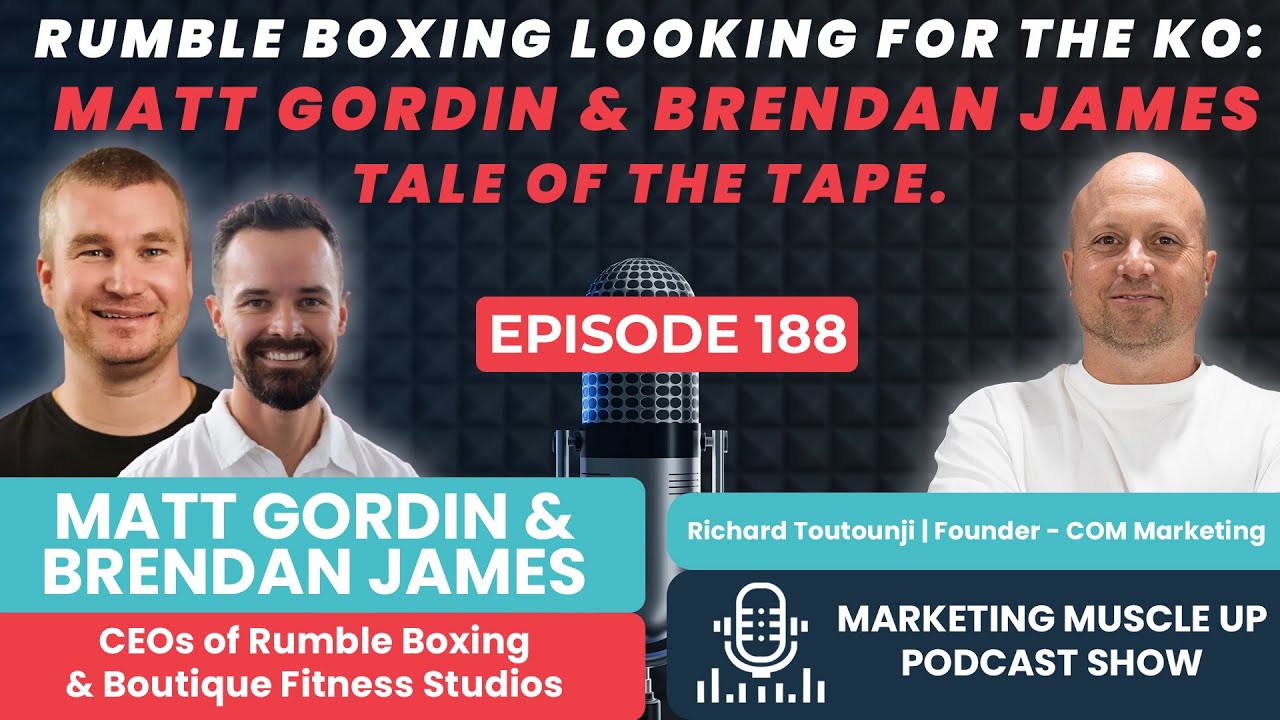
In this episode of the Marketing Muscle Up Podcast, host Richard Toutounji interviews Matt Gordon and Brendan James, brother‑in‑law partners behind Boutique Fitness Studios (BFS), a franchise umbrella that brings four US boutique fitness brands – CycleBar, Club Pilates, Stretch Lab and Rumble Boxing – to the Australian market. The conversation covers the origins of BFS (launching in March 2020, now operating 93 sold studios with 39 open and 5 pending), how importing proven US concepts fast‑tracked their growth by roughly five years, and the extensive support infrastructure they provide franchisees (marketing platforms, agency vetting, architectural drawings, equipment sourcing, POS systems, daily content creation, and a master‑instructor training program). They discuss the importance of community‑focused membership models, the niche‑specific culture that keeps members engaged, and the challenges of staffing, especially for rhythm‑based CycleBar classes. Both guests share market outlooks, noting low overall fitness‑membership penetration in Australia and strong growth potential, while emphasizing resilience, strict adherence to a playbook, and trusting the franchisor network as key lessons. When asked how they would spend a last $100, Matt says chase leads and sales; Brendan suggests a coffee‑event to retain existing members. The episode ends with a plug for prospective franchisees, directing listeners to each brand’s Australian website.
Chapters
If you're down to your last $100 that you ever had, how how would you spend that to get your business pumping or started or whatever you want to do with it?
Last $100, I'd be digging through my leads and chasing every sale I can.
Hey, welcome back to the Marketing Muscle Up Podcast Show. I'm your host Richard Turtungi. In today's episode. It's going to be exciting one because if you're into the studio space, boutique space community, this is definitely an episode you do not want to miss out on. I want to introduce my guests today, Matt Gordon and Brendan James. Now, fun fact, these boys are actually brother-in-laws. Brother-in-laws. Wow. I want to hear about that because going into business with a partner, preferably your brother-in-law, is going to be interesting one and lifelong friend. Most importantly, a shared passion. For the franchisor industry, after graduating from university, Matt dwelled into the business world while Brendan explored other options trading. Now their joint love for the one thing the fitness industry led them to inspired to bring on successful brands like Cycle Bar, Club Pilates, Stretch Lab into their hometown back into Australia, and they collaborated, put it all together, and that resulted in the boutique. Fitness Studios, BFS, a hub for these fitness brands. Now, from my understanding, I've got a run sheet here. It's got 30 locations and 80 studios already flourishing. Welcome to the show, guys.
Thank you, Richard. Nice to meet you.
You too, guys. Have I got those numbers correct? 30 locations, 80 studios?
It's actually 93 sold now. Uh, we've got 39 open and another 5 due to open before Christmas.
Outstanding. Now, how long have you guys had Boutique Fitness Studios? It doesn't seem that long since I've heard you guys in the marketplace.
Yeah, maybe close to just going on 3 years now. So we maybe a little bit naively started in, in sort of March 2020 was when we sort of signed the initial deal. And then we opened our first studio in September 2020. So right in the, right at the start of COVID which was Yeah, like I said, maybe a little bit naive to start a new fitness franchise, but in hindsight, it's all, it's all worked out really well. We had a ton of inquiries and, and got a, got a bunch of studios signed up early on, um, and sort of, yeah, we sort of rolled out from there.
Amazing. Well, they say, um, there's no overnight success, and I never believe that story, so I would love to know a little bit more about the backstory here. You've got some exciting backstories— I mean, backstories, I should say, uh, a trader Is that correct, Brendan? I'd like to like touch on that a little bit more.
Yeah, so I kind of, after I graduated university, sort of commerce finance, I ended up working for a proprietary trading firm trading high-frequency options. So did that in Sydney, moved from Perth to Sydney, did that for a number of years, and then managed to get sent over to Chicago. I was trading currencies, commodity options in Chicago for a number of years and Had my son, moved back to Australia, traded in Korean markets, Japanese markets, Hong Kong markets, sort of a whole bunch of variety. And then realized that life was missing out in the way of work and decided to try and spend a bit more time with my family. And so we packed up from Sydney and we moved to the Sunshine Coast and we took a little bit of time off. And then as a lot of people do, we got bored and so then started to figure out, well, what's next? And we'd had franchising was sort of in the blood a little bit for both Matt and I. You know, my parents were in franchising as were his and started to look at Pilates. It was something that my wife had done for 20-odd years and it was the only thing that solved her back issues that she had. So we decided to go down down that space. And through the connections in the US, it sort of, it was a pretty direct pathway to Club Pilates and then through to Exponential and the rest of the group.
Yeah, amazing. And Matt, brother-in-law, so how did that work out? Where did your path sort of join in this business world?
Yeah, I guess obviously I'm married to Brendan's sister. So, you know, we were dating back before university, basically. So Brendan and I were at UWA together, became really close, and then, like you said, went our sort of separate ways. So Brendan moved to Sydney to do some high-frequency trading. I went down the financial accounting route with KPMG. And after about 12, 18 months of doing 80 hours a week and having no work-life balance, unlike what they sort of promote as their recruitment plan, Decided to get into the family business, which was a bicycle franchise group that we had around the country. So dad had 25 bicycle retail stores. I had built a couple of our own stores up, sold them off, eventually ended up working at head office managing the group and then had an opportunity that I sort of couldn't say no to and had the opportunity to move to the US and set up Bike Exchange over there, which was a an online bicycle marketplace similar to carsales.com, I guess, but for the bicycle industry. So it was a very successful business in Australia. We packed up everything we had here and moved over to the US with a 1-year-old and launched a new business over there, which was interesting, exciting, challenging. You know, while we're over there, it was, we were living in Southern California. So it was a pretty awesome place to be. Kind of fell in love with Cyclebar while we were over there, became members of Cyclebar. And originally with our background, I guess we were planning on sort of, I guess, ripping off the concept and bringing it home to Australia. And then, you know, just by luck, I guess exponential, we're based in Irvine in Southern California as well. So we sort of were able to meet at their offices, meet their team. And once you have a chance to see what they've built, the team that they've got, the offices are pretty impressive. It was pretty clear quickly to, you know, sort of partner with these guys rather than to compete. And then, you know, just a little bit by luck, I guess Brendan had sort of moved up to the Sunshine Coast and had already started his own Pilates fitness franchise, I guess, and had a couple of studios. So we came back independently and did Started with Cycle Bar. About 12 months in, we picked up Stretch Lab and about a month later we picked up Rumble Boxing. During that period, we had sort of, you know, Brendan had done a deal with us to do Club Pilates and start rolling that out independently. And pretty quickly we realized that, you know, hey, we're kind of doing exactly the same stuff but doubling up in marketing and sales and franchise recruitment and all of that stuff. So,
Yeah.
We did a deal last December to bring it all back in underneath the Boutique Fitness umbrella. And yeah, I don't think we've looked back. I think working together, we've both got our own strengths. We know what each other's role is and I don't think we've put a foot wrong since we started working together. I think it's been surprisingly very, you know, we've just gelled really quickly.
Amazing. So I gotta ask, you know, what happens at the The family lunches, is it business or not allowed?
Depends if his mom's there, I guess.
It's frowned upon sometimes, but, you know, if we're up to the bar ordering a beer, it often results back to business pretty quickly.
Totally. So it's an interesting story and I wanted to kind of ask about the backstory because a lot of people see the final product. I know you guys are early in this journey of boutique fitness studios. But when, let's say, an independent owner has got the one location and they're trying to figure out how to do it all, you made a really good statement there, confession there, Matt, about to come and rip it off. And I think I want to touch on that because, you know, this whole concept of, you know, do I go and do it myself or do I go and get something that's already set up, proven, got the systems, got the process down packed. I mean, I'm already hearing this story and, you know, you guys have both had, you know, careers in probably some amazing industries that has helped this business, I'm assuming. But essentially, you know, bringing these brands across, what do you think the time difference is if you were to do everything ground level versus bringing some great brands across? How long does that save?
I feel like it's probably fast-tracked us 5 years in terms of being able to go straight to market and start selling brands without necessarily having any open or anything like that. We've got stories to share from Exponential and how how good a job they've done over there and how many studios they've rolled out and some success stories from there. So, you know, just to get the support, the structures, the sales processes, the, you know, there's so many mistakes and Brendan can attest, you know, he was doing his own brand before he converted to Club Pilates and there's just so many mistakes that you make doing it yourself. But even just the marketing tools, right? So, you know, to connect up with our platform that we use, DigitalStack, and have all of our marketing campaigns, videos, photo shoots, introducing new instructors or campaigns coming through, just that marketing side of it is massive. Having some, we've got some marketing agencies that we vet, that we partner with and have a cap program where we sort of track the performance of all the individual marketing agencies with each studio, making sure that they're hitting their average costs. that we want. And, you know, some studios may not be working with a particular agency, so we can see what agencies are working well with that brand and we can move them across and help guide them there. To little things like the architect drawings, the equipment suppliers, the point of sale systems, particularly for something like Cyclebar where there's you know, all sorts of stats that come out of the class and that sort of stuff, having all that technology connected. Rumble with all the workouts and the slides provided every single day with new music, new workout sheets, new PowerPoint presentations. It's impossible to do that as a single studio. We've got, for Rumble, we've got 6 full-time master instructors in the US putting content together for the workouts every day, right?
Yep.
So you just can't do that as a one-man band kind of thing. So I think there's massive benefits both from us as a franchisor to take on existing brands, but also from an independent level, the support and structure that they get from signing an agreement, signing a lease, working through architects, designs, construction, training for opening, sales process, presale training, marketing ongoing, all that sort of support. It's massive. It's almost impossible to do it on your own.
I would agree. And I can actually say I did do it on my own first. Like we did do the Club Pilates knockoff to begin with just here on the coast. And yeah, I made far more mistakes both in time and more importantly financially than the cost of entering into a franchise agreement. And then when I now look at All of the things that I had to kind of learn and where we ended up with versus the documents and the training that we give in under a week. It was stuff that 2 years on my own, I wouldn't have learned the stuff that we hand you a textbook for basically. It's very different to go out and try and start again. And often there's mistakes that you can make right at the beginning. that pretty much can ruin a lot of your chances and might take, you know, 5+ years to fix that. If you set up a membership profile with a certain structure to it, that is fundamentally incorrect and you've now signed a bunch of people up on that, your ability to work that through and not give it to new people and get rid of it from old people, it's just virtually impossible and it can cripple a business. So it's It's definitely, yeah, the benefit, the process, the structure, everything that we hand out is quite a lot.
Well, totally right. I mean, we speak with a lot of independent operators and the first thing when they come into our program, it's the price. I mean, their pricing is all wrong. Even if they get hundreds and hundreds of people and they couldn't even fit in the studio, they're still not gonna make any money. And that's a massive mindset shift, as you said, trend and to change, to change that is absolutely huge. Um, so yeah, definitely the guidance is, um, a fast approach. I've got, I've got a question though, right? With all these independent, like with all the boutiques going up, you've got 4 in your, um, in, in your brand at the moment. Um, you know, what, what do you think the market's going to do? I mean, are we talking about that everybody's going to have a membership, multiple memberships? Does it mean that people are going to bounce between they feeling like Pilates or You know, Rumble, I mean, not just your brands, but overall, like, is, do you think that's where the market's going, where we are just going to be choosing what we feel at that point? What are your thoughts on that?
I think the, I think there's still so much growth in the, in the market and I don't have the stats off the top of my, off the top of my head, but there's still a very small proportion of the general population that actually hold a fitness membership and, and that's growing year on year on year. So I think there's a lot of room for growth for all the companies and all the different brands out there. Ultimately, it comes down to building a great community, having a really good team, having a great product. And I think that's where we believe our brands are sort of best in class in each of those categories, whether it's Pilates or stretching or indoor cycling or rumble boxing.
Yeah.
You know, we believe we're best in class and that helps to one, drive that, you know, making sure we can get a good membership price, but to making sure you build that community doing, you know, we do charity events, we do wind-down Wednesdays or Friday nights at the bar and things like that, that, you know, building that community focus. And I think that's really the difference between a boutique-style gym, which we're probably 5 years behind the US in terms of, you know, they've rolled out with Orangetheory and all the expo brands and all that sort of stuff. Versus Australia where there's lots of sort of, I guess, you know, startups like us that, you know, there's a bunch of other brands that are in a similar spot other than F45. Probably no one has really got that 200, 300, 400 level yet. Yeah. But I think there's plenty of room for all the brands if they're done right, if the community is built properly, you know, and people will come and go and that's fine. We don't need 1,000 members at each studio. We want, you know, 300 to 400 at each studio. And people will come and go naturally. I think a lot of people will have a 24-hour membership and potentially a boutique fitness membership of some sort. But yeah, I think there's plenty of room for growth for all brands and I think it's just getting bigger and bigger.
Yeah, no, awesome. And can I ask you guys, are you, which is your favorite, you know, is there a favorite child between the bunch?
I think it's kind of where we started, right? I know that the Pilates one is the one that I started with so that there's always a little soft spot for it. But I think, you know, ultimately we want all of them to excel and be the leader in their field. They're all very different. None of them compete with each other, which is great. And we do think that people can Can be a member of multiple locations. Look, realistically, that's that's not something that you see happening a lot.
Yeah.
Not because people don't want to do multiple different workouts because they definitely do, but it's much easier to pick a workout, pick a niche that you're most passionate about, and everybody else. At that gym has the same passion for the same niche. So you just get along better. So you actually, whether you try to do it or not, if you're in a niche environment, you're among friends and, and you then end up in a community. And the thing is, you get some people that, that might pay their expensive membership and they might come once a week, maybe some are twice. Some people we have try and come 10 times a week depending on their, their membership level. But even those that maybe only come every now and then, yeah, um, they still keep it because they're like, that's my happy place. Even if it's not, um, I'm not getting everything result-wise because I don't go as often as I should, they still keep it because when they're feeling like they're down or they're stressed out and they want to go, they're like, I'm going to go over there, that's my happy place, it's my people, it's my community. So, um, that's the big difference that you don't— I don't believe you get it as much with your, your 24 hours and you check in, check out gyms.
That's a really good way to look at that. Um, it's a great way to look at it just in regards to what people value. You know, back in the day, it's always like, how many sessions are you getting? And we keep telling our guys not to, you know, go that way. You're sort of saying, hey, it's the happy place. It doesn't matter what you come, you're going to get a, uh, a great return, uh, emotionally, physically from that, uh, when you find that happy place. It's That's a really good way to put that. I like that.
And if it is your happy place, you go more often and you actually get the actual benefit for the reason that you signed up in the first place.
And the niching is powerful too. You know, when it's like, I like cycle, I like boxing, everybody's in that same, that same world. So that does, it's like the COVID days, right? Like everybody doing the same thing, right? It's like this.
We actually have a member at Cycle Bar that did sort of 750 rides in just over, just over a year when we first opened and she's got a tattoo A 750-ride tattoo on it. Oh wow, this is pretty impressive.
Wow, you got— you guys paying for the tattoos? $750, is that right? That's $750 to get a tattoo. How amazing. Um, I just want to change gears a little bit, talk about, you know, where you— just a few predictions of what's going on, um, in the Australian fitness industry. Because I mean, you've obviously spent a lot of time in the US understanding, um, the industry there and seeing that need and brought across. Can I just actually backstory for a second for those who don't know much about these brands? Can you just give us a quick insight of what these brands look like in the US and the amount of people that, um, amount of locations or people they're connecting with? So for example, like Rumble or something like that.
Yeah, so I think, um, Exponential as a whole, uh, has about 6,000 studios sold and roughly 3,000 studios open now. So a massive, you know, a massive footprint in the US. Some of their brands are pretty much sold out. So I know Club Pilates and Stretch Lab over there is basically sold out sort of around that $900, $950 mark. And Club Pilates has almost all of them open as well, which is super impressive. Their numbers are huge over there. I think the average unit volume is around $800,000 per studio for Club Pilates. So yeah, pretty impressive numbers. I think over here, you know, we're looking at sort of around that, you know, I think if we can get to sort of 150 per brand would be our target. So we're not really interested in getting, you know, 500 per brand like some of the others have done here. Yeah. I think, Our territories are a little bit larger. We want to make sure that we set them up for success and make sure that everyone has a good catchment area. I think that's really important and probably more so after seeing what's happening with some of the other brands in Australia.
Yeah, great insights. And obviously it's a huge, huge potential. Tell me about when people have first, like consumers are first hearing the brand Rumble. Stretch Labs, and are they— have they got any insights? They may have been to the US, they've heard about it, or some people just going, wow, this is awesome, how'd this just come about and pop in my community? Is there a bit of that? Does the brand equity piece help from the States?
I definitely think, um, in some areas it does for sure. Like in Sydney, a lot of people have heard of Rumble, obviously, yeah, traveling through LA and, and whatnot. Maybe not so much in all areas, but certainly that story and the backing in the background. And once they start to look into it, it certainly does. Rumble obviously had that celebrity piece as well. So it was backed pretty heavily early on with like Justin Bieber, Sylvester Stallone, Selena Gomez, all of these kind of people that worked out there.
And I
don't think you can buy that, right? Like that was because they built an amazing product that had amazing trainers. You know, he was, Noah was very pretty much famous in the fitness industry in the US and they built this cult-like following that, you know, it wouldn't matter who we get to go to the gym in Australia. There's probably no one at Justin Bieber's level, right, of that celebrity focus. So, you know, I think that sort of stuff has certainly helped, particularly in Rumble. Like when we first launched, we, you know, we sold probably 35 studios in the first 12 months. which was, which was pretty impressive. A bunch of, um, you know, XF45 owners and other, other people that had heard and seen the brand. Um, and we're just starting to get them open now, um, which is exciting as well.
And I think to add to it, the, uh, the— within their respective industries, I think the brands are quite well known. Like, if, if you're a Pilates aficionado, like if you're a Pilates instructor, you know about Club Pilates. It would be very unusual for you to not know who Club Pilates is. There's probably more Club Pilates than there are any, all the other Club Pilates combined almost. Like there's so many of them. And the same with cycling, everybody that does indoor cycling, they know of Cycle Barre and SoulCycle. They're the 2 big ones. So within those industries, definitely within the clientele. And I think that's where you have to advertise, right? You bring these big brands and we know that the model is successful and we know who we're targeting and we know a lot of it. these bits and pieces. But that doesn't mean that just because it does exist over there, that it exists in its same form here. As we said, the fitness industry in general, Club Pilates, Rumble, so like they're huge in the US, but they're huge within the fitness industry in the US. There still would be probably a very large portion of the US economy that have never heard of either of those brands. More people that don't know of them than do know of them, but within the respective space. So we still are trying to bring the brands themselves to not only the fitness industry people that are already in that, but we're trying to bring it to people that don't currently do anything. They're not part of that intake yet. So we're trying to target everybody and make it accessible, make it fun, and get these people coming in and working out. Expanding what it is they do on a daily basis.
I want to change gears for a second. Let's talk about staff. Uh, one of the biggest things in, um, I know the fitness industry at the moment for a lot of brands is staffing problems. Now I'm just thinking, and I want to ask the question to you, if people love the brand they work for, or they say, oh, I want to— I, I definitely want to go to Rumble, I, I've been seeing this brand, I want to I want to instruct there, I want to have a job there. Do you— I'd love to know your thoughts on it. Is it easier to find staff? Is it the same problem? Like, are we getting the raving instructors that love the brands and say, I'm 100% working for you, like, sign me up? Is that the case, or do you guys have the same issue with staffing that a lot of clubs have?
Yeah, I think for, for the most part, we, we find the trainers relatively easily. Um, obviously we go through a launch program when we, when we start marketing and start looking for trainers, but When you provide sort of a best-in-class experience and almost, you know, if you look at our sound system and the build-out, the lighting, the AV setup, the stage, the platform we give the instructors, it's kind of the best place they could possibly work in their field, right? So I think we do attract a lot of really good talent and for the most part, we keep them as well. We don't lose many instructors. Particularly the good ones. You know, I think across all of our brands, we find that relatively straightforward. I think cycle bars are probably a little bit more challenging because there's not that many rhythm riding centers in Australia. So
there's
a lot of Mills riders and a lot of cycle instructors, but then teaching them to ride to the rhythm is a little bit challenging. So that's probably, you know, we still— We get through that program and we've got a really good master instructor training program in place. But some of those instructors just can't hear the rhythm, right? And if you can't hear the rhythm, you can't ride to the rhythm. So that's probably the one challenge with Cyclebar. But the other brands, yeah, we have a lot of inquiries across the board. And typically, you know, it's a process you got to go through and interview them. And some of them, you know, may say, hey, I'm already qualified, so I don't want to go through your training program. But Whereas, you know, another brand, they might be a Cert 3 in fitness, so they just rock up and they can start training tomorrow. All of our programs have sort of a master training program and an online boot camp that we go through because we think that that's really important to make sure that not only are they qualified as an instructor, but that they understand what we do, how we do it, why we do it, and what makes Rumble Rumble or what makes Club Pilates Club Pilates. So Even if they are fully qualified, it's compulsory that they go through our training program. And it's not a super long, tedious thing, but it's really important to make sure that they understand what we stand for and why we do what we do.
Yeah, that's good to know. And that really shows that brand equity piece that obviously the best want to have. As you said, they're a great rider. They want to be in the best place to do their craft, to hone it so that That totally makes sense. I wanna ask a question just around the, the, the world, the fitness world that you see at the moment, you know, between digital fitness, in-studio wellness, that's obviously huge at the moment, and just fitness in general. How, how do you see it at the moment and how do you see that changing in the next 5 years where people are putting their dollars and spending their time?
I think, I think it's changing quite a lot. I think, To say the COVID word again, really slungshot a whole bunch of stuff and kind of threw in that challenge into the environment. All of a sudden everything was online. Yeah. Online in virtual went crazy and everybody wanted to be a part of that. Very, very quickly we realized that people, that doesn't work. By itself. Yeah, by itself, because there is absolutely a place for it. And it's really important in conjunction. But people need to go to a place, people need that community. And I think people are finding more and more after COVID that friendship, community connections are really important. But on top of that, I need to move my body on a daily basis, I need to do stuff that works for my mental health, I need to make sure that I'm encouraging other people around me to do the same. And not just fitness, but as you mentioned, wellness. And this is sort of, you know, the Rumbles and the Cycle Bars, that's heavily in the fitness. Your Pilates is kind of blending in the mix. And now our Stretch Lab is really more in that wellness space than the fitness space. And I think people are realizing now that there is far better longevity in their life and their health and their well-being by maintaining activity, being an active person, and looking after their wellness. And I think that even the governments and everybody's starting to realize that money can be saved by spending money on wellness programs and keeping people happy and healthy. And then you save 10 times that on sickness programs, which is just working on, you know, fixing problems after they've occurred. And I think that the The social media is following this exact same thing and people are starting to pick up on that. And I think that as it happens, you know, our percentage of people, which I think it's less than 20%, it's like 15% of the population that are actively going somewhere and doing something. Yes. You take that to 30%, okay, it's still a really small section of the economy that should be doing something on a daily basis. But if we went from 15% to 30%, We are drastically underdone with the number of gyms in Australia and everybody thinks we've got too many. But as people grow and want to attend more, we're going to need more. And that's, that's, I'm quite confident in that. And I think that that's why even though everybody's popping up, there's so many, there's not going to be enough in 10 years' time. So it's going to keep growing.
I love it. And that's coming from a trading, someone's been on the trading floor. And that's my next question, Brendan, to you. Let's talk about the leading edge and the bleeding edge, right? I had a corporate wellness company, uh, probably 15, 16, 17 years back now. And back then you go into corporates and I said, hey, this is our seated massage, this is our nurses, this is our doctors. And I really, you know, there was a lot of bleeding edge moments there where I thought, oh, I'm a little bit too early to this particular market. How do you know if you're in a business, um, or you're thinking about, hey, I've got the new wellness concept, something else is coming out, How do you know if you're in the bleeding edge or you're in the leading edge? Do you have, you know, how do you balance that out?
I think one of the interesting things for us is like we're in Australia, in a lot of ways we're slightly behind the US in a lot of the things. We've got plenty of things where we're ahead.
Yep.
But in this space, a lot of the times we are slightly behind and the things have come through and have shown success, Then trickle down. We probably have a more intense fitness demographic in Australia, but I think in terms of the offerings and the focus on wellness in the US, Stress Lab, as we said, Stress Lab are almost sold out. They've gone ballistic and sold so many locations and their amount of members that are recurring members is just growing quite exponentially. And when we look at what we've got here, we're definitely getting there, but you still get those questions. Like, it's not the cheapest product that is out there, but it's a product that we know people need and we know that people benefit from if you come and you do the work and you attend regularly and you get those things. And in the US, that's worked through its program and now it's known and people are like, yeah, I'm in, I'm there, I'm doing it. So we believe we are on the leading edge of where we are in Australia because it's kind of worked through. Yeah, you don't want to be too far ahead of your time because often if you're too far ahead, it's normally the second one to market sometimes that can be the one that shows all the success. But yeah, I believe with what we've got, we're definitely in the right space.
Totally. I once got stuck in the mud in a 4-wheel drive on national TV because I was first in the car and there was 12 cars behind me and number one didn't win the race. So totally get that. Hey, yeah, I wanna ask 2 quick questions before we wrap up, guys. I wanna ask both of you so you can both have your answer. We'll call it the quick question. So question one, if you're down to your last $100 that you ever had, how would you spend that to get your business pumping or started or whatever you wanna do with it? And I also want to know what's the biggest lesson that you've learned that you've sort of flipped and made out to something that was a negative at the time, now it's a positive. Brendan, what's your— well, how would you spend your last $100 if that was it?
These are great questions. They've thrown me on the spot. Look, I really think that you I believe solely in that you gotta spend money to make money. I do believe in that aspect and I think that it's ever apparent in not just this industry but many industries that they're starting out today. It's really hard to start off and go, you know, I'm gonna, this thing's gonna bring in every dollar. It's like taking investment and growing and spending that money that will bring money in later. In this space, I think it's anything that you can do to, at the studio level, let's not talk about the franchisor level, at the studio level, it's anything that you can do that can either bring in an additional lead or potentially help create a little bit of a better space for people that you've already got in your studio to stay. So whether you do a coffee event and you buy some coffees for the people that you've got in there that are already paying you to be part of your studio, I think that's where it really needs to be.
Go for those customers that already love you and give them a bit more. Hey, I like that. Matt, what's your answer on last $100? What would you do with it?
Last $100, I'd be digging through my leads and chasing every sale I can. I think sales fixes everything, whether it's at the franchise level or at the studio level, the conversion number is super important. Making sure that you're converting those leads into memberships is really the only thing you can spend $100 on, I guess, is sales. And I think just to sort of touch on that a bit further, I think from a franchisor point of view, I think ultimately business is expensive these days, right, to get off the ground. I think if you think about all the technology, all the software that's needed, the expectation of franchisees of of the support that you need to provide. So I think all of that stuff's really important. And same from a franchisee level, when you get started, you gotta get in, you gotta make sure you're following the process, following the playbook, hitting those sales conversion numbers right from the start, starting from presale all the way through. And hopefully you don't get down to your last $100, and that would be the best way to do it. I think in terms of You know, what we've learned is you've got to be resilient. I think both from a franchisee level and from a franchisor level, resilience is key. You know, you're going to get things thrown at us all different directions, and whether that's from, you know, issues with council approvals or delays in buildouts or noise, trying to control noise in certain scenarios. from the music results, maybe if they, you know, if they're, if a studio is behind on presale numbers or something like being resilient and getting through to that point and building a great product both from a franchisor and a franchisee level, I think is the biggest takeaway. Business is hard and no matter what brand or what business you start with, you've got to be resilient. You can't just sort of throw your hands up 3 months in and say, too hard. That's probably the number one key to success that we see from all of our studios, the guys that put in the work and that are resilient, that things aren't going to go perfectly every single time. And it's the way you deal with that and the way you respond to that that I think is really important.
I love that. That's solid resilience. Brendan, do you have something else that you want to add on to that? Your biggest business lesson, I should say.
Definitely the resilience is a big one. There's no doubt about it. And I think it's just The trusting people as well is another thing. We see that very strongly in our case and in all franchising. When you're signing to be part of a franchise, you're joining into a network that has proven success and has proven process and so on to follow. And I think that one of the big lessons I think a lot of people find is that following the process works. And giving feedback, although is great, feedback without attempting to follow the process is not always well received. And it's really important that rather than being like, we know better, and trying to push change on something that hasn't been tried, we strongly encourage people to follow the playbook. And then really give it a try and make sure that you're doing everything perfectly. And then if something's not working, let's discuss and move forward. And I think that that's, you know, our best performing studios, hands down, are the studios that follow the playbook to a T. And it's not just us here, it's the guys in the US. And we went to the US, we're going in a couple of weeks actually again for convention. Last year we were there, we went around to a few of the different brands, the best in class. highest performing studios and we're like, tell us the secret. We want to share the secret with all our franchisees. What's your secret? Why do you perform better than anybody else? And they're like, I just do what I'm told. That was their answer. And it's, uh, so, you know, I think that that's probably the biggest, uh, the biggest lesson that I've learned in this, in this space.
I think that's solid. You know, sometimes you've got to get the advice and follow the advice that you pay for or pay, paying for. Don't have to invent the wheel. Definitely on this podcast, I've learned a hell of a lot of that. Especially if you're independent and you're really trying to break through. Sometimes you just gotta follow the playbook. Guys, this is, um, really, really, uh, a great podcast. Really enjoyed talking to you guys for the first time anyway. Um, and I look forward to hearing how, you know, next time we're on the, uh, extra studios and extra opens that you've got. That's outstanding. Um, listen, I want to give you guys a bit of a plug because I actually think that this is, you know, for people that do want to get behind and follow the playbook and not go down their own path, I think this is an amazing opportunity that they can get behind. Um, can you guys give yourself a bit of a plug? Where, where can I go and say, hey, I'm interested, how the hell do I get involved? Where's the best place to send them to?
Uh, yeah, I think each, each of our brands have their own, own website. So, um, cyclebar.com.au, clubpilates.com.au, uh, doyourumble.com.au. And stretchlab.com.au. So if you look up the franchising links on the site, fill out the forms, and then we'll be in touch.
Awesome. Amazing, guys. Thank you so much for your time and your insights. And yeah, I look forward to connecting in the future with, yeah, all about the boutique fitness studio. I think it's an amazing opportunity, and thanks for bringing it out to impact this country. Thanks so much, guys.
Thanks for having us.
Cheers. Thanks, Richard.









