S1 Ep 1: How To Stay In Your Lane As A Fitness Business Owner
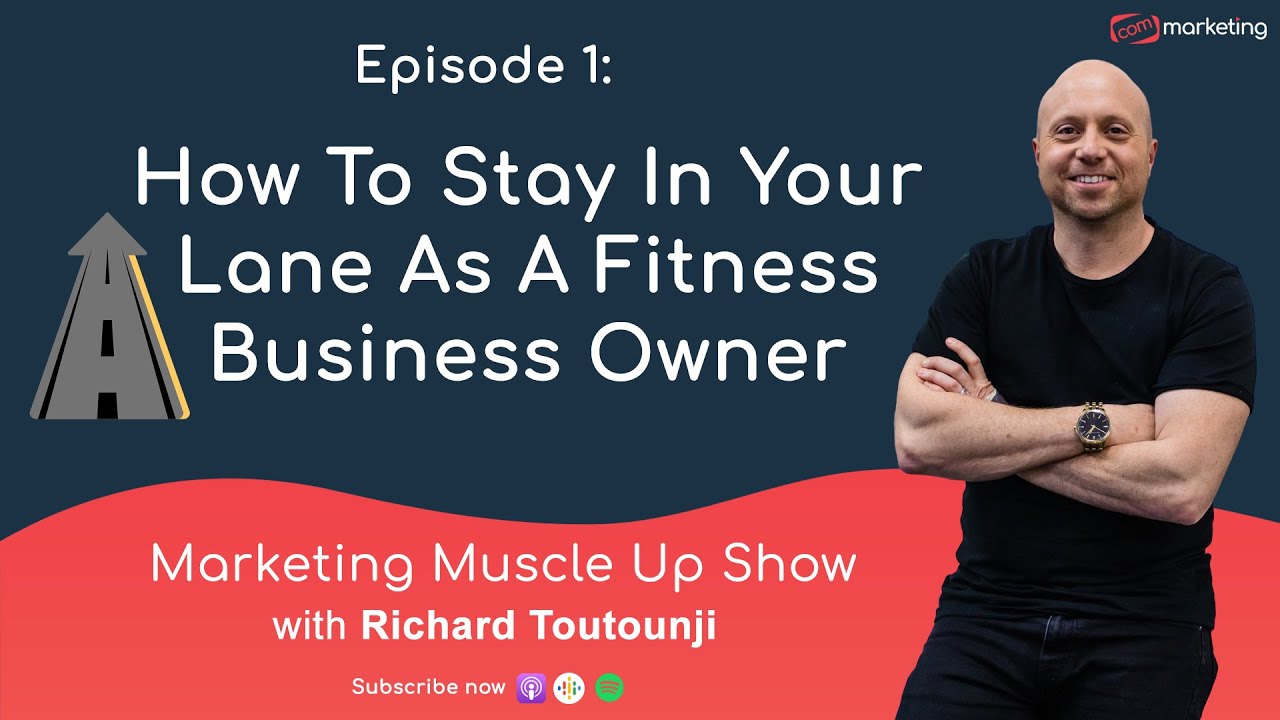
In the inaugural episode of the Marketing Muscle‑Up Show, host Richard Toutounji, joined by Ev from Core Marketing, launches a podcast aimed at fitness‑industry entrepreneurs. The conversation weaves through Richard’s personal entrepreneurial backstory—early ventures like selling spray‑painted house numbers, a “book of business ideas” with domain‑name hoarding, and a failed fitness‑studio purchase—illustrating his curiosity‑driven, “shiny‑object” mindset. They discuss the challenges of idea overload, the importance of finding and staying in one’s “lane,” and how to accelerate that discovery through risk‑taking, mentorship, journaling, and disciplined decision‑making. Richard emphasizes the need to recognize pain and burnout as signals to pivot, the role of timing, and the value of mentors, coaches, and supportive partners (especially his wife). The episode also outlines the podcast’s format: short‑ and long‑form episodes, client strategy‑session excerpts, and future guest interviews, all designed to give fitness business owners practical marketing, branding, and profitability insights while encouraging them to focus on their unique “secret sauce.”
Chapters
Welcome to the Marketing Muscle-Up Show. My name is Ev. I'm Head of Digital Brand here at Core Marketing, and I am jumping in for the first episode here. To have a little chat with Richard, who is going to be your regular host. So, welcome to your show, Richard.
Well, thanks for inviting me to my own show, Ev. Good to kickstart this show off.
Totally. I'm really excited that we are finally getting around to launching this or relaunching it again. So, tell me, you have, you know, you've got a few shows, you present quite a lot, you've got, you You've got a following out there. Why do you want to start a podcast?
Well, you said it. You hit the nail on the head. I tried to start a show actually with yourself and my friend Nolan a couple years back, just an audio show. I think we got to around 6 episodes. We did one sitting and we released it, but that was it after that one. So we fizzled on that one. I do love videos. those who know me, I do love video. It's always been my sweet spot, video. So we've always had podcasts, but just in a video format. But I really wanted to try to figure out what couldn't we bring to the table? What can I bring to the table that's going to be different that's out there at the moment? And that's why I'm pretty excited to be presenting this and putting a line in the sand and say, okay, let me bring my best to the table because I really think— this day and age, you know, we're going to talk all things, we're going to talk all things marketing, sales, business, entrepreneurship, fitness, obviously. But the thing that I really want to dig onto, which is something that doesn't go out of fashion, which is kind of why you do things in the first place, it's your uniqueness and how to get to that spot as fast as possible. I think there's a lot of information out there, there's information overload. you know, crazy amounts of information. So it's just about hopefully we can connect to the people that need to be connected and hear this message. And I'm gonna bring some pretty cool things to the table that pretty much nobody ever hears. And a lot of it's gonna come from client conversations, from in the zone. And that's what I'm really pumped to bring.
Yeah, I think that's really cool. And I imagine it, and I think maybe, I think maybe we said this when we first started, tried to start this podcast, is like, you know, those, we talk about like hallway conversations. Hmm. And it's, it's those little things that you kind of like, you know, you're chatting away or you go and grab a coffee and you're like, oh, what about this? Or this is coming up. Or, you know, I think that, I think that there is an aspect that you do you bring your best work when you are solving problems for our clients. I think that is a big, it's a big kind of thing for you. And I think it probably goes all the way back and it's how you kind of solve your entrepreneur kind of spirit at the moment is that you, and you actually, this is a fun story I think maybe we can start off with is that you had a book of business ideas that you tried to sell at one point.
Yeah. Yeah. Early in the piece, actually, it was with a business partner, Paul, and he— me and him had some ideas. We both brought a lot of ideas to the table. And it was just, we kind of started to create a page per an idea of a business, like a concept that you can get involved in. And pretty much sell the book. So you could basically purchase an idea and that it's good to go and also including a logo and things like that. So it's like, here's the idea, here's the format, here's the logo. And then, you know, true story actually, just a few weeks ago, I saw somebody actually doing that idea. It got fed to me. I haven't told you that one, but yeah, I saw that idea come through. Like you buy a logo and a brand name and charging some ridiculous amount for it. But isn't it interesting? Yeah. Ideas. I think as entrepreneurs, nobody has we don't have a problem with ideas as entrepreneurs. And I'm talking to those who are in that shiny object syndrome. If you're in that zone in your life, the shiny object syndrome, I think everybody goes through the shiny object syndrome. And I think it's through a time period we can talk about as well. But definitely when you have an excess ideas, a lot of the time, then the flip side of that is that sometimes you have a problem with executing the ideas consistently. And that's certainly been me in the past. I think I've owned the most amount of domain names known to man. You have an idea, you buy the domain name just so nobody takes it. And I ended up with quite a few hundreds of domain names that sat there for years and years and years. Because as an entrepreneur, as a business owner, as somebody who has this idea, you know that it's the best thing ever. And back in the day, you'd buy your domain name, URL, the Facebook handle, the Instagram handle, just to make sure nobody took it. So if that's you, we'll talk about that a little bit too.
Yeah. And I can attest to the fact that you do own a lot of domain names. I have seen them all. And I often wonder for you, where did this entrepreneurial spirit come from or where did it start? start, because I have heard some stories about when you're younger and, um, and some of the ideas even, even when you were young. You told me one time that this guy came to the door painting numbers on the street and that you chased him down the road to find out all about how he did that. And I think that you, you have this, uh, like obviously from a really young age, had this drive to, you know, come up with ideas.
All right. Well, let's go there. Let's go way back. So yeah, this podcast is going to be random, but it's going to be pretty cool. And so I'm glad you asked me the question, Ev. And thanks, Ev, for joining us in this first episode and kickstarting it. So the question is like, for those out there that are really going after the shiny objects. So it sounds like we're going down that path straight away, which is good. And then also too, for those who are figuring out which way to go down, what happens is you chase everything that you see. So you see a concept, you go, that's good, let me do that. So this is the story, what happened. I mean, we're talking about when I was much younger. It's actually my birthday.
How young are we talking?
Well, we're talking about like, it is, I am celebrating my birthday today. If you're watching this
on my
birthday. That's true. And so I'm talking maybe 10, 11, 12. I've got no concept of what ages were back then. Maybe 13, 14. I don't know. But obviously I had enough. I definitely wasn't driving licensed or anything in that kind of world. I was living at home, my mum, my dad, western suburbs of Sydney and quarter-acre blocks. That's the kind of where we were living at the time. And so this guy, I remember clearly it was a Saturday morning and the doorbell rang. Maybe it was like 9:00, 9:30. My dad answered it. And then this guy was at the door. I didn't see it. And then he left. And I've got 2 boys now. And now I understand that kids are curious. And so I think I was just really curious. So who was at the door, Dad? And he goes, oh, some guy's selling me something. I said, what do you mean? What was he selling you? You know, as kids, you just ask. He was selling me numbers and he just like brushed it off. I was selling numbers or something. He probably doesn't even remember the story. And I said, what do you mean numbers? Like you spray numbers on the gutter. I said, what? So I ran outside and I kind of wanted to chase him down to see what he was doing. And then I went outside and I saw what he was doing. He was painting numbers on the gutter. So, you know, if you were in residential, you got the gutter, you got driveway and your gutter. He was painting numbers in white. I was like, what's he doing that for? My dad said it was something to do with some— so you could— so it was reflective at night. Ah, reflective at night. So I chased him down and then I walked the street. So I must have been, I don't know, the age that you can walk around. I walked the streets and I saw that every kind of second or third house had numbers sprayed. And I said to my dad, how much did he ask for? I think it was like $15 or $20. And they go, what? $20 to paint a number? And so that afternoon, I decided to go to— it wasn't Bunnings at the time. It was the one before Bunnings. I don't know if you can remember that. It was like a hardware store. No. So I went to the hardware store and I bought myself spray can, right? White spray can. It was about $4 to $5 to $6 a bottle. And then I bought stencils with numbers. And so that Saturday, basically what I do, I I kind of made the stencils easy to spray and I tested it out on some wood at the back. And then next day, Sunday, I said, stuff this, I'm going to do it. $15 a pop. I think it was $15 or $20 just to spray. And I go, this is money for jam. I mean, if I— and I counted the streets and I said, if I can do all those houses and spray the gutters, all I have to do is knock on the door and ask. And so let's talk about, you know, how do, as entrepreneurs and business owners, how do you actually start asking people? Well, I asked because I thought, well, at the time I was working McDonald's, I think it was like maybe $5.73 an hour. And I said, okay, that's where my brain was at. And I go, okay, if I can literally make one knock on the door and ask somebody, would you like the spraying on this? And then I kind of said, okay, well, what's the advantage of spraying? So let's go back to sales. The advantage is that, well, people can see you at night. What about ambulances? Can ambulances see you at night if you're in an emergency? So that was the pain point I found. And all these things I said, okay, this is so, so advantage. It's very hard to see numbers sometimes, especially got mailboxes and that kind of stuff. So then on I went on Sunday morning and I asked my neighbors, well, not that neighborhood because that could have gone on Saturday. So I found another place to go. And on my way there, that was kind of the process of how it worked. That day I made about $200, $300. I thought that was a pretty good day. And then it was funny because then the next week I asked a friend to do it. I said, well, I can do $200, $300. Let me get a friend in there. And then that day we made literally $20 the weekend after. And then after that, he said, oh, this is not going to work. And the next weekend after that, I made $1,000 in the day.
It's not bad for a little chasing someone down the street and finding out what they do.
I think it was the curiosity, right? The curiosity of what happens if you ask. What happens if I ask? I think that's what we have to do as anybody that's leading. We work with a lot of fitness professionals, but anybody that's leading anything, you've got to ask the question. You've got to be curious.
I think you've hit the nail on the head there with curiosity. And it's something that we don't often talk about in business. That, you know, I do think that, you know, it's the people who are asking the questions who are kind of pushing different doors open to see, I wonder, I wonder if that will work, or I wonder if this will work. And, and those are the people who end up succeeding rather than the people who just sit there and are like, I don't know what to do next. Right. It's like, I don't— I'm not sure you've ever sat there in your life and wondered, I don't know what to do next.
Well, I think I'm talking to anybody who doesn't have— has an idea problem. I mean, I'm like, wow. I mean, where does the idea stop? I don't think they do stop. For anybody who's always coming up with the latest thing or the latest invention or reinventing, sometimes it's exhausting with all the ideas. And that's why the journaling works. That's why the meditation works. That's why staying in your lane works. I mean, staying in your lane, that's a big one. Staying in your lane.
Yeah.
You know, sticking to the thing that you want to do and you love to do. But I don't think, you know, people throw that term out, stay in your lane, and I do as well. However, until you know where your lane is at, you've got to try all the lanes. You've got to see what works, what fits, you know, what you like, what you don't like. And unfortunately, and fortunately, but I think sometimes more unfortunately, that can take us down a very long path. Of testing and trialing and test. And don't get me wrong, like all these, all these items, you know, make the person that you do. And I think it's made the person for me. I mean, 40 today, if you're listening this on the 7th of September. And that's why I said, hey, I want to start this podcast because I want to draw a line in the sand. And I want to draw a line in the sand to say, listen, this is my lane. I'm happy to stay in it. I don't really want to go too far this way, too far that way. If I don't have an opinion on something, I probably won't talk, but that's okay because that's who I am. And so I think once you start to figure out who you are, then you can open up the right lane and you can take control of your lane. But it's, you know, I think it's the journey to figure out what lane you're in. And I think that journey can, you know, that's the journey of life. That's the journey. But once you got the journey and once you understand where you're at, I think what this— this is what I want this podcast to be about is to understand when you're at the journey, lock it down and lead the way.
I think that is such a great thought. And I've got, I think I've got 2 questions from there. One of them is, how— is there a way to kind of speed up that journey? But my second one is also kind of How do you then, once you're in your lane, stop the shiny object syndrome?
Okay. The first question is— okay. Remind me the first question again, Ev.
The first question is, can you speed up the journey to find your lane?
Well,
I,
for years, it's always been the mission to speed up the journey. Everybody knows that you want to speed up the journey. I remember early on the piece, I tried to speed that journey up. I bought a fitness studio. So speaking of my parents again, the second story, my parents, but I'll go into a little story and I'll give you the answer there.
Yeah.
I left school in year 10. I wish I could leave in year 9, but I managed to stick around all of grade 10. And I just knew what I wanted to do. I wanted to be a personal trainer at that age. I think it was 1990, 9, 8, something like that, 7, not sure, around then, there was no such thing as personal training and there was very little information about it. It was at TAFE, you could do a course for 6 months. So that's what I kind of decided to do. My career advisor was excellent, I loved her, and she really helped me to, to, um, continue the focus of what I want to do. So, so, so I'm going to answer a few questions in this, but not to compare comes down to just going out and doing what you feel like you need to do deep down. Now, I think it's a bit harder with social media. I think it's much harder, much, much harder. However, you know, back there, as you know, Ev, there wasn't a huge amount of Facebook and Instagram back in the day. So, so what we're getting to then is that we want to understand that how can we actually now start to focus on what we're going to do. So I think it's deciding on what you're doing and not overanalyzing things too much, just getting it done. Now, I found it was much easier then than now. And I think also too, you've got to note down time. So that was, you know, when I was 17, 18, 19, that kind of stuff. And at the same time too, I was working as a personal trainer and, you know, my boss was about to go into a purchase a studio, a fitness studio. I was in western suburbs. She was going to purchase in Neutral Bay in Sydney. I've never been there in my whole life, never even crossed that way of the world. Didn't even know the suburb, didn't even know the address, didn't even know where North Sydney was. Right. So it was in Neutral Bay, Grosvenor Street. Anyway, long story short, it was a It was a $100,000 investment to purchase it. She was going to go into business partners with somebody else. I had no idea. I mean, she was only my boss for 3 or 4 months, mind you. And I saw the opportunity. I said, well, this is interesting. Let me see if we can do this. And so I just asked my parents. I said, listen, what do you think? I asked my dad, do you have any equity on your home loan? And at the time I didn't know what that was, but I kind of figured it out fast because I was trying to find money. And he kind of always explained to me about figures and finances and that kind of stuff. And anyway, so cut a long story short, I probably didn't have much equity there, but there was a bit of equity there, meaning that I think they could borrow again up until, I don't know what it was. But anyway, there was enough there to borrow. I think it was $45,000 I needed. And so he showed me that I could set up a— I had to pay him back and all those kinds of things. And he'd draw a list and I had to every week put in his account and mark it off. And I signed to say I paid it. It was like a legit loan from my parents, not this I'll never pay you back business. Each week paid back into his account. But anyway, the concept of the story was big risks, big risks, but you don't know they're big risks when you're in the moment.
Yeah.
You have no idea that they're big risks. Now we work with a lot of fitness professionals, studio owners, and I guess at a different age when you've got more to risk, You may have a family or you might have a mortgage or you may be transitioning to a career and then you're going to work for yourself. We see a lot of that. You may be done with the corporate world and you want to start up something. And so your mind is a totally different space because you've had losses, you've got risk factors, you may have a mortgage, there may be things, you've got some kids and there's risk. I can only imagine that'd be very much harder. I've never had that experience. But when you're younger, I mean, the concept is when you are younger, I think you can take more risks without overanalyzing yourself. And when you start to build up equity in yourself and who you are, you may have, you know, a business or a following or some clients that are paying you some money and you're responsible now. You're a big person. You've grown up. Well, it's harder to start something new.
It is.
So I do believe, I think your first question was like, How do you stay in that lane? I don't know if that was the question. My mind—
It was.
You can see where I'm trying to create some ideas here. But yeah, I don't think you have to stay in your lane, but I do believe that you need to understand where your boundaries are. And as soon as you know that, you've got to get out of it. And so for me, I got out of that business in a year and a half. I felt that I didn't have the knowledge and the skills that I probably should have had. And I was, to be honest with you, I was 18, 19. I was like, okay, this seems a bit boring now. I'd like to do something else. And then one day I just said, hey, I wonder if I can sell it. And I swear to God, no, I'm not joking here, but the guy that was going to buy the business that I took it off from and bought it with my boss, one day, and this is a true story, one day, and this is a week before I said, I think I need to sell this business, mum and dad. I was living at home at the time. I need to sell the business, mum and dad. I'd like to go overseas on a cruise ship and work. And I saw that idea in a magazine, by the way. Yep. And all of a sudden, all of a sudden, this guy walks in the door, the guy that was going to buy the business that he really didn't like anymore because I pushed him out of the deal. And he walks in the door.
Right.
I'd like— I'm interested in looking for a business and buy this one. I was like, oh my gosh. So a bit of luck or a bit of—
Universe.
A bit of universe, a bit of magic.
Yes.
Does exist. So yeah, I do believe that there's opportunities around us and if you don't take them, everything has timings as well. Everything's timing orientated. The internet was timing, the TV was timing, the social media was timing. So everything does come to timing as well. And I think that's a big thing after interviewing a lot of people as well. It is about timings. if you do take it or you don't take it, that's all history and you can't kind of repeat this cycle of history. You can't repeat the day. So you make a decision every day.
Yeah.
Are we going to go into that or not? But I think there comes a time when, you know, I've also flipped it too and I've had a lot of very close friends and colleagues and people I know that have probably made wrong decisions like I have as well, but decided to keep rolling in that way and trying to figure out, you know, get back to yesterday. And so I think that's a— I think we all like to live in the yesterday and the, uh, and, you know, what it could have been or wish it be, but that's the game.
Yeah, it is. And I think, um, it's an interesting point that you kind of like, you got, you know, a year in or however long you got in and then you're like, okay, I've seen this idea. about going on a cruise ship, uh, how about I kind of, you know, chase that? And my question is, and, and I think that's happened to you a lot of times, like, you know, cruise ships, and then you've, uh, you've wrote a book and you, you did all of these kinds of things. So I want to know, because I think that there's a moment right now for a lot of people who we've had, obviously we've been through a big lifetime event, like you don't go through pandemics very often. And I think there is a lot of people thinking through, do I still want to do what I do? Because they've had the time to think about it. So my question is, how do you know when it's time to move on or when it's time to kind of just like buck up and be like, no, this is what I'm doing? Like, how do you make that decision?
Great question. I think when we make decisions like that, again, depending on how much we have to lose will make your decision easier. So if you've got a lot to lose, decisions will take a long time. There's a really good book, I think by Andrew Matthews, his name is, and it's not here because I recently moved, but the book, the scenario there is that you're never going to learn your lesson. So basically until you learn your lesson, the rock is going to keep hitting your head, right?
Hmm.
Until you decide to do something, that rock is going to keep hitting your head. hitting your head and hitting your head and hitting your head. It's a great book. He's an illustrator and I've got all these series and it's great for anybody who doesn't like to read much, by the way, and just look at the pictures and some tags. And the concept is that you're never going to move to the next space if you decide that you want to be still in the, what's the word, if you still want to be in pain. Pain. So if you keep wanting to be in pain all the time, you're going to continue to receive more pain. So if you're doing a job or an activity or a business or a client and that person is giving you pain consistently. It's there, you're coming home exhausted, you're drained, you're bitching about the conversation or the person multiple times. You're not allowing yourself to, you know, kind of get to the next process. You're staying in this negative situation. Now, you know, life's not about fairies and unicorns all the time. However, It's not normal. I don't think it's normal to consistently hate your job or to consistently hate your clients you work with or consistently hate what you do or the projects you're working. That's not normal. People may have normalized it by the whole, oh, it's Friday, let's, you know, so good for the weekend. Like, that may be a process that depending on what sort of groups you hang around, obviously listening to this, you're probably not those people. However, I do think there's a period of pain. And then once you've reached that kind of period where it's starting to influence and affect other parts of your life, like relationships, like, you know, you may not be able to see the kids for a very long time, but society thinks that's normal to only have a little bit of time. Or you may not have gone on a date night with your partner or your wife or husband for a long time, and there's pain there. Or you may not have had to, you know, the business. you know, has kept costing you. You've got to keep putting your own money in every single week, every single payday. Or there might be a staff member or a team member or a trainer that just is always never supporting you, never rising you up. Well, when there's too much of that going on on a consistent basis, and I can tell you right now, it's very hard to see when you're in the moment. So my next question is how you speed it up. You need good people around you. It's a mentor or it's a or it's a good solid friend that you have alliance with to say you can tell the truth, or it's just journaling and understanding faster what this is about. But when you're in a state, it's very hard to get out of that.
Yeah.
I know I've been in it for years multiple times and you think it's normal, but it's not. And it can be normal if you want it to be normal. But I think also too, this pandemic, this COVID world has taught us one thing that what we thought was impossible once, you know, working from home or Zooming or, you know, I remember the 4-Hour Workweek, maybe we'll go into that later. And,
you
know, it's the one day a week, try to work from home, or it's the, you know, I can't have meetings in my bedroom or, you know, all these things that were once, you're crazy, have all flattened the world. So I think the opportunity, if there's an opportunity right now and the curiosity is that if you've been wanting to do something or smell something or try something or stop something or start something, I mean, wow, this is the time to do it. This is the time to do it because everything is an option. Everything's available. Everybody can understand. Everybody can relate. Everybody will, you know, that whole guilt factor disappears as well. So I think if not now, when? But I think to speed that up— Yeah. Mentors, coaches. And to be honest with you, I didn't have mentors and coaches for most of my whole life. So that's maybe why a little bit slow to the mark, possibly, right? Is that you're self-learning, you're self-analyzing, which is a good and bad thing. Yeah. I wouldn't, you know, I'm not one to go to the same course. I've been to Tony Robbins many times, but, you know, once I reached going to 3 times, I thought, okay, that's enough. Let's go do some work now, Richard. So there is a time limit of things as well. And But I think close people around you.
Yeah, I think you— yeah, I think you really pick up on a great point there because I, I think that a lot of the times when people have these transition moments is they are in their head so much and they, they tend to kind of get in this vortex of like, you know, a bit of a black hole of thinking and it's like an echo chamber. And so actually just talking it out. And I think that's why most people listening here are business owners and stuff like that. And so I think that sometimes that can be a lonely place. And I think having coaches or having people that you can talk to gets you out of that headspace, right?
Totally. I mean, for me, I look at a lot of things in my life personally of a lot of businesses have had and started and stopped and, or remolded and renamed it. Um, I mean, my biggest ally is probably my wife, Joey. She's the one person that's been with me the longest. Um, I don't think I've had a relationship apart from my, my family that's, or friends that have really lasted that long in regards to conversations about business or where we're going and things like that. So in a way, again, positive and negative. Like if you've got a lot of outside factors, outside people that are looking in, that's really powerful as well. But then if you've got someone to ride with you, that's powerful as well. Many different factors. But yeah, I do think there's— you need— I think ultimately it comes down, you need the reasons of why you're doing this certain activity for and As soon as you hit those pain levels and those boundaries too many times, it's time to step away and try something else. There's a saying there, never give up, and all these never give up quotes and keep striving through, keep pushing. Yes, I believe in all that. However, there is a time when you've got to make a call and you've got to understand when are you ready to to maybe slightly adjust as well. But there's also a thing I want to add in too, Ev. It's the concept of multiplication and years. And we talked about staying in the lane. And I heard this process, I think it was through Andy Frisella, his podcast many years ago. And he talked about it. I think it was him. He talked about, we all know that I'm a big believer that 7 years, it takes 7 years to kind of get in your one industry and your one thing in your lane, it takes 7 years to kind of be that person you want to be perhaps. Yeah. So I think that's a highlight to say that if you're thinking that you start this business and it's a year, look at anybody, it's always at least 7 to 10 years. 7, you know, some people, you know, hit the magic number, but they've probably been somewhere else that's given them some heads up on that. But let's say if you start from 0 to 7 years and you're, let's say you're a fitness professional or a studio owner or any kind of business, and what happens is that you're going to then you know, every year progress in relationships, in business, in connections, in clients, in wealth, in whatever you do. And then someone comes in, let's say in year 1. Well, they start from year 1. Then someone comes, starts in year 2, they start from there. They don't start where you started. So let's say you started here and they're starting here. Like year 1, they've started year 3 and you started 3 years ago. Well, you've got 3 years ahead and you may think, well, they're very similar to me, same studio, same business. But they're not. Because you have 3 years of learnings, you have 3 years of mistakes, you have 3 years of wins, you have 3 years of everything where they're starting at zero. Now, if they've come in from a similar industry or similar thing and they're coming in, sure, they can take up some time, but if it's not exactly the same alignment, you still gotta, you know, make up those times. So sometimes we worry a lot. I certainly have. We worried about people that are just starting up something fresh because let's be honest, anybody can start up something online now. with a website and a Twitter account or Instagram or Facebook and we're good to go. You know, it's not that hard. It's not that hard. But again, that doesn't really worry me anymore when somebody just starts up with something because then I look at the background of somebody and I go, how long have they been doing this for? What is the skills they're bringing to the table? Are they in that first, you know, 0 to 6 months learning? I mean, look at me with the with the signs, my parents. Like I could have made that the best business in the world. But in fact, what happened, if I continue the story, the first day I went out and made $300, then we made $20, then we made $1,000. The next day I made $500. And the next day I think it was $200. I said, oh, well, the newspaper brought out something to say you shouldn't do business with these guys, the local newspaper. So that didn't help.
You got caught.
I got caught, but it was a hack. But anyway, I stopped it. Right? Because I got a bit scared and I started something else. So it's like, it really comes— I mean, I wasn't, you know, that wasn't my journey. The journey wasn't to spray stuff on a street. That wasn't me.
Yeah.
So you do have to understand that, but that gave me the skills of sales, of communication, of talking to somebody, of making a sale, where now I think, oh, that seems very easy. But no, I've had 20 years of that, 25, 30 years of doing that. asking, well, of course it's a lot of it easier now because I've been doing it for 30 years.
Yeah. And I think that comes back to the journey. And I think that you learn the lessons and those lessons compound into then, you know, whatever that ends up being, you know, whether that ends up being stay in your lane, you know, forever or for a specific time. It's like you learn the lessons and then, yeah, like I think you've I mean, I obviously get to kind of hear a lot of different stories. And, you know, I do think that everything adds up. Like, you know, we just had a conversation with a client the other day about how she should get back out and start doing flyers. And she's like, flyers? You're like, yeah, like this is how I started my first business, you know, in the fitness industry and stuff like that still works. And I think you— You're gonna take all of these little things that you've done and, you know, the Garfield flyers, and maybe we can talk about that in another episode. And I think you, yeah, all of those things like coming back around to kind of where we started with like, okay, yeah, you've done a lot. You've had all these shiny objects and, you know, all this different stuff that's happened in your life and this kind of entrepreneurial spirit, but it all comes back. And kind of funnels back into what you do now, which is, you know, help health and fitness business owners grow their own businesses. So you don't have to come up with new ideas anymore. You come up with ideas for them. Yeah.
And I love that part. And some of the items we've been talking about in this podcast is I'm actually going to take grabs of basically strategy sessions. So in our program, we have a program called Ninjas. You'll hear me speak about that a bit. And I do a strategy session and a lot of people said, oh, Richard, you don't have to do that strategy session. You can scale it up and get a coach to do it or something. I still love the side of that because you get to know what the game is and where it is. But anyway, we do a strategy session. So a lot of the concepts and the processes will come from the strategy session. So I'm going to grab pretty much, you know, little chunks, longer, smaller chunks. So you can kind of directly hear what's happening. through a paying client that has decided to commit to grow and scale their personal training business, their fitness business, their gym. And, and I'm going to sort of show you how, how their journey's been. I'm just going to take like the, the best bits. It's really just been the thing that just decided and it will turn someone's opinion around. And then from there, you know, I'll kind of introduce you to other people along the way in their journey. But from those moments was the moments their business would have adjusted and changed. And you'll be able to see quantifiably in this key moment, that's when these items happened. So I'm pumped about that because to be honest with you, apart from my assistant and the client, there's very little people that actually hear this conversation. So—
Yeah.
Obviously some of the things will be private, but I'm going to try and bring the best I can. And you talked about the hallway conversations and I call it the water cooler conversations. And Those things don't really exist in a workplace at the moment. However, it is the sideway conversations. I mean, I remember, I mean, and just for the audience here, I mean, Ev, you've been with KOM for, I think, 7 years. Is that correct?
I think so. Yeah. 7.
And the quick story is this, is that you're renting one of my offices out in my office in Sydney. You're paying your rent because I saw, you know, I talk about, I just recently moved and I sliced your credit card statement. Slip up where it said you're paying us each this month to be there, and to be honest with you, I didn't talk to you for many months because that's kind of personality. Am I'm an introvert? I think like you, and introverts don't mind speaking to a lot of people, but the one-on-one conversations we struggle with a little bit. And so I didn't really have that one-on-one conversation with you for a long time. But I think that the gist of this—I don't know where I'm getting with—the gist of this was that I really forget where I'm getting with. But the gist of this was that when you are able to pull yourself out there. in the right positions, then, you know, things happen. And so for you, you've been with KOM for now 7 years, you've had a whole different role, roles. But just so for the context of this, you'll be popping in a little bit here. The context of this is that you can take a lot of my concepts and you can turn them into slides and presentations and education pieces, which is a true honor for me to have you by my side to be able to do that. And yeah, you're getting the the insight bits. And so I'm really, really excited about, you know, bringing these things to the table.
Yeah, I am too. And I have an unusual position where I do get to hear some of those conversations that you have. And it's very interesting, one, to see how you work. And it's when you get connected with a client, it's like You light up when you have these best ideas and then they get these light bulb moments like, oh my gosh, my business could change and I don't even have to add one client. Like honestly, like it's like sparks fly when that happens. So I'm really excited to bring these conversations to everyone because I really do think that they are going to be helpful and kind of spark a whole lot of ideas for other people kind of at scale. So, okay. So we are going— so today is day 1, episode 1 of the Marketing Muscle-Up Podcast. And we've got some, a whole lot of episodes coming up, right?
Yeah. We just, we're really just warming up. And I'm pumped for this because there is a lot of cool stuff here. And I think the things that you're going to hear on this podcast I doubt you'd hear it off anybody's podcast, especially in— we will go deep in the fitness and wellness industry, but the tactics are for a lot of different businesses and conversations. So we'll talk broad, but we'll also talk straight into fitness and give you really clear examples as well because that is our daily world. But I mean, business is business, Ev. And I think that's something that will probably be the first lesson. Maybe we should start to have some lessons here. I mean, lesson number one is that business is business and it doesn't matter what business you're in, the same items are still required. It's marketing, it's able to sell, it's able to have conversations, it's able to retain, it's able to understand how to be different in the marketplace. And that's what I'm really, really specialized in, how to be different in the marketplace. And of course, how do you brand that? And that's a lot of what we do at KOM. How do we brand? How do we create personality? How do we have the best credibility piece in our marketplace? And then ultimately, how do we have an engaged community that love us, not just like us? Because it doesn't take that much to— and we're talking to— and I think that the context is I do want to talk to small business operators, medium operators, because I think sometimes we hear podcasts and we go, oh no, they're— massive company, we compare themselves. But at the end of the day, I don't believe that's the case. I think everything's equal in business. And this is for everybody here. This is for a business operator. This is for someone who's working within a business so they can probably understand why their boss has so many crazy, stupid ideas for. This is for the husbands and the wives, the supporters of those people that are going, well, What does it all mean, especially if you're not in the business? Hopefully that can help you to understand what's going through with your with your other half. And for those budding you know business owners, especially fitness businesses and and gyms and personal trainers who who who see that shiny object and they go that's what I want to do. I'm the best at that. Well, well done to you, and let's and let's help you grow into that into a into a business because there's a saying there. And I heard this from my friend Jamie Hayes the other day. He was on our, um, he was in our interview and he pretty much said, which is a good point, was that your business won't last long term if there's no profit.
That's it.
That's probably a bit harsh for anybody that is in the fitness or wellness space. And you're sitting there going right now, I didn't go in this for profit. And I can understand because I didn't go in for profit for a good pretty much my entire career, and I'm still not in it for that reason, by the way. However, however, however, if you want to make an impact and if you want to reach more people and if you want to stay in the business long term and if you want to have a happy life, we are going to talk a lot about having a really happy life.
Yeah.
And if you want those items and you want more time off and all the things that you went into business for, but you're probably not getting at the moment, is that's what we're going to focus on here to ultimately get to the numbers that you need so you can sustain in this business. And to me, I think as a budding entrepreneur, as somebody who's hands in the mud every day, is that once a business owner, and get this, once a business owner can actually pull out a regular income like any staff member that they're probably paying and struggling to pay each week, possibly. And they can pull out that every single week and pay their super as well, and then still pay their staff and have a little bit of money left over, enjoy their life. I'm I think that's success today.
Yeah.
And I think that's, you know, if you're in that boat or you're getting to that boat, this is for you. And sometimes if you're thinking, well, I should be there, this podcast is for you because ultimately the ones that are able to consistently have cash flow coming through the business can, will consistently be here in 7, 8, 9, 10 years. And if you can't, you're not going to be here because, you
know,
I'm going to share some of these stories too. And I'm going to talk about, I might even bring Joey on the podcast as well, my wife, her tag's Feel Good Joey. And, you know, this actually happened between us is that, and I know we're probably going to wrap up now, but this happened between us where I said to her one day, I said, Joey, what are you doing what you're doing for? You're not making any money. And it was a pivotal moment of my stuff-up back then because that really affected her of what she did. And she did it because she wanted to impact. And at that moment, I was frustrated because I wanted to make sure that we were making money and focus on one direction. So at the same time too, you just— I want to guide you through when those times to pull the trigger. And where not to pull the trigger. And I'll take you through my learnings and my discoveries and through this process here. And today I am 40, big 4-0.
Whoa, happy birthday.
Thank you. Thank you. We are in a pandemic. We are in lockdown all around the world. So I thought, you know, I did have this big dream that I want to get a boat and go to Maldives and put everybody on the boat.
I remember. I remember we thought about that.
So what we will talk about is, I guess, the change that I've had as well. I've moved, I've bought a lawnmower, a tractor, a ute, and that's my midlife crisis. But most importantly, I'm pumped for this podcast. And so over the next 40 days, we're going to bring basically 40 episodes to you. And there's a few reasons why. Number one is because I don't trust myself doing this once a week at the first part because we all know what habits are like. So I need to make sure that I overcompensate the process of this and get it out. So 40 days, every day for 40 days just to represent 40. So I'm going to drop that every day and I'm going to bring my best myself. I'm going to have some guests on here. You're going to see— the scenes. I'm going to bring my wife, Joey, to the table as well. I'm going to drag her into this podcast. Ev's going to kind of throw me some curveball questions as well now and again.
I am, yes.
Then I might do some rants as well. Also too, I speak to a few really close friends of mine in the mornings. It's one of my routines and I'm going to grab a bit of insights of that. So next time I speak to them, I'm going to do some recordings of that so you can kind of really hear where the navigation of businesses and small business and fitness business in this space. And then my intent is to ensure that everybody who's listening is actually building up equity in their mind of how to stay in my lane and know which lane I need to be involved in. Because the worst thing, the worst thing is being in the wrong lane for a decade. Yeah. I've been there.
Yep.
Being in the wrong lane, you know, for longer than you have to be. I've been there. So I am going to take you through how not to be in that wrong lane and how to majority of the time stay in the right lane. Because if we can get you there faster by understanding your uniqueness, I call it the secret sauce, as you know, Ev.
Yep.
What's your Michael Jordan move? What's the KFC for you? What's the secret sauce for you? What's the secret ingredients for you? If you can understand that early in the piece, you win the game, full stop.
Yep. Well, I am excited. This is going to be good. I remember you said to me last week, how about we do 40 episodes in 40 days? And I was like, okay. So I'm excited for it. I think it's going to be really cool. I think there's going to be a lot of conversations and A lot of value for people out there. So yeah, I think—
I'm just going to butt in there. So for those who hate long podcasts, we're going to have some short episodes. For those who like podcasts, we're going to have some long episodes. So it depends again where you are. At the moment, I've been listening to a lot of short podcasts, 8, 7, 8 minutes. I'm into those because I've got short gaps, but then other times I love the long podcast. So again, there's no right or wrong. It's where you are at the moment and you've got to plug into the right information for you to rediscover the lane that you need to be in.
Yeah, absolutely. And I think there is going to be a lot of variety. People are going to hear a lot of different kinds of things. We're going to have these a few times. We're going to have conversations with other people. So there's going to be a big variety of things that people can listen to and get value from. So Richard, thank you for letting me be on your first episode and ask you some cool questions. questions and find out a little bit more about you. I'm looking forward to doing some more of these as well.
Yeah. Looking forward to jamming. And thanks everybody for tuning in for episode 1. Tune in for the next 40 days where we'll— well, I'll drop some serious truth and experiences and my story. And if you resonate, welcome and let's have some fun.
Let's do it.









