S2 Ep 13: Bouncing Forward Into A Brand New Tomorrow
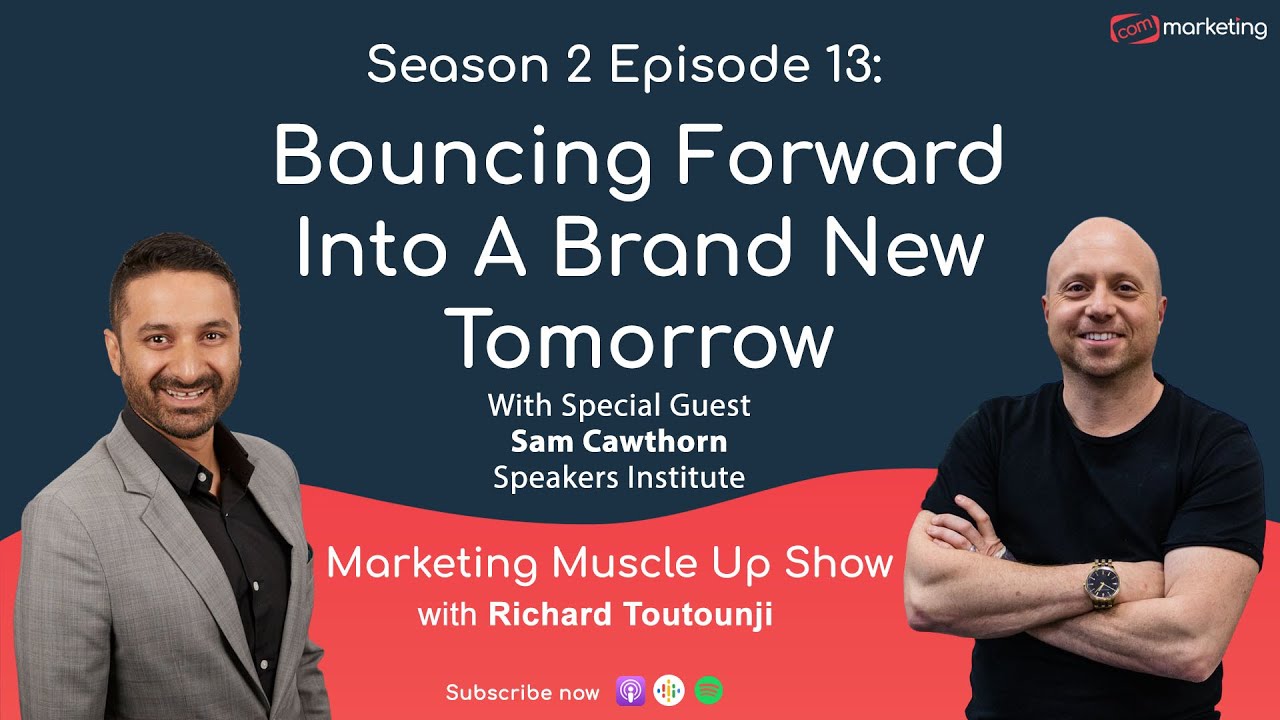
In this episode of the Marketing Muscle Up podcast, host Richard Toutounji interviews resilience expert and speaker Sam Cawthorn. Sam recounts his life‑changing car accident that left him with a missing arm and a paralyzed leg, and how he turned that crisis into a platform for helping others. The conversation explores the concept of "bouncing forward" – using adversity as a springboard rather than trying to return to a pre‑crisis normal. They discuss mental steps for shifting mindset, the power of a strong personal "why" (drawing on Simon Sinek), and the strategic creation of self‑inflicted crises to force breakthrough thinking. Sam emphasizes the shift from brand‑centric marketing to the "profile economy" where people follow people, urging entrepreneurs to become influencers by building personal visibility, vulnerability, and radical simplicity in communication. They also touch on future‑focused content ("the future of…"), the importance of proximity (surrounding yourself with supportive, high‑performing peers), and practical advice for fitness‑industry owners on sustaining growth post‑lockdown. Throughout, the tone is conversational, enthusiastic, and motivational, with both hosts sharing personal anecdotes and actionable frameworks for turning crisis into opportunity.
Chapters
Welcome back to the Marketing Muscle Up podcast show. I'm Richard Turtunji, and today I've got a very special guest, very special friend. Really looking forward to today's episode. I want to kick off today, and the reason why I asked this guest is I want to kick off today. We're talking all about season two. We're talking about all all new opportunities. We're talking about two years that we've gone through being shut down, being open, being locked down, training outside our studios. And I thought, let's just get that conversation to open up. And I've got. My great friend, Sam Cawthorn. Welcome to the show. Good to be here, Richo. Awesome. Now, for those who don't know Sam, let me just run a little bit of your bio through because I think this is going to speak words in your backgrounds of going through tough times and coming out being resilient. And you've been through a whole different adversities over the time. You had a major car accident back in Tasmania. And through that time, you lost the use of your arm, your leg, and you've got a concept that's not about going back to normality. You've got a concept that's actually bouncing forward. And you've been able then to transform thousands of professional speakers having influences of millions and millions of people per month using this concept of bouncing forward through adversity and turning that into your cattle-ness of, I don't know that's a word, but really turning that into the next part of who you are. And you're always going to these stages of redeveloping. Author of 11 books. Young Australian of the Year. And you've done this through understanding where the opportunity lies, but also figuring out where you've come from and the adversity and the challenges and the crisis and using that as actually opportunities. And I just thought this is a really fitting time in the world to get you back on. It's been a while that I've had you on the show. Sam, welcome to the show.
Yeah. Thanks, Rich, man. That sounded amazing, that intro. Thanks for that. That's all
right. I had it sent across via your VA. But Sam, we've spent a long time together and many different situations. And there's times where we'll catch up late nights in the Speaker's Institute office and then just catching up in all different environments. If it's over coffee, usually a lot of time it's in a pool or working out or in a spa and really understanding where the next opportunities are. As business owners, we're always looking for opportunities. So Sam, fill us in your story a little bit and I've got a few questions I want to ask you.
Yeah, look, absolutely. Look, basically originally from Tassie and I was this little young punk kid that had these big dreams that I could change the world. Actually, by the way, I still believe I can do that. But I was working for the government at the time. and just driving along in my big company car, big V8 Statevan, and I fell asleep behind the wheel. I had a little bit too much on my plate. It was about 3 o'clock in the afternoon. I was doing a lot of kilometers and I just fell asleep behind the wheel, had it on cruise control. I veered over the other side of the road and there was a semi-trailer truck. The police said it was a 206-kilometer head-on. And obviously my arm was ripped off, so just above my elbow. So yeah, I've only got one arm. Oh my God. And then obviously, and then my right leg was completely, you know, just shattered in multiple different areas. So they managed to salvage my leg in general. However, it doesn't work. So my right leg doesn't bend at all. So yeah, just suddenly now I live with a disability. But, you know, you know, as they say, crisis creates opportunity. And I still believe that today more than ever, particularly many of us are actually right in the middle of a crisis. You know, looking at, you know, pivoting, looking at reinventing, looking at, you know, a brand new tomorrow. But what we know about a crisis is that our biology links so much pain to it that says we must get ourselves out of it. And so for me, I was, you know, I was faced with this massive crisis and I suppose I started my whole new professional career. I then learned how to share my story and now I've shared my story in over 60 countries around the world, have been on stage with the likes of presidents to some of the biggest thought leaders and speakers on the entire planet. And obviously written a number of books all in and around, you know, this whole concept that it's not about going back to where we've been, it's not about going back to where we were in 2019, early 2020, it's about learning from the current and actually bouncing forward into a brand new tomorrow. So that's what I'm excited about. I believe that the the future is yet to be created. And that's what we do. We create a new tomorrow.
I love it. And you've got a saying to say, the best is yet to come. And you've taught me a lot of things over the years. In fact, just to take a little backstory with Sam, we met many years ago at an entrepreneur event. I think it was in Costa Rica. And for those who listened in to Joey's and mine episode, Joey, I think, connected with Sam and then we kind of kicked it off. And my very early memories of Sam is, and this is a kind of a clue around, I think, how we actually bounce forward, is that I remember very early on and we were kind of like just, what is it like, man dating probably at the time, Sam? And just kind of had a coffee or two together. That was it. And Sam rings me up one day and he says, Richard, Richard, Richard, I'm going to go to India. Do you want to come with me? And I go, I don't know. What's in India? And, you know, such a random conversation. And that's the way that Sam works. And then the next day, I think he paid for my ticket, booked a flight, got my visa sorted, and we're on a plane. We're having a conversation all the way to India in the plane. And, you know, that's the kind of level of putting yourself in a different situation. I think at the time I wanted to learn how to kind of get our brand out and how to speak. And I think at the same time too, you wanted to understand a bit more about videos and platforms and things like that. And it was sort of like, we just, you know, you dive into something headfirst and you go for it straight away. But my question to you, Sam, do you remember that, by the way?
Yeah, I do, man. But look, Man, the onus is on you, man. I throw out ideas there left, right, and center, but only a few people will actually grab ahold of it. But man, you were ready, you were curious, and that's why I like you, Richo. You're really curious to see, I wonder, I wonder if, I wonder what, what could. And that, I believe, is the essence of being a really good entrepreneur.
Okay. So curiosity. Is the key here. And then, you know, we are talking about a crisis that we're just finishing. And Sam, I know that you've been training with one of our— you actually introduced us to one of our ninjas. And you've done a lot of physical training, especially through your— you call it disability, but I actually never knew you were disabled after hanging a lot of times with you.
Yeah.
You walk faster than most people. Like, I can't keep up with your pace. So
Didn't you beat me in a swimming race once?
Or did I beat you? Once, but it was very close. Here I am with 2 hands and Sam's got one hand and it was very close, put it that way. So we are talking about just moving forward into that step, but what happens, Sam? I just want to throw a question out for those. They've been shut down for 2— well, they're shut down or they haven't been able to run business as usual. They may have had a loss. big impact gone, clients have left them. If they're listening to this, they're probably pretty smart operators, but the mentality of starting over, the mentality of being able to— you call it in your book, we've got that here. I've always got a copy of Sam's books with me. Bounce Forward: How to Transform Crisis into Success. What are the steps mentally you have to actually take to start transforming the mind to then deciding to take the steps and the action? And I look back at your story in a hospital bed, had to not go back to your career. What are those mental steps? Because they're challenging steps, especially when you're not in a good place, Sam.
Yeah. Look, exactly right. Look, I really like a lot of Simon Sinek's literature in and around this. So obviously Simon Sinek, top 3 most watched TED Talks on the planet. And he talks about Start with why, and ultimately his whole concept is it's not about what we do, not how we do it, but why we do it. And and really, that's the very first thing that we all then need to start navigating. What is our own intrinsic motivation? Because in most cases, that's not. I don't think it is earning money. Money is a result. It always has been a result. But there's no purpose or destiny tied to that necessarily. So for me, everything is based on like why do you want to make a difference? Why do you want to help other people? Why do you want to? You know, go out there and actually transform people's lives. So if your why is strong enough, the what and the how will fall into place. And sometimes for me, I literally will create a crisis in order for me to see how strong my why is, in order for me to think differently and get me out of that situation.
Wow. Okay. I was going to stop you right there. You said you will go out of your own way to create a crisis.
Yeah.
Okay. This is phenomenal because I'm now talking to pretty much every other entrepreneur, business owner, and I know quite a few, Sam. And this is a great— I didn't put two and two together, but through this time, Sam, I can tell you right now that our clients, our marketing ninjas, they've had a phenomenal time of growth. And it's almost like They love— it's almost like something happened in this crisis and it's just phenomenal because we've had some huge growth through a crisis, through their studio being locked down, yet they're still growing. I mean, is that what it takes, Sam?
Yeah. Look, without a doubt. Look, for me, you know when it's a problem or an issue or a burden, right? We tend to procrastinate dealing with it. We do, don't we? We say, I know it's a bit of a problem. I know it's a bit of a burden. I'll deal with it when I have time. I'll address it when I can schedule it in. But the reality is, when it's a crisis, what the science will tell us is that our biology links so much pain to it that says, I must get myself out of it. You know, in the midst of a crisis is when the greatest of innovations and thought leadership will emerge. If you study over throughout the history of time, from world wars to global financial crisis, to even the current pandemic, what you'll find is some of the greatest innovations have derived from those crisis moments. So for me, you know, exactly what I'm saying, you know, I will create a— if I want change, I'm going to create a crisis. If I want to actually start thinking differently, if I've got a brick wall in front of me and literally a bit of a hopeless situation, I'm going to create a crisis in order for that fight or flight mode to actually then see the possibilities. So Yeah, I reckon, I reckon if you're still, if you're still listening now and if you're still surviving, now it's time for you to thrive. And the best way to do that is actually purposefully create a crisis. And, and, um, and when you're in the moment, it'll suck. But, uh, but then you'll look back at this moment and think, I'm so glad I actually went through that. And that's a key word there, through.
Through. I think a lot of people can resonate that with now. A lot of fitness business owners can resonate with that now. I said to my team this morning, you know, we, we kind of nearly out of this, you know, this stage of the crisis where studios have opened back up again. So, okay, Sam, so let's hold that thought for a second, right? So we've been in a crisis, we've been fight or flight. A lot of them have taken flight. Some businesses that weren't in a good shape going in decided, hey, that's not for me. They've, they've gone there. They said, you know, I'm going to stop right there. But the ones that are listening on to this. Yeah. most likely they're coming out of that. And so I kind of believe there's a theory at the moment where business is going to be really bad for a lot of people soon. I'll tell you why. Because government handouts are kind of— I won't use the handout, but government kind of credits are wrapped up. The fight or flight response is kind of stopping to a degree. Studios are open. So it means that, you know, things are back to normal, etc., etc. And so what we've seen over 2 years with people is that they've, they've just taken this and they've run with it and they've signed up more people and they've, and they've done their one-to-one sessions in the park for like 12 hours straight when they wouldn't do that before. They've gained a lot of momentum. So my question is, how do we then take what we've got and then take it to the next level over the next 6, 6 months, over the next 12 months? You know, this is a new season. Do we have to, you know, we've been in a crisis. So what do we need to do to continue through? What, you know, what are the strategies for that?
Yeah. So look, I always look at business owners and people that are even listening to start thinking like an influencer. And in most cases, start thinking that you are an influencer. And ultimately, you know, what, like a lot of people sort of look at influencers, you know, someone that's taken off their clothes or, you know, selling us health products. But the reality is what a true influencer is, is someone who is winning our attention.
Hmm.
And what we're going to see, particularly over the next year, is this great resignation, which basically means a lot of people are either going to resign from their current jobs. And then through that, what we'll then see is a lot of people now wanting to either try new things. I think there's going to be a massive influx of people in your space. There's going to be more noise in your space than what we've ever seen in the history of time. And so my encouragement to you is, what are you doing right now to learn how to stand out? What are you doing right now to learn how to win people's attention? And this is everything. Maybe a skill set you might need to upgrade is how to communicate more effectively so you can influence others. Maybe a skill set that you now need to learn is more in and around social media and how to really maximize your own presence in order for you to win people's attention. I truly believe that you know, as business owners, um, uh, 70 to 90% of our focus needs to be sales and marketing, uh, not necessarily the delivery or the programs itself. And so for me, uh, as we're going to see a more saturated industry, uh, my encouragement to you is start thinking like an influencer, start learning how to win people's attention.
Oh, so People Follow People, that's actually the name of Another one of your books I've got here.
Yeah. Oh, look at you. You got all my books there.
I had them all here. I've got a shelf here, Sam, of all the authors I firsthand know, and you've taken up half my shelf, to be honest.
Yeah. So the concept of this latest book called People Follow People is if you look back 10 years ago, get this ready, in the top 100 most followed things online, 50% of them were human beings, but the other 50% were government brands, logos, companies, organizations, media, and the But you know what it is today? It is now 92% in the top 100 are human beings and only 8%. So in 10 years, it's gone from 50% to 8% of company brands, logos that we follow. So what that means is this, is that company brands, logos, organizations, and the like, they have lost our trust. They've lost our trust.
Yep.
And so what we're now moving towards is this, what we call the profile economy where people follow people. And so instead of, instead of hiding behind your own logo or hiding behind your own company name, my encouragement to you is realize that people follow people. Your greatest visual asset is your face. It's not your logo, it's not your company, it's your actual personal face. Uh, and I believe the more that we're trying to think like primary translators and the more that we're building our profile the more that our company and our brand will grow. If you think about it, we associate Elon with Tesla. We associate Virgin with Richard. We associate Apple with Steve. So my encouragement to you is build your own personal name first because people follow people.
So you're saying build the name, get that out there, and then they start, okay, who's behind this? Let's buy their product or services.
And then you get them in your funnel. You get them in your funnel through your face. You don't get them in your funnel through, through your, through your company logo.
Sam, I want to ask you a question. There's a lot of people out there, a lot of, you know, specifically fitness pros. They're really great at what they do, as you know, love what they do. They're amazing what they do. But when it, when it comes to putting themselves on camera or putting their face out there, There's something that stops them. What are your thoughts on that? Have you seen that happen? Yeah.
You see it all the time. You know, look, I'm going to go back to, I'm going to go back to the why. If the why is strong enough, the what and the how fall into place. Actually think about a fulcrum in life. Watch this. Ready? Think about on one side, you have, you know, your worry and your fear about, you know, looking good and avoid looking bad. You know? So if we try something and we fail, we're going to look bad. So we're not even going to try, you know, or, you know, if we launch something, if we release some content, you might see a couple of people won't like it, so you're not even going to launch it anyway. So on one side, you have this whole feeling of looking good and avoid looking bad. But then on the other side, yeah, the other side of the fork in the levee is this whole concept of I have to make a difference to humanity. I have to add value to human beings. I have to go out there and make a difference and earn money for my family so that it's on the table, you know. So it's this whole area of I have to go out there and make a difference. But you know what's really interesting? We allow this to trump that. We allow this, we allow the icky feeling of, you know, looking good and avoid looking bad to trump this whole area of I need to make a difference to other people's lives. So for me, it's having that inkling of bravery, that moment of courage Where you think, wait a sec, I have to make a difference and I don't really care about what people think of me. I have to go out there and serve humanity, make a difference rather than I'm worried about what they think of me and I'm worried of the trolls. Because the reality is this, if you don't have trolls, you're not making a big enough difference in the world.
Good scenario there. And I love the concept of why. I think we've all heard that one before, but it's really understanding that if it's not strong enough, You most likely will kind of buy into that fear. The concept of just having that bravery for the first few seconds. Mel Robbins talks about that in the book The 5 Second Rule, which I really love, by the way. The concept is, you know, 5 seconds, just be brave, and then it all flows from there. It's kind of like getting your clients to do a workout. They want to work out, they get on the treadmill for 2 minutes, and then they're good to go for the whole workout.
100%.
Very interesting. Very interesting, Sam. You know, crisis. You know, we continue talking about the concept of a crisis and, you know, talking through this with you and the motivation, your energy, it kind of inspires a lot of people. And, you know, what you've been saying is, hey, be that influencer, be that influencer. Is that what we're talking about? Should we be talking about what we're going through as a personal influence or should we be talking about how we can help our clients. Because I think that's also too, you know, in marketing, Sam, a lot of people want to stay on brand. Like let's talk about our, the next, you know, what we should eat for nutrition or fitness. But then there's a side of other people when they're talking online in marketing and they kind of go through the Kim Kardashian kind of world that's all about them, them, them. Where do you find the balance, especially if you're not super confident of like letting a camera in your house and filming your kids and all that kind of stuff? Where's the balance? You know, is there boundaries? Should there be boundaries, Sam?
Yeah, look, certainly story is always going to be the key ingredient to marketing, isn't it? And those stories, my encouragement to you guys would be to make them as transparent as possible. This whole area of being really vulnerable and authentic is really attractive now. The word vulnerability comes from the Latin word vulnerabilis, which means an open wound. And I believe everyone's got scars out there. But, but the more that we are transparent to say, hey guys, I failed time and time again in this, but I've learned how to navigate that failure, let me share with you. So the more that you're actually really transparent, and obviously, you know, and, and then you're sharing through personal experience rather than preaching to them, because no one, no one likes a preacher. You know, you have to do this, you need to do this, you do this, you can do that, you can like it. We don't like that.
Mm-hmm.
What we now like and what we're leaning into is saying, hey guys, I've actually learned this. Let me share with you something that's worked really well for me. And that's what's working really well. So obviously that, you know, being a storyteller in your marketing, in your everyday life, and the more that you are sharing from your own personal experience, the more people will grab ahold of that and you're going to connect with their heads and hearts, which is going to be key. And, you know, I actually talk about, you know, show the story rather than just tell it. So what you want to do, you want to, you know, you want to show them the emotional journey that you've been on, show them that you've also struggled in this area. And if you truly connect with their pain point and their problem, then they're going to listen to, you know, your, your solution that you have for them.
Mm-hmm.
But if you just simply preach to them and tell them what they need to do, then you're ultimately not going to truly connect with them. So it's about, you know, showing the story, showing you how it's made you feel, showing your own personal journey and how that's enlightened you and then encouraging them accordingly. So I've actually even written a book on this called Story Showing: How to Stand Out from Storytellers. It's very cool.
I'm seeing if I've got that book here. I mean, Story Showing. I don't think so.
Oh, you got it?
Hang on, hang on, hang on. Here we go. Here we go.
Here we go.
We've got the trilogy here. Here we go. If you're watching this, you can watch this on YouTube and you can see that. Story showing. Yes. You bring more books out than most people do Facebook posts,
eh? Yeah. Look, Richard, I'm waiting for your book, brother.
Totally, totally. And let's actually talk about that. This has been super interesting, by the way, especially on marketing. I just want to recap a couple of things here. You know, people— sorry, people follow people, but at the end of the day, be a little bit more vulnerable in your marketing and your socials. be a little bit of an open womb where you feel comfortable at. And I think that's a great, great piece because then you're unique. Then you lose the competition, don't we? We have a story. And I think that's really super interesting how you can, you know, really showcase what you can actually do because the fitness game is, as we know, much more than just the sets and reps. The fitness game is is life evolving and life changing in actually how we do things. Very interesting. So the consistency when you're in this, I mean, you just started saying you've done 3 books here. How do you, you know, you go through the ups? What's the future? How do you predict future? And I guess my big question is, and you've kind of touched on it before, people are going to start to follow people and really slice in. But to a person that doesn't, you know, the person that's relatively new to business, relatively new and thinking, hey, I just had to get a studio and I was good to go, how do you predict local kind of trends in an area? When we look at, you know, we hear the global stories, but how do we take that down local, in a local level, if that makes sense, Sam.
Yeah, yeah, absolutely. So I'm going to talk about 2 things here. One is I believe everyone is a futurist, and if you want to win people's attention, you must start being bold as being a futurist. And number 2, I'm going to talk about radical simplicity. Okay, let's start first of all with radical simplicity because that'll actually then go straight into the other area, right? Get this ready. I believe we're now living in the era of the polymath. Now, what is a polymath? A polymath is like a jack of all trades, someone who's actually quite good at a number of different disciplines. You know, Riccio, like yourself, you know, I believe you're really good at marketing, you're really good at sales, you're good at leadership, you're good at management. I believe that you're really good at systems and processes, you're good at finances, you're a good father, you're a good husband, you're a good business owner, you're a good speaker, you're a good writer. So ultimately now, all of a sudden, Richard, you're this polymath. And I believe that, you know, I am also a polymath. And there's a lot of people out there, they all now, we're living in this era of what we call the polymath. Now, now what that means is this. If you're in education, and I believe if you're watching, if you're listening to this right now, you're actually in the, in the, in the, in the, in the industry of education. You're empowering others, you're helping others, you're supporting others, you're motivating others. And so you are in the field of education. And what that means is this. With our attention spans now shorter and sharper than any other time in history, the onus then is on us in order to, how can we communicate what we know in the shortest, sharpest possible way? The media call it soundbites. And so in this world of radical simplicity, I'm only going to spend my time in something if it's going to teach me fast, quick, and get me immediate results in the fastest, quickest, possible time. Why? Because I'm a polymath. And in this era of the polymath, if you're not communicating in a radical, simple way, then they're going to press unsubscribe. There will be a glazed look over their face. They're going to move on to the next shiny thing. So, so, so my encouragement to you is, is whenever you are communicating, empowering, marketing, leading, teaching, and the like, uh, always think about how can I make the— how can I communicate this in a way That is easily catchable so they can learn it fast and they can move on to the next. It's called radical simplicity.
Radical simplicity. Love it.
Now, obviously the next part here is that at the moment, one of the hottest topics on the planet is wellbeing. And ultimately, if you have an opinion on the future of wellbeing, can I tell you that that will be the most clickable shareable thing. That, um, that what we, what we want right now is something that's going to encourage me to work where the future is going. And, and so what we need to be is be bold with our opinion. We need to be opinionated, uh, but always talk about this, what we're going to see in the future. The future of, the future of fitness, the future of well-being, the future of mental health, the future of muscles, the future of, uh, you know, eating, the future of this. Like If you start having an opinion and start writing articles on this, it's going to change your life. 3 of the most powerful words in the content world right now is this: the future of.
The future of. I love it. So the future of X fitness business, X whatever you're doing, add in the future and you get people's attention.
Yep.
This is outstanding.
It's awesome.
Outstanding. We got way more than we bargained for in today's episode. I think, Sam, You've been a bit of quarantine at the moment. You've been traveling around. And so you're ready to go, right?
Yeah. I've been in lockdown for about 4 months. And then I came down here to Tassie. We're just doing the next season down here for family. And I just had to quarantine. I'm still in quarantine. I should be out in a couple of days. But Richo, I'm really pumped about 2022. I truly believe 2022 will be our greatest year we've ever had. I truly believe that if you're listening to this right now, you have a hunger to ensure that 2022 will be your greatest year you've ever had in your life. And ultimately, there is more. And I truly believe that the best is yet to come.
Well, this is so good. I've really enjoyed this episode. And every time we catch up, it's a good pump up. And One more thing I want to add to it is that if you do have— you taught me one great concept as well too, which we always talk to our clients about, and it's called proximity is power. And I live and breathe off that, and we teach that to our program, and that's definitely come from you. And I think it's really important through this time as well is that by now, if you're not already have some kind of level of proximity, if it's a friend, a mentor, a coaching group like we have, somebody that you can bounce an idea off. I think that's super important in a framework of just the consistency because business is not always highs. There's lows of it. And to get to that endpoint you want to get to, we have to endure some of the ups and downs. Can we just quickly, quickly, quickly just touch on proximity, what it does mean to you personally, Sam?
Oh yeah. Look, there's now undisputed evidence that now shows that we're the average of our 5 people that we spend time with. And so, you know, you cannot expect to live a happy, positive, successful life if you hang around with negative, sad, unsuccessful people. And it was a real trap for me, particularly during the pandemic. I've never watched so much TV, never watched so much news, never, you know, never hung out with so many people that were either skeptics or negative Nellies and the like. And so I had to really consciously start disassociating myself from, from that energy and that, and that consumption. And so, and so nowadays I'll pick and choose who I'm going to spend time with. I'm very wise who I lend my focus to. And, and the more that I'm conscious of that, the more that I can protect myself in order for me to, you know, stay focused, uh, be vitalized and, uh, and excited about the future. Because there's nothing at all, nothing at all that I've seen on the box Any news or account of fair that's actually showing me that, um, that the future is bright. So man, I'm excited. And obviously, I'd way rather spend time with you, Richo, than, uh, than watch the new Netflix, uh, show. What's it called? Like, um, what's this games called? What's it called? Hunger Games? What's it? Squid Game. Squid Game.
Have you seen that? Well, what I see is I go to Netflix and I see the top 10 things that Australia is watching at the moment, and we're in a very bad state If that's the top, if there's truth in that, we got problems. We have problems. We have way too much time on our hands. We've got some serious problems out there. That's for sure.
And that's where people get their entertainment from. So yeah, I'm just very wise where I put my attention.
So good. Well, Sam, I'm going to definitely get you back. I think there's so much good content here. I mean, I've got 3 books that we can definitely talk about. So I'm definitely going to ring you up and get you back. on this show because I think that the future is bright. I agree with you. And there's great insights in here, I think. And we've been very lucky today to get the best out of you. So thank you, Sam. And also too, guys, if you haven't yet picked up one of Sam's books, all you have to go, I'm sure you go to Amazon. Go to Amazon's the best place, Sam, where you can find them there.
Yeah. Any good bookstore. Any good bookstore.
Yeah. Yep. And check them out there. There's a whole bunch. There's 11 books there and start to get the insights. I love one thing when you listen to something like a podcast like this, go and Google Sam and go and watch a YouTube clip or read a book. And you get engaged deeper into people that way. And I think the whole proximity, you also don't need to— if you don't have amazing proximity in your life right now, hell, just follow people that influence you and they'll lead you to someone else too. So that's what I'm really excited about. Thanks, Sam, for sharing your For knowledge there in lockdown. Just always love it.
Thanks again, Richard. Thanks for having me. I'm looking forward to the next one.
No dramas, team. If you enjoy these episodes, all you have to do is you can subscribe and make sure you get these every day at 10:00 AM and you can listen to the latest episodes. If you have enjoyed this, be sure to give it to a friend, text them, send them a message and say, hey, I think this episode is going to really help you. And that can be a big influence in their life. Thanks so much, guys. I'll see you next time on the Marketing Muscle Up Podcast Show. Bye for now.









