S2 Ep 18: Build A Successful Fitness Business By Scratching Your Own Itch With Jen Dugard of MumSafe
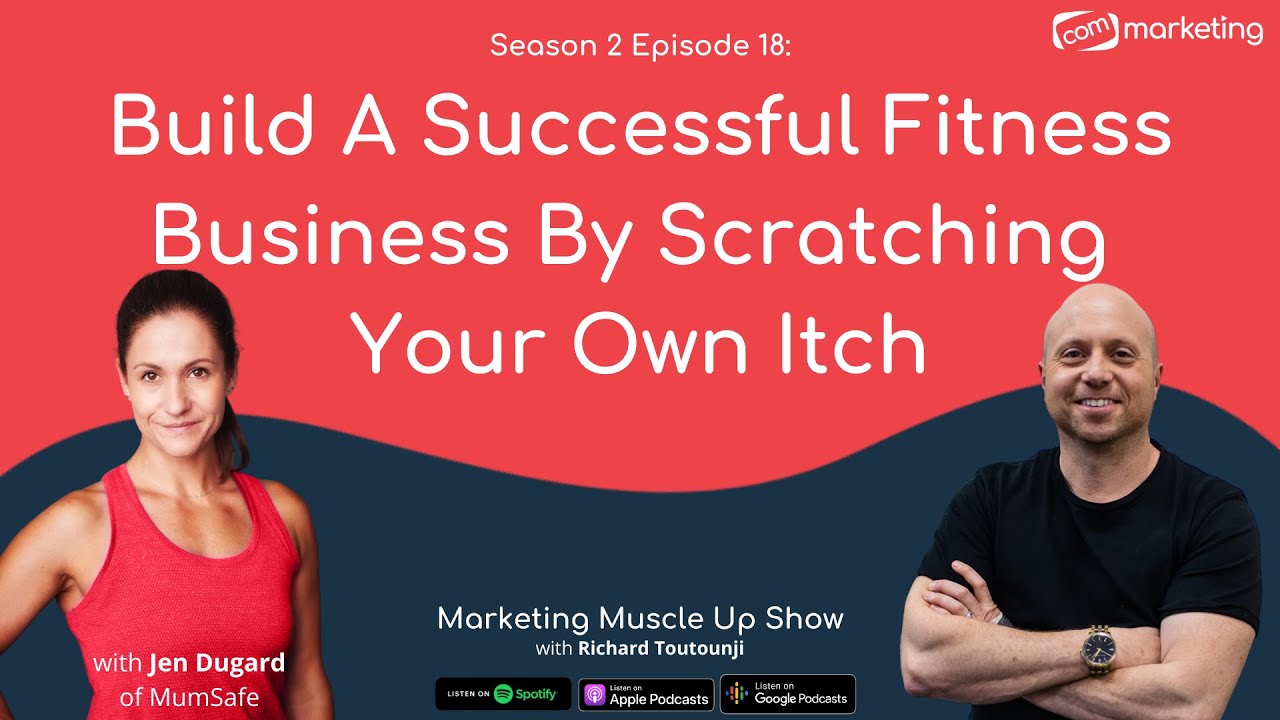
In this episode of the Marketing Muscle Up Podcast, host Richard Toutounji interviews Jen Dugard, founder of MumSafe, about how she built a niche fitness business focused on mothers and later expanded into trainer education. Jen shares her personal journey from a personal trainer at Fitness First to creating the Body Beyond Baby group‑exercise brand, launching on‑site childcare sessions in Centennial Park, and eventually selling that business to focus on the MumSafe education platform. She explains the MumSafe accreditation process, the Safe Return to Exercise certification, and the standards trainers must meet (partnership with women’s‑health physiotherapists, appropriate insurance, industry registration, and ongoing CECs). The conversation then shifts to marketing tactics for niche fitness businesses: defining a client avatar, becoming “locally famous,” using an elevator pitch that even a child can repeat, and applying a “layering” strategy (the 7‑11‑4 framework – 7 hours of interaction, 11 touchpoints, 4 locations). Jen also discusses the importance of aligning business decisions with personal life values, the trade‑off between experience and formal degrees, gender diversity among MumSafe trainers, and practical social‑media habits (consistent Instagram Stories, platform selection based on target audience). Throughout, Jen emphasizes a values‑driven, community‑focused approach to sustain a long‑term career in the fitness industry.
Chapters
Welcome back to the Marketing Muscle Up Podcast Show. I am Richard Turtungi, and today I want to talk all about moving your business into more of a niche. As you know, in marketing, we're always about ensuring that we get attention in the marketplace. And today I've got a really special guest on. Some of you may have heard of her name before, but I've got the one and only Jen Dugard. Welcome to the show.
Thank you for having me. I'm very excited.
I am too. And for those who don't know Jen, let me just read out some snippets of the bio that she sent me, and I'm going to kind of readjust a little bit. If I can, Jen. But the thing I like about this story and Jen's background, Jen's actually been a trainer in the industry doing her hours in the park, one-to-one, one-to-many, all those kind of things, doing them early, doing the late nights. But then all of a sudden, Jen said, I'm going to start niching myself down an audience of moms and really making sure that moms get trained safely. She is the author of How to Love Your Body as Much as Your Baby, which I think is an amazing title, by the way.
Thank you.
And now what Jen does, she has a business called Mums Safe, serves both mums and fitness entrepreneurs. She runs courses, runs events, and really Mums Safe training. You can check her out, mumssafe.com.au, ensuring fitness professionals are properly educated and upskilled in working with their pre- and postnatal clients, which I think is really cool and I think is really important. And I want to touch on today how Jen's been able to do that because this is a congested market, mums. There's a lot of mums groups around and, and mums community forums, but she's really putting her hand up and saying, hey, we've got over 80 fitness professionals throughout Australia and New Zealand and And Singapore and Asia and really showing people how to actually be a great, as the business name says, Mum's Safe Trainer. You've done a lot, Jen.
I have, but I loved, you know what I picked out of that when you said all of a sudden, I'm like, fuck, I wish it was all of a sudden. 15 years, all of a sudden.
Yeah. Talk about that. 15 years in the industry, Jen. Is that correct? Yeah.
Almost.
Yep. And I love talking to people who are all of a sudden and have been in industry for a long time, but all of a sudden it could be a rebrand, a rechange. And I've definitely seen you're on the rise moving into this space and niching down moms and really owning that. So I've probably done a sloppy job of getting your background, but can you just sort of expand on the bio a little bit of really the background? Because I love hearing backgrounds before we get into You know, it's interesting you said that, like the backgrounds are the key to figure out, you know, where we are now because a lot of people, you know, Jen, they go, oh, I want to be this, I want to be that. But my first question I always ask somebody is, what have you done in the past? Because then it can really understand how fast or slow you can move based on the history. So take me through and take the audience through, like what's the background of Jen?
Yeah, absolutely. So I started pre- Group fitness in the park. I was a everyday PT at Fitness First, so I had a Fitness First membership at Bondi Platinum when it first opened.
Oh, Platinum with the very very early days that kind of stuff. Yeah. Yep.
I didn't quite have the black black locker room, but um I had the other one. And so I was a member up there working in the film industry and um became I started doing Fitness First boot camp down at Coogee Beach. And while I was doing that, I have a background in gymnastics and coaching gymnastics. I kind of went, oh, I could do this. And I was considering whether I stick in the film industry or get out. And I decided to go do my Cert 3 and 4 and also got a PT for myself up at Bondi Platinum. And when I learned what the PTs earned versus what the bootcamp instructors earned, I kind of decided that I was no longer going to be a bootcamp instructor, but I was going to be an actual personal trainer.
Show me the money.
Exactly. Went into Fitness First in the days when you can go in with your Cert 3 and you had a mentor and you could be doing your Cert 4 throughout that process. Right. My dad was a very— he was big on the old audiobooks. So like your Jim Rohn, your Dean Martini, all of those people. So I'd grown up with this kind of business background. So when I was getting out of film and deciding to go into fitness, I knew I wanted to be a PT, but I knew that it wasn't going to stop just as being a PT delivering, exchanging time for money. It was going to start there, but it wasn't going to end there. So I had a baby in 2018 and left Fitness First, found myself in this world of motherhood, started a blog, called the blog Body Beyond Baby, and then the business followed. So I launched group exercise with onsite childcare in Centennial Park in 2008, shipped my child off to daycare because I realized that I know, all good intentions, keep him with me wasn't going to work.
Right.
So my original goal with the business was literally to start to niche down. And I know we're going to go in that direction and talk about that. But the only financial goal back in those days was that my business did not cost us money. So I had to earn enough to have him in daycare for the 2 days a week that he was there and to grow the business from there. So that gets me into Centennial Park and I spent 10 years running group exercise sessions in Centennial Park for mums and we became the biggest mum-focused fitness business in Sydney's eastern suburbs. We launched in Willoughby, we launched in Birchgrove over on the, in the inner west. None of those locations were as big or as successful and I put that down to me not being in that space as much. Right.
Yep.
Um, they did work, they worked, but they weren't as big. Um, and I held that business for 10 years and then decided I launched what, what became the trainer education in 2016, '17, Safe Return to Exercise, and then finally sold Body Beyond Baby as it was in 2018.
Wow. And so all I'm hearing here is that you had this drive to focus on one audience type really early on and And a lot of the time, you know, when we, but you know, if fitness professionals listening to this, it's always like, I want to train everybody and I can help everybody. And when I ask, who's your avatar? Who's your niche? Oh, it's everybody. And early on you're sort of saying, no, I'm helping moms. I'm helping moms. I'm helping moms. I'm helping moms. Why were you so passionate around choosing an audience at that stage?
Yeah, I guess first I don't want people to get disheartened if they don't do that immediately, because I did spend nearly 2 years servicing the masses in Fitness First, cutting my teeth and getting experience before I did that. And I don't think that's a bad thing. Um, sometimes we don't know who we want to work with and we discover that when we delve ourselves into the industry and we find ourselves attracted to working with one specific person.
Yeah.
I guess with all the, I guess the business stuff that I'd learned, I knew at some point I was going to need to have a pitch of knowing who I'm talking to very and quickly communicate who my target audience was. And I guess when I found myself surrounded by other mums, I was easily able to go back into the gym. I actually didn't know what I was doing in order to recover postnatally at all. I had no clue, but I did have enough of a clue to get into a gym to start to move again and then to start to seek out the knowledge that I, or the information that I needed. And I, in the early days, I partnered with a women's health physiotherapist therapist to get that extra information. But I think it was, it must have been the business stuff that I'd grown up on to start to know I just want to talk to that person. And I knew that I wanted to be known for something.
Wow.
So I remember way back when searching around and there wasn't what you said before about it being quite a congested market. It wasn't back then. There was me and probably 2 other groups in the eastern suburbs. And I was on a mission to be the group out of those 3 businesses, that was the one that was the most known. And I guess that—
Is that, you gotta have a bit of competitive spirit back then? What would you call it? Like, you know, when you, when you see those competitors, is it like, oh, those people? Or is it, you know, ah, like, I'm, I'm gonna beat them in a nice way? Like, which one were you?
I think, I think there was, there was definitely a scarcity mindset back then for me. So there was definitely a competitiveness. and I wanted to, you know, rise to the top. And they were probably more known than I was when I first started. And then over time, um, that, that kind of changed. I think one of them left the industry and the other one moved into doing something a little bit, a little bit different. But there was definitely a competitive spirit and a desire. Having come out of film, like, years ago, I wanted to be in film in front of a camera. So it was like, how do I, how do I get— move into a space where I grow my profile and become known, which would then serve my business. And I did early in my, I guess, PT career, I did the Key Person of Influence program. I did that in 2013. So it was early but not early, 5 years into already working with moms. And that really kind of supercharged it. It reinforced what I knew I needed to do. And I then followed that path.
I think I have a Key Person of Influence book here actually.
I've got about 3 of them. 3 on my shelf.
There you go. I've got 2 for some reason here. So yeah, great.
Because they give them away freely so that you give them away so that people find out.
There you go.
Great plug, clever.
Love it. Okay. One thing I just picked up there and I wanted to go on a bit later, but you started in front of the camera or you were in the film industry. And that's a really super unique angle because a lot of people hate the camera when you put it in front of them. Like we're talking about fitness professionals say, hey, do a Facebook Live. they can't stand the camera or they kind of break down and cry on that camera. But, um, for you, your background was film?
Well, I was behind the camera, but pre-getting into the film industry and being behind the camera, I wanted to get into acting and all that kind of stuff. I probably wasn't very good, which is why I never went there. But what I am now, what I discovered from that process, is I'm pretty good in front of the camera. And back in those early days, I was much happier speaking to a camera than getting in front of A, like, speaking on a stage.
Yeah, really good, really good. And, and the camera is, uh, definitely something, um, that you need now running a fitness business, I would say.
Absolutely.
So let's talk about that then, the journey. And, um, I guess where I wanted to get to now is your— okay, you've niched down, you've sold that, and then you're going, okay, I'm gonna, I'm gonna help a lot of people. And I think a lot of people in the fitness industry may know you from what you do right now, which is the Mums Safe program, because obviously when you're training, uh, have a lot of courses and training people how to be a Mums Safe trainer. Um, tell me about the education side of things, because moving from a PT to education, and what are the fundamental things that— I guess, what are the fundamental things you need to present to trainers? I haven't— sort of random question, but then Yeah. Tell me about the Mumsafe program and how you— I love how you get it out now. You've got a— I think it's a platform there where the name sort of says it all. Is this a problem in the marketplace where there's people that are not just getting— they're just training mums? And is there a problem? Is that why? You have this platform?
The short answer to that is yes, there's a big problem. I'm going to backtrack because the first question you asked me was how to become an educator.
Yeah.
And I think the first answer to that is do your time and become known for what you do in some way, shape, or form. So, I am not— I don't have a university degree. I have a PT certificate and I have over a decade of experience. experience working hand in hand with women's health physiotherapists, working with mums themselves. Now, if I had a degree in women's health, I could probably fast-track that process. And I know that there's educators entering in the market now that have got less experience. But one of the things that even Fitness Australia alone looks for is length of time in the industry or qualifications in order to, to gain that CEC certificate in order to, to teach trainers. So Had I not got that experience in working with mums over 10 years and become known for that, I think it would have been a lot harder to move into educating trainers.
Quick question, what do you think's better, experience or degrees?
I, I'm an experience girl, but that's because I'm not very good at sitting down and doing— like, I want to be physically in the space doing the work, not sitting at a computer doing the work. So I've always thought if I could do a degree that was really, really specialized in what I want to do, I'd go do it, but I don't want to do all the shit that you need to do to tick off the piece of paper when what I want to do is probably about 20% of all the stuff.
Totally. Yep, totally. It's the hustle hard degree, pretty much.
Yeah. And when you start in film, like, you start making tea and coffee for people before they pay you to do anything. So, I've got a good work ethic, which I think has served me well.
I think work ethic is very important. Okay, cool. That's good to know. Our next question was then, let's talk about Mumsafe for a little bit. And specifically, this is probably going to interest anybody who is in the fitness industry and training mums. And they're saying, well, I'm a good trainer and I can train mums and I don't have a— I'm not— how do I become a— I mean, I'd want to become a Mumsafe trainer, that's for sure, if I'm a trainer. Tell me about Mumsafe.
So Mumsafe is the evolution of Body Beyond Baby. So when I sold Body Beyond Baby, the group exercise business, I retained the brand and I did that Specifically because I knew that Body Beyond Baby was known. I knew that if you Googled Body Beyond Baby, it would be known for mum's fitness, and I wanted to reach more mums through educating trainers on a bigger scale. So we retained the Body Beyond Baby brand, and we created what was called the Body Beyond Baby affiliate team, which meant lots of things to me. But it soon became— well, soon, a few years later, it became very clear in the market that Body Beyond Baby is a great name for a fitness business, not necessarily a great name become known as the go-to place for mums to find a trainer or for the trainers themselves to carry that brand. So they were carrying the Body Beyond Baby affiliate brand and people like, what is that? We did some market testing around Mumsafe versus Body Beyond Baby and being a Mumsafe trainer or getting onto the Mumsafe website, it doesn't take you very long to work out what it's all about and why and to build trust with, with that person. So, um, To become a Mum Safe Trainer, someone has to have Safe Return to Exercise, which is my certification. And from a credibility perspective, what I wanted to do is help those trainers that were really invested in working with mums become known for not just ticking a box. Yep. So Safe Return to Exercise, it's a great 16-hour course over 2 or 3 days depending on how you choose to complete it. But you can tick that box and then say you're Safe Return to Exercise accredited and never implement any of the stuff within there. So never go out and get a women's health physiotherapist, never, you know, execute or do any of the things in the course, but you have, you hold that certification. A MumSafe trainer must be actively implementing all of the things that they learn within Safe Return to Exercise to be called a MumSafe trainer. So they have to prove that they have a women's health physiotherapy partnership. They have to prove that they understand the safe return to exercise education and that they're implementing it so that with their pre-exercise questionnaire and all that kind of stuff. They have to prove that they're actually insured to be doing what they're doing. So some people have contractors, they have nannies on site. If they're holding a $200 regular PT insurance, they're not insured to be— to have those nannies or those contractors working. with them. And then we also ask for industry registration, which we both know is not compulsory, but I believe that it's a direction that we need to go as an industry to uphold best practice and get credibility with allied health and all that kind of stuff. And then the final thing is that they're committed to their ongoing education. So we provide ongoing education in working with women and mums, which equals 10 CECs per year at the end of the year. And, and they're consistently learning more than that minimum level of safe return to exercise in that space. So that is what a MumSafe trainer is, and that's what a trainer has to do in order to become one.
Very good, team. If you're listening to this, are you a trainer that trains mums? I love this, uh, MumSafe trainer. Okay, cool. So, so there's a big, um, You know, to me it sounds that it's not just, you know, offering the courses, but what I'm seeing, you know, what I'm seeing has to happen to create a brand is to create a big community and to create a, you know, that continuation. And I think you do that really well with how you communicate to your audience, which is trainers who train mums.
Mm-hmm.
And just random question, is it Mainly women, or do you have a mix of guys who train mums? What's the split, would you say?
It is mainly women. We do have a couple of guys, so the split is very small. And I was actually talking to my mum the other day about— she's like, you need more diversification. And I'm like, I do. I need more men. I need more— I would like more men. I would like more cultures. But I'm also very aware of not going out to say, hey, you're a man, or you're of a different cultural background now come and be my token person. So genuine call out. Like, if you're not seeing yourself recognized in the trainers that we're working with, I would absolutely love for you to come forward and discuss, have a conversation.
Yeah. I mean, I think there's so many male trainers that are training females in pre and post. I mean, yeah, that's why I was just very curious around that.
Yeah, no, they're definitely outnumbered, but we have a couple of great guys.
All right, come on, guys.
Come on, guys.
So by leading this charge, I really want to— this is the Marketing Muscle Up Show and people jump on here to hear the stories, but also hear a few tips around marketing.
Yep.
I'd love to know what your you know you've been in the industry for fifteen plus years. I'd love to know what your non-negotiable items are. You know when people say you know what's the morning routines? What's the rituals? What are your marketing rituals that you've put in place in your business or you know other businesses that you that you work with?
Yeah, absolutely. So the first one that is knowing your client avatar, but beyond that is becoming locally famous. So you need to know your client avatar before you can work to become locally famous. But as a fitness business that is in the local, in a local area, you need to be the business that's on the lips of every single person in your area that potentially wants to work with your ideal client. And if you don't know your ideal client yet, what is the thing that at the party, Somebody can communicate with somebody else to go, oh, you said that, so you need to go to this person.
I like that. So on the lips. So tell me, you know, one or two things. How do you get on someone's hot lips? What really—
How do you get on someone's hot lips? We could go anywhere with that question. I think having an easily communicatable pitch is the first thing.
Okay. So the elevator pitch concept.
The elevator pitch. Yeah. So I'm a fitness professional or I run group exercise sessions in Centennial Park with onsite childcare. Super easy. My kids know what I do. My grandmother could communicate that.
And my friend at the party. The kid test and the grandma test.
Kid test. I do that all the time.
So good.
Yeah. And it's interesting through my evolution, it's like you, my kids knew I was the trainer that trains the mums and now they know I'm the trainer that trains the trainers to train the mums. And if your kids can communicate it, somebody else can do that.
What a great analogy. You know, actually test it out on your kids and your grandparents. This is genius.
Yeah. What do I do? What does mommy do?
What does mom do? What does dad do? What does mom do? Okay. That's great. So know the avatar and know the elevator pitch. So then easily you can get it on everybody's list. And when you say locally, I mean, should we be going into, you know, is it spending a lot of time in the local areas? Is it more You know, is it face-to-face kind of local or is it more online local?
Is online— is local online? Anyway, I guess it can vary depending on what you're trying to achieve. But I think if I pull it back to the 3 non-negotiable marketing activities, the second one would be the layering effect. And that is where you look at the different ways that you can become locally famous. And not being too, I guess, egocentric to go, I'm not going to go give out flyers, or I'm not going to go talk to my local coffee shop. And doing that to support the stuff that you do online. So I'm all for old school marketing, but layered to work out where, what's working, what's not working, and then adding the next layer to that. Because what I find a lot of trainers do is they'll go, yep, someone told me to do flyers. So they'll go do flyers and they'll decide they didn't get any leads from doing flyers. So then they'll go, I don't know, give a talk at the local playgroup if we're talking about mom-focused fitness business and they'll go, well, no one really spoke to me or I only got one lead from that. So they never do that again. And then they go, I should set up my Facebook page and run a Facebook ad. And it's like, well, you know, none of these things on their own are working. It's when you over time strategically add layers and layers and layers to that. And if you're testing and measuring at the same time, you're going to be working out which ones of those layers are working best for you so you can put more time and energy there. But I truly believe that without those layers, you don't end up being that person that they go to. There's some research out there. It's the 7-11-4. I always forget what the 4 is, but it's people need to spend 7 hours with you to know, like, and trust you. They need to see you in 11 different places. And I can't remember what the 4 is. I always forget. I should look it up. But one of the reasons I wrote a book was so that I could spend 7 hours in someone's lounge room, which is super easy for me to then do. And those 11 touchpoints, if you're not the person, so let's say someone does talk about you in the party, at the party, but then they see somebody else's flyer and then they see somebody else's car driving around your local area, they may not come back to you because you're not being seen in all of the places. You've planted the seed, but you don't have that layering effect in order to actually become locally famous.
I love it. 7-Eleven and the 4 actually represents 4 separate locations, I believe.
Oh, what's the 11 then?
11 is 11 touchpoints.
11 touchpoints. Yeah. Okay. So it could be a flyer, it could be— yeah.
But you mean, you said that anyway, you know, where are they seeing you in all different places? And I think that's a really good one. 7-11-4, like that one. So it's 7 hours interaction, 11 kind of locate, 11 sort of touchpoints and then 11, 4 different locations. And Yeah, that's real. It's a really good analogy because locally you don't have to. And this is interesting because a lot of people think they have to take over, like they have to be the next—
Michelle Bridges. Taylor, Michelle Bridges. I thought I needed to be that and then I realized.
But yeah, when we, when we think locally or, you know, niching becomes a bit easier.
Yeah.
It comes a bit cheaper.
Yep. And then what that does is it enables you to get bigger. So probably my third one would be to get known online. So do the Google test to start to become— yeah, so you show up. So if someone Googles your name or your business, they shouldn't have to Google both. Then you start to become known online for what you want to do. And whether that initially is a great Instagram page using your bio and that comes up when they search or a Facebook page, but then going outside of that and publishing publishing content either on your own website, but ideally for other people. And I started to do that really, really early on in the game.
So good. Okay guys, do the Google test. I think they've already done the Google test. You need a 10 out of 10 score. I think that's the rules, right? 10 locations on the first page. Is that the game, Jen?
Well, I just like to see how many pages.
How many pages? Okay, this is great. So how many pages can you get a 10 out of 10 score for? Let us know your number. What number it is for you. Okay. These are good. So do the Google test. The layering effect was number 2. And number 3 is know your ideal client, also known as avatar, and ensure that your kids or your grandmother knows what you actually do. I'm going to do that test today with my boys.
How old are your kids? How old are
they? 2 and 4. Maybe the 2-year-old. He might say something about—
as long as you say something about marketing and fitness, I think you're winning.
Oh, well, actually my 4-year-old knows. He says, Com marketing. So he's always going about com marketing. Let me just see if he knows the elevator pitch. I did get a new sign behind me, Jen, actually.
I see it. I like it.
So it came in yesterday. So if he can read that, I might just give him the elevator pitch on that one.
Okay. Love it.
Okay. This is really cool, guys. This is very good. I'm loving this. So the non-negotiable activities is really important. And I see that you are doing that as well. And that's one of the reasons why I want to get you on because It's one thing saying, it's another thing doing. Tell me how you stay motivated in your marketing. Like, I'm seeing you out there every day talking to your audience in a very specific way. And I like seeing it because I love just seeing how it works and I'm not seeing, like, you're always on it. How do you make sure you don't miss out that organic marketing flavor?
Yeah, I guess it's easier for some people than it is for others around Facebook and Instagram. Some people absolutely hate it. And if you hate it, I would, one, either don't do it. And I know that sounds controversial, like choose one and just do one. Don't force yourself to do all of the things. But for me, having a regular time. So mostly if I'm doing a Facebook and Instagram story, it's going to be around 6:00 AM, maybe 7, 8, depending on how my morning's played out, but I always try and get an Instagram story up early in the morning.
Yes.
And then having a think about, I try and relate, make things relatable to the things that I want to execute within the business. So for example, at the moment, all of my conversation is around MumSafe to mums, even though I'm talking to trainers. So we're launching the actual brand to mums. If I've got a safe return to exercise course coming up that I want to fill, then I'll have a think about what, how I'm going to, I guess, talk about that and weave it in. But it's always, it's weaved in, but then you've got to make sure that you've got some kind of call to action at some point. So whether it's joining your mailing list, joining your, getting a free download, but nothing too salesy and knowing those, I guess, the peaks and troughs of I'm giving at the moment. So my whole reason for being is to give quality information and value and then knowing the times on your social media when it's time to ask people to come and work with you. Because when you're always, always asking or you only use social media for asking, it's really boring.
I call it the muffin experience. You go to a coffee shop and they ask you, do you want a muffin every day? Nobody wants one every day. We only want some occasionally. So good advice there. So I like how you said, you know, don't do it if you don't love it. And it's interesting because you eventually going to know if you love it or hate it. You might be a blogger, you might be a Instagram story. And the clue for me for you, because I know you're, you're big on the stories, enjoy watching your stories, is that your background was kind of around cameras. If it's at the back of the camera or the front of the camera, do you think that helped today?
Maybe. Yeah, I know, I know that I know how to make things look okay. I probably don't always get it right, but I don't have that overwhelm of where do I put a camera, what do I do with the lighting, that, that's not an overwhelming pace for me, which I know it can be a roadblock for some people. I was, Richard, yesterday I was talking, I had a mentor session with a client and she's not good on social media.
Yep.
As in she's not not good at it, but it's not one of her things that she's naturally drawn to do. And she asked me if she wants to grow her profile. So she said, does she need an Instagram page, a personal Instagram page to grow her profile? She's actually an exercise physiologist. So the conversation that I had with her is No, for you, in order to grow your profile in the circles that you want to grow them, we need to get you to concentrate on growing your Google searchability or publish things on LinkedIn. Forget about the Instagram profile because it just takes your time and you're not doing it well. So really understanding what the result is that you want. It's like she doesn't need people, the everyday person to find her on Instagram. She needs the academics to find her You know, in Google and on LinkedIn.
It's a great, it's a great point. And not every social media or every marketing is created equal. Um, and I think that's a, it's a really valid point. It's about where are you going to find those clients, where they're looking for you especially. And there's so many things, you know, in marketing, there's so many different things to do. I always, you know, say have 5 funnels, but every funnel is not created equal as well. So it is understanding where you're where those clients are going to come from and what they're going to see you beforehand doing.
Absolutely.
Um, really good insights there. So just on niching for a second, um, okay, let's say we have— we're a trainer, we've been in the industry for a bit, we are, um, we're going back and forth on training every day, and then we, we're kind of thinking we like a certain person we'd like to train. Uh, I always think that You know, I see a lot of people training similar people to themselves a little bit, but, but what are you— what are your tips if someone is at a stage where they think, you know what, I think there's some— this makes sense to me? Uh, what is your advice around somebody who feels they want to start niching their audience and attracting that avatar that they really love to train?
Yeah, so I think the first thing to address something that holds people back a lot is they think that if they only market or they only talk to that person, then they're going to lose the other people.
Totally.
And maybe over time you're going to start to attract more of the person that you actually want to work with, but all of the other people are not just going to instantly go away. And a lot of the time other people continue to come to you because you're good at what you do. So for example, an example of that was I only ever marketed to moms, but then I would get moms go, oh, can you train my husband? Because I was good at what I did and then I could choose then if I had the time and the desire to work with someone that wasn't my ideal client. But I think when you're starting to decide to only work with one person, it's changing your language and changing all of the messaging that you put out into the world to only speak to that person. And this is where I do like Instagram for the everyday PT or the PT that's wanting to niche down because it forces you to refine or to have that elevator pitch to fit into. I don't even know how many characters it is, but it's not many on your Instagram profile. And you want people to know when they land there, should they stay or should they go pretty much instantly. So I would, the first thing that I would do is refine your Instagram profile and then start to only talk to that person. And you actually in that process might find, if you're someone that struggles with social media, you might actually find it easier because at the moment you're trying to talk to all of the people and have all of the different conversations. And then all of a sudden you go, ah, I'm only going to talk to that one person. And it was the same for me, like way back when, and I was training mums. I was, I don't know, doing a lot of handstands on my social media.
Yeah.
I was also then trying to talk to trainers. And it wasn't until I went, okay, I'm only going to talk to trainers in this space that I started to find my groove and really have that conversation on my Instagram page. So that's the first thing that I get that work out who your ideal client is and then do an Instagram overhaul.
I love it. Instagram, very tactical and very easy to do. Just go to the edit section and change the Instagram and wow, just like that, you will change.
Yeah. And you can sit on that for a while. You can go, okay, this is what I think I want to do. I'm going to give that 30 days to only speak to this person. And then you can go, you know, start to adapt your website and all of your other collateral as well to match. Your ideal person.
I think that's great. I think it's a really great place to start. Go to the IG profile and give it a test. Give it a run for the money. Jen, this has been outstanding and I love the journey. I love the story and I love the niching. I am obsessed with your niching and the avatars and talking to that. I think you do that really well. What's your final thought, Jen, for anybody who is, who, anybody who's in that space like you were and they wanted to kind of like, I guess, keep them in the industry for a long time, is it A, maybe it's a multiple choice, I'll give it to you. Is it A, should I niche down? B, should I just change my roles in the industry? Or C, should I just leave the industry because there might be— better careers or better money elsewhere, and I'm talking specifically to anybody who has been in the industry, you know, longer than kind of 5, 6, 7, 8 years to a degree, and they're, they're making this decision, um, you know, what, what, what would you advise here so they can continue through hopefully? What are your thoughts?
I would take them through a process of understanding their life values, because if you don't know what you want out of life, none of those decisions are going to make sense. So, and when I say life values, a lot of people can easily reel off their business values. So they'll tell you what their business is all about. And then they often go about creating a life that has to revolve around the business that they've created. And then when you find yourself at a crossroads of stay, go, choose something different, do any of those 3 things, you've got to start to think about what you or how you want to live your life until you can figure out what is the right thing to do. So for example, my 2 personal values are courage and connection. And one of the driving forces to sell my fitness business when it, when it was the time, apart from it being cold outside in Sydney in winter, was that my value of connection was in conflict with dropping my daughter at school each day. She didn't we had trouble dropping her off and we still do sometimes now. And I had to basically shove her through a school gate in order to leave by 10 past 9 to get to the park by 9:15 to then be training clients at 9:30. And over time, that became something that wasn't working for me or for her or for our family. And it was the same reason that I stopped doing early morning PT before I sold the business was I needed to be there for my kids. And did I, if I'd not known my values, so if I didn't know that connection was a value, I was maintaining the connection in my business. So I could have gone forward just going, yep, this is great. This is my business value. Keep doing what you're doing. The kids will just have to work. But when you take that value into your all life areas, so health, fitness, financial, spirituality, family relationships, all of that stuff, it was very obvious that my value of connection was being upheld with my clients. But in fact, you know what? It wasn't being upheld with my clients because by the time I got there, I was emotionally exhausted and had to then force myself to try and connect with them. So I So I then had to draw on my value of courage to go, what do I need to change and what can I change in order to move forward in the way that's going to serve me long-term? Which then led to a process of going, okay, how much money do I need to earn with Safe Return to Exercise? Getting my financial spreadsheets out and being able to do this kind of getting to that tipping point of this business or this income stream is now providing me with enough confidence and flexibility to go get rid of that And then create the space for this other one to then come up again and then move forward into that decision. So shit doesn't change overnight, but when you check in with your values and you know what your values are and you know what you want to create, then you can put a plan into place that might take you 6 months to a year to execute, but you then have purpose to move forward into that. So—
Wow, I love that. And check in with the values is kind of what resonated with me there the most. Important to check in to see how that's going regularly.
I mean, you've just done the same thing, right? You've just moved and you— there must have been a values-driven conversation at some point that told you to do what you've done. And it's scary to just move.
It's really— I mean, the most scariest thing is I had to find a ride-on lawnmower, Jen. I had no idea.
You've just completely—
I mean, and there's no Uber Eats around here either, Jen.
That's shit. I would actually struggle with that.
We've got 2 places with Uber Eats. So we're just getting there. But it's a good theory you talk about. I love it. Because, um, I wasn't expecting that last, last answer, the life values. But I think, I, I think it's beautiful because the end of the day, you know, deciding not to do a session, let's say in the morning if you're a trainer, and maybe, you know, doing the other hours or readjusting who you have to get into to fill that, uh, keeps you in, keeps you loving your career, loving your life, and then keeps you in an industry that has an amazing amount of flexibility if you look at it correctly.
Yeah, I spend a lot of time— I can't answer anyone's business question until I know their life values, and that's it.
Love it, guys. If you've enjoyed this episode, uh, make sure you go out and, um, stalk Jen's Instagram. Give us some love there. Jen Dugard, isn't it? Is that correct on Instagram?
Nice and easy. Yep.
So good. Better than Toutounji. D-U-G-A-R-D. Jen Dugard, and you can follow Jen there and check out what she does daily. Otherwise, check out Mum Safe. Google Mum Safe or Jen Dugard and you'll find her. Jen, thanks so much for jumping in and giving the wise words of wisdom.
Appreciate it. Thank you.
Guys, if you enjoyed this episode, really simply what you have to do is say, hey, this is a cool episode, copy and paste it and send it by text message. So you should listen to this. You can watch this on YouTube, and if you have really enjoyed this, go and go and rate it and share the love. If you want more of this information on and different style, you can join our group Crush Your Fitness Marketing, and in there we drop a whole bunch of marketing strategies and tips in there. Guys, until next time, thank you so much for listening to the Marketing Muscle Up Podcast Show. Bye for now.









