S2 Ep 24: Is This The End For Fitness Australia?
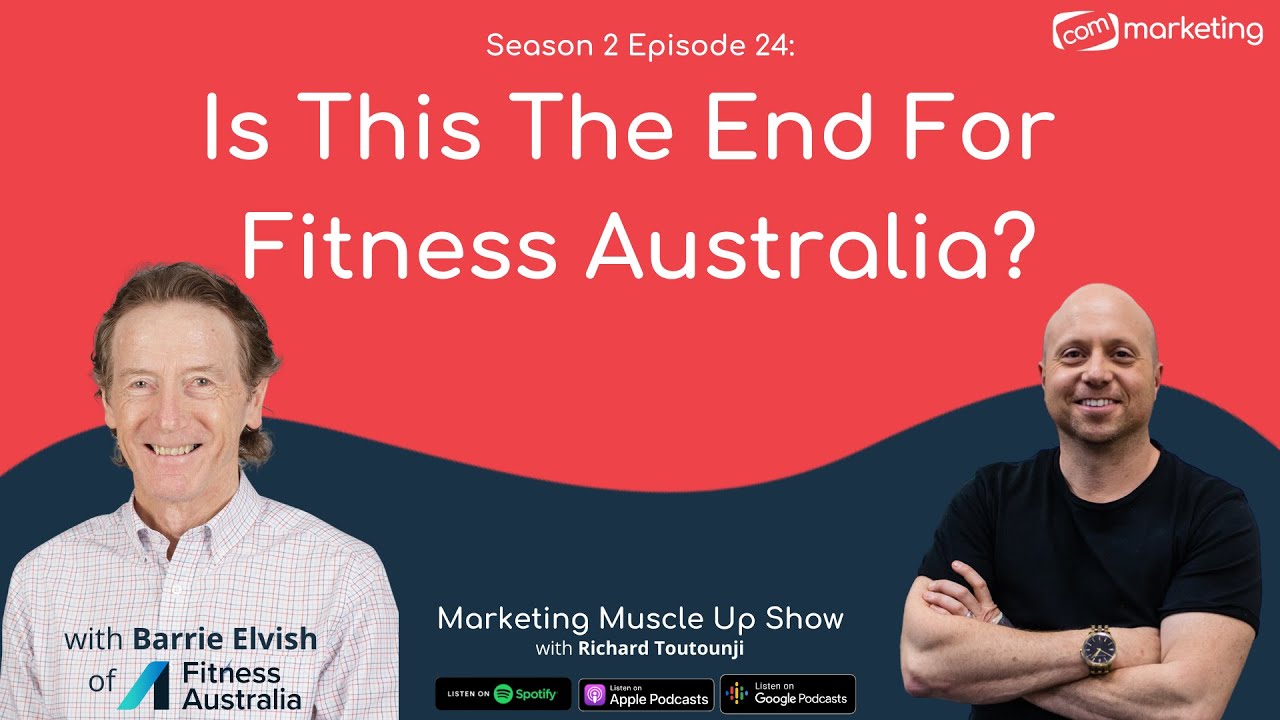
In this Marketing Muscle Up podcast episode, host Richard Toutounji interviews Barry Elvish, who announces his resignation as CEO of Fitness Australia and unveils a major strategic shift for the sector. Over the past two years, the fitness industry endured abrupt COVID‑19 shutdowns, being lumped with sport and recreation, which led to negative public perception and regulatory uncertainty. Barry explains that the industry must move forward, not merely return to pre‑pandemic operations. The response is a rebrand to "AusActive", dropping the word "fitness" to emphasize inclusive activity and health rather than sport. The new brand includes a green‑and‑gold logo, the slogan "activating everybody, every way, every day", and a consumer campaign slated for early 2022. The rebrand aims to change government perception, positioning the sector under health/preventative care, and to secure partnerships such as a Medibank accreditation program that offers exercise professionals free accreditation, insurance benefits, and referral leads. Membership categories are expanding to include yoga, Pilates, and dance studios. Barry stresses the need for industry unity, new signage, digital badges, and coordinated marketing to drive consumer confidence and increase participation, which he argues will also reduce public health costs. The episode concludes with a call for all members to adopt the new branding, support the campaign, and look forward to a brighter, collaborative future for the Australian active community.
Chapters
Welcome back to the Marketing Muscle Up podcast. I'm Richard Toutounji, and in this episode we've got some alarming news. And first to the market, I've got Barry Elvish on the line. And Barry Elvish had a big day today, resigned as Fitness Australia CEO. Barry, welcome to the call.
Well, Richard, it's great to be with you again. It's been a while since we've, we've shared cameras with each other, but as you say, it's a big day, a momentous day for Well, myself as the ex-CEO of Fitness Australia, but also as the association moves forward, it's a really good day for everybody.
Well, let's deep dive into that because this is big news for the fitness industry and also big news for the broader industry, wellness and everybody out there in a bit more broader spectrum and consumers. for, um, you know, consumers that are really the backbone of the fitness industry who are going into gyms and studios and personal training every day. So let's talk about this news, uh, Barry. Today is the day that you have resigned as Fitness Australia, but also there is a major name change and a major reason why we're doing that. So let's take— take me through what is going on here. It's been a, been a big 2 years, the last 2 years. What has happened over the last 2 years, and what have we learned in industry, and where are you moving forward with what is known as Fitness Australia?
Well, what we have learned over the last 2 years, Richard, is really what haven't we learned. And we've learned some, some lessons which are good lessons, and we've learned some lessons which have been some hard lessons. If we cast our mind back to March last year, You know, it seems ages ago now when we were basically as an industry, as a sector, shut down with 24 hours' notice, no consultation, just decisions made by key stakeholders, decision makers that had the ability and still have the ability to influence the commercial operations of all of our members, to influence the ability of our members' members, that is Australians actually going to a gym, etc. So we were shut down, and to make it worse, we were then categorised along with many other retail sectors including hospitality, cafes, bars, casinos, cinemas, you name it, that's where we were put. And from that time on until where we are today, it's been a time of learning, a time of difficulty. Many states in Australia have been into extended lockdowns. I mean, we have Melbourne, which has got the dubious record of being the most locked-down city in the world, as I understand it. And our industry, the fitness industry, was the most locked-down industry in Melbourne. So 2 accolades, to put it in one word, that I think we all would have preferred not to have had. But having said that, let's look forward. The country is now coming out of COVID We've now got pretty close to 90% nationally in terms of vaccinations. And I think people are starting to look forward to getting back to some degree of normality in their lives. It's going to be a new normality, of course, but some degree of normality. But that also means that our sector has to get back to some degree of normality as well. But for our sector, it will be a new normality. Absolutely.
Well, let me just stop you there for a second, Barry. It has been a very strong nearly 2 years. I do remember probably the last time we did jam together on a podcast was back in March last year when, you know, there was the 24 hours to close down. And like other sectors as well, however, what I've seen over the last 2 years come out of Fitness Australia has been an unstopping wave of, you know, getting the answers that the industry needs and pushing politics and fighting for why rules for one, other rules for another, i.e., the fitness industry. And so you say right now that we are moving into a new normal and things have changed. And so what you are saying and what's happening today is that you are saying that we need to not move back, but we actually need to bounce forward. Talk about these things that you're planning on bouncing forward for the industry and what it actually means for everybody right now.
Well, I think we've got— the industry's got 2 choices at the moment, Richard. We can go back to as we were 20 months ago and pat ourselves on the back and say we survived and what a wonderful industry we are and how good have we been and all the rest of it. Or we can actually take the opportunity, which we have been doing over the last 20 months, in consultation with our members, non-members, government stakeholders, private health funds, all the rest of it, to look at why we got in a situation 20 months ago where we were shut down and what can we do to try and avoid that happening in the future, because it's very important that we take on board some of the unpalatable messages that we also received 20 months ago and that we also continue to receive publicly from Chief Health Officers, Premiers, etc., making statements that really were basically trashing our industry. And one of the things that is really clear, and it's come out loud and clear to me in the discussions with the, with the various health departments— and let's just think about that for a minute. I've had many discussions, you know, over 50 discussions with health departments around the state and federally since March last year. And they've all said within some degree or other, you know, Barry, in the past, government's never really known where to put the fitness sector as an industry, where it should sit in government thinking. And by default, because they didn't know, they lumped us with sport and recreation. So we sit and still do at the moment, although we're working to change that, we sit in every state jurisdiction And the federal government under the portfolio of sport and recreation. Now, that's not where we belong. We aren't a sport. I can see how that's happened because people associate exercise, physical activity, getting fit, playing sport. There's a— I guess there's a link there.
Sure.
We're not a sport. A lot of people that exercise and undertake physical activity regimes have no intention of playing sport. They're just doing it because they want to feel good rather than look good. But what's come out in those discussions is also that they didn't know where to put us, but also they didn't know the value of our sector in the wider Australian community. And this is really important because we were shut down because we were perceived as unsafe, unhygienic, unregulated. But people perceptions very much based on outdated images of what our sector and industry is about. So we know that what was the fitness industry when it first started back in the days of, I guess, bodybuilding, the Arnold Schwarzenegger, you know, men standing in front of mirrors with 6-packs looking at themselves. We know that it's transitioned from there fairly quickly into where a situation where we now have more female members than males in our facilities.
We
now have more female members of Fitness Australia and our AusRETS, 2 as many females as there are 1 male.
Yep.
However, the trouble is that all the trash in our industry was based on the old images. So you had people talking about people being unsafe, sweaty, unhygienic, just really bad images. And that hasn't done us any favors whatsoever.
Old school never dies, hey?
Old school never dies. And let's also not forget that when we were shut down back in March, so was every other physical activity that takes place indoors. So yoga, Pilates, dance, martial arts, you name it, they're all shut down because the government categorised all those activities as gyms. Now, many of our facilities do have yoga and Pilates and dance and spin and all the rest of it.
Yep.
That's because we have moved on and we have evolved as an industry, but the government perceptions of us hasn't. And if we're not careful and get to, I guess, update those perceptions and inform government what we are now doing, what we now look like, what takes place in our centres, then we're going to be in exactly the same situation when COVID-69 or 101 or whatever comes up in the future, or some other community issue or pandemic or whatever happens and the government sort of thinks, what are we going to do about fitness sectors, the fitness centres, because they're not safe, etc. We have to change the government's perception. We have to move away from sport. We have to move under the Department of Health.
All right. So what I'm hearing here is that we got a big serving, we learned a big lesson. Yes, a lot of other industries got shut down, but what you're saying is that It, it was the categorization of sport and rec, and that's still the way the old school is still bleeding hard, even though that is not the case for the, uh, I'd say the, the fitness professionals that are registered through Fitness Australia and then do hold up their qualifications and CECs and all those kind of things that are mandatory to do. And so what this change, uh, which I'm going to ask you about in a second, what this change is, is going for is Is it more focused on pushing a consumer campaign in government, or is it more focused on the industry, the fitness industry as we know it? Is it changing both in a positive light, or is it just focusing on one part, the government?
No, it's all interrelated actually, Richard. And put a bit of context as to you know, how we were treated as opposed to so-called health industries. We had this ridiculous situation during the lockdowns that an allied health professional working in one of our facilities could still offer their services during our lockdown, one-on-one rehab programs.
Yes.
But a personal trainer offering exactly the same program could not. And that's because we aren't regulated and so on. So to come back to your question, It's going to involve changing the consumer's mind. It's going to involve changing how we operate and present ourselves. It's going to change how the government looks upon us. To put that into some context for you, we have just completed some research which will be released very soon.
Yep.
Which looked at the cost of COVID closures to our centres and the gym sector generally. That research, which was done with Deakin University down in Victoria, has shown that Australians who, I guess, indicate that they are exercising at the moment— so these are Australians that say, yes, I actually exercise, I partake in some sort of physical activity— over 50% of those Australians do that activity in a gym or a leisure centre or a health club or Pilates or a yoga studio. So in one of our sort of radars.
Yep.
Over 50%. Now, we had a situation during the lockdowns where the government would say to us, Australians, you can go outside for 4 reasons only. You can do your food shopping, you can go to a medical appointment, if you can't work from home, you can go to the office, or you can go outside to exercise. So the government was realizing and stating and reaffirming the importance of exercise Yep. Particularly now to deal with the mental health issues that have come from COVID lockdowns. And just to digress for a minute, you know, my background's early childhood, and speaking to some of my colleagues from that sector, they're telling me that kiddies coming back now to kindy and childcare, having been at home with their parents, are demonstrating different behavioural patterns. So they're more introverted, they're not reaching out to work with other kids. They are doing things by themselves. And if we translate that to adults, there is an absolute need at the moment for the Australian community to reconnect with each other. To, I guess, feel safe out into the community again. And we know that our health clubs, our gyms, our fitness centres, etc., provide that function. So to bring that back now, because that's part of the mental health situation, Over 50% of Australians say they exercise in, in our sector. The government is saying exercise is critically important, not just for physical health but mental health. But the government hasn't realized that the majority of Australians get their exercise in our sector, and that's because in the past they've lumped our sector under sport and rec and not under health. where we should be, because exercise is essential to maintain your physical and mental well-being. We know that, but we haven't told key stakeholders, particularly government, that that's the situation. COVID has provided the opportunity for us to educate health departments that this is where we belong. As I said before, I've had over 50 conversations with health departments I've had 2 with Departments of Sport and Rec. So the opportunity is there to reposition our sector away, but we have to do— we have to look at some other things as well, part of which is the name of Fitness Australia, and part of which is which modalities we actually embrace and bring under, I guess, our wings to bring them into our fold. And that's what today is all about.
Excellent. And let's get into the name in a second. So just as a recap here, and I just want to come just for the, the, for the sector for a second, for the, the fitness professionals, and just digress just a little bit here. Over the last few years, there has been a lot of internal conversations around, uh, what is the value of being in the industry. And you've said it multiple times before Fitness Australia have, you know, made mistakes, and and yes, we could have done better. And you've said that time and time again. And by what I'm hearing here, is this like drawing a line to send, seeing this amazing opportunity as as you put it, this new era we're about to go into? And and are we do we all need to rally up together? Because to me, I think there's a lot of been a lot of separation within the industry. Is this, uh, this new name that we're about to get to in a second, is this the start of that process?
Drawing a line in the sand is a good analogy, Richard. I think we have to leave the past behind. When I say that, I'm not saying we leave behind the legacy, the good points of what Fitness Australia represented, but we need to move forward and recognize that the industry has changed and we need to reposition ourselves in the minds of the consumer. in the minds of government, in the minds of key corporate and other partners,
and
also in the minds of our members. And there has been criticism in the past, in many cases quite warranted, of what Fitness Australia did or didn't do.
Yep.
But to be quite honest, after 3 years as the CEO of Fitness Australia, I'm a bit sick to death of hearing the criticism. It's time now to get on board. We have responded as an organisation from the board down. Acknowledging the, I guess, the shortfalls in the past, but more importantly, acknowledging the opportunities that COVID has presented to us. It would be— we would be abrogating our responsibility as an industry association if we did not embrace these challenges, these opportunities with gusto, with energy, with positive optimism.
I love this because this is what this industry is all about. This is what, you know, fitness professionals are about. It's about looking to the future and giving the best, and I think this is a great way to do that. So Barry, let's talk about the new name. I think this is hot on the lips of everybody, and I think it's— I'd love to know the name, what it stands for, and why you've chosen it.
Okay. Well, the new name is OzActive, and we have picked up on OzActive for a number of reasons, I guess. Oz, of course, because here in Australia, we recognize ourselves as Oz, and Oz is you know, Go Aussie, oi oi oi, and all the rest of it. Active because we want to get the community active again. We have— I guess I omitted the word fitness from the new name because fitness, when we talk to key stakeholders and interested parties that want to join with us and come under, I guess, and collaborate with us, they tell us that fitness is an obstruction in their minds because their modalities aren't involved with fitness. They're involved with movement, with exercise, with physical activity. Other people tell us that fitness as a word can be, I guess, perceived as elitist rather than inclusive, and exclusive again rather than elitist as well. So we're not leaving fitness behind in terms of where we've come from, but we need to understand— and this comes back to my earlier comments— that our physical facilities and our personal trainers, our exercise professionals, I think, a move beyond, beyond just fitness. They now have a role to play in their clients' and the consumers' and Australians' wellbeing and wellness, and that goes well beyond necessarily just being fit. So the new name AusActive actually picks up on Australia, it picks up on activity, which gives us the opportunity to tell the federal government, guys, 3 years ago this month you signed up to an international campaign to get 15% more Australians more active by 2030. In those 3 years that have passed, you have done nothing. Why don't you partner with an organisation that has got the ability, the membership, the reach, the spread, the credibility to actually activate that campaign and get Australians fit, exercising, participating in physical activity, whether it be bushwalking or, you know, working in the garden, surfing, doesn't matter. but get them exercising, physical activity, because we know over half of them are going to choose a gym, a health club, a leisure centre, and what is currently known as a personal trainer to use to get that program going. So there's a direct benefit to the wider community, there's a direct benefit to our members, and you know what, Richard, there's a direct benefit to the government. Because at the moment, for the last 10 years, the federal government has been spending increasing amounts on rehab health products, not in preventing those issues becoming a problem in the first place. They have been spending over the last 10 years less money in preventative health and more money in addressing the problem once it's become a problem. Case in point, when the budget was presented this year by the Treasurer, Frydenberg nominated mental health as a national priority and then committed billions more dollars into programs that deal with people who've got mental health problems. Now, coming from a background of having mental health issues myself, I have absolutely no problem with spending money on addressing problems when they become a problem, but it is much better and more cost-effective to spend money on preventing those problems from becoming a problem in the first place.
I don't think anybody can disagree with you on that point. And just on that, Barry, I'm just going to show the new— we're going to share the video right now.
Let's go. Let's go.
AusActive, activating everybody, every way, every day. That's the slogan, Barry, or one of them.
Yep. So let me explain the logo to the people that are watching this podcast, Richard. I mentioned AusActive. Okay, so you've got the Aus recognized as Australia. Active speaks for itself. The colors green and gold pick up on the de facto Australian national colors. Forget the union, you know, the Union Jack, etc. These are our de facto national colors. coming off the boxing kangaroo and, you know, our Matildas and all that sort of gear, our cricketers. It represents stepping up and progress. It represents diversity of shape, represents a flag we can rally behind. Now let's come down to the tag that goes with this, activating every body. This doesn't mean just your body and my body. It means every government body, every community body that might be interested in working with us to get the community activated, involved in exercise again. Every way, taking into account different modalities. In other words, Australians, choose your choice, choose what makes you feel comfortable with, and every day, because it's important to do at least something every day. So this is the new name, this is the new logo. We are super excited about this. We think it really represents where we want to go in the future. Most of the members we've been speaking to in doing previews with our larger franchise groups particularly are wrapped in this. This is an example of the consumer campaign that will start early next year in summer when people are thinking that it's lovely weather, people have got spare time to start doing things on holidays and also thinking about New Year's resolutions. So activating everybody, every way, every day. And can I just add here, the images that we will use in the final product may not be these images, but there's certainly a commitment that the images we use will be reflective of everybody, everybody's shape, every ability. Because one of the things we have been critical of in the past, or guilty of in the past, is perhaps representing images that actually played into the perceptions that the government had back in March last year, which worked against us. Right. So we didn't even pick up the message then. So this is about being more inclusive rather than exclusive.
Wow. And this is outstanding groundbreaking news here. And I think we can clearly see that this is not a quick name change or logo change. This is a very directional change. And I want to touch now, Barry, on what it actually means for fitness professionals, what it means for a studio owner, independent, what it means from a personal trainer who's, you know, maybe doing it part-time, full-time. What does it mean for a gym owner? What are they going to get out of this new name? What are they going to get out of it? And what do we need to do to also get behind this so it is, you know, it is a huge success?
Yeah. Well, and you You've just hit the nail on the head there, Richard, because we all need to get behind this. If we don't all get behind this, it's going to have, I guess, minimal impact. So to give you an example, many of the viewers may recognize that.
Yeah, it's a Fitness Australia business member. I think you get a sticker, Barry.
That's a sticker.
Yep.
Now, we used to provide that to all of our facility members.
Yes.
And I would probably guess that about 100% of our facility members, our business members, probably On a good day, maybe 98% or sorry, maybe 2% actually put it up on their facilities.
Okay. If they did, they would've put it in the very corner, maybe in the glass or something
like that. Yeah, maybe they put it behind the do not enter or the exit sign or something like that. Now, what that tells me is people weren't putting it up. Now, why weren't they putting it up? They weren't putting it up because basically it tells people nothing. What does it tell the consumer? Nothing. What does it tell a person walking, a client coming in? Nothing. Really, it's totally irrelevant. So I don't— I completely understand why businesses did not put that sign up. However, if we can just go back to that sign again you had before, Richard. Yes. The consumer campaign that we'll be running will be very much leveraging off the AusActive brand. And we will be providing new signage to all of our members.
Great.
And if we just sort of think about it for a minute, we're committing money, the board's committed money for the next 3 to 5 years to launch this consumer campaign because we did a survey last year asking our members what they wanted. And 2 messages came back very strongly: we love the advocacy you've been doing, but stop advocating on behalf of the sector, just advocate on behalf of your members. Because their non-members are basically coattailing. And secondly, launch a consumer campaign that demonstrates, informs, advises consumers about the benefits of a member, be it an individual or a facility, being part of now AusActive. So the consumer campaign will be built around AusActive, and we want the money that we're going to commit over the next 3 to 5 years is probably going to have about, you know, that much impact.
Sure.
In the wider consumer and wider community.
If you're watching this on— if you listen to this on audio, just a small, tiny—
A small, yeah, a small, because it's limited by how much money we can spend. But if we can get all of our exercise professionals, be them group exercise leaders, personal trainers, yoga, Pilates, whatever, basically putting that badge on their polo top, on their sleeve, whatever, Then we're going to have 20-odd thousand mobile billboards.
Yeah.
When they walk through the shopping centre after they've done their session, that can be a discussion starter. If we can get our over 3,000 facilities putting a sign up on their facilities as well, again, it reinforces the message. Now, in the discussions we've had with most of our members, particularly the big chains, we've asked them to actually include that signage not just on their facility, but in their own marketing materials so they can be proud to be part of an organisation which has got an altruistic, I guess, motivation to get Australia fit again, exercising again. Now, that's a great altruistic ambition for all businesses to get behind. There's also a commercial benefit, of course, because the more Australians that are getting active, the more they're going to go to a gym, as our research tells us. So there's a commercial outcome. So if we actually get our exercise professionals, we get our facilities to advertise, and they also put it through their own materials, then that impact starts to become exponential, much more than a small bit, and it starts to become self-fulfilling. So it's going to become really important because what we know is when a person's thinking about using a personal trainer or looking for a Pilates studio or a yoga studio, whatever, If they're not referred to that person or that studio by a work colleague, a friend, a family member, a neighbor, whatever, then they don't know what to look out for. But if they can look out for the AusActive signage, that will give them confidence that the facility, the professional they're engaging with, is professional, operates to a code of practice, operates under a code of ethics. is interested in their safety and wellbeing, will make sure that the programs that they do, they work with that person, are contextual to their ability, their age, their demographic, whatever. So it's going to provide some reassurance. Now, that's all words. Let me give you a concrete example.
Please.
We have just signed an agreement with Medibank whereby Medibank will recognise for a 12-month period All of our exercise professionals with a Cert IV or above, they, they will then have a 12-month period of grace— those, the exercise professionals— to become accredited by AusActive. If they want to maintain Medibank registered provider status, they'll have to become accredited under AusActive. That will give them a AAA rating. AusActive accredited. That accreditation program, which we were piloting over the last 12 to 18 months, will cost our exercise professionals nothing. It will bring into them more income coming out of the Medibank Private Health Fund and other health funds we're currently negotiating with as well. It will also generate for them a cheaper public liability insurance through Guild Insurance. So there's an incentive To become accredited. Now, many of them—
Just hold on just a second there. If you are listening to this and if you've ever thought, hey, and you're a fitness professional, what am I getting for my dollars? I think Barry just became the marketing guru here, basically delivering leads into your inbox. This is the Marketing Muscle-Up podcast show, but if you're an AusActive member, and that means that you have access to this amazing opportunity and people can now use their health benefits, health insurance benefits to find a fitness professional. That's basically what you're saying, Barry.
That's correct, Richard. At this stage, it's Medibank is the one that is only doing this with OzActive, and they have done this knowing full well that OzActive was coming. We had discussions with them as part of this, part in putting the contract together. They also know that we are launching, or we have launched now, new modality category memberships for yoga and dance studios, businesses.
Yes.
But also people that work in those facilities because Medibank want us to partner with them to go back to the Federal Health Department to try and, I guess, persuade the federal government that they need to put yoga and Pilates back into the rebatable health program that private health can offer.
Yoga, Pilates, and dance. Is that what you just said?
Yoga and Pilates at the moment. Dance, we're also talking to. Yoga and Pilates, there are new membership categories for studios, so for the facilities, and new membership categories for individual yoga and Pilates instructors, teachers.
Outstanding, outstanding, Barry. This is great work. And I mean, this is huge news for the industry and also— I mean, for the industry, but also for, you know, the people, the fitness professionals that have done it tough over 2 years. This is the bouncing forward effect, which you've been leading the way. This is just outstanding.
Well, the big— I think the big move here, Richard, is that Fitness Australia— what was Fitness Australia, now AusActive. And I've got to get my mind out of it.
What is Fitness Australia again? Sorry, I just forgot about that already.
Sorry, I don't know, something. It's gone, it's finished, it's past, it's historic, had a role to play, it's moved on. What it's— I guess is it's about time that AusActive started these consumer campaigns. As I said, they'll be starting early next year.
Yes.
It's about time we started telling the consumer the benefit of having— using an AusActive facility or AusActive exercise professional. It's about time we said to the federal government, you need to look at us as a critical or the critical partner in the Australian community in launching preventative health campaigns and getting Australia fitter and healthier. And by the way, government, it's going to save you a lot of money because the research we've done clearly shows that every dollar spent in preventative health has returned between $3 and $6 to the public purse. So great opportunity. Mental health, top of mind. Olympics coming to Australia in 10 years' time. There will be a trickle-down effect to people thinking about exercise and physical activity. It's just really good timing now. So COVID has caused untold damage to the sector, a lot of angst, a lot of hardship and heartache. But we can turn this around and now actually use it to our benefit moving forward.
Wow, Barry, this is, uh, you know, I, I, um, as you know, ComMarketing, we've dealt with a lot of fitness professionals over the last 2 years and we've had a lot of talks and, uh, there's been a lot of things happening. But this to me is great news because new is always good. But you're not just, you know, getting a new logo here. You're, you're, you've you know, Fitness Australia has put the work in over these last 2 years to restructure, um, to restructure this to be bigger than ever, better than ever before, and rightfully so. The fitness industry has changed since the good old days, since the '70s, '80s, and '90s, as you first pointed out. And it is time right now that especially if you are— is still, I should say, if you are still in the fitness industry and you haven't stopped somewhere along the path and said, you know, I don't like this, I don't like that, I mean, this is, this is the future and, uh, the world is moving at such a rapid pace. And it's been, it's really been a pleasure over this, uh, I think you've been in the role for 3 years, Barry. Uh, I personally know you've made massive changes and adjustments to this, and this probably is, um, is that, is that pinnacle point where, where, uh, the fitness industry is set up for success. My kind of final question or final kind of thought to you is that Everything is here for the fitness industry to win. Everything is here to change the status of being in the industry for a couple months and having a long career out of it. If you can kind of maybe summarize the future that you see next year in 2022, what do we need to do as an industry to be better, Barry? What do we need to do to stay as better operators, as better leaders, as better fitness professionals? What are your top tips entering into 2022?
Well, I think, well, it's probably not beholden to me to give advice to people that are professionals in the field, but I guess just what lessons I've learned over the last 3 years with Fitness Australia, what was Fitness Australia, and now that is part of the past and that's good to move on, is that I think the members, be them businesses or individuals, need to understand and appreciate, and sometimes it's easy to forget this, particularly over the last 20 months, because let's be honest here, Our industry has been trashed. It has been brought down and criticized quite unfairly, quite erroneously, on misguided, outdated perceptions, on data which didn't stack up to analysis and all the rest of it. So it's not a surprise to some degree that, you know, some people have left the industry. But we also need to reflect that compared to Europe, compared to North America, industry has actually survived quite well in Australia. And I think that's because there is an inherent appreciation and understanding of the good that we do in the wider Australian community. And that comes back to that research I mentioned before, where over 50% of Australians choose our sector as their preferred regime or their preferred venue for getting fit and maintaining some degree of physical and mental health. It's easy when you're hammered for 20 months to put your head down and say, I've had enough of this, and feel really, feel really bad, feel downcast. But the bottom line is, is that the role that we play is critical, absolutely critical in this country's future, in addressing the obesity, dementia, diabetes, all those physical health problems, but particularly now the mental health problems. We know the role that exercise plays in this. We know the importance of having people that are qualified, committed to professional development, committed to the interests and wellbeing of their client, and looking after their wellbeing as well as their client's wellbeing. The role is critically important as we move forward. I can't, I can't understate that enough. And the new AusActive is not trying to become part of allied health. That belongs in the allied health sector. But we want to, I guess, be the precursor to the community having to use allied health services. We want to head them off at the pass. We want to be there on that preventative health side. And it's the role that our members play is critically important. And moving forward, if they support this and actually, I guess, agree with this,
Yep.
we need to work together. We need to put aside what was the issues in the past that divided us. We need to work together. We need to have one unified, strong voice And we need to support each other because the opportunities are there. If we don't grasp these opportunities, people are going to look back in 5 years' time and say, what a waste, look at the opportunity we had there, look what we didn't do. And the opportunities are there, and the opportunities, if we grasp them and run with them, will help us rebound and rebuild even quicker than we can possibly imagine. And I'm, I'm very, very confident. So as much as we started this off, Richard, with my resignation from the CEO of Fitness Australia, I'm actually really quite chuffed and pleased to at least see the transition as the CEO of AusActive for a little while longer until we get this bedded down, and then I can ride off into the sunset and pick up my surfboard and head back to the beach again. But, you know, this is such a wonderful opportunity for everybody. All I can say is please get behind it, please become part of it, Please support it. Please promote the AusActive. Please welcome in the new modalities of yoga and Pilates. And, you know, the future is, I think, very, very bright.
Love it. Well, Barry, I'll be welcoming my AusActive hat when I get that in the mail. I'm looking forward to wearing the t-shirt and wearing it proudly. This has been great to have you on the podcast today, the day that you're launching This new brand. And just quickly, when— so it's launching today, and will the new Fitness Australia be sort of wrapped up? How fast will we be getting the merchandise and stickers? And is that a process now to the end of the year?
So between now and Christmas, Richard, all of the hard merchandise will be distributed out through the various outlets to the facilities, et cetera. We'll be providing at no cost digital signage and badging and stuff that people can use on their own polo tops, etc., and their sleeves and so on. Working with the, the bigger franchise groups, as I mentioned, to work with them to get it on their staffs as well. We'll be providing the hard copy, and I'd also say look out early next month for the first of our new e-journals, which will also be a regular publication coming out digitally, which will help reinforce the new direction And I guess help promote to consumers and our members the benefits of being part of it.
Amazing, thank you so much, Barry Elvish, CEO of AusActive. Guys, you heard it here, it's all big changes and it's all positive for your fitness business. And on the Marketing Muscle-Up Show, it's all about how to generate better leads, better quality, and I think this is just a great way to do that. Get behind the AusActive, activating everybody, every way, every day. Thank you, Barry. Look forward to chatting again, hopefully not through another pandemic. We'll chat next year to see how all this is taking shape.
Thanks, Richard. And just to close off, I wish everybody who's watching this or listening to it a safe and happy Christmas. Come back in the new year ready to start kicking goals.
Awesome. Time to rip in, guys. If you enjoyed this episode, the easiest thing you want to do is you want to share it, copy and paste the link, text message it, send it in an email, or just share it on Spotify. Share on Apple Podcasts, get the message out there about the new changes. And let's get into a solid 2022, guys. Thank you for tuning in. I'll see you next time or listen— hear you next time on the Marketing Muscle Up Podcast Show. Bye for now.









