S3 Ep 17: Featuring Emma Masters and Vanessa Leone
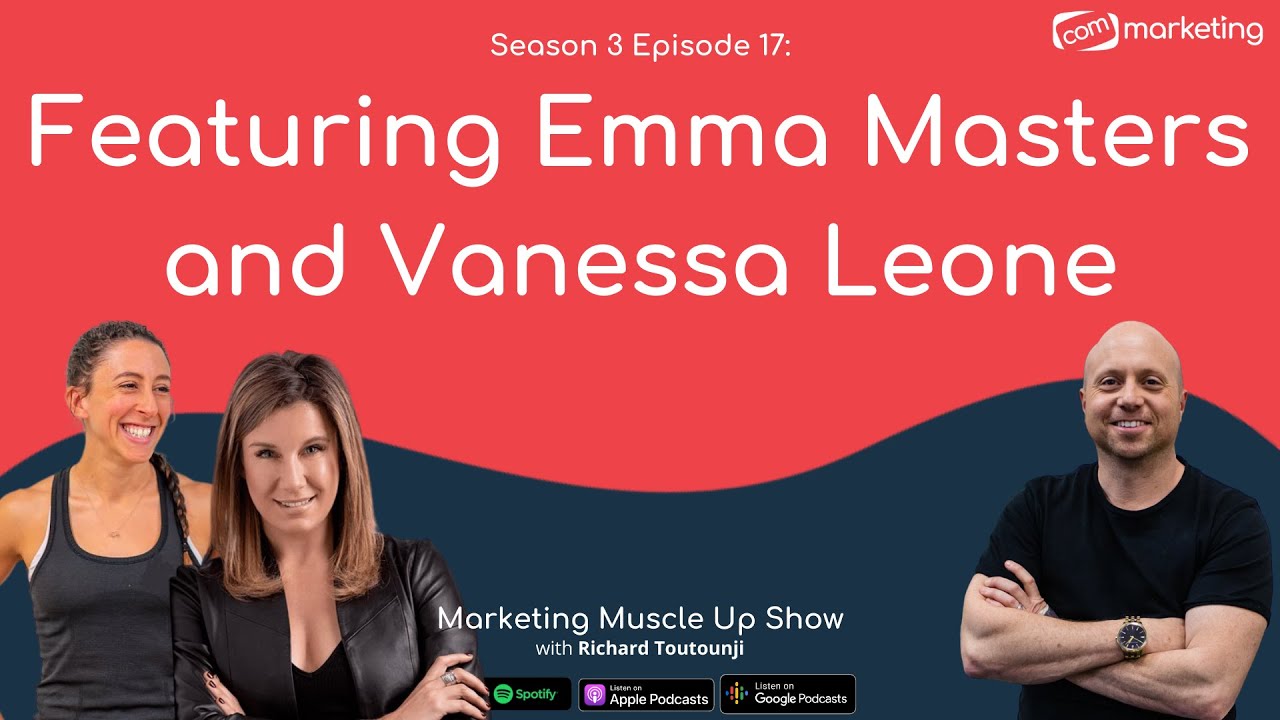
In this episode of the Marketing Muscle Up Podcast, host Richard Toutounji interviews two leading fitness educators, Emma Masters and Vanessa Leone, about the concept of "exercise to experience" – transforming group‑fitness classes from pure workouts into memorable, emotionally‑rich experiences. The conversation explores the evolution of group exercise over the past two decades, the importance of performance, music, community, and instructor authenticity, and how these elements drive member retention more than pure results. Emma draws on her musical‑theatre background to explain how curated playlists and immersive soundtracks can evoke emotions, while Vanessa highlights the scientific underpinnings of programming, the need for PT‑level knowledge in group settings, and the value of intentional class‑gap scheduling for social connection. They share practical, low‑cost tactics (e.g., 5‑10 minute buffers between classes, learning members’ names, high‑five rituals, tailored playlists) that studios can implement immediately to improve member experience and referrals. The episode also touches on industry trends, the rise of boutique studios, challenges faced by both independent and franchise operators, and advice for instructors who feel they lack a "performer" personality. The discussion concludes with actionable takeaways and promotion of their Instagram @exercise2experience and Richard’s Facebook group for further resources.
Chapters
Welcome back to the Marketing Muscle Up Podcast Show. In today's episode, we're talking all about exercise to experience, and I highlight the word to, by the way. On the call today, I am going to talk to two amazing female operators in the fitness industry: Vanessa Leone and Emma Masters. For those who don't haven't heard of Emma or Vanessa, you may have been under a rock. But it's really important that if you're in the game of studio, if you're a studio operator, you're group exercise, and let's be honest, we're all training people with. multiple, you know, no, we're not going the one-on-ones. There's a lot of group and small semi-privates going. We need to really listen to this interview. Vanessa has been in this space for a long time, 25 specialized courses of further education. Wow. Your wall must be quite full of certificates. And she now passes the knowledge on through teaching fitness professionals through conferences all around the world. If there's a fitness conference, Vanessa's there. And then Vanessa's partner in crime, Emma. Emma is an international fitness presenter and educator who lives to connect and inspire. You would have seen Emma around if you're in this space. An exercise group manager for Virgin Active Australia, UK, indoor cycling master educator. The list goes on and on and on and on and on. too long to list out, but basically what Emma does is she's an expert in this space of Group X and ensuring that your business can also retain and, and I think the word that was used, showman or showwoman, and really ensure that it's an amazing experience. Welcome to the call, Vanessa and Emma.
Hello.
So good to have you here. It's probably the first time we've all jammed together. Uh, watching this on YouTube, like, I'm, I'm the, um, thorn between the two roses here. And we're both based in, um, Gold Coast, is that correct?
That's right, yep, sunny Gold Coast.
Yes. And Vanessa, you're in Sydney, right?
Yes, I would say sunny Sydney, but it's not been— it's been, it's been weird Sydney for the last few months.
Well, Vanessa, um, I remember, um, seeing you at a Virgin Active. I was a, I was a I think I was a member down there and then I ran into you at a conference or something like that. I've seen you present. I think you both presented at Filex and the experiences that I remember is just like you guys are just in the— I think it was a Filex virtual and all I'm thinking is we were on the other side of it putting the event on and I'm seeing you two at the front of doing doing all these amazing squats and exercise and thinking, oh my gosh. And on our side, we were trying to just keep up, having a bit of fun. And, and really, you guys are at your— at the pinnacle game of experiences. And I want to talk about that today. And I know probably a lot of people have been through your teaching and your training, but let's first start off with what, what got you into this concept of experiences? You know what I mean? People get into fitness and they say, let's get fit, but you're going to another level where You want— I mean, I'm assuming you guys are teaching and you're wanting people to have like they're walking out and they go, wow, that was amazing. And we all know those classes get full fast. So where'd this, um, where'd this come from?
Really good question. I think, do you want to start that one off, Em?
Yeah, sure. Well, I think, I think we need to understand where we came from to understand where we're at right now, because group exercise has shifted so much over the last even 20 years. Hasn't even really been around that long, but I think a lot of people when they picture group exercise at first thought think of Jane Fonda in her spandex, in her G-string, in her leg warmers. And I'm all about that, by the way. I think we both are. We've both got a little bit of that in our hearts. But it has shifted so much over the last particularly 10 years where we've kind of morphed and changed into this idea of fitness experience. And so I think we're just excited about it because we both have a little bit of a performer in us. I come from musical theater. I did that as a professional for the first chunk of my life before getting into fitness. I won't say how many years. I won't give away how young I am. But I love bringing that element of emotion, of craving actual feeling, of being able to dig deep in people's emotions into the fitness world that I did as a performer so that it's no longer just about, you know, counting to 8 and cheerleader and pom-poms, but actually we can create experiences that allow people to change their lives. You know, and that's not an uncommon thing for us to hear is that, you know, I walked into a group fitness studio and I cried and I felt a release, or I felt this crazy amount of emotion, or my day got better, or I suddenly had a breakthrough. Now that's incredible. That's the kind of stuff that people get when they go to see a psychiatrist, but we can actually create that in our fitness experiences if you put the right beautiful magical combination of things together. And so me and Vanessa realized, geez, no one's teaching this stuff. It's just something we've kind of innately birthed over the years of being in group fitness and seeing this transformation. But hell, no one's teaching it and no one's telling people how to do it. And so I think that's why we kind of wanted to create a pathway to instructors so that they could understand what this group fitness experience is.
Well, yeah, that's great because I, I, I, um, I don't know if you know this bit of a secret, but when I did my personal training course, this is a long time ago too, and, um, that we had to, we had to learn a track, and the track that I learned was, uh, Raining Man. And the only thing that I was focused on was the grapevine to see if I could master the grapevine with the music. And so they know, nobody told us about you know, you had to really, you know, showcase. It was just like if you were great or there was— I mean, there were some people just could do the grapevine really well. I sucked at it. But what I could do is I could fluff my way around it and really just connect with the audience. And so I kind of managed to get through. And it is a big problem, I think, especially now where we— I mean, those days are probably very limited, I would say. I haven't done that. I haven't been to Robbie's class for a while, but I'm assuming— It's a lot less about that. It's more about, um, you know, there's a lot of— I mean, now I understand what Group X is in your eyes. It's a lot of Group X. Like, it's all everywhere, isn't it?
Well, that's the thing. It's, it's changed so much. It's even when I did my Cert III, you know, there was a couple of those, you know, not quite— I don't think I did a grapevine, but there was a couple of those little semblances in there. And I don't— I, I honestly can't remember if I've ever taught a grapevine in Group X exercise. And I come at it— no.
That's an experience.
And I come at Group X from, I suppose, more of a PT background. And I think a lot of people do come to group exercise from personal training, because what we've noticed from the shift of group exercise is a whole bunch of personal trainers moving from big box or coming from a bigger gym, opening up their own premises. And how they do it isn't— they don't want to see 30 or 50 one-on-one clients in a week. They wanna be able to condense that into a smaller timeframe. So they start putting on classes. And then you end up with things like Barry's Bootcamp or F45s or Revel or all of these, you know, BodyFit kind of scenarios where you have PTs running a group exercise class that has the principles and the science and the foundations that you want from a workout in terms of the— Yeah. PT side of stuff, which I'm all about, mind you. You know, my exercise science degree, that's where I came from as well. But they're not taught how to teach in front of that many people. And it's fundamentally different when you are in front of a big group of people, even more than just 4 or 5 people. Yeah. It's fundamentally different than when you're with one-on-one. And that was something that was never taught. And Emma and I were lucky enough to kind of bounce off each other and learn those bits. You know, I, I was lucky enough, I just kind of happened to be good in front of a crowd, but I got the theatrics and I got the presence a little bit more from, from watching Em teach and watching the emotional side of stuff that she brings to classes. And then Em took a little bit of science from me. So
it's a, it's a, it's a give and take relationship. Yeah.
Yin and yang.
Yin and yang.
Vanessa, just, just going back on yours, you've got an exercise science background. And I mean, Emma, you've got that, that experience through, through dance and presentation and so forth. And so Vanessa, is it, is it, I mean, how does the, you know, you've done a lot of different courses and you've been presenting a lot just like Emma has. How, how does the, um, I guess, how do you know that the time is like, like changed? I mean, who, who kind of said, hey, we now are in a different zone? Because I think that this Group X, like, I've, I've, whenever I've gone to a fitness conference, and I'm not probably the target market, whenever I've got a fitness conference, I just like avoid like the plague anything fitness Group X. I'm avoiding that, you know, I'm going to every other PT or anything like that. But I think that's wrong. And is it now time to say to everybody, like put everybody on note to say, this is the future?
Yeah, 100%. There's a massive misconception about what group exercise actually is. And I think that there are a lot of people who still think that we wear spandex and just run around on stage and don't really know what we're doing. And if you have a look at the education space, like Em said, there is so much more that's targeted to PT. And then you go to a group exercise session and it's about the class. It's not necessarily potentially about the science behind why that class works or what happens. But if you have a look at our really well-executed programs, like Les Mills, they have both elements. They have the scientific minds behind the programming, every quarter re-immersing themselves into everything that makes that program that program.
Right.
They've got the people who execute it. Absolutely amazingly every single time. And Em came from that background, right?
Yeah, 100%. I think we can learn a lot from the pre-choreographed space because they've been nailing it for so long. But what we're seeing now is people opening these boutiques, as Vanessa said, and that's very much come from, you know, the US. If we look to the US, I'm sure a lot of your listeners do so, you know, we're inspired by their, you know, hectic amount of boutiques that they've opened in the last 10 years. And that's just starting to dribble over here now. And What sort of to allude what Vanessa was saying, we've got personal trainers that aren't really experienced in teaching in these big atmospheres where they're suddenly gonna be put in front of lots and lots of people. Hmm. And I think the problem with that, the mixing of those 2 worlds is that a lot of people aren't putting a lot of emphasis on training and developing their instructors. They wanna have really experienced PTs. Yeah. They bring those in, but maybe they're not, they're quite dry. They're not good at the performance aspect. They don't know how to, you know, really deeply motivate to create behavior change. And so they're sticking these PTs in front of people and they're a little bit overwhelmed. And for a really long time, as I said, people haven't been putting investment into their trainers. They're putting investment into other things like sales, marketing, trying to get money in that top end, but they're not investing in kind of creating the experience that are gonna keep members staying and keep them, you know, exactly where they are and telling their friends about it to bring more people in. And I think if you're a business out there and you are wondering why your retention actually isn't, as high as you'd like it to be and your attrition is hugely high because you're bleeding members, maybe you need to not necessarily look at the front end, the marketing and the sales. I know that's definitely what you do and you do a great job, but I think sometimes we also need to look at, okay, why aren't they staying? What is it about the experience that isn't tantalizing them as much as that we'd like? Why are they moving to the center down the road? And I would say 99 times out of 100, it's because the experience they're getting isn't up to scratch. They're not enjoying their time there. So they're going to go next and try something else. And that's going to only continue to grow as we become more and more like the US and our boutique industry starts to boom more and more. There's going to be more competition, more talented people just down the road. And so we have to make sure these standards are high now before that happens.
Yeah. I mean, this is great. And this is— I'm so excited about this topic because I'm now excited by Group X. Thank you. And I'm really— I'll tell you why I must be super excited because yeah, we teach so much about marketing and sales and I was just on a podcast yesterday and I, you know, I said to my guest, I said, listen, what's the best marketing and what's the best marketing tips? And he goes, well, number one is get results for your client. Number two, kind of look the part, right? And And in a, in a way, you go into any, you know, let's say Fitness First in the city, you've got 20 trainers there, I can guarantee you that the busiest trainer is going to be the one that's getting the results and the one that can communicate well. And I think we can do the best job we can on sales and marketing. At the end of the day, if the product is not good, you can't fool consumers now. You just can't do that anymore. And that's what it sounds like your, your process solves. It's the middle piece of the funnel that, um, sometimes— and, and I've seen this in, in, you know, F45s. I've seen the numbers. I've said not just F45s, I'm picking on— sorry guys. I've seen the numbers in gyms and in studios. And the first question I have, someone says, oh, I need to get, let's say, 30 new clients every month. But the first thing I go, well, how many people are you losing every month? And as soon as I know if that number is close to it or near it, I'm gonna tell you one right thing right now, the product is crap and there's a reason why they're leaving. Exactly right. When the shiny new object comes up the road and they've had a great experience, well, I would go there too. It makes sense.
Yeah.
So
I might even— oh, sorry, I was just gonna say I might actually give an unpopular truth here that I actually don't think it's as results-driven as we like to think it is. I think results are really important and I'm not ever advocating for an experience that doesn't deliver results. But actually, a lot of surveys now are looking at the most important things that keep people in our group experiences are things like music and the rockstar ability of the instructor. So are they being inspired? Are they creating behavior change? Are they leaving you with a thought for the day that is actually making you think a little bit deeper or get to know yourself a little bit better? Which is crazy, right? Like I think for so long, we'd say results, results, results. I think results are still important, but actually I think you could drop it down that list a little bit.
And I think community would come in— sorry, I think community would come in even before those results as well.
Yeah,
it's like the popularity of CrossFit, and you're not going to call CrossFit group exercise, but I kind of like to put it more in group exercise than in personal training because it's not, it's not that.
Because these are the things that we can all fix.
Exactly.
Yeah, we can fix all these items.
Yeah,
really interesting. So, so tell me a little bit more about the exercise to experience. What, what, what the hell is it?
I think—
Now that I'm interested in this topic, you've got me. Like, how do we, how do we fix the funnel problem, the clients dripping problem? What is exercise to experience?
I think, you know, experience is such a buzzword. And I know we used it in our course title, We use it a hell of a lot, both of us, when we teach, when we present. But we really are in like what we call this experience age. I often joke in presentations, a really great example is to look at how much are you willing to spend on breakfast right now? So I'll ask you, Rich, how much are you willing to spend on a really nice breakfast with maybe some coffee and a nice wheatgrass shot on the side?
Overpriced avocado on toast, that kind of stuff.
Yeah, yeah.
$20, $25.
Yeah, Sydney, you're looking higher, right?
$30, $35, whatever it costs.
Whatever it costs, right? And that's a really important point, and I'm sure your listeners will agree. We've all almost remortgaged our house just to be able to afford a delicious breakfast out, but we're so willing to do that, um, as a generation, and the future generations coming up even more so, um, even though we know that that same breakfast will cost us like, what, $5 to make, maybe a little bit more depending if it's avocado season. But if it's not, we're in, we can buy 2 avos. But we're willing to pay 3, 4 times the amount, not for owning something, not for a physical item, but for the memories, the community, like Vanessa said, for the convenience, for the luxury, for the fact that we get to have a really delicious breakfast. Yes, but also everything else that comes with it. And as an overarching title, that's called experience. So, I think as businesses, not just in fitness, any business in the world, if you're not kind of honing in on this idea of creating experiences for your clients, for your members, for your customers, then you're going to be held back. Because everywhere we go now, whether it's to Lululemon to try on clothes, whether it's to our hotel down the road, whether it's to a cafe, whether it's to our fitness product, we're looking for memories, feelings over physical things. And so we have to be doing that as a business. So that's kind of how we got to experience.
Yeah, this makes sense. I mean, dinners make sense. Like, I was just the other day, I went out with my wife Joey and I said, how many dinners do you think we've actually been to in our life? You know what I mean? How much money have we spent on that way? Uh, like, why even bother, right? It's even counting. But, but you're right, like, we, we all want the experience. We all want that that thing that's going to give us a feeling of some sort. If it's, you know, not having to wash the dishes or having avocados in a different way or having the lemon on the side you have to cut. There's 1,000 different ways. And what you're sort of saying is thought of the day and, you know, the rock star, you know, experience and things like that. There must be so many different ways that people can take this on other than, you know, Learning how to surely cue better or how to do a grapevine better.
Well, that's it.
We're past that stage, but—
Well, no. Well, like, that's the next part of experience is like, you've got, you've got the feeling and the, you know, the convenience and all those factors that Emma said. But the other part of experience and the other meaning of experience is quite literally how experienced the person is at delivering that. Does that make sense? Sure. So how trained are you? How much do you know your members? How much do you know your programming? How well do you know your music? How well can you put together that experience for the people that you have in front of you? And maybe the people who come in at 6:00 AM are different to the people who come in at 9:00 AM. So how do you tailor that experience to create one that is actually not— that's not generic, that's actually modified to fit the people who are coming in and being a part of what you're giving out? And that's the side of experience that we're talking about. So, we've got— there's both angles to it. It's not just the fluff or the really nice bells and whistles. It's, no, learn your shit. Understand these major scientific principles, the psychology and the emotion of what a different cue can do for one person and what it might do for someone else, or what a behavior change you might get in someone. By being a little bit more friendly with them or the way that you stand in front of them even. Like, you can create feelings of safety by the way that you stand when you greet your members.
This is great.
Yeah. And that's the kind of stuff that, like, my science brain goes a bit mad on, but it ties in so beautifully with what Emma said because it's how you cultivate that altogether.
Magic.
And can it change like in a second? Like if you don't give that experience one, like how far, how bad, like how tough are the consumers out there?
Sorry, like totally it changes. So like both Emma and I have been to many, many classes where we've had an incredible experience or like a terrible experience. And sometimes it really, like the difference between that is certain things that the instructor might say throughout the class. And it could leave a bad taste in your mouth or just something really small can really change. And you've got to remember as well, like when the consumer is driving it, they're the one who is nitpicking essentially.
I'll give you an example, right? So the other day, this last weekend, I went out to a new restaurant. Joey was Instagramming this restaurant, right? We're talking about food. So let's continue on to lunch, right?
Yeah.
And so we had breakfast. So this is lunchtime. And so we— she, she found this Instagram, the pictures look great and that kind of stuff. I went in there. So I think we ordered a rocket and pear salad, right? So anyway, the pear comes out and there's a sticker still on the pear, you know, she's cut the pear and the sticker's on the pear. It's like they've cut in 4 pieces and there's 4 tiny little stickers. And I'm thinking, okay, it's supposed to be the knees-bean and the best restaurant out there at the moment, but it's like, well, I didn't have a good experience. Now, usually in that situation, I complain, but I decided not to complain. But what I'm going to do is I won't go back for a long time. Is that— that's the cutthroat out there, isn't
it? People won't come back if they have that bad experience, and you might not ever really know what happened.
Yes, you don't know what happens
unless you can't take back a bad first impression. It's really hard to, you know, like always saying this to clients, to to instructors, you know, you've got to make sure that every time you are on, it's showtime, that you are making the best first impression, second impression, third impression, 100th impression, almost like your cabin crew at the front of the plane. It should be like clockwork. It's always game face. It's always showtime because we are in a way performers. You know, I absolutely think bring in your own vulnerability and personality and all of the stuff that comes with you. But we do have to have that level of professionalism so that people are getting the same service every time. It's got to be slick. It's got to be like a 5-star hotel. Because if you walked into the W, I love the W in Bangkok. It's one of my favorite hotels when I'm traveling Asia for work. And when you walk in there, every time they know my name, they know what I need. They'll give me like 100 water bottles in my room because they've learned that I go through a lot of water. I'll have a personal note in my room. Those sort of things are the things that surprise me. They delight me. They make me feel excited. But now there's a level of expectation there too, right? Because if I go back there again and I I didn't get that level of service, I might be like, oh no, they've gone downhill. Somebody must have changed the manager, or you know, it's not the same.
Still a great service. You still got a nice clean bed and sheets, but yeah, get the touch, and that touch affects the feeling that that why why maybe I won't go back next time.
100 percent. And me and my partner, and I know Ness and her partner also the same. We're such foodies, and because experience has been my life now, so you know, for at least for the last three or four years, it's been. at the forefront of our mind. It's all we talk about when we go to a restaurant or a hotel or a clothing store, you know, like this is where they're doing good, this is where they're doing bad.
That sounds like us. Okay. Let's now get on to some takeaways here because I'm, first of all, really loving this conversation because again, you know, with marketing and sales, you know, the competition is fierce out there. It costs a lot of money to acquire customers sometimes. And then you got to keep them. And so I'm definitely plugged right in here and I really would love to know what are some takeaway, what are some items that won't cost as much money, any money maybe, that a studio like a boutique studio or a gym that could literally put in and just change their clients' mind frame, like straight away, and which, which will they will share and get some more referrals? Like, let's, let's take it up a step. Like, not just, not just like love it, but they want to share it. Is there any, some, any good golden tips here you can give? All right, let's do it.
One each?
Yeah, one each.
Golden secrets.
I'll judge. Let's go. We'll do 2, but let's get the best ones.
Don't pit the yin against the yang. Okay, so essentially one of the easier ones that you can do is manipulate your timetable.
Right.
So that you have a little bit of time before and after your classes for what we call like the social connection. And that might be your social connection between members. So where they start chatting how hard the class was. Oh my God, instructor Betty made me so sweaty. Or the instructor can come up to them and say, yes, Bob, you squatted so much better today. Look at how you've gone. And you can create those moments where if a member isn't noticing that they're progressing, you might be able to engage them as you come through. Yes. But it's that kind of sociability that particularly at the moment where we've been locked away from that for so long, They're golden nuggets. They're huge. And they're the moments that regardless of the facility that we've been in, whether it's big box or boutique, those are the same key points for anything. The connection points between members and between your instructors is huge.
Wow. And so do you think you need like what you're saying, 5, 10, 15 minutes? Like how much time do we need?
Would depend on your facility and how busy and the way you'd like to schedule your classes. But I would say between 5 and 10 minutes between your classes to allow that kind of ease of, not only the ease of traffic, like coming in and out, I think is important if you have a small facility, but it does wonders for the instructor to be able to get to know their demographic in such a personal way. And that way you don't only get to greet your regular members, like the ones who are coming every time, but you also have a little bit of time for those newer members, people who are a little bit more timid, uh, who need that little bit more encouragement to be, to be confident to step into that space.
So good. You know what, um, at Virgin Active where you're working at, um, Moore Park, I remember seeing a, um, a, a, a, uh, instructor there. He was doing, I think, spin at the time. And I remember I wasn't in the class, um, but I was just outside the weights area. And every time Someone came out, he was high-fiving everybody. And I looked at every single person. Everybody walked out with a smile, like, like a massive smile, simply with a high five at the end. That's what you're talking about, right?
I know, I know exactly who you're talking about as well. So like straight away.
Yeah. Yeah. And even from me not being in the class, I felt a level of like, oh, wow, that's really nice. And I felt something, even though I wasn't even in the class at all. And so it's very infectious. And that's what I'm talking about, referrals. That's excellent. Yeah, really. I mean, it seems so simple, but I can only imagine that if then you compare that to going up the road, let's say, and what you said, Emma, like up the road, they may have better results, but I would always choose the one that's going to give me a bit of love at the end of the class for sure.
You want the good feels. Everyone's just seeking the good feels.
You want the good feels.
Yeah. As humans, really, we're chasing, right? We're chasing love, connection, even when we don't realize it. even if we don't think we're going to get it from a gym of all places, someone's giving that out on a plate, you're going to lap it up, right? And I think just to add before I start my point, which I'm toying up between 2, so it's really difficult, but is, you know, create an expectation with your instructors around what Vanessa just said, you know, like make it really clear, even if this is brand new for you, right? Bring your instructors in. From today, there's a clear expectation. You're here 10 minutes before, 10 minutes after, no exceptions. You know, this is what we're expecting of you in this time. I want you to meet, greet, talk to members, no names. Because if that's never been installed in your facility, your instructors are going to be like, what? Why is all these new rules here? Now I'm not getting paid for these 10 minutes. You know, we've heard all of these things before. So just really clear to kind of get everybody on your page singing from the same song sheet so that they understand why these changes have been made so that you can move forward together in this really positive way. Um, just that's super important, I think, because I've seen people make those changes before and the instructors have just got their guard up being like, hang on, you're asking for all this stuff from me and there's no reason why, or, you know, I'm not getting paid more. So, um, you don't want that kind of attitude. So making sure that the instructors are with you.
Yeah, yeah, great point. Because I mean, it's almost like the, the small independent studio owner and they're struggling to get that next trainer or the next trainer, and it's like because they can— they have this magic and they can't describe it, but as soon as a client comes to them, they feel better, they get better results and that. It's that, it's exactly what you're saying. You're saying framework that up and explain why you do that kind of concept. I love it.
Yeah. All right. I've decided I'm gonna
go
with my passion because it's so important. The word is immersiveness, but that's a really big word. And sometimes immersiveness can definitely cost money. And you said something that they can do that doesn't cost money. So I'm gonna go to one factor of immersiveness and that is banging playlists. You've got to have powerful music, powerful playlists, no matter what class you teach. And I think this is a relatively new concept to lots of instructors that maybe have been teaching freestyle, um, or circuit style classes where music hasn't been at the forefront of their mind. And so they might play music in their classes, but it's just Spotify on random in the background, super low, while they teach over the top of it. And unfortunately, that music isn't inspiring anybody, and it's not where the industry is going, and you're going to be left behind as an instructor, as a facility, if you're not placing more emphasis on music. I already spoke about it being one of the 2 top factors when people say why they stay in group exercise. Yeah. And I'm sure many of us have been on a run by ourselves, been in a group fitness class, been at home, and a banger of a tune has come on, that drop goes, and all you want to do is move, smile, endorphins are released, and you feel amazing. And so we have to be replicating that cocktail of emotions in all of our members each and every time we teach. And that means paying attention to things like beats per minute, paying attention to things like vocal journey over the top of your music, paying attention to things like how you're curating your playlist so it has a journey to it. The way I like people to kind of imagine this is, have you ever watched a movie without a soundtrack, without an amazing score? And the answer is no. Every basically everything we watch, even TV series, has a soundtrack over over the back of it or under the back of it. And the reason for that is that music is telling us how to feel. We know that when the music goes ba ba bum that something scary is about to happen, and we start like hiding behind the pillows or snuggling into your partner, or if it's like. super sweet romantic music, we start to swoon and think about love, or the violins start going and we start crying. Like, that music is basically telling us how to feel, and we actually can use that same amazing formula in our classes and actually get to evoke emotions in people as well as release cocktail of endorphins and hormones that make us feel good. But you've got to be aware of all of the factors that I just said and more to be able to do that. So it's a big ask, but yeah, it's an amazing platform.
I'm gonna follow you on Spotify, Emma, and just hack all your songs.
Her songs are incredible. They work, I'll tell you that much. And it's because, like Emma said, you know, if you think of the movie thing, it's actually scientific. The way that they approach it has a scientific mechanism to evoke those emotions and One of my favorite mentors in the industry, Ian O'Dwyer, he constantly talks about emotion is motion. And that's the amazing thing about exercise is we've all had transformative feelings and sessions and ways that we've kind of come through moments in our life through exercise. And we're the people who love exercise. And we know the power that that creates in someone's life. And music's a really, really great way to be able to connect them to either to you as the instructor or you to the class or to the facility because of the scientific backways, but just the emotional side that they don't need to know the science, but it's there.
Yeah. This is like, it's a new level, I think, for anybody who is really just struggling with I think retaining, struggling with having that, you know, even reviews, referrals.
Yeah.
I think it ticks a lot of boxes, and I think this is something to really take note of. And it sounds like, I mean, what we're talking about here is, I mean, this could even work in like a one-on-one situation possibly, do you think? Like,
you know,
it's the same concept, like they say, that's why a lot of You know, we teach people, we kind of try to get— we have a program called the Double to Half Club. We teach trainers to go from one-to-one to small groups, decreasing their hours and doubling their income. And, you know, what you're sort of saying there is stick, you know, a little bit before, a little bit after, induct them correctly, high-five them, music, all those kind of things. It's, it's relatively really simple, but it's not done a lot. I don't think it's done very well, or it's not done a lot. And then people are saying, why am I losing this member up the road to a new BFT or an F45? Because it sounds like those guys have got all what you're saying down packed. Is the problem more the independents or the franchises are also the issue here? Like, where do you think the biggest problem are? Or like, you know, where are people having the struggle at the moment? What sort of businesses?
I think, I think let's come at it from 2 angles. And you come at it from like the experience music side of it, and I'll come at it from the exercise point What do you think?
Yeah, okay.
Do that.
All right, well, I'd say from what I'm seeing, it's a real mix. I see definitely old-school mentality existing in some of— and that's by no means offensive at all, just that they don't have this knowledge, no one's taught it, and they're not necessarily aware of it, right? You know, I, I've been lucky enough to be out in the States. I was every year, um, until the lovely C-word that I won't mention. Um, but you know, I was lucky enough to be out there immersing myself in this so I could understand where the industry was moving toward. And now as it comes over here, it's like, okay, cool, it's coming, let's go. But if you haven't seen that, then you know, some of the older health clubs, some of the larger chains to smaller chain health clubs, just haven't seen this and aren't aware of the fact that it's coming. So they're not putting attention on things like— well, both sides of things really— programming Effective results, music, time before, after class. We could go on. All of this stuff, they're not really placing a lot of emphasis on it because 10 years ago it was fine just to rock up, put your CD or tape in the player, and get your spandex on, teach the class, and leave. That was enough. And so they haven't seen that change enough to be able to understand what's coming and what's going to take over if they don't kind of play catch-up.
Yeah, makes total sense.
You
gonna add to that, Vanessa?
Yeah, well, Emma mentioned the programming side of things, and I still, I don't really see a huge diversity in programming and in the programs that are available in boutiques or in big health clubs. It's still heavily high-intensity interval training focused, and I say that loosely because quite often it's not even really high-intensity interval training. So I won't go into that, into that tangent. So I won't go there. Yeah. But a lot of group exercise classes, even down to like yoga and Pilates, they don't know what they're— they don't know what the end result is for people. They don't know what they're training. They don't understand basic principles like time under tension and periodization and sets and reps and endurance versus strength. And those are the basic things that you learn as a personal trainer, and that we can effectively place that into a one-on-one program. But for some reason, when we come into a group, it's either like super easy or it's smash everyone and get everyone to feel like they're gonna die every single class. And I— and coming from someone who used to do that and used to smash themselves every single session, it's unsustainable. It's completely and utterly unsustainable. And you're going to get a huge— so the other part of the attrition piece is injury. If your classes aren't achievable, you're going to injure people and they're not going to come back because it hurts. Training hurts and pain is instant attrition. That's
a good one. They're
going to leave.
Instant cancel.
Yeah. So, your programming has that— has a huge knock-on effect to, yes, the end result, but can they achieve it? And if they can't achieve it, can they see the pathway to be able to achieve it? Is there a way for them to be able to grow, and is that mentioned and coached from the people within the facility? Because not everything has to be achievable the first time you do it, but you have to be shown that you can get there.
All right, I like all this. I'm just gonna throw a bit of a curveball question. So what happens to the person that's listening to this and going, okay, that's good for you girls, you can get out there and you can do it. What about like if you're super inverted and, and you are like doing small groups and you really struggle to get yourself out there? How do those people— how do those people kind of take this on? Is it, is it just more time? Is it like, no, you're not going to be successful because that's not your personality? What are some ways that, you know, these guys can do it too?
I think just starting small. Like, you know, we've given some really great takeaways today, some of which, you know, might feel like, oh, I could only do that in a big club. But, you know, some of the points that Vanessa made around, you know, making sure that you're there for your members, you're cultivating a community Those are all things you can absolutely do as an individual. You know, are you setting up Facebook groups or WhatsApp groups to chat to your members?
Yep.
Are you doing little social events with them every now and again to cultivate a community? Are you spending time getting to know your members? Do you know all of their names? Can you tell me a little bit about each of them? Do you know their bodies? Are you adapting like Vanessa said? You know, are you actually being a coach and adapting to the person in front of you rather than just generically spilling out random programs every week. You know, everything we've really said, I think, is really adaptable into the individual. It's just about shrinking it down and making it bite-sized to your personal business. All of it can be scaled either way.
Yeah.
I like how you said names. It's pretty simple, right? Names. Yeah. Like, isn't our name under— I think it's really underrated. People say, mate, how you doing? Like,
a friend of ours used to say, your name is the greatest word you can hear in any language, that we love to hear the sound of our own name. And I know that it's something that people really struggle with, me included. But if, if you do nothing else, learn members' names, it will really add to their connection to you, to your likability, and to that community piece.
Yeah. Sorry, Vanessa, what are you saying?
I was just gonna say, I think a lot of instructors initially are nervous about moving into the group space because they feel like they have to become someone, like they have to turn into this like peppy, like, ooh yeah, go person. Do you know what I mean? Like, you don't have to change your personality to teach a class. And the studio that I'm currently at, the guy who I'm working with, he is not that. He is like the stoic— silent, quiet, beautiful soul kind of man, right? He's just lovely, but he's not a woo person. And you're just not gonna see him do that.
Yeah.
And the members love him, and they love him. And I came into the studio, and there I am talking a million miles an hour, jumping in the air, high-kicking members to say hello, quite Literally, my arms are in the air like a cheerleader, and I'm super bubbly and kind of the other way. But it's because that's authentic to me. That's what comes naturally to me, and that's what comes naturally to him. So if you're trying to put on a persona or be someone that you're not, of course people are going to see through it. It's incongruent. It doesn't work. They're going to pick you out straight away. So you still have to be authentically yourself and be passionate about what you're teaching, because if you don't believe in it, that's also going to come through. Like, you can't fake that stuff. Or some people can very well, but I still don't think that it lasts that long. So that's a big piece.
This whole conversation is making me feel like I want to teach a large group X class. I don't know. Like, if anybody's out there, need a fill-in teacher, I'm keen to give this a shot again, you know?
Grapevine, grapevine times 10.
100%. I'll bring it back. Well, girls, I want to sort of say thanks so much for this. This is great. There's huge takeaways on this, and it definitely got, you know, the reason why I want to bring you on, you know, we focus on sales and marketing and the gray lines and always the sidelines are, well, what's going to help the retention? What's going to help people coming in? And I think this topic here is, is a very important topic, um, like probably, I think, underused topic, I think, for more small group, um, like small group studios. Um, that's kind of the space that we're in a lot, and I'm not seeing this as much as I'd ever like to see it. So, um, so listen, I think it's, uh, yeah, mind-blowing. Um, now what's— let's, uh, do a bit of a plug here where You know, I think a lot of people should get your, your what you do and how you do it. Where's the best spot for them to plug in? Like, where would they go to hook them up on Instagram or website? Where do you want to— Insta?
Yeah, Insta is always good.
All right. So Insta, Emma Masters, Vanessa Leone. Hit them up there. We'll put some links as well in the chat where you can go down and I might talk to the girls and try and get all our listeners a good deal somewhere. But I'll put a link in this after the chat so you can kind of take the next step and use this conversation as, what could I do right now to improve my retention, to ensure that the basic things that don't cost anything— 2 amazing examples, takeaways there. that you're doing that and doing that well. And I think most of the retention problems just from those 2 things should improve quite dramatically.
Definitely. There are some exciting things to come from us this year. We've done a few instructor courses in the previous 2 years. We actually launched most of our business during COVID So it's been a really fun challenge, but our Instagram is @exercise2experience. They can hit us up on there, check out what we've done, and they can stay tuned for some very fun things to come up this year.
Awesome.
Maybe around retention.
Maybe around retention?
Maybe.
This is awesome. Well, that's the game we're in. So I really look forward to learning more about that. I'm sure I'm going to have you guys back, and it was a great interview and good to catch up. finally with the two of you together. Thanks, guys.
Thanks for having us.
Thank you.
No dramas. Guys, if you enjoyed this episode, all you have to do is, um, be sure to share it. And, um, hopefully the girls gave you a raving experience. So you know what you do with experiences, you share. So give yourself a share. And if you do want to find more resources and ways that you can retain, jump into our free Facebook group. It's called Crush Your Fitness Marketing, Crush Your Fitness Marketing. And, um, just jump in there and we can tag you into a great video or podcasts that can help you to continue your path of scalability and growth in your fitness, wellness, or personal training business. Bye for now, guys.









