S4 Ep 9: What Are Daily Pushups And How Can It Help Your Fitness Business Grow?
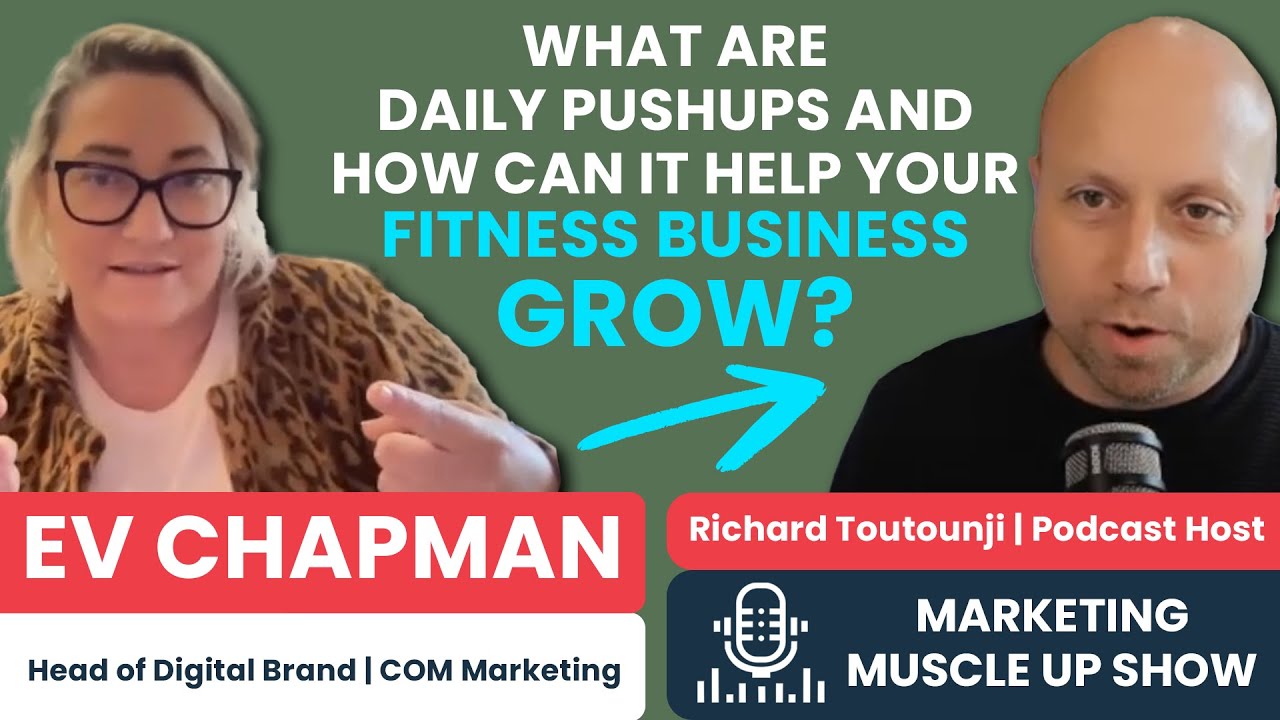
In this episode of the Marketing Muscle Up Podcast, host Richard Toutounji chats with Ev Chapman, Operations Manager at ComMarketing, about the central role of daily movement—both physical and marketing—in growing a health‑and‑fitness studio. They argue that taking any action, even imperfect, beats paralysis; the key is to make small, sustainable marketing habits (e.g., a 30‑minute daily task, a set number of conversations, or asking for a review) and to treat each habit as a 30‑day experiment. Consistency, rapid feedback loops, and a learning mindset are emphasized over chasing quick‑fix “shiny objects.” The conversation also covers how to scale effort sustainably, the difference between a “weekend‑warrior” approach (sporadic effort) and a daily‑warrior approach, and offers listeners a free “Marketing Muscle‑Up” assessment to get a step‑by‑step growth plan.
Chapters
over your career of a multi-stack marketer, I like to call it.
Yep.
What's been the same thing? If you look at the last 10 years, what's been the same thing but disguised in a different way every time? Like, what are you seeing? Welcome back to the Marketing Muscle Up Podcast Show. I'm your host, Richard Turtungi, and I started this podcast out, uh, after so many failed attempts podcasting to ensure that we could bring little bite-sized pieces of information to you in a streamlined way to grow your health and fitness studio. When I say we, uh, I have a company called Com Marketing, and each week I've got a segment we call Fireside Chats And what we do at ComMarketing is we help people grow through marketing education, telling them which Facebook ad to run, which one to pause, how to get leads from Instagram and Facebook. And I've got Ev Chapman, who's been with us at Com for over 8 years, and she's the operations manager at ComMarketing. And I thought I wanted to pick your brain each week to sort of see what's happening inside Because we run coaching program, coaching calls. And so it's a good idea, I guess, not a good idea. When I, when I speak to multiple people, you start to gauge a kind of a process that's working or what not working in the industry at the time. Isn't that right?
Yeah, absolutely. I think the more conversations that you have with people who are on the ground in the industry, the more you get to know kind of the flavor, the flavor of what's going on.
Yeah, it's like the weekly flavour. And for a long time, it's been vanilla as the flavour, but every week the flavour does change to some weird and exotic things.
Yeah, absolutely. Sometimes it's vanilla, sometimes it's, I don't know, pistachio.
Yes, the rare flavours are coming out to play. And what we are talking about is how to grow your fitness studio. same way, the same cut and paste way that it's always been. Yeah. Ev, I mean, I think a lot of people have heard you've been on many of these episodes, but what's been over your career of a multi-stack marketer, I like to call it, what's been the same thing? If you look at the last 10 years, what's been the same thing But disguised in a different way every time. Like, what are you seeing?
Honestly, the thing that I see is the people who make the moves get the results. So people who— it doesn't— sometimes doesn't even matter what moves you make, even if the moves are wrong. Okay. It's about making movement, taking action, trying things. And, you know, in marketing, we always say it's like a test and measure game. So the more tests that you have out there, the more that you take action, the more that you learn along the way. And so what I find is the people who I coach is the ones who are sitting there kind of paralyzed because they don't know how to move forward or they're thinking, I might do it wrong. I need to wait and just check that this is okay. They move much slower than the ones who are out there, not afraid to make a mistake, not afraid to maybe risk losing some money, that kind of thing. And especially in Facebook ads, it can be a little bit of a risk, but those are the people who tend to grow and who tend to kind of, yeah, you wonder what the secret sauce is. The secret sauce is movement. It's action towards something. Even if it's wrong. Um, and, and that can be a hard— they can be hard lessons, but it works.
Yeah. And movement, I think we can all understand as industry professionals that movement is what is required to have a strong and healthy and fit body. It's daily, daily movement. Yeah. Whatever, whatever exercise discipline that you say or you prefer, is it for CrossFit or if it's strength or if it's Cardio, at the end of the day, it's some level of movement. And that's what we're talking about with marketing. It's like—
It's exactly the same.
Moving.
Moving.
Just moving is the key.
That's it. Like, I mean, the key to human, like, yeah, like being healthy as a human is moving, whatever it is. And it's the same, the same in your marketing, in your business. If you are paralyzed because you don't know which way to turn or you don't know which way forward or there's too many options, that can really actually paralyze your business. The less moves you make, the less you move forward.
Yeah. And I guess, and I'm going to ask you soon, how do we unparalyze ourselves? But the funny thing is that it's a great industry because a lot of people came in this industry because we can choose the lifestyle we want in some way, shape, or form, meaning that if you put the hours in the morning, you can have a breather in the middle
of
the day or you can change around your lifestyle. Now, a lot of people are living that way, but there's other people in this industry that are paralyzed with, what do I have to do to get the clients through the door? So they're doing the training and then there's this gap to say, well, I'm not happy where I'm at. What should I do? And I think we're talking about not the hours that we put in to the actual work. Like if you're a personal trainer, you're going to train somebody. If you are running a studio, you're training in the session or your trainers are training and you're managing that process. What we are talking about here is specifically marketing, doing something daily to move in marketing.
Yeah. I mean, at the end of the day, if you only do the training part or the working in the business part, the you know, the outwardly kind of, you know, the thing that you have to give to your client, you're actually not going to grow your business. You have to be out there every day doing something in marketing, you know, whether that's starting a conversation with someone, whether that's, you know, getting some flyers, you know, delivered, whether that's online. You know, online helps because you can actually scale yourself without actually having to do all of that, you know, all that individual work. But It's a combination. If you're not out there taking some kind of action or having some kind of action online, then it's going to be really hard to grow.
And talk about, and just on that, you very clearly said you've got to do, so this is outside your current training. So I would go ahead and calculate the hours now outside your training. Your clients out, that's working, by the way. Outside, let's just be clear here. Outside that, how many hours would you spend? And that's the question. Like, how many hours do we recommend that we tell our clients? How many hours do we need to put in to change that habit of maybe we're running at 0 hours or 1 hour a week or 2 hours a week? What's the recommended amount?
Well, I mean, my answer to these kind of questions is always like, how much can you sustain? You know, I could tell you that you need another 10 hours a week in marketing, but if you can't sustain that, that's just a kind of stupid thing to say. So if you can, if you can take 30 minutes extra to do marketing and then build that up to an hour and then build that up to, you know, at some point you kind of lose the time, doesn't really matter. Like the more you go up, like you can't do like 100 hours a week and you know, it might be as good as 2. So I would start with what you can be consistent with.
Hmm.
Week in, week out, day in, day out. What can you do? And that's why often I, when I'm doing things like this, I'll break it down to the very like single actions that I can take in a day. So a lot of the times I'll be saying to our clients, okay, how many conversations could you start each day? Produce out 5 new conversations a day. 3, 2, 1, whatever it is. If you can break it down to something that is really actionable every single day, not just like, I'm gonna work on marketing. That's not actionable at all. But if you can work on, I am going to open my Instagram account and start a new conversation with one person who is a follower. That is something really actionable. And that kind of thing creates movement.
Right. Just before this call, Ev, I was talking to one of our amazing clients and I asked them, can you send, can you provide a review if you had a great experience?
Yeah.
And I sent them a link and that was movement. It was something that was added on. And that's what we're talking about here. It may not be the acquisition piece, but that one movement gets us more excited. Oh, that's great. Let's keep working through that funnel.
That's it. And I think, you know, often we stress about the acquisition because honestly, the acquisition is what gets us money. So there's obviously, we're trying to get people to buy a membership or, you know, whatever it is or whatever the structure is. But what happens is that is just an outcome of everything else that you're doing in the business. Everything else that you're doing in marketing equals the acquisition. So you can stress about acquisition or you can make movement and trust that that movement is going to equal acquisition.
I love this because it is the summary of what's happening at the moment, especially this week. And we're finding the clients that are moving, that are turning up to our training, because we always do trainings and we're turning up to our trainings They're moving and they're getting ahead and they're the ones that are winning and the ones that aren't, they're stressing about the leads, but the leads come from movement, everyday movement.
Yeah. I mean, if you think about it, if you're in the health and fitness industry, it's exactly the same as we said before. The people who move, the people who come to training, the people who then go and move every day and they take action, even if it's imperfect action, they're the ones who tend to succeed.
It seems so simple, like this concept. I guess the next question, well, not the next question. A lot of the time we can't decide what to do and we say, okay, let's set aside an hour a day for marketing. This is where we go down the YouTube library of everything you can do. And then you go down, let's go to Instagram and see what my neighbors are doing, my competitors. Let's just copy them. When you want help, what's, you know, what's a good way to follow some sort of structure?
Yeah. You know, I have been a big proponent of the 30-day experiments. I've been, I do these personally, but also like, I think a lot of the times, this is what I hear from people. I tried that thing one time and it didn't work. And I still don't have any leads. and that was yesterday. So, and I mean, look, that's an exaggeration. But I think a lot of us expect things. And maybe it's the culture that we live in. Maybe it's the internet. Maybe it's the fact we can put something in the microwave for a minute and have it ready straight away. We live in that kind of society in that we think, okay, well, I've done my one thing. Why didn't that equate to leads? Like I posted on Instagram, why don't I have any leads? But I think that The way to think of it is as, you know, in everything that you do is as an experiment. So if you have like, let's say you go down the rabbit hole of YouTube and you say, okay, this person said to post on Instagram, post Reels on Instagram every day, add 30 hashtags and blah, blah, blah, blah, blah. There's a whole lot of stuff there. You can either keep searching for more things or you can say, okay, I'm going to test that out. And so test it out. And I would say at least for 30 days. I always do kind of these 30-day experiments.
Yep.
And don't judge it halfway through and say, well, that isn't working. Give it the full 30 days and say, you know, this is a test and there's no pressure on it when it's a test. It's either going to work or not work. And at the end of the 30 days, you either Won or you learned. And that's kind of where we're at. And so doing something over a 30-day period and then not changing it, not changing your mind, not going over here to the shiny object.
Shiny, shinies are good. Shinies are good. Shiny objects are good.
You know, these are the things and that's how you actually get confident in marketing. You know, often marketing we kind of see as like, is it magic? Is it some kind of, you know, like I don't know what's working. But actually, I mean, I didn't study marketing. I, you know, I learned it all by doing experiments, by taking action, by making movements and actually learning. And it's possible, you know, for so many of our clients, they do the same thing. I've taken people from— people who don't know anything about Facebook, nothing about Facebook ads or Facebook marketing to running really successful campaigns and getting a lot of leads for their business. So, It's totally possible to learn, but you have to have that learning mindset. And a learning mindset means that you're going to fail and you have to be okay with it. It's going to be imperfect, but you're going to have to move anyway. You know, those are the kinds of mindsets to change. And it's sometimes hard. Like these are our businesses. They're our babies. And so you want to make sure everything's right, but sometimes you just need to make a move. And guess what? Social media, the internet moves really fast. So if you make a mistake yesterday, people are not remembering today.
Like the paper concept, but it's even better because you can delete. Yes. Love that concept. And it's like, you know, fitness pros, you understand the concept of a weekend warrior. It's those— I remember Eastern States, Bondi Beach, you would do a run from like Coogee to Bondi. And if you went at about sort of like 9, 10 o'clock, you would have the thing called the weekend warriors, the ones that are walking there. And then you'd have the fit ones that slept in there, they're 5 or 6 o'clock slept in and they're running at 9:30, 10, and they're pissed off because there's all these slow walkers out and about enjoying the scenery. And if you're a weekend warrior in marketing, Well, your business will be okay because it will stay, but it certainly won't grow doing one marketing trick a week. It's a daily progression.
It isn't. And I think, you know, those days are very much gone. It's, you can't, you're not going to be able to work on marketing, I don't think, one time a week. You know, if we were still in, I don't know, pre-internet days, maybe that is possible. But the world moves really fast. Your, you know, your audience expects to see you online. And if they don't, they're seeing other people. And that's, you know, that's not to say you need to be online all the time. But I think, you know, that daily regularity of showing up in people's feeds and being there and being seen
Very good. Love that concept. It just seems too simple, but it does work. It's the same with us.
Well, sometimes it is the simple things that do work the best.
It is 100% correct. So guys, if that's you thinking about marketing too much, stop thinking, more doing. Once the doing happens, you know, more things progress. It's the same thing with fitness. Once you, once you just get your shoes out and you put them on and you step outside and you say, I'm going to be 5 minutes, then it's 30 minutes later, then you're going to walk, then you run. Same concept here. We need to get some wins under our belt and we need to do it regularly. And that's exactly what we're finding that's happening now in our clients. The ones that are doing the work daily is definitely getting those results. And so If you are, well done, guys. If you, if you do need help with this and you need more of a structured, clear way path, a step-by-step process, my recommendation is jump on our website commarketing.com.au and you can basically fill a form in there and it will get you a what we call a marketing muscle-up. So we'll look at the marketing you're currently doing, we'll look at where you're winning, where you need some improvements, and then we'll give you a pathway to show you exactly how to achieve those results. So, um, that is something that we do offer. It's, uh, free of charge if you listen to this podcast. Just say, hey, I heard you on the podcast, and then you can jump onto that. It's been a blast. I get the message loud and clear. It's, uh, it's, it's turn up, do the push-ups every day.
That's it. That's all it requires.
Excellent, team. I hope you enjoyed this episode of the Marketing Muscle Up podcast show. Uh, that was with Ev Chapman, operations manager of ComMarketing, and, um, I'm sure a lot of you who've been through our program have seen her amazing Facebook ads and a lot of people are running them now and have the confidence to run because Facebook's not, it's not like a scary thing anymore. It's just you've got to follow some things and make them work. And then most importantly, have the feedback loops. And I think I just want to add that in before we leave is that it's the feedback loops that are key here. If you do something and you don't know what you did wrong, Then you get in your head.
Yes.
And you sit there and you swell around it and go, oh, what did I do? What is— so it's really important to get quick feedback loops and then move forward so you can progress in the next stage of what you have to do.
Yeah.
Awesome. Thanks so much, team. I'll catch you next time in the Marketing Muscle Up podcast show. Bye for now.









