Streamline Your Sales Process With Automation 💯
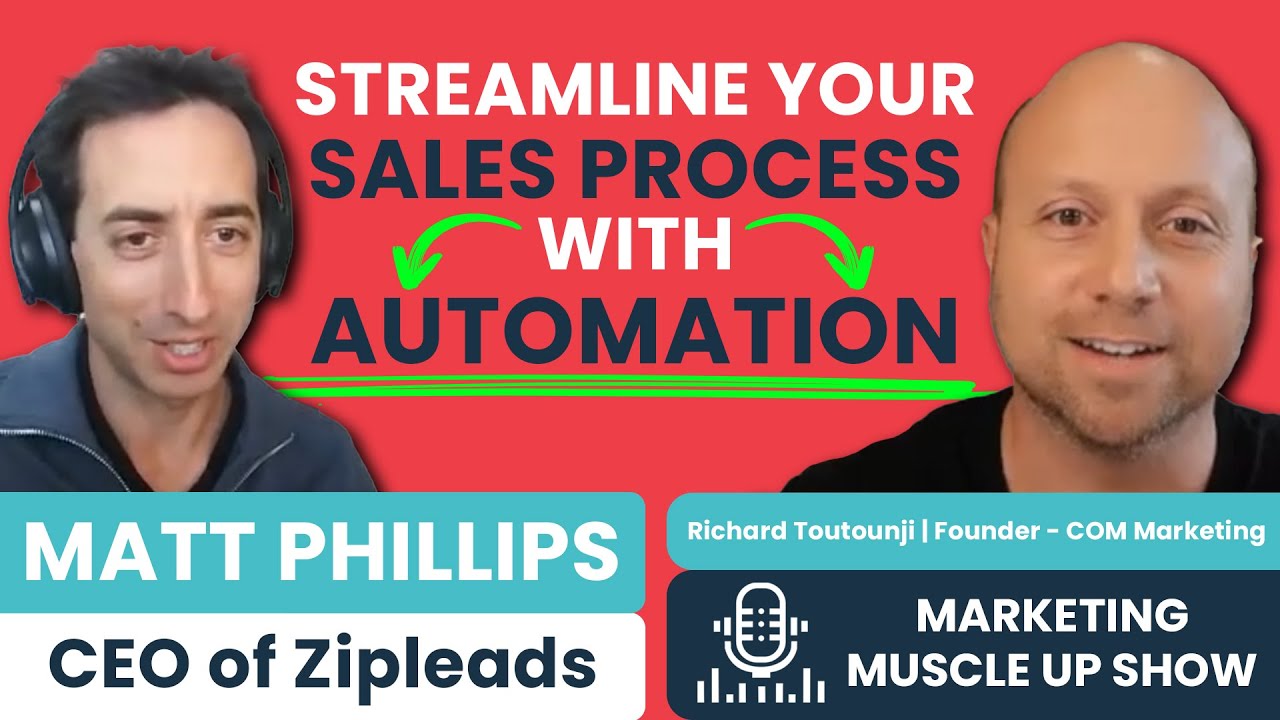
In this episode of the Marketing Muscle Up Podcast, host Richard Toutounji interviews Matt Phillips, a former Australian infantry officer turned fitness‑industry automation specialist. Matt explains how his military background instilled a focus on efficiency, which later inspired the creation of ZipLeads – a lead‑to‑booking and conversion system designed specifically for fitness studios. The conversation covers the evolution of marketing automation from simple email sequences to integrated, multi‑channel "hybrid automation" that feels personal, the importance of micro‑commitments (quick surveys, booking calls, social proof) to move prospects along a decision path, and real‑world metrics showing how ZipLeads can cut outbound calls by up to 75% while doubling conversations. They discuss current post‑COVID challenges for fitness businesses, shifting consumer preferences (e.g., rise of reformer Pilates), and offer strategies such as genuine free trials versus low‑price offers to overcome price‑anchoring effects. Matt stresses that automation should free time for higher‑value activities like content creation and member retention, not replace human interaction. The episode ends with a call‑to‑action to book a demo at zipleads.com.au.
Chapters
Anyway, so what's interesting about that I find is that I was not by far the best magician in Perth, but I was probably one of the busiest, if not the busiest, because I applied myself in studying marketing.
Welcome back, team, to the Marketing Muscle Up Podcast Show. I'm your host, Richard Toutounji, and in today's episode, we're talking all about A way to save more time for you to do the things you actually love in your business. Because heck, why do we go in the business in the first place for? There's an old saying that I quit my 9-to-5 job to then get a job that works 24 hours. I don't know if anybody can relate to that, but my guest today, we're going to talk all about that, how to get your time back when you're struggling to figure out where it actually went. So on my show, on the show today, we've got Matt Phillips. Matt Phillips, has been in the fitness industry. Well, I would say he's been in the fitness industry for a while, but he's really experienced the fitness industry since 1999. And he's done that through martial arts school, Cobra Martial Arts. That was a TV show recently on that. We'll talk about that in a second. And actually, Matt's enlisted in the army, officer in the Royal Australian Infantry Corps. 10-year service. So Matt's changed uniforms now and he's now moved into the fitness space and particularly he's actually moved into the automation space. And I'm starting to understand where this structure came from. So Matt, welcome to the show.
Yeah. Thanks, Richard. Thanks for having me on. Really keen to chat about this today.
Yeah. Well, we connected probably about 2 years ago, Matt. I was seeing that you're doing some cool things with A bit of automations. I've always been a fan of automations in our program, in our com marketing program. We used a lot of different ways to get automation, and over the last few years, there's just so many different things and changes that have taken place. And when we connected about 2 years ago, you, you know, you— all the things that we were doing with 1,000 different plugins and add-ons and connections, you were partnering with the team, a development team, to create what is now called Zip Leads. And basically for those, you know, basically for those who know what Zip Leads is, it launches ads, automates call bookings, it tracks leads, it brings emails in. And the thing that I love about it, Matt, and probably the reason why I'm most excited about it, but any other feature, is that I love it for the sales system because Instead of having things written down on a piece of paper or an Excel sheet, you're actually able to drop and drag. Like somebody, if they're in a sales process, like, you know, they're disconnected and then you maybe talk to them, you're trying to chase them 4 times on the phone, you know, there's 7, 8, 10 touchpoints. It's very easy to do. And that's, you know, what really excites me most about this system. But yeah, I want to talk all those things today. So welcome, Matt. Welcome. Good to have you here.
Yeah, thanks, Richard.
Now, talk about your experience in the military. There's obviously some— and the police force, I should say, too. There's obviously some trainings and some structure you get from that. I always love to know a bit of background first. What's— tell me about that. How did that, you know, how did you go from that to, you know, working with fitness professionals now?
Yeah. So it's funny how it's full circle because I was actually meant to take over and run the very next sort of location for the martial arts school I was working at. Right. And so my boss had forgotten that I was actually always going to go back and reapply to the military because I actually got kicked. I actually got knocked back. They said, come back in 2 years. So I worked at the martial arts school for 2 years, reapplied, got in, and then that was the next 10 years in the infantry. And yeah, it's definitely a valid base. I mean, there are a lot of people that do go from the military into business. It's a very good grounding in that because as you said, the reality of business is that you probably do trade in a 9 to 5 initially
Yep.
For a 5 to 9 or even worse, 24/7. And yeah, I mean, I heard this, you know, there's really a lot of science now behind why I suppose military training or any sort of hardship really does set you up well for later on in life in terms of, you know, what we're learning now in science about motivation and ability to actually be motivated intrinsically and keep moving because a lot of stuff in business is hard. But I guess that does relate through to what we're doing now is because at the end of the day, I learned a lot about the importance of efficiency in the military, right? Everything is efficiency. And so when I was out and I got into my— launched my own online business, yeah, I was looking for ways to make things faster and more efficient. And then later on, as we transitioned to fitness marketing in a coaching way, we used to, you know, we used to run people's Facebook ads, we used to coach them. In fact, your business and my business used to be very similar just before we connected. And that's why it was quite refreshing to meet someone on the same page as us in terms of focusing on long-term growth, sustainable business strategy growth. But really where we've diverted is that focus on the automation piece, because what we found is that you can— having all these ideas and what to implement, but having to do it in several different places Doesn't even matter. You can have all the motivation in the world, like, you know, you can't just sort of work harder through it. You do have to— it's very clichéd, but you do have to at some point work smarter. And that's what's very rewarding for me in this work that we do is, I mean, we'll talk about some of the benefits, I'm sure, today, but it's seeing the, you know, the business owners, you know, hearing the stories of how much headspace they've got back. Just by getting this visibility, like what you're talking about, the visibility of being able to drag your leads to where they are, see what's going on in the pipeline, know that there's this great system of automation running in the background. It doesn't matter if a lead comes in, they'll be getting handled in some way and you can pick up where you need to.
Yeah, it is amazing because as I said before, like as you grow, you just get sucked out with time and this is the difference here. The transition of the software, I mean, there's lots of software around. We used ActiveCampaign for many years. There's MailChimp. There's, I guess, the old way of automations is like, okay, we use automations to send out a newsletter instead of sending out one by one on Gmail, you could send it as a group. And then we had the second kind of round of automations is let's do a funnel and let's send an email and they can, we can send automated emails And I remember when I came across this many, many years ago, it was like, oh, so that means someone can sign up and I can automatically send an email out in day 2 and day 6 and day 7 and day 9 and day 30. I thought it was the best thing since sliced bread. But then of course everybody else does that and we know what email inboxes look like now, full of messages. And then, you know what the new version of automations is, is much more than that. because it's bringing the social media, the Instagram chats, the reviews, all this into one platform. And this is the major difference here, I think, with, let's say, automations 3.0. Is that fair to say, Matt?
Yeah, absolutely. And part of our transition in this was that it was like we would work with businesses who were doing automated stuff, right? But it had become like automation for the sake of automation. I mean, Zip Leads is a very specific process. Like ZipLeads is a process as much as it is a system. Like 95% of people using ZipLeads are using the ZipLeads conversion system because what ZipLeads really is specifically in the fitness space is it's not an upgrade. It's like it's installing something that is missing because, you know, everybody has their membership management platform, your Mindbodies, your Gym Masters, you know, your spaces like that, your ClubFit, that sort of thing, right?
Yep.
And to a degree, they have some automation in there, but what's missing is the step from when the lead inquires to become a member. And there's this big gap here that people are just sort of, you know, trying to do their best to get them in there, but it's not systemized. And so we had a systemized approach already, and then Zip Leads with our partner developers matched that. So i.e., the lead comes in, let's get them to make a micro-commitment, actually book a time to chat with us. Stop clicking on everybody else's ads. Book a time to chat with us. Answer a very quick survey question. See some very specific social proof. And this moves someone through, I call it the decision path. So you get a higher quality conversation and more of those conversations. So it is, it's not a magic bullet. You don't get everybody signing up, but it is a great solution because it's literally less manual effort for a higher quality result. Especially if you are paying for those leads as well.
Yeah. And I guess because the market is different now than it was before where there's a lot of different ways people are going to connect with you, it's not just one stream now. There's not one front door, there's multiple doors they can come into your business. And I think that's the thing that crushes a lot of fitness pros where they just can't keep up with all these things that are going on.
Yeah. I was talking to one franchise owner, she has multiple locations and they've recently come on board with ZipLeads and Yeah. She hadn't even like started running their ads yet, but for her, like having everything, all these DMs, these messages from Facebook, these text messages, these emails all in one conversation thread with each contact was such a breath of fresh air for her. And so that's another big part of it for sure. Yeah.
Well, Matt, I just want to go back because I've got a few notes and there's one little interesting fact I just want to— I know sometimes people think automation is a bit boring, but Let's just lighten up the show a little bit. Matt, there's a little surprise that— well, there's a secret that I found about you that wasn't really publicized on the Zip Leads website or anything like that. And I had to dig quite a lot to find it. I approached you about it and in fact, it's true. Tell me your little secret, Matt.
It is. And we've even demonstrated that on some of your comms as well. And there'll likely be a lot more coming. But I used to be— it's not meant to be everywhere— actually a magician. So a professional magician for quite a few years in Perth. And so I would perform at weddings, events, flown around the country in some instances as well as a magician. And so I guess the— that's funny as it is. If anyone does see us anywhere, any— we're bringing some of that out again. So by the way, if you come and see us at We might talk about the expo at the end of this, Richard, that we're going to be at. There'll be a lot of magic happening down there as well. So yeah, I used to be a magician and still am, I suppose. So anyway, so what's interesting about that I find is that I was not by far the best magician in Perth, but I was probably one of the busiest, if not the busiest, because I applied myself in studying marketing. And I think that's like a lot of industries. I mean, same with fitness. It's not going to be the studio that's getting the best results for all their clients. I mean, we would want that, but it's going to be the person that knows how to sell books. They're not the best books, they're bestsellers. So you want to be the best-selling magician. You want to be the best-selling fitness studio.
Yes.
Because that's the best way to, you know, to impact more people. And it's a snowball. I mean, that's what happened with the magician career. Like, you know, As soon as you get some momentum there, then referrals go crazy. So yeah.
Yeah. Very interesting. Very interesting. It's about attention and the magician definitely gets
attention. Yeah. It's attention and inattention in magic. Yeah, for sure.
Now, Matt, listen, you talk to a lot of fitness business owners just like myself. We run webinars most months together and tell me what you think the, you know, the 1, 2, or 3 top challenges right now are In the space?
Yeah. I think there's a lot— well, I don't think this, I'm watching it happen. There is a lot of disruption still on the back of the lockdowns. I mean, you look at Perth, for example, I mentioned Perth a second ago. I mean, they are really struggling over there because they're still off the back of obviously COVID coming through there. But now there's a sentiment there in a lot of communities where people are even less willing to go out and do stuff because they're concerned that the rules have relaxed.
Yeah.
worried about even going out in public. But even if you— so that's an issue going on there. But even on the East Coast here in Australia, like people are— I mean, I was on a call helping someone with the re-engagement. They were using Zip Leads to re-engage with their leads. They had a few hundred leads. They got 6 or 7 phone bookings just within a couple of hours, which is awesome. So obviously I have to plug that there. But one of the ladies was like, you know, that had texted back saying, oh yeah, I can do that. By the way, I am a little bit concerned about COVID still. So I'm not sure if I really want to come in. So you've really got to be still mindful of that in terms of people being hesitant to physically come in. Again, I think that, you know, what's the solution to that? I think phone call-led sales approaches are very effective because getting on a phone call is a micro-commitment. Getting on a phone call is very safe. And so if someone is concerned about that, you can address that, you know, directly on that phone call.
Yep.
And then, yeah, I think related to that, so not on a separate note, I suppose, you know, what's another challenge going on right now is that we've seen businesses come back after this 2 years of lockdown on, off, on, off, and then, you know, doing what they were doing before and it's not working.
Yeah.
Now, I don't know why that's the case, but I do know that the fitness, I suppose fitness trends have still moved on. I don't mean that people have moved to online versus offline. I mean like trends of things like, know, reformer Pilates has become a much more popular form of fitness in the last couple of years. Other forms of fitness become less popular. So there's been some shifts there. And then at the same time, you know, we've progressed further down the route of, you know, people, you know, wanting stuff now, now, now, instant solutions. Yeah. It's very fast-paced marketing. And so we are seeing that, you know, the types of ads that were working a couple of years ago are not as effective anymore. And I think this is something we might have covered later, but I'll just mention it now. Yeah. I think the issue there in terms of the solution is trying to not necessarily reinvent things, but think outside the square in terms of what our offers are. Because I think what's, you know, what has been working has been less effective, but it doesn't mean there's no way to grow the business. Because we've actually seen some offers that we would not have recommended work really well in the last few months. We're talking like the old 7-day free trial, which traditionally has attracted a lot of tire kickers and hard to convert. But when people are really struggling with the volume of lead, going back to that very basic, come in for free, it's free, there is no catch. We're not talking about buy a year membership and we'll give you a free month. It's not that, it's genuinely something that's free. Those businesses is what I'm seeing getting lead volume right now.
Very interesting. Very interesting. And tell me about then, so basically things are changing, we need lead volume. You're saying go back to running basic stuff, $7, 7 days kind of concept.
I don't really like that. Yeah, the free thing is quite different than $7 because I also say to people that the problem with your low barrier offers is the price anchoring effect of that's therefore what the services are worth. Whereas free is very different. If it's $200 a month for a membership, transitioning from free to that, there's no real subconscious resistance there. Whereas $30 a month to $200 a month, it's harder to To, you know, at a subconscious level to breach that. So, but yeah, even if that's the point, the point is that to get people in the door, but that is where we need to go back and look at our sales approaches. So I guess on that note, it was something that I guess I've seen, Richard, this is on topic, is this idea of automation post-non-sale.
Hmm.
So quite a few people have spoken to me this week about their automation processes for, Matt, what happens when the person, they get on a sales call, And we go through it, looks like a really good fit. And they want to go away and think about it. They want to digest all the information. They want to have a think about it. They want to talk to their partner and they're like, what's the best automation to send on the back of that? And I was joking the other day that the perfect automation is to avoid it and actually look at your sales process.
Hmm.
Why didn't that person really sign up? Because it's probably a lack of clarity. It's probably something didn't fit. They're just saying that they need to go away and think about it. Rather than just closing the sale right there and then.
Oh, so you mean going away and thinking about it actually means something else, eh?
Yes. It's a shock and horror. I'll ask my wife.
I lost my wallet. I'll come back soon. I'll come back later. These are all signs that your product, they don't like your product for some way, shape, or form, pretty much.
Yeah. And even the people that genuinely mean it, if you explore that with them,
Yes.
Then you can often turn that around because if they genuinely were just making an excuse, well, then they'll tell you at that point. But yeah, that's something I— it's interesting here because even though I run an automation company, I'm very mindful that we work— automation won't fix everything. The great thing with automation is freeing up your time to fix those things that won't be fixed through automation, right? You can't send someone to a sales page and say, just sign up here. It's not going to work versus a phone call or an in-person session. So we all understand that. But yeah, yeah,
yeah. Very good. That's my language. Like, yeah, we all know that sales, the best sales is face-to-face or over Zoom, over the phone, things like that, which is really important. So then let's talk about what fitness businesses should be automating. Like, if let's talk to somebody, talk to somebody that doesn't like technology, doesn't like They just want to go, just go basic, let's stay basic. What, what are the 2 or 3 things that we need to be automating so we can do more of the things that we love to do?
Yeah, sure. So the number one thing is the initial nurturing of inquiries. Doesn't matter if they've come from Facebook ads, a website inquiry, a phone call, whatever it is. I'll give you some specific examples of this. So the key back to Zip Leads is take— let's take phone calls. Someone rings you up and you miss the call, right? Now, it's not okay to like— this could happen on Sunday and you're not doing anything, right? It's not okay anymore to get back to that person the next day or a couple hours later. At a bare minimum, we need an automated message going back to them saying, you know, hey, it's Matt from Zip Leads or wherever. Just missed your call. When's the best time to reconnect? All right, whatever. And then you can at least text them back. and arranged that appointment and it started on an automation. That text back is automated. Take your leads from Facebook ads, right? A lot of people are getting leads into spreadsheets and then going through and calling them. It doesn't, it's not okay for your business anymore. It won't work because, you know, there's so many businesses advertising on social media. Half the reason that, like, again, why is this important that someone clicks your ad is because they've already clicked on 7 other ads. So the algorithm is showing them more more fitness ads
and
now they've engaged with your ad. Now they're gonna see even more. And so there's 2 things like one, yes, you wanna automate the opportunity for them to book a phone call. That's what we do at Zip Leads. But also if they don't, automate the conversation to say, hey, thanks for your interest. Would love to have a 10-minute chat just to see if this is the right fit. Would a morning or afternoon work best for you? Right. And just automate that initial engagement with them to to start that conversation. And so that's 2 examples there, I guess. What's the other one? And obviously from your website as well. Same thing, contact form. Yeah, it's got to be like, it's got to lead to some sort of micro-commitment like book a phone call straight away. And even if they fail to do that step on their own, to have a messaging sequence that is starting some sort of 2-way engagement. As you said, email's okay, but, you know, emails are very full. They don't read them instantly. Text messages is the way to go. So yeah, number one is the initial contact with the lead is the critical thing to automate for sure.
I like it. Micro-commitments, you call it micro-commitments. Get a little micro-commitment and they, even as an email to pick up the phone when you call them, that to me makes sense. And I love automations that make sense. The ones that don't make sense, we ignore them straight away. Matt, this is a show on marketing, so I'd love to know, you know, what's— apart from automations, I reckon that should be your number one answer. Maybe that was, but what's the number one marketing strategy that's working right now in the industry that you feel is hot?
Yeah, I think like you're right, like that's part of the answer. I mean, that's the marketing strategy to make sure that your contact is immediate. But what I will say that's a that is important with this is because we see this over and over and this is still critical right now. I mentioned it a second ago, the late— the couple ladies with their— it was actually— it was— it was a Pilates business actually doing their re-engagements, getting 7 calls booked. I would say that it's— it is hybrid automation. Yeah. So what does that mean? What I mean is that like, let's think about the typical text blast that a lot of fitness businesses do. Right? So it's just going to be, you know, hey, it's Matt at Zip Leads Fitness. We're doing a, this, you know, the May 28-day challenge. You can save $200. Click here to sign up. Right? That's a real sort of typical automated blast. Just send it out, get people to sign up. Boom. Right now, I know people don't make them that crass sometimes, but a hybrid automation is right at the other end of the extreme. Where the message actually says more like, hey Jane, it's Matt at Zip Leads Fitness. If it's an old member, be like, hey, we miss you. We're running a restart challenge in May. We're running a restart kickstart, whatever. Would you like some more information on how it works? So you don't even give any information and nor does it even sound like an automated message. And so it's very common to get a much higher engagement rate back. And even people who don't want to do it will actually write back because it's automation that appears to be coming from someone just sitting in the office sending a text message.
So
in terms of marketing strategy, it's automation that's not automated because when you're using Ziply, it's like we will set up your account for you, for example. Yeah. And you won't see anything in there that says reply yes to get this or click 1 to do that or whatever, right? Because as soon as you show your cards, if you like, that this is automated, Like, but you will lose a ton of people straight away just because they just don't want to talk to a robot. Now, it's okay to use automation, but if you can make it personal, you will just get a much better engagement rate. So I think that's the big thing. It's often really the thing like, you know, obviously there's, you know, there are other platforms that do automation, that do 2-way SMS now. Like things like that are starting to grow. But that's, I think, from our perspective at ZipLeads, what's key about how we use the platform, how we set it up, and we encourage people to use it. Is to take that marketing strategy of hybrid automation instead of just, oh, how much can we automate and let's make the most biggest fanciest automation to just run my business on autopilot. It's just a pipe dream. It doesn't exist. And in reality, if you wanted— if you didn't want to talk to anyone, you wouldn't have started a fitness studio anyway.
100%. Yep. Love it. Yes, there's no point automating everything because you don't talk to the actual client in the end and you shouldn't even have your business then if that's the way you want to go. So That's the reason why we love Zip Leads and it makes businesses really, really easy. I just love this conversation because it— I mean, Matt, before we go, tell me about the time that we're going to save. What sort of time should we save here? I mean, there's no point doing automation, then you got to do— where would the time go? We just suck up the time somewhere else or what?
Yeah. So there's some really good examples of this. So if you look at— I know a lot of listeners here might have their own independent studios, but There are some examples of businesses that are, they're super busy already. They're like, well, that's a quality problem to have. But we're talking like businesses have gone from like, you know, they will typically make 7 or 8 phone calls per lead. If they're getting 100 leads in, they're making 800 outbound phone calls a month. And installing Zip Leads, almost overnight, they go to making about 200 phone calls for those same leads. But here's the kicker, they talk to twice as many people.
Boom.
And so it's not just— that's where I mean this combination. It's more conversations, but it's way less effort. And it doesn't matter if it's like employees or the studio owner. There's just so much more time to then spend on things. So this is an example. So an example of this is like, this is sort of like whether it's this snowball effect is that a lot of people that start using Zip Leads very soon thereafter start doing some fun things with Zip Leads where they start setting up weekly check-in automations. for their members and now they're getting a boost of retention through Zip Leads. They actually have the time to take back over their social media marketing and run their marketing, maybe do more social content. And so it's always a thing with business that I think it's always good to keep in mind as business owners. Yes, we want to get our time back and there's the dream of like, oh, well, I could just, you know, if I didn't have to do all these manual tasks, it'd free up my time. I wouldn't have to work so much. Not necessarily. You may still end up doing the same hours, but The exponential growth of your business can be like shocking when what you do is you take that time and you reinvest it into the business rather than just say, well, now I don't have to make those phone calls. I'm just gonna take more time off, right? Which you can totally do, but you'll probably just continue at the same growth. But if you can take that time you've got, reinvest that time, you know, then your business can be in a very different place, you know, 2, 3 years down the track.
Love it. Guys, get onto it. zipleads.com.au, Matt?
Yep, zipleads.com.au. You can just book in a demo with myself or one of the team and we can chat with your business because that's the other thing with Zip Leads is that we— you can't just sign up to Zip Leads because we don't want to waste your time. We're all about time. We don't want to waste our time. And so we will have a quick chat with you to make sure it's a good fit. If it is a good fit, we'll let you know. And we do mean that. Because we have various guarantees in our products as well. So we really don't want to waste our time. And yeah, you can have a chat with us. We'll have a quick look over what you're doing. Would this actually benefit your business? Is this the right time to put this in? And if it is, then yeah, we can help you out.
Love it. Thanks, guys. If you've enjoyed listening to this episode, be sure to share it with a friend, subscribe, and give it some love on social media. I'll catch you next time on the Marketing Muscle Up podcast show. Bye for now.









